Manchester by the Sea ~ A Capsule Movie Review

manchester-by-the-sea

Manchester by the Sea ~ A Capsule Movie Review by Allen Kopp

Manchester by the Sea is a somber study in loss and tragedy, set in bleak New England winter with gray skies and a gray heart. Lee Chandler (played by Casey Affleck) is a working-class man with a foul-mouthed wife and three small children. He drinks more than is good for him and it’s while he’s under the influence of alcohol that he makes the terrible error in judgment from which he will never recover.

As the story moves back and forth in time, it takes us a while to know who is who and what is what. Lee Chandler’s brother, Joe (played, coincidentally, by an actor named Kyle Chandler, who was the unhappy husband of a lesbian in the movie Carol last year), develops a heart condition in early middle age and dies. He has one child, a sixteen-year-old son named Patrick. Joe’s wife, Patrick’s mother, is an unreliable, drunken shrew, so Joe leaves guardianship of Patrick to his brother Lee. Lee, now divorced, works as a janitor/handyman, living in one room, and he has plenty of problems of his own (including alcoholism), so he probably isn’t the best choice in the world to take care of a confused, sexually precocious sixteen-year-old boy. Patrick probably isn’t going to be happy in any circumstances, with his father dead and his mother “away.”

The Manchester of Manchester by the Sea is Manchester, Massachusetts, and not Manchester, England, as the title would seem to suggest. It’s a contemporary story, so that means there’s lots of foul language and naturalistic acting, with parts of the dialogue mumbled and unintelligible. The outdoor scenes are wintry scenes, with piles of dirty snow everywhere and cloud-covered vistas, so there’s nothing pretty to look at, even the sea. There’s nothing happy about this movie, including the way it looks, but it’s an engrossing, immersive movie; its two hours and sixteen minutes race by with barely a thought of how much longer it’s going to take, and when the end comes we were probably wishing for a little more.

Copyright © 2016 by Allen Kopp   

The Medici Boy ~ A Capsule Book Review

the-medici-boy-cover

The Medici Boy ~ A Capsule Book Review by Allen Kopp

Donato di Niccolò di Betto Bardi (better known as Donatello) was one of the most gifted sculptors and artisans of Renaissance Italy. He lived from 1386 to 1466 in the politically volatile city state of Florence. His bronze statue of David is among his greatest works and one of the most famous works of the Italian Renaissance. He shows David as a beautiful, delicately nude youth, a shepherd boy who has just slain the giant Goliath. We see David’s foot resting on Goliath’s head, a sword in his right hand, his left hand on his left hip and his left knee canted out. He is an almost androgynous figure with long, curling hair and a slight frame. He looks like anything other than a slayer of giants.

In The Medici Boy, John L’Heureux has written a purely fictional account of Donatello’s creation of his bronze statue of David and his obsessive and destructive love for the model, one Agnolo Mattei. Agnolo is a male whore, a bardassa. He prowls the streets at night, looking for men who will pay him to perform sex acts. (Donatello is, of course, a real person, while Agnolo is a fictional construct.) For all his physical appeal (some people don’t see it at all), Agnolo is a trouble-maker. He exerts a kind of spell over Donatello, a physical attraction that develops (for Donatello) into an all-consuming passion. Sodomy is, of course, a terrible sin and a crime in Florence, referred to as the “Florentine vice.” Men who engage in the forbidden practice are subject to severe punishment, including imprisonment, fines, or even death. (The penalty for each conviction is more severe than the one before.)

The Medici Boy is told in the first-person voice of one Luka Matteo, a worker in Donatello’s workshop (bottega). He is himself an artisan, but he also keeps the account books for the enterprise and handles other details that Donatello is too busy to handle himself. He has a wife, a former prostitute, and four children, two of whom are “carried off” by the Black Pest, a terrible disease that seems always to be lurking in the background in fifteenth century Italy.

Luka is a sort of step-brother to Agnolo, the male whore who has stolen Donatello’s heart, but he hates Agnolo for all the trouble he causes. (He is also a little bit jealous of Agnolo because he ingratiates himself with both men and woman.) When a political conflict erupts between the different factions in Florence, the opposing side hopes to use Agnolo to inform on Donatello, in an attempt to bring down the powerful Cosimo di Medici, a long-time associate and patron of Donatello.

For a speculative story about a real person (Donatello) in a real place (Florence, Italy), The Medici Boy is convincing and believable. We can easily believe that this is what “might have happened.” It’s obvious that the author has done a lot of research to render the time and place just right, although he has filled in the details of the lives of the characters with fictional details. It’s an easy and fascinating book to read, especially if you like historical fiction that removes you from your distasteful surroundings and transports you to another time and place. The sexual content is never graphic or offensive (after all, it was not written by Jacqueline Susann) and is handled in good taste and never sensationalized. Now that we have that out of the way, go and get the book and read it.

Copyright © 2016 by Allen Kopp

Arrival ~ A Capsule Movie Review

arrival

Arrival ~ A Capsule Movie Review by Allen Kopp

A huge pod-like object, obviously an alien spacecraft, has landed in the farm fields of Montana. We soon learn that there are eleven other pods in different locations around the world. Have aliens come to destroy human life on earth? If not, what are they (the aliens) here for? They seem to be trying to communicate in a non-human language but, of course, humans don’t know what they’re saying. The military engages the services of a renowned teacher and language expert named Louise Banks (Amy Adams, superb in any movie she’s in). She is taken to the alien pod in Montana where, it is hoped, she will be able to figure out what they are saying.

Louise Banks is a recent divorcee with plenty of heartbreak in her life, having lost her young daughter to disease. This, of course, means that she is provided with fellow language researcher and love interest in the person of Dr. Ian Donnelly (Jeremy Renner). Louise and Ian ascend into the alien spacecraft to confront the aliens and try to discover what they hope to accomplish by coming to earth.

Right away we see the aliens as Louise and Ian see them. They aren’t acid-slobbering killing machines as in the classic sci-fi movie Alien, but they are not pleasing to the eye. They resemble octopuses at the bottom of the sea, except that they have no eyes or mouths that we can see. The researchers right away dub them “heptapods” because they are about seven feet tall and seem to have seven legs or tentacle-like appendages. Louise discovers that they have names and they communicate in a strange language that, unlike human languages, is not based on sound or symbols but on thought. Inside the alien spaceship, she removes her bulky hood and breathing apparatus so the aliens can get a clearer picture of what humans are like. Ian does the same. This helps to establish a connection with the aliens.

The aliens communicate by extending their tentacles and writing before them, in an ink-like substance, in large, semi-circles with feathery extensions. After studying these “writings,” Louise begins to get a clearer picture of what the aliens are trying to communicate. She learns, for one thing, that time for the aliens is not “linear,” as it is for us. (This is a difficult concept for humans to grasp.)  The aliens want to help humans because they will need help in the far-distant future (this is very vague.) Louise also learns that her own life has taken, or will take, a non-linear course and that this will allow her to know what will happen in the future. Her past, her life, and her future are somehow bound up with these strange creatures from an alien place.

Arrival is dark, in the way it looks and in its tone. There’s a sense of foreboding throughout much of the movie, a feeling that we don’t know what the aliens are going to do—or what might be done to them while they’re on earth (some countries are calling for aggressive military action). If the ending is unsatisfying because we don’t learn as much as we’d like to know about the aliens, we forgive it because the rest of the movie is so much more interesting than the rest of the stuff that’s playing at the multiplex.

Copyright © 2016 by Allen Kopp
Hacksaw Ridge ~ A Capsule Movie Review

hacksaw-ridge

Hacksaw Ridge ~ A Capsule Movie Review by Allen Kopp

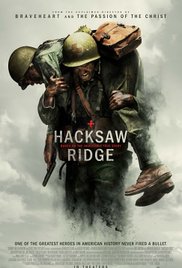
I’d rather have Mel Gibson behind the camera where I don’t have to see him. His latest directorial effort is Hacksaw Ridge, a gripping World War II story with a conscientious objector from Virginia as its central character. When Desmond Doss sees that his country is in trouble, he can’t sit out the war and do nothing. He wants to enlist, but there’s just one thing: he’s a Seventh Day Adventist with very strong principles against carrying a weapon. He enlists, anyway, though, and soon finds himself in unexpected trouble in the military. His officers and fellow soldiers can’t and won’t understand his religious principles. How can he be such a fool as to believe he can go to war without killing the enemy or at least defending himself with a gun? He is harassed, beaten, called a coward, and yelled at (I would crumple under the yelling and name-calling) and finally given an easy way out, but he is not to be deterred. He wants to serve and he believes the best way for him to do it is as a combat medic. He will be the one to put people back together, he says, while everybody else is taking people apart.

He is about to be court-martialed for his refusal to pick up a weapon, but his drunken father, a World War I veteran, produces proof from somebody he knew back in the day that shows his son’s religious convictions are protected by the good old Constitution of the United States. (We can’t let politicians shred it!) He goes to war with his division and soon finds himself fighting the battle of Okinawa. Okinawa is of strategic importance to the U.S. war effort. If it can be breached, the next step is Japan.

The fighting on Okinawa is as close to hell as anybody has ever seen. (Bloody and graphic battle sequences, showing mutilations and head wounds.) Casualties are heavy on both sides. As a medic, Desmond Doss displays bravery beyond what anybody might have ever imagined. He selflessly rescues about seventy-five of his fellow soldiers from the battlefield under heavy fire from the Japanese. He manages to get each injured man down a cliff, using a butterfly knot that he learned in basic training. The man who was labeled a coward for his refusal to pick up a gun becomes an unexpected hero.

Actor Andrew Garfield (memorable in The Social Network and Never Let Me Go) plays real-life Desmond Doss with sweetness and sincerity. He goes to war armed only with a small Bible his girlfriend (later his wife) gives him with her picture in it. As modest and quiet-spoken as he is, he is never willing to compromise his principles under pressure that would make most of us buckle. We need more people like him.

Copyright © 2016 by Allen Kopp

This House is Haunted ~ A Capsule Book Review

this-house-is-haunted-cover

This House is Haunted ~ A Capsule Book Review by Allen Kopp

This House is Haunted by John Boyne is a gothic ghost story set in Norfolk, England, in 1867. Eliza Caine is a plain, twenty-one-year-old teacher at a girls’ school in London. When she and her father, her only living relative, go to hear Charles Dickens do a reading from his work on a cold, rainy night, her father, already ill, catches a chill and dies. Now alone in the world, Eliza applies for, and gets, the position of governess to the Westerley family at Gaudlin Hall in Norfolk, England. (She doesn’t know the family’s name until later.) From the beginning, she knows almost nothing about the job; how many children there are or what the family is like. Her feeling of mystery only intensifies when she arrives at the crumbling old family mansion to begin her duties anew and finds nobody there except the two children, Isabella and Eustace. Isabella is older and seems to know things that nobody else knows; Eustace, at eight, is sweet and innocent.

Miss Caine discovers, to her horror, that she is just the most recent in a string of governesses. Only the governess right before her got away. All the others died mysterious deaths. Is she going to be next? As if several dead governesses before her isn’t bad enough, she soon feels a mysteriously malevolent and unseen force in the house that wants to get rid of her, to kill her if necessary. Slowly and bit by bit she learns the secret of Gaudlin Hall and the mysterious Westerley family for whom she works. Why doesn’t she just leave and go back to her old teaching job in London? She has grown attached to Isabella and Eustace, especially Eustace, and doesn’t want to leave them alone in the house. And she isn’t thinking only of the children, but also of herself; she is beginning to feel a growing romantic attachment to Mr. Raisin, the Westerley family lawyer, even though he is in his late thirties and already has a wife.

This House is Haunted seeks to emulate the Victorian writing style of Charles Dickens, but in its tone is more like Jane Eyre by Charlotte Bronte. A young, plain woman, educated and alone in the world, strikes out on her own to take a job in an unknown place far away from what she knows and there encounters mystery and unexpected romance. Unlike the works of Charles Dickens, though, or Charlotte Bronte, This House is Haunted is quick, breezy, light-weight reading. There’s nothing too surprising here. The horror is very mild, unlike the recent trend in movies and books of horrific, shocking, grisly horror.  The story is so familiar that it almost seems clichéd but is still thoughtful, entertaining, and well worth the time and effort to read it.

Copyright © 2016 by Allen Kopp  

Verisimilitude

verisimilitude-image-5-jpg

Verisimilitude ~ A Short Story by Allen Kopp 

Irene Gribble hit her mother in the head with an iron and sent the old lady sprawling. She hit the far wall of the room, head first, and fell to the floor like a hundred-pound sack of flour. Irene, observing from the ironing board that she wasn’t moving, figured she was pretending, as she had always been a great one for self-dramatization.

“You can get up now, mother,” Irene said. “I know you’re not hurt.”

No sound issued from the recumbent old woman.

“If you don’t get up now and stop pretending, I’m going to pour a pitcher of water in your face. That’s what they always do in the movies.”

She went and stood over her mother, hands on hips, and nudged her with her foot. “Well, at least I got you to shut up for a while,” she said.

She finished her ironing, washed some dishes, threw away some rotten vegetables in the refrigerator, and in another few minutes she checked on her mother again. This time she knelt down beside her and put her ear to the old woman’s chest. She heard no sound of a beating heart but, then, she had always been certain there was no heart there, anyway. When she saw that her mother wasn’t breathing, though, she knew she was dead.

“Well, what do you know about that?” she said.

She stood up and took a deep breath. She felt surprisingly calm, considering that she had just killed her own mother. She sat down at the kitchen table, lit a Lucky Strike and thought about the phone call she needed to make.

“A song came on the radio that she liked and she was dancing,” Irene would tell the police. “She always loved to dance. Her eyes were closed and she had her arms around her imaginary partner. She didn’t see the rip in the carpet, caught her foot in it, and fell backward against the wall.”

No, that didn’t sound quite right. Whoever heard of anybody getting killed while they were dancing?

“I was outside in the back yard,” the story might go. “I found her like this when I came in from outside. She must have taken a terrific fall.”

Or this: “I don’t really know what happened. I was upstairs and I heard a crash. When I came running down, I saw that she had climbed on a chair to change a bulb in the ceiling fan. She must have fallen over backwards off the chair and hit the wall. She was taking a new medication that caused her to black out when least expected.”

A little better. I have to make it sound convincing. Give it verisimilitude. I always liked that word. That will be my word.

As she stubbed out her cigarette, she realized her hands were shaking and she erupted into a torrent of pitying tears, not for her mother but for herself. What if they don’t believe me? What if they suspect I killed her? I can’t let them think that. My own mother. It makes me sick just to think about it.

She felt more alone that she had ever felt before in her life. She had only one living relative, her brother Ernest, and, although the two of them had never been on the best of terms, he might help her to figure out the best way to handle the situation.

She called his number and was relieved that he was available; he answered his phone on the second ring.

“Ernest!” she said. “Something terrible has happened!”

“What?”

“It’s mother! I need you to come over right away!”

“Are you two fighting again? I told you I refuse to get involved.”

“No, it’s not that! It’s more than that! She’s down on the floor and I don’t think she’s breathing.”

“Call an ambulance.”

“I think it’s too late for that. I need some help.”

“With what?”

“Just come over and see for yourself.”

“I’ll be there in half an hour.”

An hour later he walked calmly into the house, removing his sunglasses. Irene was sitting on the couch in her bathrobe.

“Where is she?” he asked.

“In the kitchen.”

He went into the kitchen and a couple of minutes later came back into the living room. “She’s dead,” he said.

“I know she’s dead,” Irene said. She had taken tranquilizers, twice the recommended dosage, and felt calm, at least for the moment.

“Are you going to tell me what happened? The two of you were fighting, weren’t you? You think you might have killed her and you want me to help you cover it up.”

“That’s not quite true!” she said defensively. “You’re right about one thing, though. We were fighting.”

“I always said it would come to this. The two of you would end up killing each other.”

“Well, now she’s dead and I’m alive,” Irene said.

“You need to call somebody,” he said. “Call an ambulance, even if she is already dead.”

“How’s Malcolm?” she asked.

“Who?”

“Malcolm. Isn’t that his name?”

“His name is Martin and this is no time for small talk.”

“Are you two of you still living together?”

“Yes! And it’s not a crime!”

“Well, you don’t need to yell at me! I’ve had enough of that from her!”

“I knew it was a mistake for you to move in with her after your divorce.”

“She said she wanted me to. She said she was lonely.”

“The two of you have been fighting your entire lives.”

“I know, but it’s all over now. I feel a deep sense of relief, don’t you?”

“Well, at this moment, I can’t say relief is what I feel,” he said. “I’ve just seen my mother dead on the kitchen floor. That’s rather a shock in the middle of an uneventful day.”

“What do you think I should do?”

“Call somebody and tell them what happened. Call the police.”

“I’m scared!”

“Why?”

“I’m afraid they’ll think I was somehow responsible for what happened.”

“Weren’t you?”

“Well, in a way I suppose I was.”

“You’d better tell me exactly what happened.”

“She was a horrible person!”

“Yes, we’ve been through all that many times.”

“She always had to have somebody to fight with. Daddy or Aunt Jo, grandma when she was still alive, you, or me. Of course, now it’s me because I’m the one living with her.”

“Tell me what happened.”

“Well, a person can only take so much. She found fault with everything I did. I stay up too late at night and sleep too late in the morning. I smoke too much and I make slurping sounds when I eat soup. I’m not clean enough. I leave grease spots on the stove. I’m lazy. I don’t do my share of the housework. I’m a terrible daughter and a terrible person. I let my marriage fail. I take dope and I’m a shoplifter. I’m not a real woman because I never had any children. It goes on and on.”

“Same story, different day,” he said.

“I can take just about anything she heaps on, but when she accuses me of stealing money from her purse, that’s beyond the pale!”

“She said you stole money from her?”

“Two hundred dollars. Out of her purse when she while she was taking a nap.”

“Did you?”

“Of course not!”

“All right. The two of you came to blows over two hundred dollars that she said was missing from her purse.”

“I was ironing a blouse. She started screaming at me about the money. She called me a thief and whore and she said if I didn’t give it back she was going to call the police. When I told her I didn’t take the money and that she probably spent it and didn’t remember, she pulled a steak knife out of the drawer and threatened me with it. She held it to my stomach and said she was going to gut me like a fish and that it’s what she should have done the day I was born because I had always been a terrible curse to her. She kept on and on in that way and I hit her in the head with the iron to get her to shut up.”

“A hot iron?”

“It was on medium.”

“Then what happened?”

“I guess I hit her harder than I thought. I was so mad. It stunned her and she started falling backwards. It was really kind of funny, like the witch in The Wizard of Oz.”

“I don’t remember any witch falling over backwards in that movie.”

“For a few seconds it was like she was running backwards and then she slammed head first into the wall.”

He groaned and put his hands over his eyes. “What did you do then?”

“She didn’t move for a while. I figured she was all right and only pretending to be hurt to scare me. I finished my ironing and washed the dishes and then I went over to her and nudged her with my foot.”

“And nothing happened?” he asked. “She was already dead?”

“Well, I didn’t believe at first that she could really be dead. You know how melodramatic she’s always been and always making a play for sympathy.”

“When you realized she was dead, why didn’t you call an ambulance?”

“I was going to call, but then I thought how odd the whole thing must look to people who didn’t know what really happened. I was afraid they would come in and take a look around and just naturally assume that I killed her.”

“And you didn’t kill her?”

“No, it was an accident.”

“You have to call the police and let them decide if it was an accident or not. If she was threatening you with a knife, that’s self-defense, isn’t it? Weren’t you defending yourself?”

“It depends on what you choose to believe,” she said.

“I’d like to believe the truth,” he said.

“You know mother was always disappointed in you.”

“I know and I don’t care.”

“She wanted grandchildren,” she said.

“Tough,” he said.

“She called you all kinds of names. Not to your face, of course, but behind your back. To anybody that would listen.”

“Are you going to call the police or do you want me to do it?” he asked.

“She was a terrible person. Aren’t you at least a little bit glad she’s dead?”

“Right now the only thing I’m glad of is that I got away from home before it was too late.”

“You hate me for what happened, don’t you?”

“No, I don’t hate you. I’m worried about what’s going to happen to you.”

“I won’t go to jail,” she said. “I’ll kill myself first.”

“I’m going to call the police and tell them what you told me.”

“I have a better idea.”

“What is it?”

“We can wait until the middle of the night and drive down to the river and dump her in. Of course, we’d have to figure out a way to weight her down first.”

“Are you crazy? Do you think I want to be involved in covering up a murder?”

“I’d do it for you.”

He laughed. “Somehow I don’t think you would,” he said.

“There’s a space below the basement floor that has a metal covering over it,” she said. “Big enough to hide a body in. Nobody would ever find her there until long after we’re gone.”

“You should hear yourself! I can hardly believe what I’m hearing. You’re talking about hiding your mother’s body? What do you tell people when they come looking for her? That she just ‘stepped out’ and you don’t know when she’ll be back? I don’t think people are going to accept that.”

“Always such a pessimist!” she said.

“I’m going to call the police and try to explain what happened without sounding like a lunatic,” he said.

“No, you go on about your business,” she said. “I want to be alone for a while, to sit and think. To grieve for the lady who gave me life. I’ll call the police when I’m ready.”

“So you’re going to handle it on your own?”

“Yes.”

“And you’ll do what’s right?”

“Don’t I always?”

“I’m going to leave now. I’ll come back tonight around dark. I hope you’ll have called the police by then and tell them the truth about what happened.”

“Of course. You don’t have a thing to worry about. You’re the guiltless one, as ever.”

“Tomorrow I have a funeral to arrange,” he said, and then he was gone.

She drank a couple of vodka martinis and took a bath, her first in four days. When she was dressed again and her hair clean, she backed her car into the driveway, as close to the back door as she could get.

Taking the two spare tires out of the trunk—new and old—along with a jack and other tire-changing tools, some assorted rags, a flashlight, and other junk, she set them on the ground beside the car.

In the bottom of her trunk was a compartment underneath a panel held in place with thumb screws. She removed the screws and lifted out the panel and after she had done this she went back into the house.

She had thrown a blanket over her mother’s body, but it wasn’t enough. Thinking fast, she went upstairs to the walk-in closet and pulled down a large garment bag containing coats and dresses that hadn’t been worn in twenty years. She emptied the stuff out onto the floor and took the bag back downstairs.

Getting her mother’s body inside the bag and the bag zipped was easier than she anticipated. She dragged the bag to the back door and then, checking to make sure the woman next door was not snooping around in the back yard, she dragged it out the door and the few feet to the car. With one great heave and a shooting pain in her back, she lifted the bag off the ground and into the compartment, quickly replacing the panel with the thumbscrews and putting the spare tires and other stuff back into the trunk. She felt much better now, having removed the body from view.

Going back into the house, she sat down at the kitchen table and, cigarette in hand, wrote a note to Ernest, which he would see when he came by later. The note read, in part: Mother and I are going away for a while. I don’t know when, if ever, I’ll be back. The deed to the house, in your name, is in the safety deposit. Do what you think is right.

She packed a bag containing enough clothes for a few days, locked the doors, turned off the lights, and got into the car and drove away.

She drove all night and all day the next day, into the next state and then the next one after that. At dusk on the second day, she stopped in a small city that seemed like another world and spent the night in a beautiful old hotel on the bank of a river. In the morning, after a restful night’s sleep and a wonderful breakfast, she drove around for a while until she found a place where used cars were sold.

The car didn’t bring as much money as she thought it was worth, but she didn’t care to argue about price and accepted the first offer. She drove away in a newer model, only two years old, in almost perfect condition as if it had hardly been driven at all.

In her not-quite-new car, she continued driving in a westerly direction. She had always wanted to see the Grand Canyon, so she spent a couple of days there, enjoying the solitude and the wide-open spaces.

From the Grand Canyon, she drove to Las Vegas, a place she had heard about and dreamed about but never visited. She had a feeling of excitement to be there, just as she felt as a child when the whole family used to go to the beach or the amusement park.

In Las Vegas she checked into a hotel room with a magnificent view and locked herself in, ordering lavish meals from room service, charging all to a credit card. At night she would lie on the bed in her room, turn off the lights and open the curtains, drinking from a bottle of chianti. Looking out at the millions of other-worldly lights, she couldn’t remember ever feeling so contented and free from care in her life.

When she went out among the crowds, in the casinos or on the streets, she felt safe and anonymous. Nobody paid any attention to her. Everybody was there to enjoy themselves, just as she was.

On her fourth day in Las Vegas, she was walking on a crowded street when she saw an old woman up ahead in a bright yellow dress. It was the same stiff-jointed limp, the left shoulder lower than the right one, as her mother; the same hair tinted the color of apricot jam. She didn’t know how it could be, but she was sure it was her mother. She wasn’t dead after all! She had somehow got herself out of the trunk of Irene’s car and here she was, same as always! Just like a miracle!

In her happiness at seeing her mother alive, Irene started at an almost-run to catch up with her, but still she was two blocks away. With all the people milling about on the street, she lost sight of her for seconds at a time, but the yellow dress was like a beacon that she could not lose sight of.

Abandoning all caution, she stepped off a curb into traffic. She didn’t see the taxi cab that knocked her down and ran over her. The driver screeched his brakes and jumped out. A crowd gathered. Traffic became snarled. An ambulance came to take her away, but there was nothing to be done. She didn’t have any identification on her, so it took a while to piece together who she was and why she was running. Nobody had seen a thing out of the ordinary.

Copyright © 2016 by Allen Kopp

20th Century Ghosts ~ A Capsule Book Review

20th-century-ghosts

20th Century Ghosts ~ A Capsule Book Review by Allen Kopp

20th Century Ghosts is a collection of contemporary short stories by American writer Joe Hill.  Not all the stories in the collection are about ghosts; some are about other things, but nearly all the stories have some element about them of mystery or the unexplainable. As with any collection, there were some stories I liked and some not so much. Whether you like them or not, they are all quirky and unconventional, written in an engaging and compelling style that keeps you turning the pages to see what’s coming up on the next page.

The short story “20th Century Ghost,” from which the title of the collection is derived, is about the ghost of a nineteen-year-old girl who haunts an old movie theatre. In twenty years or so, there are around two dozen people who have had encounters with the ghost girl in the theatre, and those who do never forget the experience. The girl died violently in some way that involved the letting of blood. She was so in love with the movies and loved talking about them so much that her ghost just naturally has to haunt a movie theatre.

Many of the stories in this collection are about the loneliness and alienation of youth. “Pop Art” is about a lonely boy who has, not exactly an imaginary friend, but an inflatable one. When he loses the friend through an odd quirk of fate, he goes on to an inflatable girlfriend. Inflatable friends are so much more agreeable than real ones.

With a nod to Franz Kafka’s “The Metamorphosis,” “You Will Hear the Locust Sing” is about a boy named Francis who lives in the desert and who, through exposure to radiation, turns into a giant locust. (Years ago I wrote a similar story called “Happy Trails” about a woman in the desert who turned into a giant bug that, I’m happy to say, was published in a literary magazine called Churn Thy Butter.)

“The Black Phone” is about a thirteen-year-old boy who is kidnapped by a crazed child killer. The story is told entirely from the point of view of the boy and not by the police or by the boy’s parents. The boy is locked in a windowless room that has a mysterious phone on the wall. If the phone is disconnected, why does it sometimes ring?

In “The Widow’s Breakfast,” a hobo in the 1930s travels around from place to place by snatching illegal rides on freight trains. He is rattled because his best friend and traveling companion has just died. When he comes upon a farm where a lonely widow lives, he rediscovers what it feels like to be treated with kindness. There’s something odd about her children, though.

At about fifty pages, the short story “Voluntary Committal” is the longest one in the collection and comes at the end. It’s about a teenage boy name Nolan with an idiot savant younger brother named Morris. Morris builds elaborate “forts” in the basement out of boxes and then paints and decorates them. When Nolan and a friend named Eddie do a stupid thing on a highway overpass that might have involved somebody getting killed, they are scared they will get caught. When Morris hears them talking about it, they are convinced he is too retarded to understand or to know what they are saying. Or does he know a lot more than they think? When Eddie becomes an annoyance to Nolan over his fear that Nolan will tell what happened on the overpass, Morris has an unconventional way of getting rid of Eddie in a way that nobody will ever be able to figure out.

Copyright © 2016 by Allen Kopp

Hollow City ~ A Capsule Book Review

hollow-city-cover

Hollow City ~ A Capsule Book Review by Allen Kopp

Hollow City by Ransom Riggs is the second novel in a fantasy trilogy, the first novel being Miss Peregrine’s Home for Peculiar Children and the third being Library of Souls. I’ve read the first two novels in the trilogy and will read the third one, well, someday. It is about a group of “peculiars,” children who have special talents or abilities; for instance, Millard is invisible; Bronwyn has superhuman strength; Horace is a boy-sized gentleman in monocle and top hat who has the gift of prophesy; Hugh has an army of bees at his command living inside him; Emma can produce fire at her fingertips; Olive floats because she is lighter than air; Enoch can animate the dead for brief periods of time.

Into this mix of peculiars comes Jacob Portman, an odd, sixteen-year-old American boy who ends up in Wales trying to find out what happened to his grandfather, Abraham Portman, who was peculiar in the same way that Jacob is. These peculiars live in a “loop,” meaning a time and place that are outside the real world. (Their particular loop is in 1940, during World War II.) Peculiars the world over live in loops and each loop is presided over by an “ymbryne.” Miss Peregrine is the ymbryne of the particular loop this particular set of peculiars occupy. Jacob believes there is nothing special about him, but as he becomes drawn into the group of peculiars, he discovers that he does in fact have a special talent. He can feel “wights” when they are near. Wights are the deadly enemies of the peculiars because they want to extract their souls and eat them. That’s how they become “hollowgast.”

At the end of the first novel in the trilogy, the peculiars’ home in Cairnholm, Wales, is attacked and destroyed by Wights. Their ymbryne, Miss Peregrine, has been turned into a falcon and has a good chance of not being able to switch back. The peculiars must flee their home, with Miss Peregrine (who is now a falcon), with them. They have only a short time to save Miss Peregrine or she will be a falcon forever. Hollow City is a kind of picaresque novel, as the peculiars have all kinds of quirky adventures and experience all sort sorts of dangers as they travel to London. Wait a minute! Don’t they know it’s 1940 and there’s a war on, with London under almost constant attack by German planes? It turns out that Germans are the least of their worries.

Hollow City is light, almost effortless reading. To make it even more interesting and fun to read, the text is liberally punctuated with “peculiar” vintage photographs that fit in with what’s going on in the story. In an interview at the end of the book, author Ransom Riggs says that in the first book, he wrote the story to match the pictures and in the second novel he wrote the text and then looked for pictures that were appropriate to what was going on in the story. Either way, it works, if you, the reader, are willing to suspend disbelief and be drawn into a fantasy world somewhere in the vicinity of Lewis Carroll, L. Frank Baum, or Gregory Maguire, but not quite as far as the nightmare world of H. P. Lovecraft.

Copyright © 2016 by Allen Kopp 

Dante ~ A Capsule Book Review

dante-cover

Dante ~ A Capsule Book Review by Allen Kopp

Dante Alighieri was born in the Italian city state of Florence in the year 1265. When he was nine years old, he first saw Beatrice (pronounced Be-a-TRE-che) Portinari, who was also nine. She didn’t even speak to him for nine years after that, surprising him that she knew his name. For Dante, Beatrice became his ideal of love. It was a spiritual love that transcended any earthly appetites. She died at an early age, about twenty-five, but Dante never forgot to the end of his life the effect she had on him. She figured prominently in his epic poem The Divine Comedy (Divina Commedia in Italian) and in other of his works. He went on to marry, not Beatrice but another woman, and had three sons and a daughter. (His daughter became a nun and his sons became celebrated in their own right.)

Poetry in Dante’s time was mostly being written in Latin for the educated few, but Dante wrote in Italian, thereby legitimizing and popularizing the practice of writing in one’s own dialect, which in his case was Tuscan. People at once recognized his genius. His entry into politics, however, caused him to be exiled from Florence, and he was never allowed to return. He traveled around from place to place for the rest of his life. He wrote his most famous work, The Divine Comedy, over a period of about twelve years, from 1308 to 1320, one year before his death from malaria at the age of fifty-six.

Dante’s epic poem, The Divine Comedy, is one of the most famous and celebrated literary works in the world. It is divided into three parts: Inferno, Purgatorio, and Paradiso. On the surface it describes Dante’s journey through hell, purgatory and heaven, but on a deeper level it is an allegory representing a soul’s journey toward God. Inferno is on one level a horror story as Dante witnesses souls in eternal torment for sins they committed while still alive, each sinner being punished according to his own sin. Virgil, the ancient Roman poet who lived from 70 B.C. to 19 B.C., serves as Dante’s guide through hell, into purgatory, and then into heaven. In Purgatorio, souls have at least a chance for redemption (which in some cases might take centuries) after they have paid their penance. Paradiso is, of course, what all aspire to (but few seem to attain), and there Dante meets his divine Beatrice and eventually sees God.

This concise (200 pages) biography by R. W. B. Lewis in the “Penguin Lives” series is an overview and introduction to the life and work of a long-ago literary figure who still packs a wallop today for a lot of people who have made it their business to know these things. If you are a student of literature or Italian or Italian literature, or a person who just likes to read biographies because they are “about” something, then Dante is an interesting figure to learn more about.

Copyright © 2016 by Allen Kopp

The Percy Costellos

the-percy-costellos-image-2

The Percy Costellos ~ A Short Story by Allen Kopp

(This short story is a continuation of “At the Mannequin Factory,” posted on September 4, and “The Celestial City,” posted on Sept. 16.)

She was without illusion. She was ugly. She would never be anything but ugly. Ugly was not without its compensations, though. People didn’t ask her for directions or to lift things down for them at the grocery story; they looked through her as if she wasn’t there. She had heard about women (mostly from watching the eye, which she didn’t bother with much, anymore) having terrible problems with boyfriends and husbands, or just men in general. And, then, of course, there were the children that resulted from the relationships with these men; the children were a whole different set of problems that one might avoid by being ugly. She didn’t choose to be ugly; it was just the way things happened. If she had been given a choice, would she have chosen to be beautiful with all its attendant problems? No, she would have chosen not to be born at all.

Shakespeare might have had any of a dozen women at the mannequin factory—and not just mannequin women, either, but real ones. He was, if not exactly good-looking, at least passable, with a good smile, abundant hair, clean fingernails and a flat stomach. Why he would pay any attention at all to Elma the Ugly was beyond her ken.

She was sitting at her desk when he came in and placed a chocolate bar with nuts in front of her. Her first instinct was to say she didn’t want it, but when she saw the way he was smiling at her she couldn’t bring herself to say it.

“What’s this for?” she asked.

“You don’t like chocolate?” he asked.

“Why me?”

“Because we’re friends.”

“No, we’re not.”

Her voice didn’t have quite the edge that it had before. She was softening toward him.

“Have lunch with me today,” he said.

“I never eat lunch.”

“I have something I want to discuss with you.”

“I don’t want to hear it.”

“Mr. Hilyer is out of town at a mannequin convention.”

“So?”

“Nobody will know if you step out for lunch today.”

“I’m not hungry.”

“I’ll come by about a quarter to twelve. We’ll go to a spaghetti place I know.”

“I don’t like spaghetti.”

 “I’ll see you at a quarter to twelve.”

She spent ten minutes in the ladies’ fluffing up her hair and painting her lips with a lipstick she had taken to carrying around with her. At a quarter to twelve, her heart was pounding and she felt nauseated.

He showed up exactly on time and she was waiting for him.

The spaghetti restaurant was a ten-minute walk from the mannequin factory. He walked leisurely, as if he had all day. She worried about how much time she was going to be away from the mannequin factory but said nothing.

Over a plate of spaghetti, he leaned forward and said, “You look different now. Better.”

“There is no reason for you to make personal remarks about the way I look,” she said.

“You saw the Celestial City,” he said. “That’s why you look different.”

“I will admit that I took the stupid pill you gave me because I was feeling very bad.”

“And you were looking for an escape.”

“I thought I was going to die and I wouldn’t have cared much if I had.”

“You saw the Celestial City.”

“I saw something. I don’t know what it was. I won’t ever do it again.”

“It made you feel better, though, didn’t it?”

“I don’t know why I don’t call the police and report you for the drug dealer that you are.”

“That’s not what I am.”

“I have to get back to the mannequin factory. I shouldn’t even be here.”

“Nobody will know you’re gone.”

“Thanks for the lunch,” she said. “Let’s not do it again.”

“I have something important I want to discuss with you,” he said.

“No matter what you have to say, I don’t want to hear it.”

“I want you to meet me after work on Friday.”

“How do I know you won’t murder me?”

He surprised her by laughing. “If I wanted to murder you,” he said, “I could have already done it. Remember, I know where you live.”

“Let’s just forget the whole thing,” she said. “Forget you’ve ever seen me. Forget you know where I live.”

“It’s about your parents.”

“You don’t know anything about them. They keep to themselves and so do I.”

“I don’t want to say more now than what I’ve already said. Meet me on Friday at five o’clock.”

“I won’t,” she said.

“Yes, you will.”

He was waiting for her at the door as she exited the mannequin factory on Friday. She sighed when she saw him but went with him to his Cadillac.

He drove out of the city into the country and stopped at an old cemetery, the Cemetery of the Holy Ghost.

“Is this where you’re going to kill me?” she said.

“If I was going to kill you, this would probably be the place to do it,” he said.

They got out of the car and he led her past a myriad of grave monuments, down a hill and then up another hill to a recent grave that didn’t have a headstone. The dirt was still mounded up and there were some remnants of old flowers.

“I need to get home,” she said. “I have things to do.”

“I’ll bet you’d never guess whose grave this is,” he said.

“No, and I don’t care.”

“It’s my mother. She died almost four months ago.”

“All right. Now that we’ve seen it, can we go?”

“Not just yet. She made me promise before she died that I’d find you and tell you the truth.”

“The truth about what?”

“Let’s find someplace to sit down.”

“I’d rather stand. That way I’m closer to leaving.

“Suit yourself. Do you want to hear this or not?”

“Do I have a choice, now that you’ve dragged me out here?”

“Your father is Percy Costello and your mother is Estelle Costello? Is that right?”

“How do you know their names?”

“When my mother was young, she was a baby snatcher and she was never caught.”

“She was a what?”

“Just let me explain. She made her living as a baby snatcher. She was never married to my father and she needed money to raise me.”

“What does that have to do with me?”

“Percy and Estelle Costello are not your real parents.”

“Are you crazy? What are you talking about?”

“When you were nine months old, my mother kidnapped you from your real parents and sold you to Percy and Estelle for a thousand dollars.”

“That’s not true.”

“The police looked for you but after about three years they figured you were dead and gave up. Your real parents were dead by then, anyway, killed in a plane crash, so there was no reason to keep up the search.”

“I don’t know what your game is, but I don’t believe a word you’re saying.”

“My mother told me all about it from the time I was old enough to understand. She never stopped feeling guilty over it. She used to sit at night and cry about it. She had newspaper clippings about your disappearance as a baby and how the police never had any leads.”

“I don’t believe you.”

“Your real name is Paulette Merriman. Your father was a policeman and your mother a high school teacher. You were an only child. You lived in Lincoln, Nebraska.”

“I was never in Nebraska.”

“Percy and Estelle wanted you to help around the house because they had trouble walking and doing things for themselves. They promised my mother they would never mistreat you and would give you a good home, like a puppy or a kitten. She told them she’d keep an eye on them to make sure they kept up their end of the bargain. If there was any reason for her to think you were being neglected or mistreated, she threatened to go to the police and tell them the whole story.”

“I think you have me confused with somebody else. I never knew anybody named Paulette Merriman. That’s not my name.”

“When I was in high school, we lived about three blocks from you and we both went to the same school. I used to see you at school every day. You were so shy you wouldn’t even look at me.”

“I don’t remember.”

“My mother used to park on the street and watch you go in and out of your house. She would ask me almost every day if I saw you at school. She would want to know what you were wearing and if you seemed clean and happy.”

“What did you tell her?”

“That you were like a little mouse afraid of being eaten by the cat.”

“I don’t believe any of this.”

“There was an English teacher with a fake nose. Her name was Miss Jilson.  I’ll bet you remember her, don’t you?”

“That doesn’t mean you went to the same school.”

“A boy a grade ahead of us got drunk and passed out on the highway at midnight and was hit by a car and killed. Everybody talked about it for weeks.”

“Ellis Persons,” she said. “That was his name.”

“Now do you think I’m lying?”

“Just because you know about Ellis Persons isn’t proof that what you’re saying is true.”

“Just think about what I’ve told you. I think it’ll all start to make sense after a while.”

“You’re a liar. Take me home now.”

“Ask Percy and Estelle if they’re your real parents. Ask to see your birth certificate. Ask them where you were born and when.”

“They’d only pretend they don’t know what I’m talking about. I’d never get the truth out of them.”

“Didn’t you always having the feeling there was something missing in the way Percy and Estelle behaved toward you? They didn’t mistreat you, but not mistreating you was the only good thing you could say about them.”

“How do you know so much about it? I want to go home now.”

On the way back to town, despite her objections, he stopped at a road house. They went inside and sat at a back booth, had chili and ribs. The place was quiet. She had her first beer out of a bottle and then a second.

She didn’t say anything for a long time and then she said, “All these years I’ve cleaned up after them, taken them their snacks, breathed their cigarette smoke, helped them to bed and to the toilet, and I’m not even related to them.”

“So, do you believe me now?”

“If it’s true—and I’m going to have to see some proof—I’m going to kill them.”

“No, you’re not. You’d go to prison.”

“Not if I do it right.”

“I have eighteen thousand dollars. That’s enough for you to go far away and live decently until you can find a job.”

“I don’t want money from you.”

“It’s not from me. It’s from the person who kidnapped you and ruined your life. I told her I’d see that you got it. She thought it would square her in heaven.”

He didn’t take her home until eleven o’clock, and when he pulled up in front of her house he shut off the engine.

“I want you to see my people,” Elma said.

“Percy and Estelle?”

“No. I mean my real people upstairs in my room.”

Momma and Poppa were sitting in front of the eye, puffing away in a fog of cigarette smoke. When Elma came into the house with a person they didn’t know and had never seen before, they didn’t even look up.

“Get me some cheese crackers!” Momma said.

“About out of smokes here!” Poppa said.

“Good evening, sir!” Shakespeare said. “How are you, ma’am?”

“They don’t hear you,” Elma said. “They’re in a trance. That’s what the eye does to them. And the Marlboros.”

“This is no way for a person to live,” Shakespeare said.

After Elma got Momma and Poppa the things they wanted, she took Shakespeare up the winding stairs to the rooms above and, once they were inside, she locked the door.

Shakespeare’s enthusiasm for the mannequins was equal to Elma’s own. He admired all the figures in her collection, their clothes and especially the way their faces made you feel that everything was going to be all right.

“I paint their faces, you know,” he said. “They speak to me in my dreams.”

Frankie, in the bed in the silk pajamas, was her favorite, she said. She pulled back the covers and picked Frankie up and set him on his feet beside the bed.

“I have another pair,” she said. “I want you to put them on and take Frankie’s place tonight.”

She took a pair of yellow-and-red silk pajamas out of the dresser drawer and handed them to Shakespeare. As he undressed, she turned away and prepared herself for bed.

So now she lay in bed, with Shakespeare beside her in Frankie’s favorite silk pajamas. She turned off the light and lay back and pulled the covers up to her chin. She didn’t need the Celestial City or anything else as long as he was there beside her, living and breathing.

(To be continued.)

Copyright © 2016 by Allen Kopp