Hell or High Water ~ A Capsule Movie Review

Hell or High Water

Hell or High Water ~ A Capsule Movie Review by Allen Kopp

When scruffy Texas brothers Tanner Howard (Ben Foster) and Toby Howard (Chris Pine) begin robbing banks, it’s more a question of seeking vengeance on a particular bank than a desire for money, even though they are poor. As Toby Howard says, he’s been poor all his life; his parents were poor and his grandparents; it’s been like a disease handed down from generation to generation. He’s a divorced father of two sons who would like to see his children have a better chance at life than he ever had.

Tanner Howard, Toby’s brother, is an ex-convict (out of 39 years, he says, he’s spent 10 of them behind bars). He is much more willing to fight, ignore the rules, and cause trouble than Toby is. When he returns from prison, their mother has just died. Both brothers feel they’ve been cheated by a certain bank, with seven branches in different Texas towns. They begin robbing these banks, taking what is considered small amounts, and not going after what’s in the vaults. Droll, about-to-retire Texas Ranger Marcus Hamilton (Jeff Bridges) methodically tries to figure out what’s going on with the brothers and what they will do next. He reasons that, since the brothers are only robbing the different branches of one bank, they probably have a grudge against that bank and are trying to get enough money for a particular reason.

For a time, the brothers are successful with their robberies. (Toby is able to catch up with his child support payments and pay off the debts on the farm. If anybody asks, he has the excuse of gambling winnings to account for his sudden wealth.) Although not very smart or experienced, the brothers manage to keep one step ahead of the law because they are bold (especially Tanner) and don’t mind taking chances. (They steal cars to commit their robberies and then have the cars buried under sand.) Tanner knows, however, that they won’t be able to go on that way forever. “Did you ever know of anybody to get away with anything?” he asks his brother. Toward the end when the brothers are parting and tell each other they love each other, they know and we know that their time is about up.

Hell or High Water is solid storytelling, a rich film with fully delineated characters. The Texas landscape is bleak and colorless; the Texas accents are at times indistinguishable. There’s nothing pretty or romanticized here, no special effects, no cutesy Butch Cassidy-type touches where we are made to feel the criminals are really good-hearted studs who ought to patted on the back for their crimes because they have such toothy smiles. If the ending (at least one element of it) is surprising, it makes perfect sense and we see, finally, where it has been heading the whole time.  And, yes, Marcus Hamilton gets as evidence the baby-voiced, bosomy waitress’s (button your uniform, dear) $200 tip that Toby left her, even though she told him she had to have it for her mortgage. Did she really think he’d care about that? No, poodle, not when catching bank robbers is at stake.

Copyright 2016 by Allen Kopp

Florence Foster Jenkins ~ A Capsule Movie Review

Florence Foster Jenkins

Florence Foster Jenkins ~ A Capsule Movie Review by Allen Kopp

It’s wartime 1940s and the place is New York City. Meryl Streep is Florence Foster Jenkins: society matron, patroness of the arts (particularly music) and self-deluded singer. She has a smirking husband (Hugh Grant), a fawning vocal coach, a devoted maid, and a piano accompanist named Cosmé McMoon (played by Simon Helberg, who resembles French writer Marcel Proust). Mr. McMoon is chosen over a bunch of other pianists because in his audition he plays “The Swan” by Camille Saint-Saens, which reminds Florence of when she was young. Right away when Mr. McMoon hears Florence sing, he knows that something is not as it should be. She shrieks and screeches and is led to believe by those around her that she is a wonderful singer with perfect technique. What Mr. McMoon eventually comes to realize is that everybody loves the good-natured and well-meaning Florence and that nobody has the heart to tell her she isn’t nearly as good a singer as she thinks she is.

Florence isn’t well, we find, and probably won’t live much longer. She contracted syphilis from her first husband on their wedding night when she was eighteen and, in these days before penicillin, has had it ever since, almost fifty years. The doctor says he has never seen anybody live so long with the disease. Her second husband, for his part, loves her and is devoted to her but has a much-younger girlfriend on the side; he reveals to the doctor that he and Florence have always had a sort of platonic, non-sexual partnership, so he never contracted the disease.

When Florence gives a concert at Carnegie Hall, her husband goes to great lengths to buy up all the newspapers in the neighborhood so she won’t see the scathing (true, so, therefore, unkind) reviews. She gets a copy of one of the newspapers anyway and discovers that people consider her the “worst singer ever” and are only laughing at her. She has a moment of self-realization that, up to this moment, has eluded her. 

Florence Foster Jenkins is, we are told at the beginning, based on true events, meaning, I suppose, that part of it is true and part of it made up. Simon Helberg, who plays Florence’s accompanist, is, in reality, a pianist himself and plays all the piano parts, which is truly impressive. Meryl Streep does her own singing and is, as always, superb in the title role. Now, if she will only leave politics alone and stick to acting, everything will be fine.

Copyright © 2016 by Allen Kopp

Dracula ~ A Capsule Book Review

Dracula cover

Dracula ~ A Capsule Book Review by Allen Kopp

Irish author Bram Stoker lived from 1847 to 1912. He is known today for his famous Gothic novel Dracula, published in 1897. It’s a story of good versus evil that has inspired countless stage plays, books, movies and TV shows. It popularized the ancient legend of vampires and made it part of mainstream culture. Who doesn’t know that vampires are repelled by garlic, cast no reflection in a mirror, and can only be killed by a stake driven through the heart and the cutting off of the head?

From the first page we are immersed in atmosphere. Englishman Jonathan Harker is a solicitor working for a London real estate agent. Count Dracula, living in a crumbling, isolated castle in the Carpathian Mountains in Transylvania, has purchased a piece of property in London known as Carfax Abbey. (Why anybody would want to buy the creepy old Carfax Abbey is never questioned.) Harker travels to Castle Dracula in Transylvania to handle the business end of the sale. Right away he sees that Count Dracula is beyond eccentric. He is never seen during daylight hours, he doesn’t eat food or drink wine, and his eyes and mouth are red and his teeth are sharp. (“Listen to them!” Dracula says about the wolves howling in the hills. “Children of the Night! What music they make!”) When Harker is confined to his room and not allowed to go home when expected, he begins to wonder if he will ever make it out alive. When he looks out the window, there is a thousand-foot drop-off, offering no means of escape. At night he witnesses Dracula leaving the castle by climbing down the wall like a fly. To make matters worse, some of Dracula’s “brides” are awfully interested in getting their hooks into Harker. (“He’s young and strong!” they coo.) “Leave him alone!” Count Dracula says. “He is mine!” No matter what evil he is engaged in, he is always suave and courteous.

When Dracula departs his home in Transylvania to take up residence in England, he goes aboard a ship call the Demeter. He’s not your ordinary commercial traveler, though. He has fifty coffin-sized boxes of dirt containing soil from his native Transylvania in the ship’s hold. When the Demeter docks in England, all the crew are dead, mysteriously drained of blood. Nobody can figure out exactly what happened during the trip. We, the reader, have a pretty good idea, however.

Jonathan returns to England, physically and emotionally ill. (Either he escaped, or Count Dracula released him.) Once back home, he finds that all is not well with his fiancée (later his wife), named Mina, and his circle of friends. Mina’s best friend, named Lucy Westenra, has a mysterious illness and nobody can figure out what is wrong with her. Enter Dr. Van Helsing of Amsterdam to try to solve the riddle. He knows right away that what is wrong with Lucy isn’t in the usual run of illnesses.

Dr. Seward is also interested in the case. He was romantically interested in Lucy Westenra (as was American Quincey Morris), but she rejected him in favor of Arthur Holmwood. (When Arthur’s father dies, he becomes Lord Godalming.) Lucy and Arthur are in love and plan to be married. Lucy, however, becomes increasingly ill. Dr. Seward and Quincey Morris, even though Lucy rejected them (politely), seem to hang around to see if they might be of assistance. As these characters gradually realize the type of foe they face in Count Dracula, they vow to band together to fight evil and do all they can to defend English womanhood.

Dracula is told in “journal” entries and correspondence of the various characters, giving it a first-person sense of drama and immediacy. There is also the occasional newspaper article (as with the account of the docking in England of the Demeter), further lending verisimilitude to the story.  It is fleet in its 326 pages and is never ponderous or wordy. Though it may be considered a “pulp” novel not on a literary scale with Poe, Oscar Wilde or other purveyors of the “Gothic” genre, it’s well-written and engaging. It won’t give you a headache and it will keep you turning the pages, even though it’s a story that is familiar to almost everybody by now.

Copyright © 2016 by Allen Kopp

Cafe Society ~ A Capsule Movie Review

Cafe Society

Café Society ~ A Capsule Movie Review by Allen Kopp

Now in his eighties, Woody Allen is still writing and directing movies. His latest is Café Society, a bittersweet romance set in the late 1930s, among the snobs and elitists in the movie industry in Hollywood and, later in the movie, in New York among the “café society,” which means people who can stay up all night drinking liquor and dancing and socializing because they have plenty of money and don’t have to get up early and go to work the next day.

Young Bobby Dorfman of New York (played by Jesse Eisenberg) is dazzled by the glamour of Hollywood when he first arrives. Luckily he has an uncle named Phil Stern (Steve Carell), who just happens to be a high-powered agent in one of Hollywood’s dream factories. Phil Stern sets Bobby up in a job that is essentially that of errand boy, but Bobby doesn’t mind as long as it means he can be near Phil’s secretary, Veronica (Kristen Stewart). Veronica (“Vonny”) shows Bobby around Hollywood and soon he decides he is in love with her. She seems a little aloof, though. After a while she confides to Bobby that she has been having an unhappy love affair with a married man for over a year. Bobby learns by degrees that this married man is his uncle, Phil Stern. So, Bobby and his uncle are both in love with Vonny. Doesn’t that mean that somebody is going to end up disappointed?

Meanwhile, Bobby has an interesting and colorful family. His gravel-voiced mother (Jeannie Berlin) has all the clichés at her command of a Jewish mother. (When she discovers near the end of the movie that her older son is a murderer and has converted to Christianity before going to the electric chair, she says she doesn’t know which is worse.) Bobby’s older brother, Ben (Corey Stoll), is a gangster. If you have somebody you want taken care of, all you have to do is tell him. Ben and Bobby’s sister Evelyn is married to a left-wing intellectual named Leonard with communist sympathies. When Evelyn and her family are bothered by a bullying neighbor, Evelyn gets brother Ben to take care of the neighbor, but not quite in the way she anticipated.

When Vonny tells Bobby that Phil Stern is leaving his wife of twenty-five years and marrying her, Bobby goes back to New York in a disillusioned state. He decides he is a true New Yorker and that Hollywood isn’t for him.

In need of a job, he goes into the nightclub business with brother Ben, the gangster. The nightclub is a huge success and he meets and marries a pretty, blonde socialite who, ironically enough, is also named Veronica. He believes he is happy until Vonny from Hollywood shows up with her husband Phil Stern. It seems she wants to pick up with Bobby where they left off. Is he still enough in love with her to cheat on his wife?

Woody Allen provides off-screen narration in Café Society, as he did in Radio Days (my favorite Woody movie) in 1987. He is still writing some of the best dialogue in movies (you’d know it was his just by listening to the rhythms) and still touching on some of the familiar themes of family, romance, infidelity, disillusionment, punishment (or lack of it in a godless universe) and existentialism. And, as always, he finds a romanticism in the past that just doesn’t exist in the present.

Copyright © 2016 by Allen Kopp  

Since Yesterday ~ A Capsule Book Review

Since Yesterday cover

Since Yesterday ~ A Capsule Book Review by Allen Kopp

The 1920s were a time of economic prosperity and optimism in America. Ordinary people—factory workers, store clerks, school teachers—were able to turn a profit in the stock market. Everybody seemed to think the good times would last forever, but they didn’t. Too many people were investing in the markets “on margin,” meaning they were borrowing the money they were investing and didn’t necessarily have a way to pay it back if their investments didn’t turn out well for them. The big bubble burst in 1929 and the economic structure in America and just about every other country in the world came crashing down, ushering in the Big D: the Depression. No matter what else happened in the 1930s, the entire decade was marked by depression and a painful realignment of the economies of the world. In retrospect, people saw that things just couldn’t go on the way they had been since the end of the First World War.

Herbert Hoover of Iowa occupied the White House at the time of the stock market crash of 1929. He was more of an administrator than a politician and, no matter how hard he tried, he wasn’t able to stop the economic decline or do much of anything to improve it. He was defeated for re-election in 1932 by Franklin Roosevelt, former governor of New York. Roosevelt had a very big job on his hands going forward. One of the things he did right away was to repeal Prohibition (the Volstead Act), which, by almost any standard, was a failure and had led to a rise in crime.

Repealing Prohibition, though, was easy compared to solving the country’s economic problems. Roosevelt instituted what was called the New Deal, which turned out to be a huge expansion of the power of the federal government. Millions of unemployed people were put to work as essentially employees of the government in “public works” projects. And, for the first time, the United States government became an enormous distributor of assistance to the needy.

Of course, during the 1930s, there were other things that happened besides the Depression, the repeal of Prohibition and the New Deal. In the plains states, millions of acres of topsoil blew away in epic dust storms caused by over-cultivation of the land. The region became known as the “dust bowl” and tens of thousands of farmers and their families were displaced and forced out of their homes. The Ohio River flooded, laying waste to Louisville and Cincinnati and destroying thousands of acres of crop lands. A freak tropical hurricane blew through New England, creating much destruction and killing 647 people. (I think there’s a pattern here.) “Lighter than air” transatlantic transport received its deathblow when the Hindenburg caught fire and crashed in Lakehurst, New Jersey, in 1937. In the “crime of the decade,” aviation hero Charles Lindbergh’s infant son was kidnapped from his New Jersey home and later found dead. One Bruno Richard Hauptman, a German immigrant, was convicted of the crime and executed, proclaiming his innocence to his final breath. The 1930s also saw the rise of labor unions and sometimes bitter strikes between labor and management. To ease the pain of all the terrible things that were happening, Americans flocked to the movies. There were Mickey Mouse, Mae West, the Marx brothers, Shirley Temple, Clark Gable in It Happened One Night and Mutiny on the Bounty, Greta Garbo making a triumphant transition to talking pictures in Anna Christie, Marlene Dietrich in Shanghai Express and The Garden of Allah, Ronald Colman in Lost Horizon, and countless others to help people relieve the pain of living during such difficult times. There were tremendous strides also being made in the arts: music, painting, theatre, and literature. Unemployed painters were being put to work by the government painting murals in post offices and other public buildings. Classical music became popularized on the radio with regular programs by famed conductor Arturo Toscanini and other concert artists. “Swing” music with performers like Benny Goodman, Glenn Miller and the Dorsey brothers became all the rage. In 1939, the New York World’s Fair opened. Called “The World of Tomorrow,” it called on people to look forward to the future with hope and optimism and set aside, as least for a time, the troubled past.

The 1930s were not to end on a very happy note, though. Whereas the beginning of the decade arrived with great economic uncertainty, it would end with fear of another war and foreign dictators: Mussolini but most particularly Hitler. He seemed to be gobbling up all the countries around him. What would the United States do if Hitler invaded its allies Britain and France? Most Americans were against getting involved in another European war. It was a time of great unease in the country.

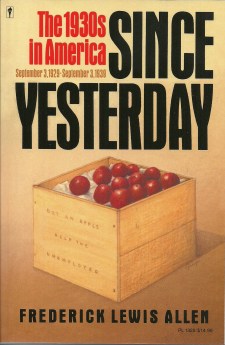
Since Yesterday: The 1930s in America is an informal (meaning easy to read, not academic and not scientific) account of the 1930s—from September 3, 1929 to September 3, 1939—by a person who lived through it and was there, historian Frederick Lewis Allen. He writes on nearly every aspect of American life during the 1930s. If you remember the 1930s, and even if you don’t, this is a very entertaining and informative journey down memory lane. Now it’s on the 1940s. If you lived in the 1930s, you were probably better off not knowing what awaited you just around the corner.

Copyright © 2016 by Allen Kopp

The Mask of Apollo ~ A Capsule Book Review

The Mask of Apollo cover

The Mask of Apollo ~ A Capsule Book Review by Allen Kopp

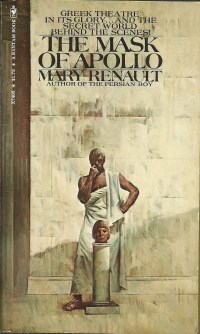
Mary Renault’s 1966 novel, The Mask of Apollo, is historical fiction, based, in large part, on historical fact. The main character is Nikeratos (“Niko” to his friends), an Athenian actor who is relating the story in his first-person voice. Nikeratos is a fictional construct, but most of the other characters and incidents, including a very young Alexander the Great at the end of the story, are real.

The setting is Greece about four hundred years before Christ. Nikeratos, being the son of an actor, is born into acting. He finds success in his calling early in life and moves up through the ranks of desired actors. To me the most interesting parts of the novel are the descriptions of the stagecraft of the period, which, even by today’s standards, were very elaborate and sophisticated. Plays were the entertainment of the masses, instead of just the cultured few. Theatres seated as many as fifteen or twenty thousand people and plays often began before dawn, with the rising sun sometimes used as an effect in the play. Only men were allowed to act on the stage, so men played in women’s roles. People in the audience never saw the faces of the actors during a performance because they wore elaborate masks (mask-making was a craft in itself). Underneath the masks the actors spoke the lines the playwrights had written. The best and most successful actors became celebrated.

If Nikeratos’s life isn’t interesting enough as an actor, he becomes involved in political intrigue in Syracuse, a powerful Greek city state at the tip of the island of Sicily. Syracuse has been controlled by despots, first by Dionysius, and then after his death by his son, Dionysius the Younger. Nikeratos befriends Dion, a moderate politician and pupil of the philosopher Plato. (They never become “lovers” in the Greek sense because they are of different worlds, but there is definitely an attraction going on there.) Dion is trying to bring stability and democracy to Syracuse by teaching Dionysius the Younger about more tolerant forms of government. Dion entrusts Nikeratos to convey sensitive political documents between Syracuse and Athens. Plato and Dion attempt to restructure the government of Syracuse along the lines of Plato’s Republic, with Dionysius the Younger as the archetypal philosopher-king. Of course, things don’t work out the way they had hoped.

The Mask of Apollo is a readable classic, somewhere between pop fiction and literature. It’s plenty engaging enough, but for me the political intrigue began to grow thin and meandering toward the end of the book. History tells us that things didn’t end well for Plato and Dion, but the last hundred pages or so seemed kind of anticlimactic. It might have been gripping but isn’t. All in all, though, it’s an interesting and informative journey to the ancient world, an escape from the dreary times we live in.

Copyright © 2016 by Allen Kopp

Three Famous Short Novels ~ A Capsule Book Review

Three Famous Short Novels

Three Famous Short Novels ~ A  Capsule Book Review by Allen Kopp

William Faulkner (1897-1962) is arguably the greatest American writer of the twentieth century. He was a genius, a literary stylist and innovator; there has never been anybody else quite like him. While some of his books are more accessible than others (As I Lay Dying, Sanctuary), his work is notoriously challenging to read. It helps sometimes, when reading Faulkner, to have a “study guide” or at least a synopsis of the chapters to be able to keep up with what is going on. He switches around from one time period to another, and the relationships among his numerous characters are often difficult to keep straight. There might, at times, even be different characters with the same name or with very similar names.

In this volume are three of Faulkner’s shorter, standalone works: Spotted Horses, Old Man, and The Bear. Not much happens in Spotted Horses. It’s about poor country people at an auction of some very wild Texas horses in Mississippi. These people are so poor that buying a horse for five dollars places a terrible financial burden on them. The thing about the horses is that they are so wild they can’t be caught after they’re sold. You don’t want to spend your last five dollars in the world for a horse you can’t catch. “Give me back my money. I wasn’t able to find the horse I bought.” “The owner of the horses took your money and has gone back to Texas. Too bad.” A fool and his money are soon parted.

The “old man” in Old Man is the Mississippi River. This readable and entertaining short novel is set in the Mississippi Delta in 1927, during a terrible flood in which there is much destruction of property, loss of human and animal life. (Faulkner renders a wonderfully vivid and evocative description of the flood.) Local officials enlist the aid of prison labor to help with sandbagging. Enter a stolid convict whose name we never know, in prison for the old-fashioned (even in the 1920s) crime of train robbing. He is soon swept away in a small boat on rising flood waters. He wants to get back before they think he has escaped, but he is not in control of where he goes. Eventually he rescues a woman who—guess what?—is about to have a baby. He saves her life (and the life of her baby) and with his strength is able to keep the boat upright. The man, the woman, the baby, and the boat end up very far away from where they started out. The prisoner wants nothing more than to get back to the relative comfort of the prison to finish his term. The irony is that he gets ten additional years tacked on to his sentence for his adventuring. Talk about gratitude! After all he went through, he should have been released from prison as long he promised not to rob any more trains.

Then we come to the short novel The Bear, which is notoriously difficult reading, at least in the fourth and fifth sections of its five sections. The time is the 1880s, when the wounds of the Civil War and slavery are still felt in the South (more about that comes later in the story). Every November all the hunters track the legendary bear, Old Ben, but there seems to be kind of an unspoken agreement not to kill him. Old Ben has been shot many times but never brought down. Tracking him is a sort of sport, not unlike a boxing match or some other sporting event. Young hunter Isaac McCaslin (“Ike” for short) grows up in the woods, becoming a more accomplished woodsman and hunter than most grown men while still a child. He comes to revere Old Ben as a sort of god. In one fateful encounter with a “legendary” dog, however, Old Ben has met his match. When one of the hunters, Boon Hoggenbeck, sees that Old Ben is about to kill the dog, he steps in and kills the bear with a knife instead of a gun. So much for the unspoken pledge not to kill the bear.

The death of Old Ben comes at the end of the third section of the novel. For the next two sections, Faulkner switches gear for some reason, making the story seem uneven. (He must have had his reasons; after all, he was the genius.) Fast forward to 1888, when Ike is twenty-one. He and his cousin, McCaslin Edmonds, are in the plantation commissary, looking at some old ledgers in which Ike’s father and Ike’s father’s twin brother, McCaslin’s father, recorded some semi-literate entries about slaves they had bought and sold before the Civil War and Emancipation. Ike and McCaslin read the ledger entries and we (the reader) read them too. They go on and on and are not all that interesting. Ike and McCaslin then engage in a long and dense discussion of how wrong slavery was for the South and how the South and everybody in it is cursed because of it. There are some very long sentences here and some very long paragraphs (one single sentence is 1600 words). You have to be a dedicated reader to wade through all this.

Faulkner is Faulkner and he is the one and only. Nobody else even comes close. You either find his work rewarding or completely incomprehensible. After you’ve read one of his sentences or one of his paragraphs, you might have to go back and break the sentence or the paragraph down into its various parts to understand what he is saying. And, as wordy and dense as his work is, he is also the master of the unspoken. Read him and you’ll see what I mean.

Copyright © 2016 by Allen Kopp

The Conjuring 2 ~ A Capsule Movie Review

The Conjuring 2

The Conjuring 2 ~ A Capsule Movie Review by Allen Kopp

If we are to believe the current spate of horror movies, there are many, many evil spirits (or demons) waiting to do bad things (or horrifying mischief) to ordinary people. In the movie The Conjuring (2013), based on a “true” story, a working class couple with a houseful of daughters buys a quaint old farmhouse in rural Rhode Island, not knowing that it’s the residence of a malevolent spirit from long ago who tries to make the mother kill her daughters. The family turns to Ed and Lorraine Warren for help. Lorraine is a psychic and her husband, Ed, is a sort of psychic investigator who assists people in ridding their homes of these spirits. Ed and Lorraine Warren are real-life people (not a handsome pair like Vera Farmiga and Patrick Wilson who play them onscreen) who travel around from place to place working on cases of various “hauntings.”

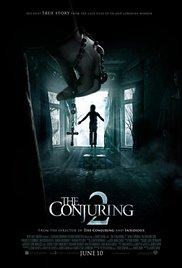
In the new movie The Conjuring 2, Ed and Lorraine Warren travel to England, to  the home of a beleaguered, divorced mother with four children in a dreary working-class neighborhood in northern London. The family’s name is Hodgson. Janet Hodgson is eleven years old. She’s been levitating, her bed shakes violently when she’s asleep and she hears and sees things (people) that apparently aren’t there. Finally, the spirit of an old man named Bill Wilkins who died in the house forty years earlier begins speaking through Janet Hodgson. (Or is he?) The house is his, he says, and he wants the current occupants to get out. After much investigating, it appears that eleven-year-old Janet is just faking the whole thing to get attention. Wait a minute! How can she have faked all the psychic occurrences that have been documented? It seems there are always those skeptics willing to find a “logical” explanation for any “proof” of ghosts or an afterlife. 

We learn finally that the spirit of Bill Wilkins is just a “pawn” for a really malevolent spirit named Valak, who manifests itself in the form of a horrifying nun. Janet Hodgson is being forced to appear to be faking the whole thing; if she doesn’t, the demon will kill her family. After many twists and turns, Ed and Lorraine learn the truth and then know how to counter the demon. 

The Conjuring 2 is formulaic, as these ghost stories usually are, but if you like well-made horror films (not slasher films) with a real plot, characters (not jiggling teenagers) and dialogue, this one is well worth your time. We are always left with the disquieting suggestion at the end that, although the living people may have won this round, the demons are only temporarily discommoded and will be back. As long as The Conjuring 2 makes money, there is bound to be The Conjuring 3

Copyright © 2016 by Allen Kopp 

Genius ~ A Capsule Movie Review

Genius

Genius ~ A Capsule Movie Review by Allen Kopp

Like other geniuses before him, American writer Thomas Wolfe (1900-1938) flamed brightly for a time and then burned out. He lived life exuberantly and was bursting with talent and creativity. In New York in 1929 he was just another failed writer. His massive first novel, which he called Oh, Lost!, had been rejected by every publisher in New York. He had a patroness, though, a woman named Aline Bernstein, who, through her connections, arranged to have the novel brought to the attention of Maxwell Perkins, an editor at Charles Scribners publishing house. Perkins agreed to give the manuscript a “quick look,” even though he was told from the beginning it wasn’t any good.

Max Perkins “discovered” Tom Wolfe, the writer. He would do for Wolfe what he had done for F. Scott Fitzgerald and Ernest Hemingway. As soon as he began reading Oh, Lost!, he knew that it was a unique work. He saw in it what other editors had failed to see, or, more likely, hadn’t taken the time to see. The book needed massive editing, but Perkins believed it was a work of genius that needed to be brought to the reading public. He contacted Tom Wolfe and gave him a check in advance of royalties for five hundred dollars. Wolfe wept.

Of course, Wolfe was reluctant to make any cuts to the book. He and Perkins spent months whipping the book into shape, which included a title change to Look Homeward, Angel. When the novel was published, it was a huge success and Wolfe was hailed as a genius. He knew he would never have been able to do it, though, without the help of Max Perkins.

In the new movie, Genius, Thomas Wolfe is played by Jude Law. He is loud, has a prodigious Southern accent (from Asheville, North Carolina), and isn’t interested in social conventions. He says what he thinks, does what he likes, and spends a lot of his time in a drunken state. He also has some domestic problems. Aline Bernstein (Nicole Kidman), his patroness, the “older” woman who left her husband, family, and respectability behind for him, is unstable and jealous. She is happy for Wolfe’s success, of course, but resents the many hours he spends on his writing. In one scene, she begins pouring pills into her mouth in the office of Max Perkins (Colin Firth) to get Wolfe to go home with her. She is a very unpleasant, bitter woman.

Wolfe’s next book, Of Time and the River, is even longer than the first. Perkins and Wolfe would spend many hours together, day and night, over two years or more, editing the book and getting it ready for publication. During this time, Perkins and Wolfe become close friends. Perkins comes to think of Wolfe almost as the son he never had (he has five daughters). The writer/publisher association develops into a close—at times volatile—friendship. Aline Bernstein tells Perkins that Wolfe will leave him as soon as he (Perkins) has served his purpose. She also threatens Perkins with a gun.

In 1938, at the age of 37, Tom Wolfe is stricken and taken to Johns Hopkins hospital in Baltimore (the same hospital where his father died). When an operation is performed, doctors discover he has a “myriad” of tumors in his brain. He dies soon after.

Genius is based on a nonfiction book by A. Scott Berg. It is an “art” film for a niche audience that won’t get much attention or make much money. Those of us who have read the great books of Thomas Wolfe and know something of his life will find the story fascinating. There aren’t many of us. At the showing I went to last night, there were three other people besides me in the audience. I walked a mile in the heat (I’d always rather walk than drive) to see it and a mile home. It was worth it.

Copyright © 2016 by Allen Kopp

Alice Through the Looking Glass ~ A Capsule Movie Review

Alice Through the Looking Glass

Alice Through the Looking Glass ~ A Capsule Movie Review by Allen Kopp

In Wonderland, Time is a “he” with electric blue eyes, a mustache, and an accent. He tells the Red Queen that her head is looking “wery, wery large today.” The Red Queen (Helena Bonham Carter), besides having an enormous head (out of all proportion to the rest of her body), has a tiny red heart painted in the middle of her lips (to show the smallness of her heart?) and a profusion of red hair. Nobody loves her, she says, but we know the reason for that is because she is so mean and loves to have people’s heads cut off. (“Off with his head!”, she shouts.) The White Queen, her fluttery sister, tells her that she loves her, if nobody else does, but the Red Queen isn’t having any of it. She hates being hugged.

The Mad Hatter (Johnny Depp) also has a profusion of red hair and enormous eyes that change color with his mood. He is rather androgynous and speaks with a lisping accent that is at times indecipherable. His friends (the Cheshire Cat, who floats in the air and disappears and reappears at will; Tweedledum and Tweedledee, rotund male twins; a dormouse, a dog, and a rabbit, all of whom speak English) are worried about him and think he might be dying.

Absolem, a blue, sometime-caterpillar/sometime butterfly, shows Alice (Mia Wasikowska) the way to return to Wonderland through the large mirror over the mantel. She is needed back in Wonderland after her earlier adventures there because the Mad Hatter, her “best friend in the whole world,” is in trouble. When she visits Hatter in his house shaped exactly like a top hat, she finds him in a low state. He tells Alice he wants her help in getting his family back and, when she tells him that getting them back is impossible because they are dead, he orders her out of his house. The Alice he knows, he says, never believed that anything was impossible.

Alice agrees to at least try to get Hatter’s family back, but she knows it will be very difficult, if not downright impossible. She must first manipulate Time (Sacha Baron Cohen), to be able to travel back to an earlier period when Hatter’s family was still alive. When she is finally able to travel back in time, she meets the Red Queen and her sister, the White Queen, as children, before the Red Queen became so mean. She also meets Tweedledum and Tweedledee before they were grown up and also meets Hatter as a child. Of course, he doesn’t have any recollection of Alice at this time because he hasn’t met her yet.

Alice Through the Looking Glass is a sequel to 2010’s Alice in Wonderland, both of them based on literary classics by English author Lewis Carroll. It’s colorful, imaginative and whimsical, full of bizarre characters and fantastic settings. For the child in all of us.

Copyright © 2016 by Allen Kopp