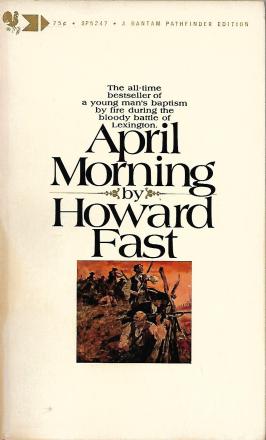
April Morning ~ A Capsule Book Review

April Morning ~ A Capsule Book Review by Allen Kopp

The American Revolutionary War began on April 19, 1775, with the Battles of Lexington and Concord. It was professional British troops, numbering in the thousands, against non-professional Colonials, numbering in the hundreds. The British were marching from Boston to procure military supplies the Colonials had stockpiled in Concord. The Colonials didn’t want to fight but were forced to it. They only wanted the English invaders to leave their land and let them live in peace.

April Morning is a historical novel by Howard Fast, told in the first-person voice of one Adam Cooper, fifteen years old. Adam lives with his family in the village of Lexington in the Massachusetts Bay Colony. On the morning of April 19, 1775, the people of Lexington receive word that the British army, possibly two thousand men, is headed toward them. They assemble a small body of “committeemen” to meet the British. The committeemen are underequipped, of course, and they know they are no match for the professional British army. They believe, naively, that all they will need to do is reason with the British to get them to desist and return to Boston.

The British immediately begin firing on the villagers on the “common” of Lexington before a word can be exchanged. (This is “the shot heard ‘round the world.”) Our young protagonist, Adam Cooper, witnesses his father being among the first to be shot. The Colonials fight back, with much bloodshed on both sides. Adam has an inadequate firearm that shoots birdshot, but still he does his part. In the course of one day, he goes from being a boy to being a man.

April Morning is not a serious examination of war, but is more a personal story of how the beginning of a war affects one person, one family, and one small village. It abounds with clichés and at no time has an authentic eighteenth century feel to it, in the way, for example, of Mackinlay Kantor’s historical novel, Valley Forge. Still, it’s an engaging enough book in its own way that has become a much-read classic, especially by younger readers.

Copyright © 2017 by Allen Kopp

I, Tonya ~ A Capsule Movie Review

I, Tonya ~ A Capsule Movie Review by Allen Kopp

Figure skater Tonya Harding is a high school dropout, a self-professed redneck girl. She’s crude and unsophisticated; she just doesn’t fit in with the American ideal of what a female champion female figure skater should be. The acorn doesn’t fall far from the tree. Her mother is a foul-mouthed, cigarillo-smoking harridan with the social graces of a rattlesnake. From the time Tonya is four years old, her mother (the figure skating equivalent of a stage mother) pushes her to be the best, spending all the money she makes as a waitress on training for Tonya.

Then Tonya meets Jeff Gillooly, a beautiful but dumb young man who, through nincompoopery, all but sabotages Tonya’s figure skating career in a few short years. Jeff has a very short temper; he punches and slaps Tonya on very little provocation, which Tonya confesses she believes she deserves. (She is then forced to cover her facial abrasions with makeup.) Jeff and Tonya get married, and it’s a tumultuous union, with much yelling, hitting, slapping and discharge of firearms.

Regardless of what’s wrong in Tonya’s life, she is good at figure skating. What she does on the ice is a kind of magic. She executes the extremely difficult “triple axel,” the first female skater to perform this move in competition, and earns a spot on the U.S. Olympic team for the 1992 Olympics in France. She doesn’t do so well in the Olympics, however; she comes in fourth. “When you come in fourth,” she says, “you get the six a.m. shift at Spud Heaven.”

After the Olympics debacle, Tonya believes she is finished with figure skating, but her star rises again and she has a shot at the next winter Olympics in Norway. Faced with stiff competition as she is, her husband and his idiotic friend, Shawn Gerhardt, try to help her by sabotaging, ineptly, one of her principal competitors. This doesn’t work out very well and results in criminal charges, a huge scandal, and the end of Tonya’s skating career.

I, Tonya stars Margot Robbie, who I remember from The Wolf of Wall Street, as Tonya Harding; Sebastian Stan, a Romanian actor who speaks American perfectly, as Jeff Gillooly; and the ubiquitous Allison Janney as Tonya’s she-wolf mother. They are all perfect. Never a dull moment. It upholds my belief that trashy, redneck characters are a lot more interesting than wine-sipping, angst-ridden, self-absorbed yuppies who have stock portfolios and Masters of Arts degrees. I know them and they bore me to death.

Copyright © 2018 by Allen Kopp

Mengele: The Complete Story ~ A Capsule Book Review

Mengele: The Complete Story ~ A Capsule Book Review by Allen Kopp

Dr. Josef Mengele (1911-1979) embodied the strange duality seen in other high-profile members of the Nazi party during the Third Reich. As physician at the Auschwitz concentration camp in Poland, he was capable of the most barbaric cruelty and scathing disregard for human life, while at the same time loving animals, trees, flowers, music and poetry. He was father, husband and beloved of his close-knit family and his loyal friends and supporters.

After World War II was over the Nazis were defeated, Dr. Mengele became the most sought-after and most reviled man of the twentieth century. While many of the infamous members of the Nazi party were brought to justice and executed, including Adolf Eichmann, Mengele somehow managed to escape justice, not for lack of trying on the part of the governments of Germany and Israel and several intrepid “Nazi hunters.”

Dr. Mengele was interested in anthropology and genetics. He believed that a super-human German race was possible through genetic engineering and scientific manipulation. At the Auschwitz concentration camp, he had unlimited human subjects on which to conduct his experiments. He was especially interested in twins, dwarves, and people with physical defects and disabilities. He would infect children with diseases and then wait for them to die so he could dissect them. He experimented with dyes to change eye color on his subjects, and the result was often blindness and death. His experiments were often bizarre, cruel, and medically useless. He was a real-life mad scientist.

If Dr. Mengele’s medical experiments at Auschwitz weren’t enough, he was also one of the Nazi officers to perform “selections” of prisoners as they exited the train cars: Go to the right and you live. Go to the left and you die. These selections were based on the physical appearance and age of the prisoner and nothing more. Dr. Mengele seemed to enjoy the job of making selections; he was always looking for new subjects for his experiments.

Dr. Mengele always maintained that he did nothing wrong at Auschwitz; he was only following orders, only doing his duty. According to him, he saved many lives and helped many victims of the diseases that were prevalent in concentration camps, such as typhus. However, there were many eyewitnesses who survived the camp who told a much different story; he was not called “the Angel of Death” for nothing. He was cruel and callous, without sympathy for his victims. If he had ever been brought to trial, the testimony of the witnesses would have convicted him.

After the war, Dr. Mengele’s life became a strange odyssey of escape, pursuit and evasion. He got away to South America; first Argentina and then Paraguay and then Brazil. He had lots of Nazi sympathizers to help hide him who refused to believe the stories about him. On the other hand, there were many people who would have given almost anything to have him brought to justice. At one time there was a reward of ten million dollars on his head. A kind of mythology grew up around his ability to escape; he became known all over the world as the one Nazi who got away. The Mengele story was fed by lies, exaggerations, misinformation and the pursuit of notoriety. Mengele “sightings” were reported in places where he could not possibly be.

This is not to say that Dr. Mengele lived a life of luxury and ease as a fugitive in South America. To remain hidden, he often lived in squalid conditions and in isolated places, separated from his family. He lived in constant fear that he would be recognized and maybe even kidnapped, as Adolf Eichmann had been. In 1979, Dr. Mengele died at age 67 of a stroke while swimming and was buried in a modest grave in Brazil. His remains were disinterred in 1985 to provide positive identification. So ended the life of an elusive monster.

Mengele: The Complete Story by Gerald L. Posner and John Ware is an exhaustive factual account of the wartime activities of Dr. Josef Mengele and his postwar life in South America as a fugitive. Dr. Mengele was a relatively young man during the war, only in his thirties, so he lived a long postwar life. The exhaustive details of the political machinations in South America, particularly in Paraguay, to keep him from being extradited, are too much information for the casual reader, like me, but, except for some tedious details and far too many difficult South American names thrown in, Mengele: The Complete Story is a fascinating account of one of the most infamous figures of World War II.

Copyright © 2018 by Allen Kopp

And That Includes Cab Fare

And That Includes Cab Fare ~ A Short Story by Allen Kopp

Mrs. Deal was eighty-five and had more cobwebs in her head than the basement and attic combined. She could no longer be trusted to stay at home by herself. She had been known to leave the front door open all night in the winter or turn the burners on in the kitchen and let dangerous amounts of gas escape into the room before she noticed the blue flame hadn’t come on the way it was supposed to. Her daughter, Patsy Ruth, age sixty-three, left her latest husband in the city and went to live with Mrs. Deal in her old-fashioned house on a corner lot in a small provincial town a good five-hour drive away.

Patsy Ruth had smothering emphysema from a lifetime of smoking Camel cigarettes, but her more immediate problem was her fragile nerves. She took little yellow pills her doctor had prescribed, sometimes twice the number she was supposed to, but still, no matter how many pills she took, Mrs. Deal tried her nerves almost beyond endurance. Mother and daughter had never been on the best of terms anyway, going all the way back to the beginning, and it was an almost impossible situation with them both living under the same roof. Mrs. Deal was stubborn on principle; it if was mealtime, she wasn’t hungry and refused to eat. At bedtime she refused to have the light off. Patsy Ruth thought at times about taking the whole bottle of yellow pills at once and getting into her big four-poster bed and going to sleep and never waking up, or going down to the railroad trestle and jumping into the shallow, muddy water a hundred feet below.

“I’m not a well woman,” she was fond of saying to anybody that would listen. “I still have my own life to live.”

To have an occasional “day off,” Patsy Ruth had to engage the services of a “woman” who was willing to spend a day, or at least part of an afternoon, sitting with an impossible old woman and keeping her from doing any harm to herself or to the house. When Mrs. Ida Stroud answered Patsy Ruth’s newspaper ad the first day it appeared, she seemed ideal; she had sat with old people before, she said, had some nursing experience, and lived only a short distance away. Patsy Ruth would have to pay for her to take a cab, though; Mrs. Stroud was fat, had painful varicose veins, and wasn’t able to walk very far.

“I guess we can manage the cab fare,” Patsy Ruth blatted into the phone, delighted that she had found the right person so easily and on the first day.

On Saturday, Patsy Ruth was going to visit the dentist, meet a friend for lunch and see a two o’clock matinee movie. She arranged with Ida Stroud to come on that day.

Patsy Ruth was gratified that Ida Stroud arrived on time on Saturday morning but was a little dismayed to see that she had brought her thirteen-year-old daughter, Stella, along with her.

“Stella don’t cause no trouble,” Ida said. “I can’t leave her at home by herself. She gets into too much mischief.”

Stella Stroud was a pale, skeletal girl with a permanent scowl on her face and dark circles around her eyes. Refusing to say hello to Patsy Ruth or to Mrs. Deal, she slumped down on the couch, folded her arms and yawned.

“We’ll all get along just fine!” Ida gushed. “We’re going to have a fine time, aren’t we? Everything will be just fine.”

“I’ll be back around six,” Patsy Ruth said.

“Don’t give us a thought!” Ida said. “We’ll all be just fine!”

“Do you mean I have to stay in this hell hole all day until six o’clock?” Stella asked after Patsy Ruth was gone.

“Find something to do,” Ida said. “Go outside and commune with nature.”

“I don’t want to go outside!” Stella said. “I didn’t want to come here in the first place!”

“Sit there and be miserable, then! I don’t care!”

“You’re just a horrible old woman, you know that?” Stella said.

Of Ida’s eight children, Stella at thirteen was the youngest. Mr. Stroud had been dead for many years, the victim of a bad heart passed down to him through father, grandfather and great-grandfather.

Ida beamed at Mrs. Deal. “You certainly are a lucky woman,” she said. “You have your daughter to look after you and you live in this fine, big house. That’s as much as any Christian woman might expect.”

“I’m a Methodist,” Mrs. Deal said.

“Where’s your husband?” Stella asked.

“He died.”

“What did he die of?”

“Shut up!” Ida said. “You’re not supposed to ask questions like that!”

“Well, I just wondered!”

 “Would you like a piece of butterscotch?” Mrs. Deal asked. “My daughter buys this butterscotch candy for me when she goes to the store.”

“No, thank you, dear,” Ida said.

“Haven’t you got any peppermint?” Stella asked. “I hate butterscotch.”

Ida gave Stella a warning look. “If you can’t be nice,” she said. “I’m going to slap you silly.”

“Well, let’s talk about something interesting,” Stella said. “I have sleep apnea. I could die in my sleep any night.”

 “Nobody wants to hear about that,” Ida said.

“Well, I don’t know why the hell not! I think it’s very interesting!”

“You think it’s interesting because it’s about you! You need to learn that the world doesn’t revolve around you! And I told you not to use words like that!”

“Words like what?”

“You know perfectly well what I’m talking about!”

“Well, pardon the hell out of me! I have to go to the bathroom! Where is it?”

“Ask Mrs. Deal,” Ida said. “It’s her house.”

“All right. What’s her first name?”

“You’re not supposed to use her first name, silly! Call her ‘Mrs. Deal’.”

“All right. Mrs. Deal, honey, I need to use your bathroom. Is that okay?”

“What?” Mrs. Deal said.

“She wants to know where the bathroom is,” Ida said.

“Oh. Go through the dining room into the back part of the house.”

Stella leapt to her feet. “It’s always so interesting to see other people’s bathrooms!”

“And don’t break nothing, either,” Ida said.

When Stella had gone out of the room, Ida gave Mrs. Deal a sad smile. “Kids!” she said. “This girl has given me more trouble than all my others put together. From the time she was born, she was trouble with a capital T, morning, noon and night. She would lie in her crib and scream all day long and all night. I told my husband I wasn’t having any more children because I was afraid they’d turn out like her. He didn’t care if we had another dozen because I did all the work of takin’ care of them. He made the living for the family, but that was all he ever did. At home he never lifted a finger.”

“I had three children,” Mrs. Deal said, “but only one of them is still alive.”

“All of mine are still alive!” Ida said. “I rue the day! Now, let me tell you, that Stella has had a rough time of it her whole life. When she was just a baby, she had yellow jaundice, whooping cough and I don’t know what all. You name it, she had it. And from the time she started to kindergarten, it’s been one problem right after another. She wet her pants just to defy the teacher and she refused to sit still and pay attention. Finally the school gave her a test and they said she wasn’t right in the head and they put her out! Can you imagine putting a child out of school? Then we had to send her to a special school in another town and, believe me, it cost a lot!”

“Maybe it’s just better not to have any children,” Mrs. Deal said. “I had three and both my boys are dead. One died two days after he was born.”

“Oh, isn’t that a shame! But it’s such a blessing to you that you still have your daughter. She lives with you and takes care of you.”

“She wants to put me in a nursing home so she can get married again. She’s been making a lot of calls, asking questions. She thinks I don’t know what she’s up to, but I’m not as stupid as she thinks I am.”

“I’d have you come and live with me,” Ida said, “but we live in such a small house. Not big like this one.”

“She’s still married to that last husband of hers, but here she is scouting around for the next one. She’s had I don’t know many husbands.”

“No!” Ida said. “And she seems like such a nice woman!”

“One of them she was married to twice.”

“Some people is like that. Can’t seem to find what they’re looking for.”

“My son was married two different times,” Mrs. Deal said. “He was an alcoholic and died at age thirty-five. Even younger than his father.”

“Isn’t that sad! Well, I guess we learn tribulation through our children if nothing else.”

“That’s what I mean,” Mrs. Deal said. “It’s probably better not to have any children at all.”

“Then we’d be alone, I guess, and that might be even worse.”

Stella came back from the bathroom smiling and wiping her hands on the seat of her pants.

“What were you doing in there so long?” Ida asked.

“Wouldn’t you like to know?”

“You weren’t smoking, were you?”

“Don’t be re-dick! I don’t have any cigarettes!”

“Mrs. Deal and I were just swapping stories about our children.”

“I bet you told her how awful I am, didn’t you?” Stella said.

“Wouldn’t you like to know?”

“I’m not ever having any kids. I don’t want the little son-of-a-bitches.”

“You shouldn’t say that,” Ida said. “You don’t know what the future holds for you. You’ll meet a wonderful man.”

Hah-hah! Where?”

“You’ll get married and live in lovely little house and you’ll realize after a while that something is missing and that something is little ones. After you’ve had one, you’ll want another and then another and then another.”

“You are so full of shit!” Stella said.

“Hey! I warned you about using that kind of language! One more word like that, and you’re going to have to wait outside on the front porch until six o’clock. Do you understand what I’m saying to you?”

“Oh, you know what you can do, don’t you?”

“I don’t want to hear another word out of you!”

“I just remembered,” Stella said. “Today is my birthday.”

“No, it ain’t, either,” Ida said. “Your birthday is in April. This is October.”

“I can make today my birthday if I want, can’t I? It’s such a boring, terrible day, I can say it’s my birthday just to help make it a little bit special, even if it’s not really my birthday.”

“No, you can’t, or if you do, just do it silently and don’t say anything!”

“I wonder if I’ll get any presents?”

“No, you won’t, so just forget about it!”

“When I get a little older, I’m going to run away from home!”

“Why wait?” Ida said. “Go now! Go anytime! You have my blessing!

“I’m not going to hang around this stupid, dead town and have a bunch of ugly babies and be just like everybody else. I’m going to Hollywood and I’m going to be a big movie star and when that happens, you’ll be sorry you were ever mean to me!”

“Send me a postcard!”

“You’d like that, wouldn’t you? You’d like to be rid of me!”

“You try the patience of a saint!”

Stella said to Mrs. Deal, “You see what a crazy old bitch my mother is, don’t you? And she never stops being crazy! She’s crazy twenty-four hours a day, seven days a week! It’s a wonder I just don’t shoot myself!”

Ida stood up, took three elephantine steps, and in one deft motion, slapped Stella across the mouth. “I don’t want to hear another peep out of you for the rest of the day!”

Stella sobbed and rubbed her cheek and was sullen for the rest of the morning.

At noontime, Ida went into the kitchen to fix lunch, leaving Stella and Mrs. Deal alone together.

“My mother says you’re a tiresome old woman,” Stella said.

“She can leave any time,” Mrs. Deal said.

“Did you ever see anybody talk as much and not say anything at all? She’s like a big gas balloon with a leak. And did you ever see anybody so fat in all your life? Lord God! I’m embarrassed to be seen walking down the street with her.”

“Stick a pin in her,” Mrs. Deal said.

“Did you know I have a boyfriend? I’ll bet you’re kind of surprised to hear that about me, aren’t you? He’s sixteen and he has his driver’s license. He hasn’t got his own car yet, but he can borrow his brother’s car any time he wants. He’s coming to pick me up tonight. My mother doesn’t want me to go out with him, so I’ll tell her I’m going to a girlfriend’s house. She’ll never know the difference. And me and my boyfriend? We’ll drive out someplace to a secluded, romantic spot, and when we’re sure there’s nobody around we’ll get into the back seat and make love. Doesn’t that sound romantic? I’m a very romantic person, but I guess you can tell that just by looking at me.”

When lunch was ready, Ida took one of Mrs. Deal’s arms and Stella took the other arm and helped her into the kitchen.

“I’m not helpless, you know!” Mrs. Deal said.

Lunch was canned tomato soup and dainty little baloney sandwiches with the crust cut off. Ida was of the opinion that bread crust made old people choke.

“I don’t like tomato soup,” Stella said.

They ate in silence. Stella discovered she could eat the tomato soup as long as she soaked bread in it first. When Mrs. Deal was finished eating (hardly anything at all), she said she was sleepy and wanted to take her nap. Ida helped her into her bedroom, covered her up with an afghan and went back into the kitchen.

Stella was still sitting at the kitchen table, looking at something she held in the palm of her hand.

“What is that you’ve got there?” Ida asked her.

“Nothing,” Stella said.

Ida grabbed Stella by the wrist and made her drop what she was holding. It was a pair of little gold earrings.

“Where did you get those?” Ida asked.

“I found them in the bathroom.”

Stole them in the bathroom is more like it.”

“It doesn’t concern you.”

“It concerns me if that daughter knows that you’ve been stealing from them and fires me. It’s not a lot of money, but it’s all I have coming in right now.

“She’ll never know I took them.”

“Put them back right now or I’m going to shake your head so hard it’ll fall off your shoulders.”

“Not on your life! You get paid for sitting around this dump all day, while I get nothing! Isn’t my time worth something? I’ll be lucky to get five dollars for these. I’m not even sure if they’re real gold.”

“It breaks my heart to know I have an unrepentant thief for a daughter.”

“There’s worse things.”

“If Mrs. Deal and her daughter find out you do such things, they’ll think you’re just terrible!”

“They won’t find out.”

“When that daughter comes back, I want you to tell her you found those earrings on the floor and then give them back to her. Then she’ll know you’re acting in good faith.”

“Screw good faith! I’m not gonna tell her anything!”

“If you won’t tell her, I will! Do you want her to know you’re a thief?”

When Patsy Ruth returned home, she was in a happy frame of mind, with smiles all around. “I’ve had the most relaxing day,” she said. “Sometimes all a person needs is to get away from home for a few hours.”

“I know just what you mean,” Ida said. “We had a lovely visit with your dear mother and the time just flew by.”

Patsy Ruth paid Ida, plus cab fare, plus an extra five dollars since everything went so well.

“Now I can pay the light bill,” Ida said.

Ida and Stella put on their coats and made ready to leave.

“Stella has something she wants to tell you before we go,” Ida said to Patsy Ruth.

“What is it, dear?”

“Go ahead and tell her while I call the cab,” Ida said.

Stella hesitated until Ida was in the kitchen, where the phone was. “I just wanted to say…”

“Yes?” Patsy Ruth said.

“I just wanted to tell you there’s a bad smell in your bathroom. I think it might be coming from underneath the floor.”

“Oh, really? I haven’t noticed any smell.”

“Some people can smell things that other people can’t.”

In just a minute, Ida came back into the room. “The cab will be here in two shakes,” she said.

“Finally, I can go home!” Stella said.

Patsy Ruth opened the front door and gave Ida a friendly pat on the shoulder as she passed through. Stella refused to look at her or return her smile.

Patsy Ruth sat down on the couch facing Mrs. Deal and lit a cigarette. Her smile had turned into a scowl, the scowl that Stella wore as she went out the door. The happiness she felt when she came home had left her. The good day was at an end and now it was time to return to the ugly reality of living in the same house with her mother.

Copyright © 2018 by Allen Kopp

Insidious: The Last Key ~ A Capsule Movie Review

Insidious: The Last Key ~ A Capsule Movie Review by Allen Kopp

Successful horror movies spawn sequels. First there was Insidious and then Insidious 2, then Insidious 3, and now there’s Insidious: The Last Key. Where will it all end?

The character Elise Rainier (played by Lin Shaye) is a woman in her seventies. She is at the center of all the Insidious movies, even if she is not the main character, because she is a psychic and has spent her life battling malevolent demons who are always out to do harm to the living. In Insidious: The Last Key, Elise Rainier revisits her childhood in a house in New Mexico. The year is 1953 and ten-year-old Elise sees ghosts all around her; the house that she and her family live in is in fact haunted. Her mother understands her, but her brutal, TV-watching father thinks that all Elise needs is a good beating every now and then. He forces her to lean against a wall and beats her on the back with a cane. It turns out there’s a malevolent demon haunting the Rainier home that forces Elise’s father to beat her and do other bad things that we find out about later in the movie.

The demon kills Elise’s mother and then Elise and her younger brother are left with the cruel father. When Elise is sixteen, she gets enough of her father’s brutality and leaves home, never to return. Then we fast-forward to 2010 when Elise is quite a bit older. She gets a call from a man who says his house is being taken over by evil spirits and needs her help to get rid of them. When the man gives Elise his address, she recognizes it as the haunted house in New Mexico where she lived as a child. She travels to the house with her two comic-relief sidekicks, Specs and Tucker, ghost hunters who have been in all the Insidious movies.

The current owner of the house is a working-class man named Ted Garza. He lives in the house alone, but, as we learn as the movie progresses, he does some of the same bad stuff that Elise’s father did decades earlier in the same house, courtesy of the malevolent demon who has taken up residence. As in all the Insidious movies, Elise must go head-to-head with an unspeakably evil supernatural monster. Its good versus evil.

The first Insidious movie is one of the best horror movies ever made, a truly creepy journey to the other side, which in this instance is called “the Further.” Each sequel in the series, though, is less effective than the one before it. Insidious: The Last Key shows that maybe the series is wearing thin and it’s time to retire it. Why is the demon with its long fingers never really explained? Why does it haunt the house in New Mexico? What is the significance of the keys? What about the little boy whose ghost plays with Elise’s toys? How did he die in childhood? Why is the prison where criminals are executed mentioned and shown at the beginning of the movie and then never again? Does the prison have anything to do with the demon? Insidious: The Last Key would have been a better movie if all these dangling plot points had been explained.

Copyright © 2018 by Allen Kopp

The Greatest Showman ~ A Capsule Movie Review

The Greatest Showman ~ A Capsule Movie Review by Allen Kopp

He was a dreamer who refused to live the dreary, conventional life that most of us live. He was Phineas Taylor (P.T.) Barnum, a show business impresario who lived from 1810 to 1891. He grew up poor and, as a man, had difficulty finding his place in the world. After several failed attempts at earning a living, he opened a museum of oddities (wax figures and a guillotine) in New York, but, when nobody wanted to see it, he added live “curiosities,” which, in the parlance of the age, was known as a “freak show.” He hired a Tom Thumb midget, a bearded lady who could sing, a fat man (he’s 500 pounds but we’ll add some padding and say it’s 750), a lady albino, Siamese twins, a dog boy, a tattooed man, a giant (he’s really tall but we’ll add even more to his height), and other oddities that people, loving the macabre and the “different,” would pay money to see. The freak show was the beginning of P.T. Barnum’s success.

Of course, it was no time before Barnum began receiving unfavorable press coverage for his “exploitation” of the “unfortunate” individuals in his show. People threw rocks in the street at the “freaks.” The show was considered lowbrow and tasteless, but that didn’t keep the crowds of people from flocking to see it. Soon, P.T. Barnum achieved the kind of notoriety he had always wanted. He bought a splendid mansion on the same street where his wife’s parents lived. Taking his show to London to meet Queen Victoria was the pinnacle of his success. In London, he met the famous singer, Jenny Lind, known as the “Swedish Nightingale.” He brought the beautiful Miss Lind across the Atlantic to tour the United States and began what many perceived as a love affair with her, adding marital infidelity to his growing list of transgressions.

He had other problems, of course, including a fire in his theatre, financial reverses that resulted in the loss of his home, and, always, being snubbed and dismissed by “society.” In the way of movie musicals, though, he is able to overcome adversity with his winning smile and his genuine affection for people. “There is no more noble pursuit,” he said, “than making people happy.”

The Greatest Showman is a singing and dancing extravaganza that is more a fantasy than the realistic story of a man’s life. The music and dancing are definitely of the modern variety and do not reflect the styles or tastes of nineteenth century America. It’s not the traditional movie musical like My Fair Lady, but is more like La La Land or Moulin Rouge. For two hours, forget you are a raging sophisticate and enjoy the sights and sounds of the pretty people on the big screen singing and dancing themselves into a frothing frenzy.

Copyright © 2018 by Allen Kopp

A New Ricky in Their Midst


A New Ricky in Their Midst ~ A Short Story by Allen Kopp

Ethel let herself in at the kitchen door and helped herself to a cup of coffee. She sat down at the table and began nibbling at the bacon that was left over from breakfast. When Lucy came in from the other room, she took one look at Ethel and began crying.

“What’s wrong, honey?” Ethel asked.

“Oh, Ethel, it’s just awful!” Lucy sobbed.

“What happened?”

“I’ve just been frantic since two this morning! I don’t know what to do!”

“You and Ricky have another fight?”

“I don’t know what’s got into him lately.”

“Well, pour yourself some coffee and sit down and tell me all about it.”

“Oh, Ethel, I hate to tell you what I’ve done!”

“It can’t be all that bad!”

“This time it is!”

“I’ll help you get it straightened out, whatever it is. What are best friends for?”

“Oh, Ethel, I don’t know how to tell you this!”

“Just say it. You’ll feel better.”

“I’ve killed Ricky!”

“What?”

“I said I’ve killed Ricky Ricardo. My husband. The famous bug-eyed Cuban bandleader known and loved by millions.”

“Oh, Lucy! You didn’t! I’m speechless!”

“I know! It’s terrible!”

“Are you sure he’s dead?”

“He’s dead, all right. He’s been dead since two this morning.”

“Well, get yourself calmed down and tell me all about it.”

“Well, he came home from the club about one-thirty and I noticed right away that he was acting sort of funny. He wouldn’t look me in the eye.”

“Oh, honey, that’s a very bad sign!” Ethel said, spraying crumbs out between her teeth.

“He took off his clothes and laid them on the chair next to the bed and went into the bathroom. I heard the water running, so I figured he was taking a bath. I gathered up his clothes for the laundry and you’ll never guess what I found!”

“What?”

“There was lipstick on the front of his shirt and, not only that, it reeked of perfume!”

“That doesn’t necessarily mean anything, honey! How do you know he didn’t just brush up against one of the chorus girls from the club?”

“Oh, he brushed up against her all right, and did a lot more than that, too!”

“Oh, honey! Now don’t start jumping to conclusions!”

“That isn’t all. When he came out of the bathroom in his bathrobe, I asked him if he had a pleasant evening at the club and he yelled at me.”

“Yelled at you? That doesn’t sound like Ricky!”

“He called me a meddling old bitch and said he was sick and tired of my nagging at him all the time.”

“Oh, Lucy! What did you do then?”

“I asked him if he had been seeing another woman and he broke down and began crying. He said he had been seeing a chorus girl named Delores for about two years and he couldn’t go on any longer with the deception. He and Delores are in love, he said, and he wanted me to divorce him so he could marry her!”

“Oh, Lucy! I can hardly believe it! I never would have suspected it in a million years!”

“I know! He’s been very good at concealing it, hasn’t he? The louse!”

“What did you do then?”

“Well, we began arguing, saying nasty things to each other. I called him a two-timing pig and he called me a henna-haired harridan. We became more and more angry. When he twisted my arm and tried to slap me in the face, I took a knife and stabbed him in the neck. It was a clear-cut case of self-defense.”

“Oh, Lucy! The neck?”

“I severed the jugular vein in one stroke!”

“Oh, honey! Wasn’t there an awful lot of blood?”

“There was, but I got it all cleaned up.”

“And where is he now?”

“He’s on the floor next to the bed. I have him wrapped up in two leak-proof sheets. There’s not a trace of blood left.”

“Oh, Lucy! I’m afraid you’re in for a lot of trouble!”

“I know! I’ve just been frantic trying to figure out what to do!”

“I think you should call the police and turn yourself in. Tell them Ricky came at you and you were only defending yourself. With a good lawyer, you might get off with a light sentence or maybe no sentence at all.”

“Oh, Ethel! I’ve thought about it from every angle! I want to call the police but I’m afraid they’ll be mean to me. They’re all men, aren’t they? Of course, they’ll take Ricky’s side and make me out to be the villain!”

“Oh, Lucy! What will people think when Ricky doesn’t show up at the club? You’ll have to tell them something!”

“I have a plan all worked out. I think it’ll work, but I’m going to need you and Fred to help me.”

“Oh, no! You’re not getting me mixed up in this!”

“Ethel, I thought you were my best friend!”

“I am, but I’m certainly not going to spend the next thirty years of my life in Sing-Sing in the name of friendship!”

“Oh, don’t be silly! Nobody’s going to jail!”

“But it’s murder, honey! It’s serious!”

“If you and Fred will just do what I say, everything will be all right.”

“Just how far do you think Fred and I are willing to go to help you after you’ve killed your husband?”

Ethel called Fred to come up to Ricky and Lucy’s apartment and, when they had him comfortably seated on the couch with a bottle of soda in his hand, he looked suspiciously from one to the other.

“What have you two dizzy dames got cooked up?” he asked.

“Are you going to tell him, or shall I?” Ethel asked.

“There’s no easy way to say it,” Lucy said.

“For heaven’s sake, just say it!” he said.

“Ricky and I had a terrible fight last night.”

“Yeah, what of it?”

“Well, I…”

“She severed Ricky’s jugular vein with a knife and killed him!” Ethel blurted.

“She what?

“In the heat of the moment, I killed Ricky, Fred,” Lucy said. “That wasn’t really my intention, but it just happened.”

“Have you called the police?”

“Well, no, Fred. You see, I don’t think that’s necessary as long as you and Ethel help me.”

“Help you do what?”

“The furnace in the basement is really hot this time of year. I mean, there’s a big door and a big fire burning inside.”

“Oh, no! I’m not going to put Ricky’s body in the furnace!”

“With all three of us, it’ll be so easy!”

“No, I’m not getting mixed up in a crazy scheme like that! Do you think I want to spend my golden years behind bars?”

“If we do it right, Fred, nobody will ever know.”

“What do you say when people come looking for Ricky?”

“Well, I’ve thought of that, too. I’ll wait twenty-four hours and then I’ll file a missing persons report. After that it’ll be easy to make it seem that he’s run off.”

“He was cheating on her, Fred!” Ethel said.

“What?”

“Yeah, he had a girlfriend named Delores.”

“If we’re lucky,” Lucy said, “we can get the police to believe that tramp Delores had something to do with his disappearance.”

“No less than she deserves!” Ethel said.

“So Ricky was stepping out!” Fred said. “The old dog!”

“I just might kill him myself if Lucy hadn’t already done it,” Ethel said.

“Well, that sort of puts things in a different light, doesn’t it?” Fred said.

“Now are you willing to help me?” Lucy asked.

“On one condition.”

“What’s that?”

“You give me one-third interest in the club.”

“Fred! I can’t give you one-third interest in the club! I don’t own the club!”

“Freddy, for once in your life do something to help somebody else without calculating what you can get out of it,” Ethel said.

“Well, it was just a thought,” he said. “You can’t blame me for trying.”

“So, you’ll help me, then?” Lucy asked.

“Looks like I don’t have much choice.”

In the middle of the night, with everybody in the building asleep, the three of them loaded Ricky’s stiff body into a large trashcan on wheels and took it down to the basement on the elevator. Fred wheeled the trashcan up to the door of the furnace; he and Ethel hefted Ricky’s body out of the can and into the furnace while Lucy stood by and chewed her nails.

“How long do you think it’ll take to burn the bones and teeth and everything?” Lucy asked.

“We’ll give it until this time tomorrow,” Fred said. “I’ll come down every couple of hours and stoke the fire.”

Lucy called the police at the appropriate time and told them Ricky had disappeared, apparently run off. He had been despondent lately over money, she said, had even mentioned suicide, and there was another woman involved. The next day, all the newspapers ran the story: Bug-Eyed Cuban Bandleader Disappears—Foul Play Not Ruled Out.

Lucy began receiving condolences from friends and business associates of Ricky’s. The phone rang day and night and Ethel stayed with Lucy to keep newspaper reporters from bothering her with silly questions. Lucy’s mother saw the news on television and called Lucy long-distance from Jamestown, New York, imploring her to “come home.”

After weeks, the case was unresolved. Police could offer no clues. They concluded that Ricky had indeed run off. There were reports of witnesses seeing him board a plane for South America on the night he disappeared. At least two people claimed to have seen him on an ocean liner bound for Greece. Others claimed to have spotted him in other locations, including a racetrack in Kansas City and a brothel in Augusta, Georgia.

The club held auditions to find a replacement band leader for Ricky. One in particular, a man named Mickey Richards, stood out because he was so much like Ricky, not only in the way he looked, but in the way he sang, talked, and walked.

Mickey Richards was hired and took over as bandleader at the Copacabana. Lucy watched him with interest and was amazed at how much like Ricky he was. The management of the club even persuaded him to change his name to Ricky Ricardo. Out in front, the theatre-type marquee proclaimed: He’s Back! He Was Never Really Gone in the First Place!”

The club was more successful than ever before, with patrons being turned away every night. People soon forgot that the real Ricky had ever left because there was a new Ricky in their midst, and this one was even better than the original.

For her part, Lucy missed Ricky terribly and was sorry she had killed him. She cried herself to sleep at night, wishing she might undo what she had done. She began making little overtures to the new Ricky, inviting him to the apartment for dinner or to a Broadway opening. A couple of times she left anonymous love notes in his dressing room at the club. She imagined that the new Ricky would fill the void left by the departure of the old Ricky and that everything would be as it was before, in the old days before he grew tired of her and fell in love with that floozy Delores.

Alas, it was not to be. The new Ricky differed from the old Ricky in one very important respect: He didn’t like bottle redheads and in fact didn’t like women at all. Lucy toyed with the idea of killing him, too, but she was afraid she wouldn’t get away with it a second time. She would talk to Fred and Ethel and ask them what they thought about it.

Copyright © 2018 by Allen Kopp

Valley Forge ~ A Capsule Book Review

Valley Forge ~ A Capsule Book Review by Allen Kopp

Valley Forge, Pennsylvania, was where the Continental Army spent the winter of 1777-1778, while waiting for more favorable weather to continue the war with the British, now occupying Philadelphia eighteen miles away. The weather was miserably cold and the army was ill-equipped, with not enough food or clothing to go around. Many of the men went without shoes. A lot of times they went without eating or ate what they could forage. Makeshift huts for shelter were constructed out of logs. More than 2500 American soldiers died at Valley Forge by the end of February 1778, from exposure, starvation, malnutrition, or disease.

Valley Forge is a novel by American writer Mackinlay Kantor. Instead of being a novel in the traditional sense, it’s more a collection of interconnected stories: a young deserter named Mum decides to return to his regiment after being treated kindly by a sixteen-year-old girl (we learn at the end of the book what became of Mum); a seven-year-old slave girl brings General Washington some apples and potatoes because she has heard he doesn’t have enough to eat; a defector is hanged while calling out for his mother; a young cobbler who has his leg amputated wonders how he will pursue his trade after the war; a gang of foragers deals with recalcitrant civilians; a young man with a horse he loves named John must deal with having the horse taken away from him by an officer (the horse John reappears at the end of the book); a group of young girls find what they believe is a litter of puppies, but what they don’t know is the puppies are really wolves and the mother will kill the girls if she finds them messing around with her babies; a young officer has a torrid love affair with an older widow who always keeps her face covered. The one person who appears throughout the book is General George Washington, the commander of the American forces on whose shoulders rests the success or failure of the war with the British. General Washington refuses to have comforts for himself while his men are living miserably at Valley Forge. He is a true American hero.

Valley Forge is an interesting, little-read book. It’s not about war or warfare but about the small moments in the lives of mostly insignificant people who are engaged in the titanic struggle for independence from a repressive, invading foreign power. Although it’s fiction, it’s well-researched and based on fact, as the bibliography at the end of the book attests.

Copyright © 2018 by Allen Kopp

Call Me by Your Name ~ A Capsule Movie Review

Call Me by Your Name ~ A Capsule Movie Review by Allen Kopp

Lanky, dark-haired Elio is not your usual seventeen-year-old boy. He reads books, plays the piano beautifully, transcribes music and swims in the river. Elio’s father is a professor, an American, and his mother is Italian. They are a bookish, sophisticated, enlightened family. At their beautiful Northern Italian home, they host a visiting academic during the summer. In the summer of 1983, that person is a twenty-four-year-old American man named Oliver.

Oliver is handsome and seems completely comfortable with himself, arrogant in a way. Everybody likes him because he’s affable and appealing. Elio is determined to not like Oliver at first, trying to appear disinterested, but the two of them begin spending a lot of time bicycling around the beautiful Italian countryside and Elio is increasingly drawn to Oliver in a way that is, it seems, new to him. If you are averse to a story about a same-sex relationship, this is probably where you’d better tune out.

At first Oliver doesn’t want to get involved with Elio because Elio is so young, but his resolve is soon weakened when Elio, not bothered by shyness, makes it obvious exactly what he is interested in. If anybody does any seducing, it’s Elio who seduces Oliver. Elio’s parents soon guess what is going on between Elio and Oliver and don’t mind very much. As Oliver tells Elio, “You are so lucky. My father would have carted me off to the nearest correctional facility.” If they were in the United States, in states where the age of legal sexual consent is eighteen, I’m afraid Oliver might spend the next thirty years in prison.

Call Me by Your Name is based on a novel by André Aciman. It’s a coming-of-age story where the young male protagonist has his heart broken. It’s usually a woman or girl who brings about the breaking heart, but in this case it’s another man. The movie version of the book, which I read earlier this year, is sophisticated, intelligent, thoughtful and beautifully made, flowing seamlessly from beginning to end. Whether or not you can accept and enjoy the story of a love affair between a seventeen-year-old boy and a twenty-four-year-old man is up to you. It might help you to know that the sex scenes are not graphic by today’s standards. My eighty-seven-year-old mother, however, would swear she’s watching porn.

Copyright © 2017 by Allen Kopp

What Better Night Than Christmas Eve?

What Better Night than Christmas Eve? ~ A Short Story by Allen Kopp

(Published in Ethereal Tales. This is a repost.)

Agnes Victoriana Wellington was, by all accounts, an incorrigible—some might even say an evil—child. As a baby, she would lie in her crib and scream hour after hour for no apparent reason until the neighbors would believe her mama was sticking pins into her flesh for amusement. At ten years old she was expelled from school because she was a perpetually disruptive influence in the classroom. Her mama and papa took her to a succession of doctors, all of whom assured them she was sound in mind and body, without any discernible physical or mental ailment that would cause her to behave in so frightful a manner. The only explanation that any of them could offer was that she might be possessed of a demon that wouldn’t desist until he had taken her back to hell with him.

Released from the imperative of attending school, Agnes was made to stay at home all the time, where she pushed her mama and papa to the limits of their endurance. She screamed and raged and fussed and threw any object that wasn’t too heavy for her to pick up. She tormented her younger brother and sister, Wallingford and Floretta, without mercy. She tied Wallingford to a tree and attempted to burn him at the stake. When Floretta was asleep in her bed, recovering from the scarlet fever, she glued her toes together and painted her lips with red ink. When her mother refused to buy her a new pair of boots, she took a kitchen knife and cut up her old ones. She called her papa an ignorant old fool. Her most hideous act of all, though, was taking all her clothes out of her closet and piling them in the middle of the floor and setting fire to them, putting herself and her family and all they possessed in grave danger.

After the fire, papa and mama were at the end of their tether. They could tolerate Agnes no longer. If they were to allow her to continue on the same path of destruction, they might very well all end up in a row of graves in the cemetery. They had little Wallingford and Floretta to think of, both of whom were blameless and deserving of a happy and peaceful life. As a final alternative and the only remaining hope, they agreed to place Agnes in the Mountainview Sanatorium for the Criminally Insane, where a certain doctor, a Doctor Pretorius, was known to have helped such patients with his progressive methods of treatment, about which nothing was known to the outside world.

Doctor Pretorius took Agnes in hand. He had her confined to a solitary room on the top floor of the Sanatorium and gave her anything she asked for and lots of good food to eat. After a lengthy period of carefully studying her and analyzing her and filling a notebook with his notes and consulting with a dozen other of his colleagues, he arrived at the conclusion that she was indeed possessed of a demon; a very unusual and rare type of demon that he had never seen before; a demon thousands of years old that was from a very deep and isolated station in hell. And, yes, it was true, as an earlier physician had suggested, the demon, for reasons known only to him, had claimed little Agnes as his own while she was still in the womb, his intention being to take her back to hell with him and make her his consort in evil. Evil was as much a part of her as her leg or her heart or her skin, which was as good an explanation as any that had ever been offered for why she was the way she was.

The question confronting Doctor Pretorius was how he was going to make Agnes the good and docile girl she should have always been and so return her to the bosom of her family to live a normal life. He tried many failed experiments with different anodynes, but nothing seemed to change Agnes for the better. One night, after a long and difficult day, he fell asleep in his study and, while asleep, he dreamed a vivid dream. In the dream, as he was walking along a lonely and deserted country road, he met a being surrounded by a kind of a glow, who told him that the only thing that was going to help poor Agnes was to eat human flesh and lots of it. Human flesh consumed daily was the only remedy that was going to keep the demon at bay and allow Agnes to live the kind of life that a child her age should be living.

Doctor Pretorius wasted no time in serving Agnes large portions of human flesh. In no time at all she began to show marked improvement. She began reading books, playing card games, working puzzles, and doing needlework like other little girls. She stopped having temper tantrums and throwing things and playing mean tricks on people. Doctor Pretorius and his staff were delighted with her progress.

Since the year was getting on to its close and the Christmas season was approaching, Agnes’s mama and papa asked Doctor Pretorius if Agnes might be allowed to return to her home and family for the blessed holiday. Doctor Pretorius harbored serious doubts about returning Agnes to the world and society just yet, but, after careful deliberation and prayer, he decided to allow her to go home for the last two weeks in December if, at the end of that time, she would return to the Sanatorium for continued rest and treatment.

Agnes’s papa, mama, brother and sister were surprised at how much she had changed in the Sanatorium (she had put on a lot of weight from her rich diet), but they were happy nonetheless to have her home again and happier still that she was docile, sweet and kind. The frightening, horrible little person that she had been was, for the moment at least, a thing of the past.

The next few days after Agnes’s return home were happy ones. She discovered she liked helping out in the kitchen and doing housework. She became reacquainted with Wallingford and Floretta, spending many happy hours talking, playing games, romping with the dogs and taking long walks around the countryside. She was never once tempted to eat them. At mealtime, she would decline the slices of roast beef or wedges of pork, saying she had become a vegetarian. She ate very modestly of vegetables and fruits, longing for the chance to leave the house to obtain the kind of sustenance she really needed.

It was after everybody had gone to their rooms and gone to sleep at night that Agnes slipped out of the house as quietly as she could to feed. On Doctor Pretorius’s advice, she walked miles away from home out into the countryside. People in the country weren’t as easy to find as in town, but the ones she found were choice, and she had the advantage of not being seen. She ate a twelve-year-old boy who was walking along the road at midnight (sweet and tender) and the next night a farmer’s wife who had insomnia (stringy but with lots of meat). There were a boy and a girl parked on lover’s lane (a rare double event), a young doctor out on a night call (muscular with a chemical taste), and a young married woman out to meet her lover in the middle of the night (a wild, gamy taste). Always she would get herself cleaned up and return home to her room before the sun came up. Nobody in her family ever knew of her nightly peregrinations.

As Christmas was fast approaching, Agnes and the other children were making excited preparations. They put up a beautiful tall tree that they cut down in the woods near their home and decorated it with as many baubles and decorations as it would hold. Their mama had instructed them to each make a list to present to Santa Claus. Whether or not Santa Claus would comply with their lists was another matter. Agnes wrote on her list that she wanted a family of dolls and a perambulator to push them around in, a miniature tea set and a wooden circus set. In her earlier life, before she went to the Sanatorium, she would have asked for a set of knives, poison darts and a blowgun to shoot them, and a prosthetic leg.

On Christmas Eve, all the presents were wrapped and under the tree. The house was gaily decorated from top to bottom; snow was whirling past the windows, adding to the feeling of Christmas. Agnes went into her room to go to bed at the same time that Wallingford and Floretta and mama and papa went into their rooms, but she was too excited to sleep, and at about a quarter to twelve she went back downstairs. She somehow had the feeling that Santa Claus would arrive at midnight and she wanted to meet him face to face and have a few words with him; it might be the only chance she would ever have to see him up close.

She sat down in papa’s big chair facing the low-burning fire and covered up with a lap robe and went fast asleep without meaning to. The clock chiming midnight woke her up. She opened her eyes and saw a man standing in the middle of the room looking at her. She knew without being told that he was the demon. He looked like an ordinary man except that he had yellow eyes. If he had horns or a tail, she couldn’t see them because he was wearing a Derby hat and a long black topcoat.

“May I extend to you all the felicitations of the season,” the demon said cordially as she pulled herself up in the chair.

“What are you doing here?” she asked. “You can’t bother me as long as I’m eating human flesh. Doctor Pretorius said so.”

“Ah, yes, Doctor Pretorius. I have to commend him for discovering my one weakness. Eating flesh is the one thing I cannot abide. It’s something I would never do.”

“Well, that’s why I doing it,” she said. “To keep you away from me. I’m not doing it because I’m a ghoul. I don’t really enjoy doing it.”

“Why aren’t you out feeding your voracious appetite? You haven’t fed since last night and you’re nearly famished.”

“If it’s any of your business, I’m waiting to meet Santa Claus and after I’ve met him I’m going out to feed.”

“Ah, yes, the Jolly Old Elf himself. I know him well.”

“So why don’t you just leave now before papa wakes up and comes after you with his shotgun? You’re not wanted here.”

“I’ve come to take you with me. What better night than Christmas Eve?”

“I’m not going anywhere!”

“Do you think you can go on killing people forever just to keep up appearances? Think how it will affect your family when they find out you kill people and eat them.”

“That isn’t any of your business!”

“When they find out what you are and what you do, it will be the end of them. Do you want that on your conscience? It’s better that you come with me now to spare them the degradation.”

“I can scream and wake everybody up if you don’t leave!”

“How foolish you are! What good do you think that will do? You would just put everyone in danger.”

Just then Floretta came down the stairs on padded feet. “I heard a noise,” she said, “and I thought maybe it was Santa Claus.” When she saw the man standing in the middle of the room talking to Agnes, she stopped in her tracks.

“Who’s he?” she asked. “If that’s Santa Claus, where’s his bag of toys?”

“It’s no one,” Agnes said. “He was just leaving.”

“This doesn’t concern you, little girl,” the demon said. “Why don’t you just run along and mind your own business?”

“Go back to bed,” Agnes said. “Santa Claus won’t come until you’re asleep. He doesn’t want you to see him.”

“I’m going to get papa,” Floretta said.

“I can take two as easily as one,” the demon said.

“What’s he talking about?” Floretta asked. “Take two where?”

“He’s just talking nonsense,” Agnes said. “He’s not right in the head. And he’s just leaving.”

“All right,” the demon said, “I’ll go.”

“Good!”

“If you won’t go with me, though, I’ll take her.” He pointed his long finger at Floretta.

“You’re not taking her or anybody!”

“All right, then. You win. But before I go I want you to show me how it’s done. With her.”

“What are you talking about?”

“You know it’s past time for you to feed, and you are ravenous with hunger. You have this delicious little creature standing right before you. Show me how you do it and I’ll go away and leave you alone. Forever.”

“What does he mean?” Floretta asked.

“He’s just making a little joke,” Agnes said.

“You have two choices,” the demon said, “and you know what they are.”

“If I go with you, you won’t hurt her?”

“On my word of honor.”

“And if I were to eat her, as you want me to do, you would go away and not bother me again?”

“Do you have any reason to doubt?”

“It’s not a difficult decision. I’ll go with you, but on one condition.”

“And what is that, dear child?”

“That you never bother her or any of my family.”

“You have my solemn oath.”

“All right, then. I’ll go with you.”

“A wise decision. Come.” He held out his hand and Agnes stood up.

“Tell mama and papa I’ll be all right where I’m going and not to worry,” Agnes said to Floretta.

Floretta opened her mouth to ask Agnes exactly where it was she was going, but a commotion coming from the direction of the fireplace silenced her. She ran and stood in the corner, where she could duck down behind the sofa if she needed to.

With a great clatter, accompanied by a huffing and groaning, Santa Claus came into the room by way of the fireplace, careful not to let the flames touch his boots. When he was all the way in the room, pulling his huge bag of toys, he stood upright and straightened his cap and brushed the soot off his sleeves. That’s when he saw the demon standing across the room looking at him with his yellow eyes.

“What are you doing here?” Santa asked, recognizing the demon on sight.

“If it’s any of your business,” the demon said, “I came to keep a rendezvous with little Agnes here.”

“Is this true?” Santa asked Agnes.

“Well, in a way I suppose it is true, but that doesn’t mean I want to go with him! I just struck a bargain that I would go live with him in hell and be his consort in exchange for his promise to leave Floretta and the rest of my family alone.”

“My, my, my!” Santa said. “You should never strike a bargain with a demon!”

“I know it was stupid but I had no other choice.”

“My dear, you always have a choice,” Santa said and laughed his characteristic laugh.

“It’s been lovely chatting like this,” the demon said, “but it’s time we were going.”

“Whatever possesses you to transact this kind of business on Christmas Eve?” Santa asked the demon. “Have you no delicacy? Have you no respect for tradition?”

“Is there any way you can help me, Santa?” Agnes asked.

“Don’t worry, child! I have a plan.”

“You should just stay out of this,” the demon said. “It’s none of your affair. Why don’t you just drop off your toys or whatever it is you do and then be on your way? I’m sure your reindeer are getting impatient.”

Santa smiled broadly at the mention of his reindeer and opened his black bag and pulled out the corpse of a recently deceased girl-child. He laid her out on the rug in front of the fireplace and gestured dramatically with both hands.

“She got in the way of my sleigh,” he said, “and my reindeer trampled her to death not ten minutes ago. I hated to leave her lying in the snow for the wolves to tear apart, so I stuffed her into my bag. I planned to take her back to the North Pole and instruct my elves to give her a decent burial.”

With a gesture from Santa, Agnes approached the tiny corpse lying on the rug and devoured it whole in the blink of an eye. She had become expert at feeding with no mess and no spilled blood.

The demon bent over double as if he had received a blow to the back of the head. He held his stomach with both hands and retched violently. When he was able to speak again, he said, through clenched teeth, “I’ll get you for this!”

“Hah!” Santa said with a hearty laugh. “You’re no match for me and you never were! Go on back to hell where you belong and don’t bother these children again!”

“All right, I’m going,” the demon said, and to Agnes he said, “You may have won this battle, but you haven’t won the war. I’ll be back. On that you may depend.” Then he disappeared as if he had been a mirage all along.

“What just happened here?” Floretta asked, speaking for the first time since Santa came into the room.

“You really are a saint,” Agnes said to Santa with tears in her eyes.

“I help wherever I can,” Santa said modestly.

“I’m afraid the demon is right, though. He will be back. Maybe not today or tomorrow but when I least expect it. He’ll have his way with me in the end.”

“Wait a minute,” Santa said. “I have something else for you.”

He reached into his bag and pulled out an old-fashioned locket on a chain and handed it to Agnes.

“It’s lovely,” Agnes said, “but what is it?”

“It’s a Holy Relic. It contains a sliver of the shin bone of St. Peter. Wear it around your neck always and I guarantee the demon won’t be able to stand to come near you again.”

“How can I ever thank you enough?” Agnes asked, putting the locket around her neck.

“Make amends with the world,” Santa said. “Make yourself worthy.”

With those words, he went about his business of placing the presents under the tree and when he was finished he climbed up the chimney as nimbly as a squirrel and was gone.

“Imagine that!” Floretta said, not being able for the moment to think of anything else to say.

Agnes wore the Holy Relic locket around her neck throughout her long life and was never bothered by the demon again. To atone for the people she had killed and eaten (never-to-be-explained disappearances), she dedicated her life to helping others. Through her charitable works and her countless good deeds, she saved many more lives than she had ever taken. Floretta, for her part, woke up in her bed on Christmas morning believing the scene she had witnessed involving Agnes, the demon, and Santa had been nothing but a dream.

Copyright © 2017 by Allen Kopp