Thieves Like Us ~ A Capsule Book Review

Thieves Like Us ~ A Capsule Book Review by Allen Kopp
Keechie Mobley and Bowie Bowers are a couple of sweet, decent kids who only want to live a quiet life in a place where they will be left alone. The only problem is Bowie is a prison escapee—he was serving a life sentence for murder when he escaped—and a bank robber. Keechie goes along with him and does what she believes is best for him, so she is a guilty accomplice, even though she doesn’t participate in any of the robberies. They are the central characters in Edward Anderson’s 1937 noir crime novel, Thieves Like Us.
Bowie has two bank-robbery pals, T-Dub and Chicamaw. They are older men. The three of them work together well as a team, even though Chicamaw is a terrible drunk and T-Dub acquires a young wife who isn’t very well-suited to a life of crime. Their problems, of course, will eventually bring them down, but, in the meantime, they pull several successful bank jobs that garner them significant sums of money and lots of media attention. The three of them are wanted across several states. This is not going to end well for them.
The last third of Thieves Like Us focuses primarily on Bowie and Keechie, rather than on the bank jobs. We see the human side of these criminals on the run, instead of just the hyped-up version that the newspapers perpetuate. They want the public to believe that Bowie is a mad-dog killer/thief with no conscience and no remorse. Nobody is safe as long as he roams free. We know from the way he behaves and the things he says that he isn’t really like this. He’s going to become a father and he believes his bank-robbery days are behind him and he will live the rest of his days as other people live. I wouldn’t count on it.
For serious afficionados of Depression-era crime fiction, Thieves Like Us is a real find. While it is a noir story dealing with crime and criminals, it is fine piece of classic American literature that fires on all cylinders. If I was a high school English teacher, I would make it required reading.
There have been a couple of different movie versions of Thieves Like Us. A 1948 version was titled They Live by Night, which is an all-right title but not as good as Thieves Like Us. A more faithful version (except for the ending) was the 1974 Thieves Like Us with Keith Carradine and Shelly Duvall perfect as boyfriend and girlfriend Bowie and Keechie. They’re not as pretty as Bonnie and Clyde, but we like them better and we come closer to believing them.
Copyright © 2021 by Allen Kopp


They Shoot Horses, Don’t They? ~ A Capsule Book Review
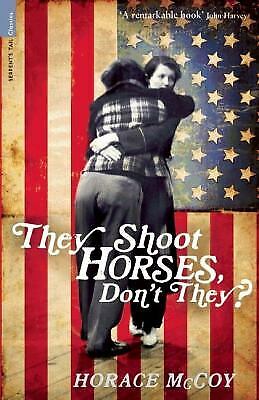
They Shoot Horses, Don’t They? ~ A Capsule Book Review by Allen Kopp
Horace McCoy was a little-known American writer who lived from 1897 to 1955. His most famous work was his 1935 novel They Shoot Horses, Don’t They?. It’s set entirely at a dance marathon in a seedy ballroom in Santa Monica, California, at the height of the Great Depression.
What’s a dance marathon, you might ask? It was where young people (and some not so young) danced (ballroom style) without surcease (with brief rest periods), before a paying audience. It was a test of the contestants’ endurance. As long as the contestants could keep going, they had a chance to win a thousand-dollar jackpot. If they stopped dancing or became ill, they were automatically disqualified. (If one member of a team dropped out, the other member had a certain amount of time to find another partner.) The idea was that the contestants, most of whom had no job and no place to live, would at least have a place to stay and food to eat as long as they stayed in the marathon. It could possibly go on for months, until only one couple was left standing.
The two main characters (dance contestants) are Gloria Beatty and Robert Styvesent. Gloria is a tried-and-failed movie actress, depressed and suicidal, who couldn’t get listed with Central Casting. Robert also has dreams of motion picture fame, but as a director instead of an actor. Gloria and Robert are sad, tired and disillusioned, and they don’t know what the future holds for them—probably only more shattered dreams and more heartache. We know from the start that the whole thing (the dance marathon or life in general) is not going to end well for them.
Many of the couples are eliminated with nightly “sprints” around the perimeter of the dance floor. You don’t have to be first in the sprint to remain in the marathon, but if you’re last, you’re going to get bounced. The teams struggle to hang on. Each believes they have a shot at the jackpot and—who knows?—there might be movie talent scouts in the audience any evening and someone will be “discovered.” It’s a brutal, demeaning spectacle—and the audience eats it up!
They Shoot Horses, Don’t They? is the only American novel of the 1930s of its kind about a dance marathon. It’s a gritty slice of life about the down-side of Hollywood. There’s nothing sweet, hopeful or life-affirming about it. Only pain, failure and disappointment. It’s thoroughly fascinating.
Copyright © 2021 by Allen Kopp

The Beauty of Men ~ A Capsule Book Review

The Beauty of Men ~ A Capsule Book Review by Allen Kopp
The lead character in Andrew Holleran’s 1996 novel, The Beauty of Men, is a forty-seven-year-old homosexual named Lark. He lives in New York, until “the plague” comes along and changes everything, taking the lives of many (most) of his friends. When his mother has a terrible accident that leaves her completely paralyzed, he “escapes” from New York and goes to live with her in a small Florida town. (He rationalizes later in the book that she “had the accident” to take him out of the New York world of men, to a place where he would be “safe.”)
In the bleak Florida town where Lark lives, he is mostly alone, except for the several hours a day he spends in the nursing home where his mother is confined. The rest of the time he is on his own to reminisce about the friends who have died, read, watch television, and reflect on his wasted, unfulfilling life. He believes he is in love with a thirty-four-year-old man named Becker, with whom he had one tense sexual encounter. The problem with Becker is he doesn’t seem to live Lark very much and isn’t interested in seeing him again. Becker has a lover with a handlebar mustache—don’t you know?—and a pubescent daughter he is trying to raise without a mother.
In his loneliness, Lark humiliates himself by frequenting gay bars and bathhouses, where he is like a ghost because his hair has turned white and he is so much older than the rest of the men there. He also turns up frequently at the “boat ramp,” an isolated, wooded area where men go to meet each other for quick, anonymous sex. (Going to the boat ramp is demeaning and dangerous.) He’s hoping to hook up with Becker once again but, of course, that isn’t going to happen.
The plot of The Beauty of Men shifts back and forth between Lark’s frustrating and disappointing life and the problems he has in dealing with his paralyzed mother. She wants to return home to die, but if Lark allows that he will lose whatever freedom he has. Does he find happiness and fulfillment at the end of the novel? Don’t count on it. It’s a dark, realistic excursion into one man’s unhappy life. There will be no Hollywood ending.
Copyright © 2021 by Allen Kopp