Thirteen writers with an impressive list of writing credits from the American Independent Press scene. Tom Pitts and Joe Clifford, two writers who once lived on the streets, focus on the desperation of drug addiction. Dan Nielsen writes about a drifter in need of more beer. Adam Moorad and Jim Meirose transport us to surreal worlds where everything is unexpected. Mental health and therapy, in all its complexity, is explored by Bobbi Lurie and Stephanie Becerra. The vulnerability of old age is laid bare by Allen Kopp and Phyllis Humby. There is dark humor from James Valvis plus dysfunctional relationships from Michael C. Keith, Jerry Levy and Elle Pryor.
Kubla Khan ~ A Classic English Poem by Samuel Taylor Coleridge (completed in 1797, published in 1816)
In XANADU did Kubla Khan
A stately pleasure dome decree:
Where Alph, the sacred river, ran Through caverns measureless to man
Down to a sunless sea.
So twice five miles of fertile ground
With walls and towers were girdled round:
And there were gardens bright with sinuous rills,
Where blossomed many an incense-bearing tree;
And here were forests ancient as the hills,
Enfolding sunny spots of greenery.
But Oh! that deep romantic chasm which slanted
Down the green hill athwart a cedarn cover!
A savage place! as holy as enchanted
As e’er beneath a waning moon was haunted
By woman wailing for her demon-lover!
And from this chasm, with ceaseless turmoil seething,
As if this earth in fast thick pants were breathing,
A might fountain momently was forced:
Amid whose swift half-intermitted burst
Huge fragments vaulted like rebounding hail,
Or chaffy grain beneath the thresher’s flail:
And ‘mid these dancing rocks at once and ever
It flung up momently the sacred river.
Five miles meandering with a mazy motion
Through wood and dale the sacred river ran,
Then reached the caverns measureless to man,
And sank in tumult to a lifeless ocean:
And ‘mid this tumult Kubla heard from far
Ancestral voices prophesying war!
The shadow of the dome of pleasure
Floated midway on the waves;
Where was heard the mingled measure
From the fountain and the caves.
It was a miracle of rare device,
A sunny pleasure-dome with caves of ice!
A damsel with a dulcimer
In a vision once I saw:
It was an Abyssinian maid,
And on her dulcimer she played,
Singing of Mount Abora.
Could I revive within me
Her symphony and song,
To such a deep delight ‘twould win me,
That with music loud and long,
I would build that dome in air,
That sunny dome! those caves of ice!
And all who heard would see them there,
And all who should cry, Beware! Beware!
His flashing eyes, his floating hair!
Weave a circle round him thrice,
And close your eyes with holy dread,
For he on honey-dew hath fed,
And drunk the milk of Paradise.
The other day I heard a commentator on TV say something about the First Amendment to the Bill of Rights. I consider myself a patriotic American, but I have to admit I don’t know—or don’t remember—much about the First Amendment or the other nine Amendments that make up the Bill of Rights. It has been a long time since I was in school, and even when I was in school, I was much more interested in other things.
The first Ten Amendments to the U.S. Constitution are known as the Bill of Rights. There were sixteen other amendments added to the Constitution later, but they are not part of the Bill of Rights; they are part of the Constitution. James Madison introduced the Bill of Rights to the First United States Congress in 1789 as a series of legislative articles. The Bill of Rights came into effect as Constitutional Amendments on December 15, 1791, when they had been ratified by three-fourths of the states.
As a refresher for all you long-out-of-school people, like me, I’m listing the Bill of Rights below. You will see that they are simply written, brief, to the point, and easy to understand. There is nothing mysterious or ambiguous about them. They are a gift to every American.
So, here they are—the Ten Amendments to the United States Constitution that make up the Bill of Rights:
First Amendment: Congress shall make no law respecting an establishment of religion, or prohibiting the free exercise thereof; or abridging the freedom of speech, or of the press; or the right of the people peaceably to assemble, and to petition the Government for a redress of grievances.
Second Amendment: A well regulated Militia being necessary to the security of a free State, the right of the people to keep and bear arms shall not be infringed.
Third Amendment: No Soldier shall, in time of peace be quartered in any house, without the consent of the Owner, nor in time of war, but in a manner to be prescribed by law.
Fourth Amendment: The right of the people to be secure in their persons, houses, papers, and effects, against unreasonable searches and seizures, shall not be violated, and no Warrants shall issue, but upon probable cause, supported by Oath or affirmation, and particularly describing the place to be searched, and the persons or things to be seized.
Fifth Amendment: No person shall be held to answer for any capital, or otherwise infamous crime, unless on a presentment or indictment of a Grand Jury, except in cases arising in the land or naval forces, or in the Militia, when in actual service in time of War or public danger; nor shall any person be subject for the same offence to be twice put in jeopardy of life or limb; nor shall be compelled in any criminal case to be a witness against himself, nor be deprived of life, liberty, or property, without due process of law; nor shall private property be taken for public use, without just compensation.
Sixth Amendment: In all criminal prosecutions, the accused shall enjoy the right to a speedy and public trial, by an impartial jury of the State and district where in the crime shall have been committed, which district shall have been previously ascertained by law, and to be informed of the nature and cause of the accusation; to be confronted with the witnesses against him; to have compulsory process for obtaining witnesses in his favor, and to have the Assistance of Counsel for his defense.
Seventh Amendment: In suits at common law, where the value in controversy shall exceed twenty dollars, the right of trial by jury shall be preserved, and no fact tried by a jury, shall be otherwise re-examined in any court of the United States, than according to the rules of the common law.
Eighth Amendment: Excessive bail shall not be required, nor excessive fines imposed, nor cruel and unusual punishments inflicted.
Ninth Amendment: The enumeration in the Constitution, of certain rights, shall not be construed to deny or disparage others retained by the people.
Tenth Amendment: The powers not delegated to the United States by the Constitution, nor prohibited by it to the States, are reserved to the States respectively, or to the people.
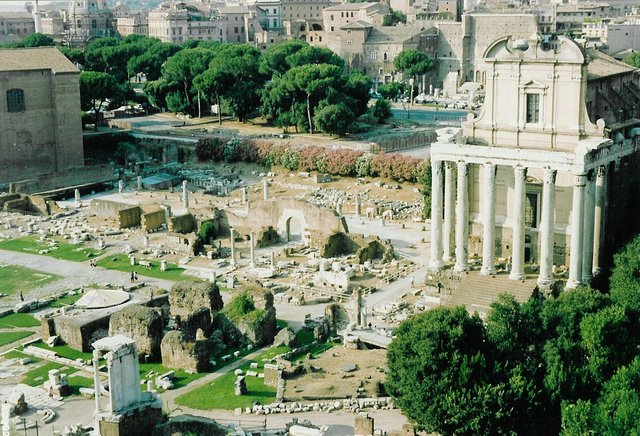
The Palatine Hill is the centermost of the Seven Hills of Rome and is one of the old parts of the city. It stands above the Roman Forum on one side and the Circus Maximum on the other. The world “palatine” is the origin of the world “palace.”
According to Roman mythology, the Palatine Hill is where Rome began. There was a cave there known as the Lupercal, where twin boys Romulus and Remus were cared for and kept alive by a female wolf. The shepherd Faustulus found the infant boys and, with his wife Acca Larentia, raised them. When Romulus and Remus were older, they murdered their great-uncle, who had seized the throne from their father, and built a new city on the banks of the Tiber River. They ended up having a violent argument with each other and Romulus killed Remus. The name “Rome” is derived from “Romulus.”
Excavations have shown that people have lived on the Palatine Hill since one thousand years before Christ. The historian Livy wrote that the original Romans lived there. Many affluent Romans of the Republic Period (510 B.C. to 44 B.C.) had their homes there. During the period of the Empire (27 B.C. to 427 A.D.), many emperors had their palaces there. You might say that the Palatine Hill was the best neighborhood in Rome.
In July 2006, archaeologists discovered the Palatine House, which is believed to have been the birthplace of Augustus, Rome’s first emperor. A section of corridor and other fragments were discovered under the Palatine Hill, which one archaeologist described as “a very aristocratic house.” The two-story house was built around an atrium, with frescoed walls and mosaic flooring, and is situated on the slope of the Palatine that overlooks the Coliseum and the Arch of Constantine.
Extending across the Palatine Hill and looking out over the Circus Maximus is the Flavian Palace, which was extended and modified by several emperors. The greater part of the palace was built during the reign of the emperor Septimius Severus (146 B.C.-211 B.C.). Adjacent to this palace is the Hippodrome of Domitian, which was kind of a small stadium for foot races.
Today the Palatine Hill and the Roman Forum beneath it are a large open-air museum and welcome thousands of visitors a day. If you are going to “do” Rome anytime soon, the Palatine Hill should be well worth the time and effort it takes to see it.
France had hosted the 1889 Paris Exposition, and it had been an enormous success, the largest fair ever of its kind. The Eiffel Tower had been built for the Paris Exposition and had quickly become a world-famous engineering wonder. A few years later, America was planning a World’s Fair of its own to be held in Chicago. American prestige was on the line. Would an American fair be able to outdo the Paris Exposition? Would Chicago, the second-largest city in the country, be able to put on as good as fair as New York, if New York had been chosen to host the fair?
The planners of the Chicago World’s Fair wanted a structure built that would rival the Eiffel Tower and become the centerpiece of the fair, as the Eiffel Tower had been of the Paris fair. After considering many proposals, they chose the design of a young bridge-builder from Pittsburgh named George Washington Gale Ferris, Jr.
The “Ferris Wheel,” as it came to be called, was, at 264 feet, the largest structure of the sprawling Chicago World’s Fair. It quickly became enormously popular and well-known. As the planners had hoped, it became the symbol for the fair, recognized all over the world.
The wheel rotated on a 71-ton, 45.5 foot axle that weighed 89,320 pounds and was at the time the largest hollow steel forging that had ever been done. There were 36 cars, each able to accommodate 60 people—up to 2160 passengers at one time. The ride on the “Ferris Wheel” cost fifty cents and made two revolutions in twenty minutes.
After the Chicago fair ended, the “Ferris Wheel” was dismantled and stored for a time. It was reassembled on Chicago’s North Side, near Lincoln Park, where it operated from 1895 to 1903. After that, it was dismantled once again and used in the 1904 St. Louis World’s Fair. After it was no longer needed, the “Ferris Wheel” that had brought so much notoriety to the 1893 Chicago World’s Fair was destroyed by controlled demolition in 1906.
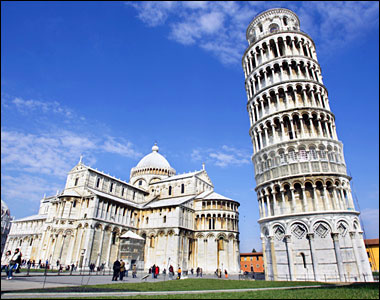
Have you ever wondered why the world-famous Leaning Tower of Pisa appears to be in danger of falling over? Is the angle at which it leans to the side intentional or accidental?
The tower is the campanile, or freestanding bell tower, of the cathedral in the Italian city of Pisa. It stands behind the cathedral and is the third-oldest structure in Pisa’s Cathedral Square (the Cathedral and the Baptistry are older). It’s tilted at an angle of 3.99 degrees and stands 183 feet high on the lowest side and 186 feet high on the highest side. That is roughly equivalent to the height of an 18-story building.
Construction on the Tower of Pisa was begun in August of 1173, during a period of military success and prosperity. By the time the very slow construction had progressed to the third floor in 1178, the tower began to sink because of a poorly constructed foundation that was set in unstable subsoil. The Republic of Pisa was by this time engaged in wars with Genoa, Lucca and Florence, so construction was halted for almost a century. (Can you imagine a construction project being halted for a century nowadays?) This century-long delay allowed for the soil to settle; if not, the tower would almost certainly have fallen over.
Construction was resumed in 1272 under the architect Giovanni di Simone. To compensate for the tilt, engineers began building upper floors with one side taller than the other, making the tower lean in the other direction. Because of this, the tower is actually curved. In 1284, construction was halted again when Genoa defeated the Republic of Pisa in the Battle of Meloria.
In 1319, the seventh floor of the tower was completed, but the chamber where the bells were housed was not added until 1372. There are seven bells in the tower, one for each note of the musical major scale. The largest bell was installed in 1655.
The Italian government in 1964 requested aid in keeping the tower from falling over, but, whatever measures were taken to keep it standing upright, the tilt that had become so famous had to be preserved. An international task force of engineers, mathematicians, and historians was assigned to study and analyze the problem. A period of structural strengthening to halt the ever-increasing tilt began in 1990 and lasted about eleven years, after which the tower was declared stable for at least another 300 years. Today the tower is undergoing gradual surface restoration to repair corrosion and blackening caused by wind and rain.
The Leaning Tower of Pisa remains a popular tourist destination for anyone fortunate enough to be traveling in Italy. Seeing the tower and going to the top of it is surely an experience not to be forgotten.
Earth has one moon, as we earth dwellers know. Jupiter, that mysterious “gas giant” that is the fifth planet in order from the sun and the largest planet in the solar system, has—count them—63 moons. Many of these moons, however, are not moons as we think of moons. Only eight are “regular satellites,” with prograde (a direction of rotation counterclockwise as viewed from the north pole of the sky or a planet) and nearly circular orbits not greatly inclined with respect to Jupiter’s equatorial plane. The other 55 moons are “irregular satellites” whose prograde and retrograde (moving in a direction contrary to that of similar objects) orbits are much farther from Jupiter and have high inclinations and eccentricities.
Of the eight “regular satellite” moons, four are called the Galilean moons because they were discovered by the astronomer Galileo in 1610. They are among the largest objects in the solar system and would be considered dwarf planets if they revolved around the sun instead of around another planet. They are Io, Europa, Callisto, and Ganymede and were the first objects discovered to orbit a body other than the earth or the sun. (The other four “regular satellite” moons are much smaller and closer to Jupiter, serving as sources of the dust that makes up Jupiter’s rings.)
Ganymede, the largest of the four Galilean moons, is the largest natural satellite in the solar system (larger than the planet Mercury) and the only satellite known to possess a magnetosphere (a region of space surrounding a planet that is dominated by the planet’s magnetic field so that charged particles are trapped in it). Ganymede is made up mostly of silicate rock and ice. A salt-water ocean is believed to lie underneath its surface, sandwiched between layers of ice. The surface has two types of terrain—highly cratered dark regions and younger (though still ancient) regions with many grooves and ridges. There is a thin oxygen atmosphere that includes ozone and some atomic hydrogen.
The second largest of the four Galilean moons is Callisto, ranking as the third largest moon in the solar system. Callisto is made up of approximately equal amounts of rock and ice, which makes it the least dense of the Gallilean moons. It has a very thin atmosphere of carbon dioxide and molecular oxygen. The likely presence of a subsurface ocean of liquid water suggests that Callisto can or could harbor life. Callisto is the most likely place for a human base for future exploration since it is farthest from the intense radiation of Jupiter.
Of the four Galilean moons, Io is the one closest to Jupiter and is the fourth largest moon in the solar system. With over 400 active volcanoes, it is the most geologically active object in the solar system. The surface of Io is dotted with more than 100 mountains, some of which are higher than Mount Everest on earth. Most moons (or satellites) in the outer solar system have a thick coating of ice, but Io is made up primarily of silicate rock surrounding a molten iron or iron sulfide core. Io has a thin atmosphere and is bombarded with radiation and magnetic fields from Jupiter.
Europa is the second closet to Jupiter of the four Galilean moons and is the smallest of the four—slightly smaller than earth’s moon. It is one of the smoothest objects in the solar system, with a layer of water surrounding the mantle of the planet. The smooth surface includes a layer of ice, while the bottom of the ice is theorized to be liquid water. The smooth appearance of the surface of Europa has led scientists to believe that a water ocean exists beneath it, conceivably serving as an abode for life. The prominent reddish-brown markings that crisscross Europa indicate low topography, meaning that few craters exist because its surface is tectonically active and young. Europa is made up primarily of silicate rock and likely has an iron core. Its tenuous atmosphere is composed primarily of oxygen.
All four of the Galilean moons are bright enough that they could potentially be seen from earth with the naked eye, but the brightness of Jupiter obscures them. They are, however, visible with even low-powered binoculars if the person looking through the binoculars knows where Jupiter is and knows exactly what he or she is looking for.
The new movie, The Raven, is a fictional and highly speculative account of the mysterious final days of Edgar Allan Poe. Nobody has ever been able to figure out exactly why Poe died at the relatively young age of forty in Baltimore in 1849, so it’s a subject that lends itself to invention and speculation. He was found on a park bench, critically ill, and died a few days later in a Baltimore hospital.
John Cusack plays Poe. He was, to paraphrase an editor of a newspaper that published some of his work, a man to whom God gave a great gift, with more than his share of misery thrown in. His genius as a poet and inventive creator of murder stories is entirely at odds with his private life. He was plagued his whole life by what was in the nineteenth century called melancholy. (The truth is he probably suffered from some kind of undiagnosed mental illness.) He was also an unregenerate drunk who never seemed to have any money—he lowered himself to cadging drinks from the local saloon whenever he was short of funds.
In the movie, Poe is in love with a young woman named Emily Hamilton (Alice Eve), whose father (Brendan Gleeson) violently disapproves of Poe. Emily might be the only thing that can save Poe from his demons. He has already lost one young wife and longs to marry Emily, but her father would gladly kill Poe if given the chance.
A “serial killer” (a phrase that wasn’t a part of common English usage in 1849) is at work in the city of Baltimore. The killer, whoever he is, is using methods of killing described by Poe in his stories. A twelve-year-old girl and her mother are mutilated for no apparent reason. A literary critic who unkindly criticized Poe’s work in the past is sliced in half by a pendulum, as in the story The Pit and the Pendulum. A murder victim’s tongue is sliced out and replaced with a pocket watch. The police suspect at first that Poe is behind the murders, but he is soon found to have had nothing to do with them. He can, however, assist police in finding the murderer. He is especially motivated to help the police when the murderer kidnaps Emily and keeps sending Poe cryptic messages about the horrible things he might be doing to her.
The story is neatly wrapped up at the end, with a conclusion that seems as logical as any conclusion might have been. It’s not a happy ending, but we find out who the murderer is, and, in a neat twist at the end, the police detective (Luke Evans) who befriended Poe in the course of the investigation exacts a satisfying revenge.
The Raven is a mainstream movie and is not a serious examination of the life and work of Poe. It is lightweight entertainment and would not be nearly as interesting if not for Poe. If you like a fast-paced cinematic mystery with lots of period touches and atmosphere (not to mention an interesting music score), however, it’s probably going to be well worth your time and effort to see it. You could do a lot worse.
The Tell-Tale Heart ~ A Classic American Short Story by Edgar Allan Poe (1809-1849)
TRUE! nervous, very, very dreadfully nervous I had been and am; but why WILL you say that I am mad? The disease had sharpened my senses, not destroyed, not dulled them. Above all was the sense of hearing acute. I heard all things in the heaven and in the earth. I heard many things in hell. How then am I mad? Hearken! and observe how healthily, how calmly, I can tell you the whole story.
It is impossible to say how first the idea entered my brain, but, once conceived, it haunted me day and night. Object there was none. Passion there was none. I loved the old man. He had never wronged me. He had never given me insult. For his gold I had no desire. I think it was his eye! Yes, it was this! One of his eyes resembled that of a vulture — a pale blue eye with a film over it. Whenever it fell upon me my blood ran cold, and so by degrees, very gradually, I made up my mind to take the life of the old man, and thus rid myself of the eye for ever.
Now this is the point. You fancy me mad. Madmen know nothing. But you should have seen me. You should have seen how wisely I proceeded — with what caution — with what foresight, with what dissimulation, I went to work! I was never kinder to the old man than during the whole week before I killed him. And every night about midnight I turned the latch of his door and opened it oh, so gently! And then, when I had made an opening sufficient for my head, I put in a dark lantern all closed, closed so that no light shone out, and then I thrust in my head. Oh, you would have laughed to see how cunningly I thrust it in! I moved it slowly, very, very slowly, so that I might not disturb the old man’s sleep. It took me an hour to place my whole head within the opening so far that I could see him as he lay upon his bed. Ha! would a madman have been so wise as this? And then when my head was well in the room I undid the lantern cautiously — oh, so cautiously — cautiously (for the hinges creaked), I undid it just so much that a single thin ray fell upon the vulture eye. And this I did for seven long nights, every night just at midnight, but I found the eye always closed, and so it was impossible to do the work, for it was not the old man who vexed me but his Evil Eye. And every morning, when the day broke, I went boldly into the chamber and spoke courageously to him, calling him by name in a hearty tone, and inquiring how he had passed the night. So you see he would have been a very profound old man, indeed , to suspect that every night, just at twelve, I looked in upon him while he slept.
Upon the eighth night I was more than usually cautious in opening the door. A watch’s minute hand moves more quickly than did mine. Never before that night had I felt the extent of my own powers, of my sagacity. I could scarcely contain my feelings of triumph. To think that there I was opening the door little by little, and he not even to dream of my secret deeds or thoughts. I fairly chuckled at the idea, and perhaps he heard me, for he moved on the bed suddenly as if startled. Now you may think that I drew back — but no. His room was as black as pitch with the thick darkness (for the shutters were close fastened through fear of robbers), and so I knew that he could not see the opening of the door, and I kept pushing it on steadily, steadily.
I had my head in, and was about to open the lantern, when my thumb slipped upon the tin fastening , and the old man sprang up in the bed, crying out, “Who’s there?”
I kept quite still and said nothing. For a whole hour I did not move a muscle, and in the meantime I did not hear him lie down. He was still sitting up in the bed, listening; just as I have done night after night hearkening to the death watches in the wall.
Presently, I heard a slight groan, and I knew it was the groan of mortal terror. It was not a groan of pain or of grief — oh, no! It was the low stifled sound that arises from the bottom of the soul when overcharged with awe. I knew the sound well. Many a night, just at midnight, when all the world slept, it has welled up from my own bosom, deepening, with its dreadful echo, the terrors that distracted me. I say I knew it well. I knew what the old man felt, and pitied him although I chuckled at heart. I knew that he had been lying awake ever since the first slight noise when he had turned in the bed. His fears had been ever since growing upon him. He had been trying to fancy them causeless, but could not. He had been saying to himself, “It is nothing but the wind in the chimney, it is only a mouse crossing the floor,” or, “It is merely a cricket which has made a single chirp.” Yes he has been trying to comfort himself with these suppositions ; but he had found all in vain. ALL IN VAIN, because Death in approaching him had stalked with his black shadow before him and enveloped the victim. And it was the mournful influence of the unperceived shadow that caused him to feel, although he neither saw nor heard, to feel the presence of my head within the room.
When I had waited a long time very patiently without hearing him lie down, I resolved to open a little — a very, very little crevice in the lantern. So I opened it — you cannot imagine how stealthily, stealthily — until at length a single dim ray like the thread of the spider shot out from the crevice and fell upon the vulture eye.
It was open, wide, wide open, and I grew furious as I gazed upon it. I saw it with perfect distinctness — all a dull blue with a hideous veil over it that chilled the very marrow in my bones, but I could see nothing else of the old man’s face or person, for I had directed the ray as if by instinct precisely upon the damned spot.
And now have I not told you that what you mistake for madness is but over-acuteness of the senses? now, I say, there came to my ears a low, dull, quick sound, such as a watch makes when enveloped in cotton. I knew that sound well too. It was the beating of the old man’s heart. It increased my fury as the beating of a drum stimulates the soldier into courage.
But even yet I refrained and kept still. I scarcely breathed. I held the lantern motionless. I tried how steadily I could maintain the ray upon the eye. Meantime the hellish tattoo of the heart increased. It grew quicker and quicker, and louder and louder, every instant. The old man’s terror must have been extreme! It grew louder, I say, louder every moment! — do you mark me well? I have told you that I am nervous: so I am. And now at the dead hour of the night, amid the dreadful silence of that old house, so strange a noise as this excited me to uncontrollable terror. Yet, for some minutes longer I refrained and stood still. But the beating grew louder, louder! I thought the heart must burst. And now a new anxiety seized me — the sound would be heard by a neighbour! The old man’s hour had come! With a loud yell, I threw open the lantern and leaped into the room. He shrieked once — once only. In an instant I dragged him to the floor, and pulled the heavy bed over him. I then smiled gaily, to find the deed so far done. But for many minutes the heart beat on with a muffled sound. This, however, did not vex me; it would not be heard through the wall. At length it ceased. The old man was dead. I removed the bed and examined the corpse. Yes, he was stone, stone dead. I placed my hand upon the heart and held it there many minutes. There was no pulsation. He was stone dead. His eye would trouble me no more.
If still you think me mad, you will think so no longer when I describe the wise precautions I took for the concealment of the body. The night waned, and I worked hastily, but in silence.
I took up three planks from the flooring of the chamber, and deposited all between the scantlings. I then replaced the boards so cleverly so cunningly, that no human eye — not even his — could have detected anything wrong. There was nothing to wash out — no stain of any kind — no blood-spot whatever. I had been too wary for that.
When I had made an end of these labours, it was four o’clock — still dark as midnight. As the bell sounded the hour, there came a knocking at the street door. I went down to open it with a light heart, — for what had I now to fear? There entered three men, who introduced themselves, with perfect suavity, as officers of the police. A shriek had been heard by a neighbour during the night; suspicion of foul play had been aroused; information had been lodged at the police office, and they (the officers) had been deputed to search the premises.
I smiled, — for what had I to fear? I bade the gentlemen welcome. The shriek, I said, was my own in a dream. The old man, I mentioned, was absent in the country. I took my visitors all over the house. I bade them search — search well. I led them, at length, to his chamber. I showed them his treasures, secure, undisturbed. In the enthusiasm of my confidence, I brought chairs into the room, and desired them here to rest from their fatigues, while I myself, in the wild audacity of my perfect triumph, placed my own seat upon the very spot beneath which reposed the corpse of the victim.
The officers were satisfied. My MANNER had convinced them. I was singularly at ease. They sat and while I answered cheerily, they chatted of familiar things. But, ere long, I felt myself getting pale and wished them gone. My head ached, and I fancied a ringing in my ears; but still they sat, and still chatted. The ringing became more distinct : I talked more freely to get rid of the feeling: but it continued and gained definitiveness — until, at length, I found that the noise was NOT within my ears.
No doubt I now grew VERY pale; but I talked more fluently, and with a heightened voice. Yet the sound increased — and what could I do? It was A LOW, DULL, QUICK SOUND — MUCH SUCH A SOUND AS A WATCH MAKES WHEN ENVELOPED IN COTTON. I gasped for breath, and yet the officers heard it not. I talked more quickly, more vehemently but the noise steadily increased. I arose and argued about trifles, in a high key and with violent gesticulations; but the noise steadily increased. Why WOULD they not be gone? I paced the floor to and fro with heavy strides, as if excited to fury by the observations of the men, but the noise steadily increased. O God! what COULD I do? I foamed — I raved — I swore! I swung the chair upon which I had been sitting, and grated it upon the boards, but the noise arose over all and continually increased. It grew louder — louder — louder! And still the men chatted pleasantly , and smiled. Was it possible they heard not? Almighty God! — no, no? They heard! — they suspected! — they KNEW! — they were making a mockery of my horror! — this I thought, and this I think. But anything was better than this agony! Anything was more tolerable than this derision! I could bear those hypocritical smiles no longer! I felt that I must scream or die! — and now — again — hark! louder! louder! louder! LOUDER! —
“Villains!” I shrieked, “dissemble no more! I admit the deed! — tear up the planks! — here, here! — it is the beating of his hideous heart!”
A Rose for Emily ~A Classic American Short Story by William Faulkner
WHEN Miss Emily Grierson died, our whole town went to her funeral: the men through a sort of respectful affection for a fallen monument, the women mostly out of curiosity to see the inside of her house, which no one save an old man-servant–a combined gardener and cook–had seen in at least ten years.
It was a big, squarish frame house that had once been white, decorated with cupolas and spires and scrolled balconies in the heavily lightsome style of the seventies, set on what had once been our most select street. But garages and cotton gins had encroached and obliterated even the august names of that neighborhood; only Miss Emily’s house was left, lifting its stubborn and coquettish decay above the cotton wagons and the gasoline pumps-an eyesore among eyesores. And now Miss Emily had gone to join the representatives of those august names where they lay in the cedar-bemused cemetery among the ranked and anonymous graves of Union and Confederate soldiers who fell at the battle of Jefferson.
Alive, Miss Emily had been a tradition, a duty, and a care; a sort of hereditary obligation upon the town, dating from that day in 1894 when Colonel Sartoris, the mayor–he who fathered the edict that no Negro woman should appear on the streets without an apron-remitted her taxes, the dispensation dating from the death of her father on into perpetuity. Not that Miss Emily would have accepted charity. Colonel Sartoris invented an involved tale to the effect that Miss Emily’s father had loaned money to the town, which the town, as a matter of business, preferred this way of repaying. Only a man of Colonel Sartoris’ generation and thought could have invented it, and only a woman could have believed it.
When the next generation, with its more modern ideas, became mayors and aldermen, this arrangement created some little dissatisfaction. On the first of the year they mailed her a tax notice. February came, and there was no reply. They wrote her a formal letter, asking her to call at the sheriff’s office at her convenience. A week later the mayor wrote her himself, offering to call or to send his car for her, and received in reply a note on paper of an archaic shape, in a thin, flowing calligraphy in faded ink, to the effect that she no longer went out at all. The tax notice was also enclosed, without comment.
They called a special meeting of the Board of Aldermen. A deputation waited upon her, knocked at the door through which no visitor had passed since she ceased giving china-painting lessons eight or ten years earlier. They were admitted by the old Negro into a dim hall from which a stairway mounted into still more shadow. It smelled of dust and disuse–a close, dank smell. The Negro led them into the parlor. It was furnished in heavy, leather-covered furniture. When the Negro opened the blinds of one window, they could see that the leather was cracked; and when they sat down, a faint dust rose sluggishly about their thighs, spinning with slow motes in the single sun-ray. On a tarnished gilt easel before the fireplace stood a crayon portrait of Miss Emily’s father.
They rose when she entered–a small, fat woman in black, with a thin gold chain descending to her waist and vanishing into her belt, leaning on an ebony cane with a tarnished gold head. Her skeleton was small and spare; perhaps that was why what would have been merely plumpness in another was obesity in her. She looked bloated, like a body long submerged in motionless water, and of that pallid hue. Her eyes, lost in the fatty ridges of her face, looked like two small pieces of coal pressed into a lump of dough as they moved from one face to another while the visitors stated their errand.
She did not ask them to sit. She just stood in the door and listened quietly until the spokesman came to a stumbling halt. Then they could hear the invisible watch ticking at the end of the gold chain.
Her voice was dry and cold. “I have no taxes in Jefferson. Colonel Sartoris explained it to me. Perhaps one of you can gain access to the city records and satisfy yourselves.”
“But we have. We are the city authorities, Miss Emily. Didn’t you get a notice from the sheriff, signed by him?”
“I received a paper, yes,” Miss Emily said. “Perhaps he considers himself the sheriff . . . I have no taxes in Jefferson.”
“But there is nothing on the books to show that, you see We must go by the–”
“See Colonel Sartoris. I have no taxes in Jefferson.”
“But, Miss Emily–”
“See Colonel Sartoris.” (Colonel Sartoris had been dead almost ten years.) “I have no taxes in Jefferson. Tobe!” The Negro appeared. “Show these gentlemen out.”
II
So SHE vanquished them, horse and foot, just as she had vanquished their fathers thirty years before about the smell.
That was two years after her father’s death and a short time after her sweetheart–the one we believed would marry her –had deserted her. After her father’s death she went out very little; after her sweetheart went away, people hardly saw her at all. A few of the ladies had the temerity to call, but were not received, and the only sign of life about the place was the Negro man–a young man then–going in and out with a market basket.
“Just as if a man–any man–could keep a kitchen properly, “the ladies said; so they were not surprised when the smell developed. It was another link between the gross, teeming world and the high and mighty Griersons.
A neighbor, a woman, complained to the mayor, Judge Stevens, eighty years old.
“But what will you have me do about it, madam?” he said.
“Why, send her word to stop it,” the woman said. “Isn’t there a law? ”
“I’m sure that won’t be necessary,” Judge Stevens said. “It’s probably just a snake or a rat that nigger of hers killed in the yard. I’ll speak to him about it.”
The next day he received two more complaints, one from a man who came in diffident deprecation. “We really must do something about it, Judge. I’d be the last one in the world to bother Miss Emily, but we’ve got to do something.” That night the Board of Aldermen met–three graybeards and one younger man, a member of the rising generation.
“It’s simple enough,” he said. “Send her word to have her place cleaned up. Give her a certain time to do it in, and if she don’t. ..”
“Dammit, sir,” Judge Stevens said, “will you accuse a lady to her face of smelling bad?”
So the next night, after midnight, four men crossed Miss Emily’s lawn and slunk about the house like burglars, sniffing along the base of the brickwork and at the cellar openings while one of them performed a regular sowing motion with his hand out of a sack slung from his shoulder. They broke open the cellar door and sprinkled lime there, and in all the outbuildings. As they recrossed the lawn, a window that had been dark was lighted and Miss Emily sat in it, the light behind her, and her upright torso motionless as that of an idol. They crept quietly across the lawn and into the shadow of the locusts that lined the street. After a week or two the smell went away.
That was when people had begun to feel really sorry for her. People in our town, remembering how old lady Wyatt, her great-aunt, had gone completely crazy at last, believed that the Griersons held themselves a little too high for what they really were. None of the young men were quite good enough for Miss Emily and such. We had long thought of them as a tableau, Miss Emily a slender figure in white in the background, her father a spraddled silhouette in the foreground, his back to her and clutching a horsewhip, the two of them framed by the back-flung front door. So when she got to be thirty and was still single, we were not pleased exactly, but vindicated; even with insanity in the family she wouldn’t have turned down all of her chances if they had really materialized.
When her father died, it got about that the house was all that was left to her; and in a way, people were glad. At last they could pity Miss Emily. Being left alone, and a pauper, she had become humanized. Now she too would know the old thrill and the old despair of a penny more or less.
The day after his death all the ladies prepared to call at the house and offer condolence and aid, as is our custom Miss Emily met them at the door, dressed as usual and with no trace of grief on her face. She told them that her father was not dead. She did that for three days, with the ministers calling on her, and the doctors, trying to persuade her to let them dispose of the body. Just as they were about to resort to law and force, she broke down, and they buried her father quickly.
We did not say she was crazy then. We believed she had to do that. We remembered all the young men her father had driven away, and we knew that with nothing left, she would have to cling to that which had robbed her, as people will.
III
SHE WAS SICK for a long time. When we saw her again, her hair was cut short, making her look like a girl, with a vague resemblance to those angels in colored church windows–sort of tragic and serene.
The town had just let the contracts for paving the sidewalks, and in the summer after her father’s death they began the work. The construction company came with riggers and mules and machinery, and a foreman named Homer Barron, a Yankee–a big, dark, ready man, with a big voice and eyes lighter than his face. The little boys would follow in groups to hear him cuss the riggers, and the riggers singing in time to the rise and fall of picks. Pretty soon he knew everybody in town. Whenever you heard a lot of laughing anywhere about the square, Homer Barron would be in the center of the group. Presently we began to see him and Miss Emily on Sunday afternoons driving in the yellow-wheeled buggy and the matched team of bays from the livery stable.
At first we were glad that Miss Emily would have an interest, because the ladies all said, “Of course a Grierson would not think seriously of a Northerner, a day laborer.” But there were still others, older people, who said that even grief could not cause a real lady to forget noblesse oblige– –
without calling it noblesse oblige. They just said, “Poor Emily. Her kinsfolk should come to her.” She had some kin in Alabama; but years ago her father had fallen out with them over the estate of old lady Wyatt, the crazy woman, and there was no communication between the two families. They had not even been represented at the funeral.
And as soon as the old people said, “Poor Emily,” the whispering began. “Do you suppose it’s really so?” they said to one another. “Of course it is. What else could . . .” This behind their hands; rustling of craned silk and satin behind jalousies closed upon the sun of Sunday afternoon as the thin, swift clop-clop-clop of the matched team passed: “Poor Emily.”
She carried her head high enough–even when we believed that she was fallen. It was as if she demanded more than ever the recognition of her dignity as the last Grierson; as if it had wanted that touch of earthiness to reaffirm her imperviousness. Like when she bought the rat poison, the arsenic. That was over a year after they had begun to say “Poor Emily,” and while the two female cousins were visiting her.
“I want some poison,” she said to the druggist. She was over thirty then, still a slight woman, though thinner than usual, with cold, haughty black eyes in a face the flesh of which was strained across the temples and about the eyesockets as you imagine a lighthouse-keeper’s face ought to look. “I want some poison,” she said.
“Yes, Miss Emily. What kind? For rats and such? I’d recom–”
“I want the best you have. I don’t care what kind.”
The druggist named several. “They’ll kill anything up to an elephant. But what you want is–”
“Arsenic,” Miss Emily said. “Is that a good one?”
“Is . . . arsenic? Yes, ma’am. But what you want–”
“I want arsenic.”
The druggist looked down at her. She looked back at him, erect, her face like a strained flag. “Why, of course,” the druggist said. “If that’s what you want. But the law requires you to tell what you are going to use it for.”
Miss Emily just stared at him, her head tilted back in order to look him eye for eye, until he looked away and went and got the arsenic and wrapped it up. The Negro delivery boy brought her the package; the druggist didn’t come back. When she opened the package at home there was written on the box, under the skull and bones: “For rats.”
IV
So THE NEXT day we all said, “She will kill herself”; and we said it would be the best thing. When she had first begun to be seen with Homer Barron, we had said, “She will marry him.” Then we said, “She will persuade him yet,” because Homer himself had remarked–he liked men, and it was known that he drank with the younger men in the Elks’ Club–that he was not a marrying man. Later we said, “Poor Emily” behind the jalousies as they passed on Sunday afternoon in the glittering buggy, Miss Emily with her head high and Homer Barron with his hat cocked and a cigar in his teeth, reins and whip in a yellow glove.
Then some of the ladies began to say that it was a disgrace to the town and a bad example to the young people. The men did not want to interfere, but at last the ladies forced the Baptist minister–Miss Emily’s people were Episcopal– to call upon her. He would never divulge what happened during that interview, but he refused to go back again. The next Sunday they again drove about the streets, and the following day the minister’s wife wrote to Miss Emily’s relations in Alabama.
So she had blood-kin under her roof again and we sat back to watch developments. At first nothing happened. Then we were sure that they were to be married. We learned that Miss Emily had been to the jeweler’s and ordered a man’s toilet set in silver, with the letters H. B. on each piece. Two days later we learned that she had bought a complete outfit of men’s clothing, including a nightshirt, and we said, “They are married.” We were really glad. We were glad because the two female cousins were even more Grierson than Miss Emily had ever been.
So we were not surprised when Homer Barron–the streets had been finished some time since–was gone. We were a little disappointed that there was not a public blowing-off, but we believed that he had gone on to prepare for Miss Emily’s coming, or to give her a chance to get rid of the cousins. (By that time it was a cabal, and we were all Miss Emily’s allies to help circumvent the cousins.) Sure enough, after another week they departed. And, as we had expected all along, within three days Homer Barron was back in town. A neighbor saw the Negro man admit him at the kitchen door at dusk one evening.
And that was the last we saw of Homer Barron. And of Miss Emily for some time. The Negro man went in and out with the market basket, but the front door remained closed. Now and then we would see her at a window for a moment, as the men did that night when they sprinkled the lime, but for almost six months she did not appear on the streets. Then we knew that this was to be expected too; as if that quality of her father which had thwarted her woman’s life so many times had been too virulent and too furious to die.
When we next saw Miss Emily, she had grown fat and her hair was turning gray. During the next few years it grew grayer and grayer until it attained an even pepper-and-salt iron-gray, when it ceased turning. Up to the day of her death at seventy-four it was still that vigorous iron-gray, like the hair of an active man.
From that time on her front door remained closed, save for a period of six or seven years, when she was about forty, during which she gave lessons in china-painting. She fitted up a studio in one of the downstairs rooms, where the daughters and granddaughters of Colonel Sartoris’ contemporaries were sent to her with the same regularity and in the same spirit that they were sent to church on Sundays with a twenty-five-cent piece for the collection plate. Meanwhile her taxes had been remitted.
Then the newer generation became the backbone and the spirit of the town, and the painting pupils grew up and fell away and did not send their children to her with boxes of color and tedious brushes and pictures cut from the ladies’ magazines. The front door closed upon the last one and remained closed for good. When the town got free postal delivery, Miss Emily alone refused to let them fasten the metal numbers above her door and attach a mailbox to it. She would not listen to them.
Daily, monthly, yearly we watched the Negro grow grayer and more stooped, going in and out with the market basket. Each December we sent her a tax notice, which would be returned by the post office a week later, unclaimed. Now and then we would see her in one of the downstairs windows–she had evidently shut up the top floor of the house–like the carven torso of an idol in a niche, looking or not looking at us, we could never tell which. Thus she passed from generation to generation–dear, inescapable, impervious, tranquil, and perverse.
And so she died. Fell ill in the house filled with dust and shadows, with only a doddering Negro man to wait on her. We did not even know she was sick; we had long since given up trying to get any information from the Negro
He talked to no one, probably not even to her, for his voice had grown harsh and rusty, as if from disuse.
She died in one of the downstairs rooms, in a heavy walnut bed with a curtain, her gray head propped on a pillow yellow and moldy with age and lack of sunlight.
V
THE NEGRO met the first of the ladies at the front door and let them in, with their hushed, sibilant voices and their quick, curious glances, and then he disappeared. He walked right through the house and out the back and was not seen again.
The two female cousins came at once. They held the funeral on the second day, with the town coming to look at Miss Emily beneath a mass of bought flowers, with the crayon face of her father musing profoundly above the bier and the ladies sibilant and macabre; and the very old men –some in their brushed Confederate uniforms–on the porch and the lawn, talking of Miss Emily as if she had been a contemporary of theirs, believing that they had danced with her and courted her perhaps, confusing time with its mathematical progression, as the old do, to whom all the past is not a diminishing road but, instead, a huge meadow which no winter ever quite touches, divided from them now by the narrow bottle-neck of the most recent decade of years.
Already we knew that there was one room in that region above stairs which no one had seen in forty years, and which would have to be forced. They waited until Miss Emily was decently in the ground before they opened it.
The violence of breaking down the door seemed to fill this room with pervading dust. A thin, acrid pall as of the tomb seemed to lie everywhere upon this room decked and furnished as for a bridal: upon the valance curtains of faded rose color, upon the rose-shaded lights, upon the dressing table, upon the delicate array of crystal and the man’s toilet things backed with tarnished silver, silver so tarnished that the monogram was obscured. Among them lay a collar and tie, as if they had just been removed, which, lifted, left upon the surface a pale crescent in the dust. Upon a chair hung the suit, carefully folded; beneath it the two mute shoes and the discarded socks.
The man himself lay in the bed.
For a long while we just stood there, looking down at the profound and fleshless grin. The body had apparently once lain in the attitude of an embrace, but now the long sleep that outlasts love, that conquers even the grimace of love, had cuckolded him. What was left of him, rotted beneath what was left of the nightshirt, had become inextricable from the bed in which he lay; and upon him and upon the pillow beside him lay that even coating of the patient and biding dust.
Then we noticed that in the second pillow was the indentation of a head. One of us lifted something from it, and leaning forward, that faint and invisible dust dry and acrid in the nostrils, we saw a long strand of iron-gray hair.