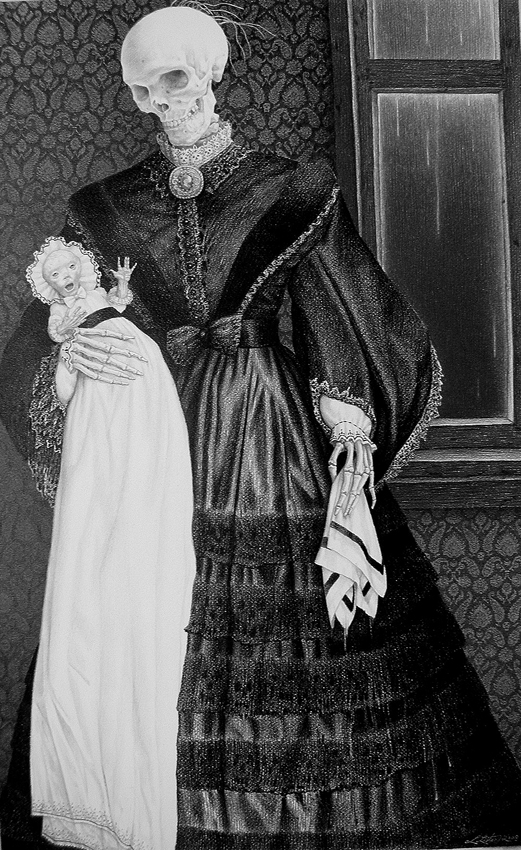
A skeleton woman in Victorian-era dress with her skeleton baby. Not a painting by Fernando Botero but an interesting example of macabre art.

A skeleton woman in Victorian-era dress with her skeleton baby. Not a painting by Fernando Botero but an interesting example of macabre art.
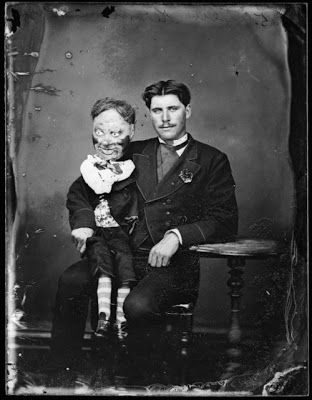
In this picture from around 1900, the handsome young man, beautifully dressed and proper, is holding on his lap a mysterious, grotesque-looking doll with a big head. What is going on here?
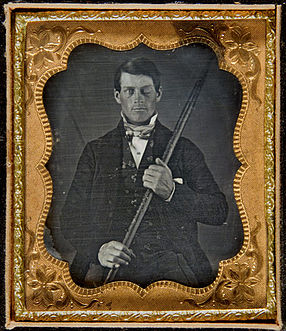
Phineas Gage ~ “The American Crowbar Case”
Nobody would have ever heard of Phineas Gage today if he hadn’t been the victim of a freakish and bizarre accident. In 1848, when he was 25 years old and working as a railroad construction foreman, an accident with explosives caused an iron rod to be driven through the left side of his face, behind the eye and out the top of his head. Much of his brain’s left frontal lobe was destroyed. He was conscious after the accident and was able to talk and move, but for days afterward he was gravely ill and expected to die. Although he was to improve over time, he was known to exhibit marked personality and behavioral changes, about which little is known, or the facts that are (believed to be) known are contradictory.
The case of Phineas Gage was referred to in the nineteenth century as “the American Crowbar Case.” It influenced discussion about the mind and the brain, particularly debate on central localization, and was possibly the first case to suggest that damage to specific parts of the brain affect personality. Phineas Gage would surely have been surprised to find himself a fixture in the study of neurology, psychology, and related disciplines, and mentioned frequently in books and academic papers.
Phineas Gage was able to carry on with his life for a number of years after his accident, minus his left eye, but finally he succumbed to the damage done to his brain in 1860 at the age of 37. He is buried in the Lone Mountain Cemetery in San Francisco. His skull was exhumed and studied after his death and is housed at the Warren Anatomical Museum in Boston.
Copyright © 2013 by Allen Kopp

Luke 6:45
~~~
The good person out of the good treasure of his heart produces good, and the evil person out of his evil treasure produces evil, for out of the abundance of the heart his mouth speaks.
~~~
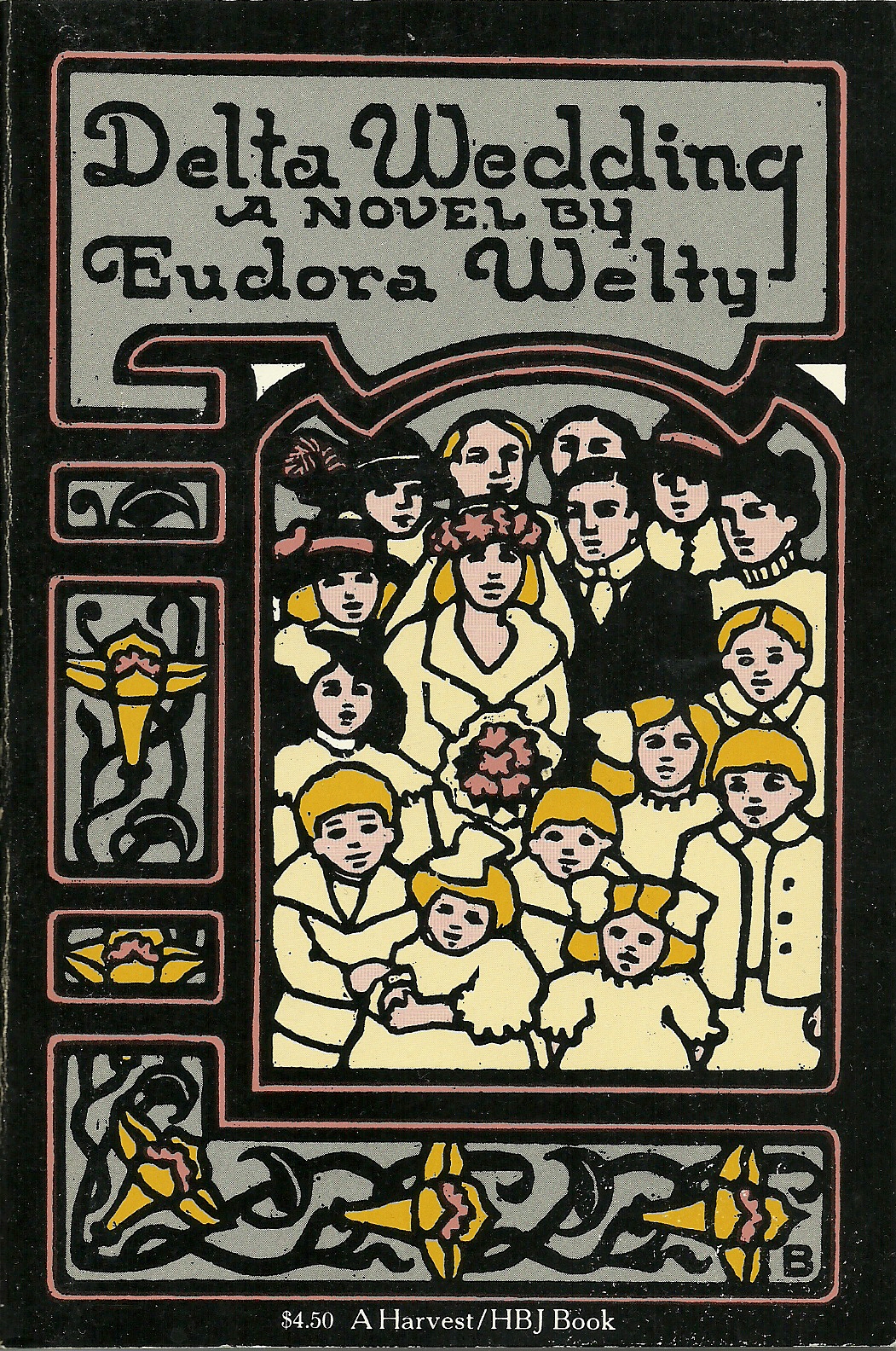
Delta Wedding by Eudora Welty ~ A Capsule Book Review by Allen Kopp
Famed American writer Eudora Welty is known for her many short stories, but she also wrote a handful of novels, including The Optimist’s Daughter, which won the Pulitzer Prize for Fiction in 1973. Her novel Delta Wedding, published in 1946, was written when her publisher suggested that she turn some of her short stories into a novel.
There isn’t much story or plot to Delta Wedding. The Fairchilds own a cotton plantation in the Mississippi Delta called Shellmounds. It’s September 1923 and their second-oldest daughter, seventeen-year-old Dabney, is marrying her father’s overseer, Troy Flavin. Troy is thirty-four years old and rough around the edges; most of the Fairchilds believe that, in marrying Troy, Dabney is marrying “beneath” herself.
Dabney Fairchild is “spoiled,” as are all the Fairchild children. The Fairchilds are moderately rich and have given all their children a good life, a life that hardly seems to have been touched by the real world. A Fairchild cousin who has recently lost her mother, Laura McRaven, has arrived on the Yellow Dog (the name they’ve given the train), for a visit. Much of what goes on at the Fairchilds is seen through Laura’s eyes.
In addition to all the Fairchild children (another one on the way), there are lots of aunts: widowed aunts (it is just a few years after World War I), spinster aunts who never married, great-aunts who remember the Civil War, a crazy aunt and a deaf aunt, etc. There are so many characters that, at times, it’s hard to keep everybody straight. Ellen and Battle are the parents of all the Fairchild children. Their children are Shelley, Dabney, Orrin, India, Little Battle, Bluet, and Ranny. Outspoken Aunt Tempe is Battle Fairchild’s sister. She has a husband, but he seems to be away on business all the time. Sisters Jim Allen and Primrose live together and never married. They live in a place called the Grove, which is owned by their brother, George. George is the most beloved of all the Fairchilds and has a rather troubled marriage to Robbie Reid. The Fairchilds look down on Robbie Reid and believe she isn’t good enough for George. Ellen, we learn at the end of the book, has a secret yearning for George but she will make sure nobody ever knows about it.
While Delta Wedding is about the events leading up to a wedding, it is, more than anything, a portrait of a large, close family in a simpler time. It’s all goodness and light, to the accompaniment of piano selections played endlessly by Mary Lamar Mackey. I’ll turn the ice cream freezer while you take the buggy into town and pick up the groceries. It’s so hot tonight I think I’ll sleep on the sleeping porch. When I wake up in the morning I’ll be as happy as I am now and there’ll be a wonderful breakfast waiting for me downstairs and I’ll be surrounded by all the people I love most in the world. They all love me, too, and, when it comes to my faults, they won’t talk about them or even acknowledge that I have any. What a family!
Copyright © 2013 by Allen Kopp
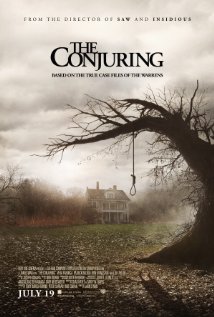
The Conjuring ~ A Capsule Movie Review by Allen Kopp
The Conjuring is a ghost story that, we are told at the beginning, is based on a true story. A working-class couple, Carolyn and Roger Perron (played by Lili Taylor and Ron Livingston), buy a large old house (built in the 1860s) in a rural part of Rhode Island. The house, it seems, has an ugly past that the Perrons don’t know about. They have five children, all girls (ranging in age from about five to about sixteen). They are a happy family but soon things start to happen in their new home that they find very unsettling. Their dog, afraid to enter the house from the beginning, puts up a fuss barking and dies mysteriously in the night. Doors open and close by themselves. Mrs. Perron experiences strange bruises on her body that can’t be explained. All the clocks in the house inexplicably stop at 3:07 a.m. every morning. Pictures the Perrons place on the wall of their children are flung down and broken for no apparent reason. Mr. Perron discovers a creepy cellar that had been boarded up for some reason. The children wake up in the night, believing someone is in the room with them. One of the children feels a definite tugging on her leg while she is sleeping but when she wakes up no one is there.
Mrs. Perron asks paranormal investigators Ed and Lorraine Warren (Patrick Wilson and Vera Farmiga) to come and take a look at the house to try to figure out what is going on. They have worked on many cases of this kind before and usually find a “haunting” to be caused by something that can easily be explained. Not this time, however. Lorraine Warren is a medium; as soon as she goes into the house, she feels it is occupied by a malevolent spirit.
The Warrens discover that the Perrons’ house was the scene of a very horrific occurrence many years earlier involving Satan worship, human sacrifice, suicide, and several unexplained deaths. The spirit that remains in the house wants to possess Mrs. Perron to get her to kill her children. The spirit’s aim is for the entire Perron family to die, which, apparently, will help it to gain favor with Satan. It will do no good for the Perrons to leave, they are told; the spirit has attached itself to them and will go wherever they go.
The Conjuring seems like pretty familiar territory. How many movies and TV shows have there been about an unsuspecting family moving into an interestingly creepy old house that harbors a secret from the past? It always starts out happily enough and then turns dark and edgy as the spirit begins to manifest itself to the innocent occupants of the house. Isn’t this kind of a cliché by now? I was expecting some twist at the end of The Conjuring, such as in Insidious, but there is no such twist. It’s well made and has some interesting characters, but offers up nothing new. It is still worth seeing, though, especially if you, like me, are a fan of haunted house movies.
Copyright © 2013 by Allen Kopp
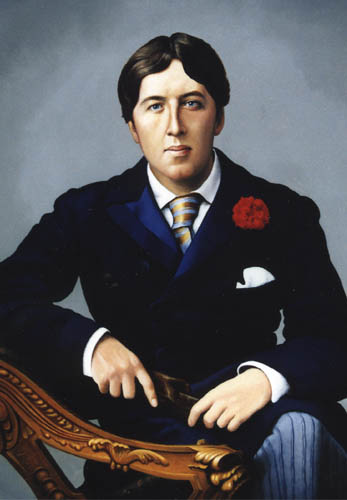
Irish playwright Oscar Wilde was born in 1856 and died in 1900, his health broken from time he spent in prison. He was a controversial figure in his time and was known (among other things) for his witty and profound epigrams.
~~~
“All of us are in the gutter but some of us are looking at the stars.”
~~~
“Ordinary riches can be stolen; real riches cannot. In your soul are infinitely precious things that cannot be taken from you.”
~~~
“Most people are other people. Their thoughts are someone else’s opinions, there lives a mimicry, their passions a quotation.”
~~~
“A man who does not think for himself does not think.”
~~~
“By giving us the opinions of the uneducated, journalism keeps us in touch with the ignorance of the community.”

Russian painter Wassily Kandinski was born in 1866 and died in 1944. He is credited with painting the first purely abstract works and was one of the most influential artists of the twentieth century. He started out as a lawyer and didn’t begin painting until the age of thirty. Having lived in Germany, he returned to Russia in 1914 after the start of World War I. He was unsympathetic to the official theories on art in Communist Moscow and returned to Germany in 1921. He taught at the Bauhaus school of art and architecture until the Nazis shut it down in 1933. He then moved to Paris, where he became a French citizen and lived until his death in 1944.
All I Have ~ A Short Story by Allen Kopp
It came to Mrs. Russ in a dream. She came awake and sat up in bed as if a light had been turned on inside her head. It was like this: she was all alone in the world and her life really hadn’t amounted to much. She had been grasping and selfish her entire life, rarely thinking of others. There might still be a chance for her to do some good, though. She would sell everything she had and give the money to the poor, just like it says in the Bible. She would start by deeding the house to the church. When she had her attorney, Vernon Bluet, on the phone, she told him what she planned to do.
“And where are you going to live after you’ve given your house away?” he asked.
“Don’t you see?” she said. “That’s the whole thing. I will be taken care of.”
“By whom?”
“You’re not a religious man, are you?”
“Religion and the law don’t mix.”
“Maybe they should.”
“It’s your house to do with as you please,” he said, “but I would just like to know why you want to give it away.”
“It seems the right thing to do.”
“You had a religious experience.”
“Of sorts.”
“The voice of God spoke to you and told you to sell all your possessions.”
“Well, when you put it that way, I suppose that is what happened.”
“After you’ve sold everything you have, then what?”
“I’ll give the money to the poor.”
“And then you’ll be one of the poor.”
“Maybe so, but I’ll be assured of a place in heaven.”
“Is that what you believe?”
“Yes. Don’t you?”
“I don’t know what I believe. When it comes to religious matters, I know nothing.”
“I like a man who admits he knows nothing,” she said as she stuck a cigarette in her holder and lit it.
“I knew your husband. He was a very practical man. I don’t think he would approve of what you want to do.”
“He isn’t in a position to either approve or disapprove, though, is he?”
“May I give you a word of advice?”
“Only if you must.”
“Wait one week.”
“That won’t make any difference. I’ve already made up my mind.”
“If you were my own mother,” he said hesitantly.
“Yes?”
“If you were my mother I’d advise you to see a doctor to make sure you haven’t had a stroke that has impaired your judgment.”
She laughed as if he had made a joke. “I can assure you there’s nothing the matter with me,” she said. “I’ve never felt better.”
“Will you agree to have a thorough physical examination before we proceed with this? As a personal favor to me?”
“I just had one,” she said, “not three months ago.”
“Have another one.”
“I want you to start the ball rolling to deed my house over to the church. When that’s taken care of, I’ll decide what to do with everything else.”
She emptied out the closets upstairs, unearthing some garments she hadn’t seen in over thirty years. She threw away the things that she thought nobody would want and boxed up the rest to give to charity. She kept out one change of clothes for herself, a pair of shoes, and a few personal items.
A man who dealt in antiques and second-hand furniture was interested in buying most of the furniture, especially the dining room table, chairs, and sideboard that were over a hundred years old and the beds, dressers and chest of drawers in two of the bedrooms upstairs. (He knew someone else who would buy all the rest of the stuff, including the cast-off furniture in the attic and the old piano that hadn’t been played in fifty years.) When a price was agreed upon, she told him to send the check to the church as a charitable donation for the poor with her name attached, which he agreed to do before his men came to pick up the stuff.
The auction people made an inventory of everything else in the house, which would all be sold in one day at public auction. They arranged all the most valuable items in the living room and dining room: family heirlooms, an antique violin that belonged to her uncle, china and silver, her husband’s book and music collections, gun and coin collections, paintings, artifacts, bric-a-brac, and objets d’art. They took pictures to be used in flyers and newspaper advertising.
It rained the day of the auction, but that didn’t keep people from coming. At first there were about thirty, which increased to fifty, then eighty and then more than a hundred. People were allowed to come into the house and look over the items to be auctioned before the bidding began.
From the beginning the auction was a success. Items sold briskly and brought handsome prices. Mrs. Russ stood to the side with a smile on her face, her hands folded in front of her. She didn’t know most of the people but recognized a few of them from the neighborhood. The minister from her church, the Reverend Frankie Finkle, was in attendance and purchased an antique crystal vase and a table lamp.
When nearly all the items had been sold and the sale was coming to an end, Vernon Bluet, her attorney, stopped by.
“The sale has exceeded our expectations,” she said to him happily as he came through the door.
“There isn’t anything you want to keep for yourself?” he asked, looking around.
“Not a thing,” she said. “I won’t need anything where I’m going.”
“And where is that?” he asked. “Heaven?”
She didn’t answer but only smiled her mysterious little smile.
“I just hope you know what you’re doing and don’t come to regret it,” he said.
She arranged to meet with him the next day at three o’clock to sign the papers to complete the transfer of the house.
After the auction was over and all the people had left, she walked through the house she had lived in for over fifty years, marveling at how different the rooms seemed after they had been stripped of all that had given them character. It was just four walls and nothing more. It meant nothing to her.
That night she slept on a pallet on the floor in her bedroom, reduced to the bare necessities. It would be the last night she spent in the house. Now it belonged to somebody else.
On her way to the attorney’s office the next day, she stopped at the bank to get the deeds to her house and car from her safety deposit box. When she arrived at his office, he was waiting for her. He greeted her warmly and showed her to a comfortable chair.
“Any regrets?” he asked her.
“Not one.”
He showed her where she needed to sign and in a matter of a few minutes the transaction was completed. She signed her car over to him, as well as the house, and gave him all her keys. Before she left, he insisted that she take a glass of brandy with him, since it was unlikely they would ever meet again.
“What now?” he asked.
“I feel wonderful,” she said. “Free of encumbrances for the first time in my life.”
“It isn’t practical, though, to feel that way,” he said.
“Practical isn’t always the same to everybody,” she said.
“You’re going to need at least some money. Cab fare?”
“I don’t need it,” she said. “I’ll walk.”
“As a favor to me, take this.” He opened his desk drawer and counted out five one-hundred dollar bills and handed them to her.
“I don’t want any money,” she said firmly.
“Indulge me.”
She took the money with a shrug and stuffed it into her purse and stood up. They shook hands and then she was gone.
She walked five blocks until she came to a bus stop. She waited and when a bus came along she boarded it and took a seat beside the window. She didn’t know where the bus was going but it didn’t matter. She still believed all would be revealed. All she had to do was go where she was directed.
The other people on the bus seemed dazed and lifeless, as if they had just come from waging battle. The bus crept onward through traffic, stopping frequently to discharge or take on passengers. Soon they entered a part of the city Mrs. Russ had never seen before or hardly knew existed. On both sides of the streets were dilapidated tenement buildings, pool halls and taverns. Some of the buildings looked as if their insides had been bombed out.
At an intersection, a car on the cross street failed to stop at the stoplight and rammed into the side of the bus. The bus driver dismounted and, waving his arms, engaged in furious conversation with the driver of the car, who seemed to be drunk. The passengers came alive, standing up to see what was happening and chattering excitedly.
The car hitting the bus caused Mrs. Russ to strike her head on the metal frame that went around the window. She covered her eyes, experienced a moment of dizziness, and when she took her hands away she didn’t know where she was or why she was on a bus. She never rode on buses!
The passengers filed off the bus to wait for another bus to come along and pick them up, which might take as long as a half-hour. While they were standing in a bunch on the sidewalk, Mrs. Russ disengaged herself from the others and walked away.
She walked three or four blocks, not knowing where she was going but knowing only that she wanted to go home. Her feet hurt, she was tired, and she had a headache. The worst part, though, was not knowing where she was going or why. There was a gap in her consciousness. Something happened but she couldn’t quite fit the pieces together. She tried to remember if she had been sick or had an operation.
She walked until she believed she couldn’t walk any farther. She believed for a while that someone was following her but when she turned around and looked behind her, no one was there. A man standing in a doorway looked at her; he smiled in what she thought was a suggestive manner and flicked cigarette ashes at her. She clutched her purse to her chest and walked on.
When she came to a hotel on a corner, she went into the lobby. It seemed cool and quiet, somehow inviting, after the street. The desk clerk saw her come in and put down the newspaper he was reading. He was bored and hoping for a little diversion.
“May I help you?” he asked.
“This is a hotel?”
“That’s what the sign says.”
“I want a room for the night.”
“You can have anything you want as long as you pay for it in advance.”
She gave him a confused look and opened her purse, seeing the wad of bills just inside that she didn’t know she had. She took them out and, after counting them, handed him a hundred-dollar bill.
“I don’t have change for that,” he said. “I’ll have to owe you.”
She nodded her head. He gave her a key and pointed up the stairs.
“Up one flight and down the hall on your right.”
She took the key gratefully and found the room and let herself in. After she had locked the door behind her, she took off her shoes, sat down and took a few deep breaths. She felt better now that she was in a room by herself, off her feet, and with nobody looking at her. After she sat quietly for a few minutes, she would be all right again.
She nodded off and woke up to a siren on the street outside the hotel. She jumped to her feet and ran to the window. It was raining now and nearly dark. And in the drops of water on the pane of glass before her eyes were all the missing pieces, now found.
Copyright © 2013 by Allen Kopp

The Lone Ranger ~ A Capsule Movie Review by Allen Kopp
The Lone Ranger bears little resemblance to the 1950s TV series of the same name, except for The William Tell Overture. It has Armie Hammer (who played the upper-crust Winklevoss twins in The Social Network and J. Edgar Hoover’s gay love interest, Clyde Tolson, in J. Edgar) as John Reid, the Lone Ranger, and Johnny Depp as the laconic Comanche, Tonto, who, when he speaks, usually says something funny.
John Reid is a lawyer fresh from the East who goes West in the 1860s, after the Civil War. His brother, Dan, is a Texas Ranger and the only likely hero in the family. John Reid’s fate becomes entwined with the repulsive outlaw Butch Cavendish, who, on his way by train to be hanged, is freed by his gang of outlaws. Dan deputizes John Reid as a Texas Ranger. Dan’s wife, Rebecca, has always been in love with John, even though she married Dan. When Dan is killed in an ambush with Butch Cavendish’s gang, John Reid takes up the fight, with Tonto to aid him. We learn along the way that Tonto’s past is a sad one. He did something stupid and feckless when he was younger that resulted in his entire village being slaughtered. He has a lot to atone for. That’s why he’s so odd!
A subplot involves a corrupt railroad tycoon named Cole (played by Tom Wilkinson, the man who seemingly can play anything) who has plans to control, not only all the railroads in the West, but also all the silver. Cole has a hankerin’ for Rebecca. We discover that he and Butch Cavendish are brothers. What a nasty pair they are!
The Lone Ranger has plenty to recommend it, including lots of action on trains and some beautiful Western scenery in and around Monument Valley. Helena Bonham Carter has a funny bit as the madam of a brothel with a Western drawl and an artificial leg made out of ivory, with a built-in gun that she shoots out the bottom of her foot. (She has Butch Cavendish to thank for the loss of her leg.) Don’t try to pay too much attention to what is going on, because the story is muddled at times. Just empty your mind (for some that will be easy) and enjoy the ride. It is, after all, a summer movie. Thinking isn’t allowed in the summer, remember?
In the end, the white-hatted Lone Ranger (on his white horse, Silver) and Tonto ride off together, a couple of misfits. They complement each other because they are so different…or are they? One thing is certain: if this movie makes enough money, they are sure to be back in a sequel.
Copyright © 2013 by Allen Kopp

