Trouble
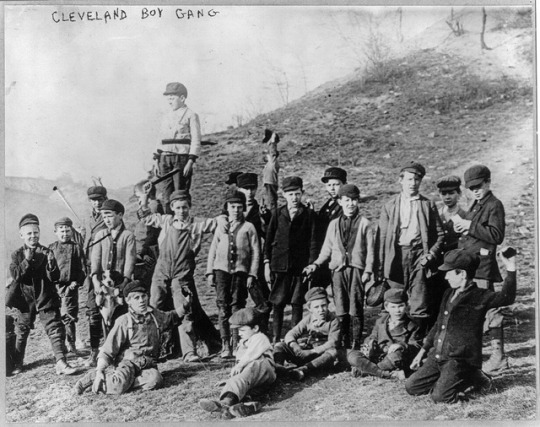
~ Cleveland Boy Gang, 1910 ~
Until We Meet Again
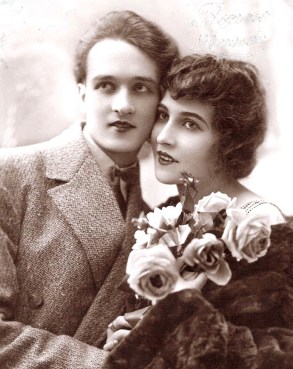
Until We Meet Again ~ A Short Story by Allen Kopp
(Published in The Corvus Review.)
During the years that Hulga Van Sipes took care of Isadore, her invalid husband, he wasn’t able to speak or barely to blink his eyes. She did everything for him: got him up in the morning and put him to bed at night, bathed him, dressed and undressed him, lifted him in and out of his wheelchair (he had always been a small man), cooked his food and fed it to him (all he had to do was swallow), and talked to him as if he might answer. She read to him, sang to him in her wheezing soprano, and sometimes she put a little rouge and lipstick on him to make him seem more alive.
When Isadore finally died in his sleep, Hulga had his body cremated without fanfare. She put his ashes in a large-sized Hellman’s mayonnaise jar and kept the jar on a shelf of the curio cabinet next to the TV where she could always see it.
Hulga thought she could go on with her life (what was left of it), but she found it was just too bleak and lonely—empty, so empty—without Isadore. She had been married to him for fifty-two years and most of them were good, fine years. She wasn’t able to erase all those years and go on her merry way as if nothing had happened.
At a store called Under the Sun on Skid Row Boulevard that sold just about anything, she bought a full-sized male mannequin (also known as a doll) with fully articulated arms and legs. She took the mannequin home with her in a taxi.
Of course the mannequin looked nothing at all like Isadore. Everything about him was shiny. He had shiny black hair (complete with pompadour) painted on his head, shiny black eyes (sparkling, like the glass eyes of a stuffed mountain lion), and a shiny skin with red spots on both cheeks. His shiny lips were slightly parted, showing tiny, perfect teeth which, of course, were shiny.
At first Hulga was put off by the difference between the mannequin and Isadore, but after a few days she came to accept the difference and appreciate it. The mannequin was a young man and at times she was able to think of herself as a young woman worthy of him (even if the mirror told her otherwise). And, even though he was inanimate, he was for the most part no more inanimate than Isadore had been.
Hulga Van Sipes was happy again or, if not happy, she felt useful and not quite so lonely. At mealtimes, she propped the mannequin up at the table and put little dabs of food on his plate which, of course, she ended up eating herself or putting down the garbage disposal. She was delighted that her grocery bills were smaller because the mannequin really didn’t eat all that much.
As she chewed her food, with the radio playing lively dance music in the background, she looked over at the mannequin and smiled and he always smiled back. He was never grumpy or out of sorts. He never dribbled food out of his mouth down his front. He was the perfect dining-table companion. How fortunate she was to have found him!
She left him in his place at the table while she washed the dishes, and when she was finished she wheeled him into the living room and lifted him onto the couch, propped his feet up and covered his legs with an afghan. (He had always been susceptible to chill, especially in the lower extremities.)
They both liked the same programs on TV. If she laughed while watching, she looked at him to see if he was also laughing. If she cried, he also cried, and if she became bored with a program and wanted to change the channels, he was always compliant.
After the weather report, she switched off the TV, took the mannequin into the bedroom and got him into his pajamas and into bed. She pulled the covers up under his chin, kissed him on the forehead and turned off the light. She always left his door open a little bit so she would hear him if he stirred.
After several months of unchanging days, the line between Isadore and the mannequin became blurred for Hulga and then disappeared altogether. The mannequin became no longer a substitute for Isadore but Isadore himself. Hulga forgot that Isadore had died (she put his ashes in the basement where she wouldn’t have to look at them). He had been with her all the time. It was a leap that she made in her mind as easily as breathing.
In October the days were warm and the sky as blue as it had been all year. Hulga wanted Isadore to have some time outdoors before winter set in again. She dressed him warmly and took him for a stroll in the park where he might observe the beauty of nature. The little outing went so well, and they both enjoyed being out of the house so much, that she took him again the next day and then the day after that.
On the third day of Hulga pushing Isadore through the park, a woman came and stood in front of the wheelchair and Hulga was forced to stop. She thought the woman was going to ask her for change because she was that kind of woman, a bum or a homeless person.
“What’s the matter with you?” the woman asked.
“What?” Hulga asked.
“What are you, deaf? I said: What. Is. Wrong. With. You?”
“Why, nothing’s wrong with me,” Hulga said, thinking she was being indulged in a joke of some kind.
“Are you an escapee?”
“Am I a what?”
“You are such an asshole!” the woman said. She was very short and fat, wore a filthy knit cap on her head and a man’s wool overcoat, even though the day was warm. She brandished a lighted cigarette like a knife.
“What was that you called me?” Hulga said.
“Every day for the last three days I’ve seen you pushing that dummy around in that chair.”
“Dummy?” Hulga asked.
“Yeah! Him!” the woman said, pointing at Isadore.
Looking down at Isadore to see if the woman was upsetting him, Hulga said, “He’s my husband.”
“Your husband!” the woman said with a hoot of laughter. “One of us is nuts and I don’t think it’s me!”
“If you’ll just let me pass, miss.”
“It’s time you woke up and smelled the roses, dearie!” the woman said. “That dummy ain’t nobody’s husband!”
A small group of people, sensing that something interesting was happening, had gathered around to listen.
“We’ve been married for fifty-two years,” Hulga said. “Not that I think it’s any of your business.”
“Well, I hope you’re married for another fifty-two and I hope he don’t give you a bit of trouble, neither.”
“That’s silly,” Hulga said.
The people who had gathered around laughed and the woman with the cigarette bowed like a courtier and went away as quickly as she had appeared.
Hulga felt the people looking at her, laughing at her the way they would laugh at a freak. She wanted to get herself and Isadore away as quickly as she could, back to the safety and security of their own home. How ugly the world was! How cruel people could be!
Feeling shaken, she stopped the chair and sat down on a bench to rest before going home. The air had suddenly grown colder and the sun, shining so brightly just a little while ago, had receded behind gray clouds.
“It was a mistake to bring Isadore out into the world,” she said. “He doesn’t need this any more than I do.”
She pushed her fingers lightly into Isadore’s upper arm and he tilted crazily against the arm of the wheelchair in such a way that only a crazy person would think he was a real man.
“You aren’t real, are you?” she said. “I’ve only been fooling myself all along.”
She began to be afraid somebody might report her and they—the bureau of crazy people, maybe—would come and take her out of her home and make her stay in a mental home against her will. They might even shoot volts of electricity into her head, as she had witnessed on TV. The thought made her feel frightened and helpless.
She dumped the mannequin (not really her Isadore, after all) out of the wheelchair under a tree and hurried away before she changed her mind.
On her way out of the park, an old man shuffled toward her.
“Can you spare a dollar?” he asked.
She looked at him and smiled. “Isadore?” she said.
“Name’s Boo-Boo,” he said. “At least that’s what my friends call me.”
“Would you like to come home with me?”
She touched the sleeve of the jacket, slick with dirt. He pulled back as if uncertain what she was might do.
“Gunsmoke is on tonight,” she said. “It’s your favorite show.”
“What time is it?” he asked.
“It starts at eight o’clock,” she said.
“You really want me to come home with you?”
“Yes.”
“What’s the catch?”
“No catch.”
“Could you fix me some bacon and eggs?”
“Sure.”
“Got any beer?”
“You never drank before.”
“Could I have a bath and some clean socks?”
“Anything you want.”
She pointed to the wheelchair. He sat in it and twisted his head around and smiled up at her.
“This is all right!” he said. “Very kind of you, I’m sure. It’s only fair to warn you, though: I ain’t much of a lover.”
She patted him reassuringly on the shoulder and began pushing toward home. She thought how light he was, how easy to push, and how much she had missed him the whole time he had been away.
Copyright © 2017 by Allen Kopp
Demonic Nun
The Demonic Nun, Valak, in the movie The Conjuring 2. I think I know her.

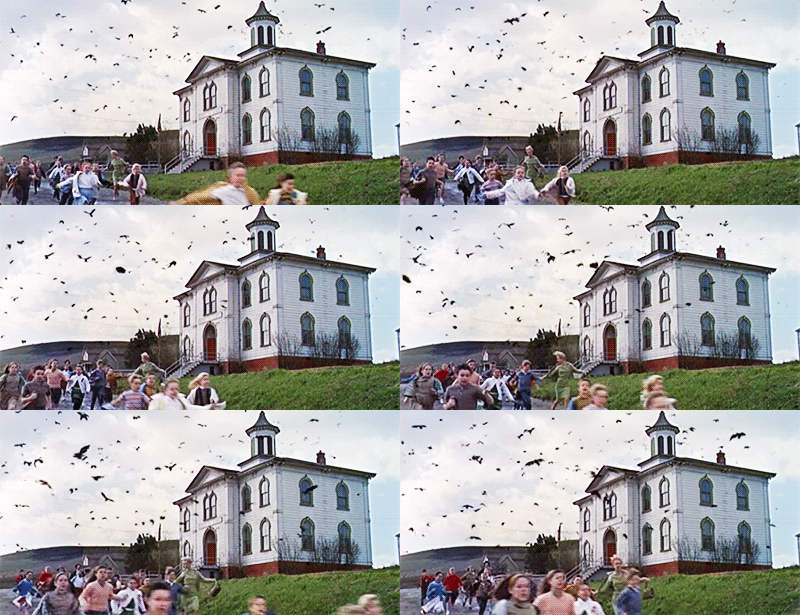
The Birds (1963)
Children in Peril in Alfred Hitchcock’s 1963 classic, The Birds.

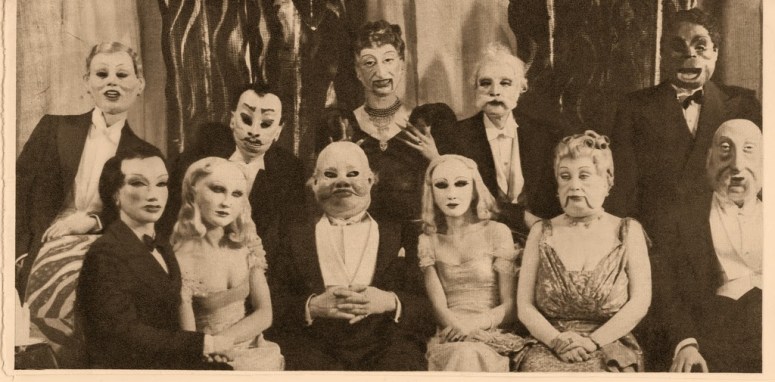
Masquerade
I love this picture. It’s a group of people in formal attire wearing masks in, let us say, the 1930s. It could very easily have been at a country club or in a wealthy person’s home. Each person seems to be wearing a carefully selected mask appropriate for his or her age and personality. It must have been a fun party.