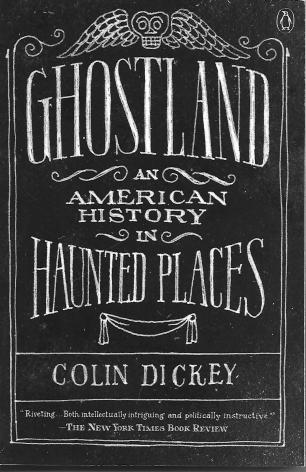
Ghostland: An American History in Haunted Places ~ A Capsule Book Review by Allen Kopp
Ghostland: An American History in Haunted Places by Colin Dickey is not about ghosts or ghost stories but is instead about the places (houses, prisons, brothels, mental hospitals, parks, cemeteries, etc.) that have, for one reason or another, come to be thought of as haunted. This book doesn’t espouse a belief in ghosts or hauntings or a disbelief in them. When you read the book, you decide for yourself.
Most ghost stories are folklore, “urban legend,” or tall tales. They start with a grain of truth and go on from there to fantastic make-believe. But, no matter how implausible the stories are, people are willing to believe them without question because they affirm a belief that there is, indeed, life after death. When you hear a ghost story that begins with a tragedy, an unresolved and unavenged murder, it’s satisfying on a psychological level because it makes you feel good that such a terrible thing has happened to somebody else and not to you and, more importantly, it makes you glad you’re alive.
Ghost hunting has grown into an industry, popularized in part by “reality” shows on TV. People believe what they want to believe. If a person on TV is telling you convincingly that a house, a commercial building, park, or cemetery is haunted, you believe it because it’s so easy to believe. Why shouldn’t you believe? When somebody takes the time and effort to dig deeper into a ghost story, however, the truth is often uncovered, and the truth is not nearly as interesting or as much fun as the tall tale.
Sometimes a house or its owner need only be eccentric or unusual. Sarah Winchester (1840-1922) is a perfect example. As heir to the Winchester Repeating Arms Company, she was fabulously wealthy. The Winchester repeating rifle was the gun that “won the West.” Sarah bought a house in San Jose, California, and began adding on to it and, once she got started, she added and added and added. The house was never finished but, by the time she died in 1922, she had 160 rooms, staircases that went nowhere, and other features that, over time, marked the house as “haunted”—haunted supposedly by all the people who were killed by the Winchester rifle. When people think of American haunted houses, the Winchester house in San Jose tops the list. Serious scientific investigation, however, has yet to uncover credible evidence of a single ghost at the Winchester house. People believe what they want to believe.
The house that inspired Nathaniel Hawthorne to write his 1851 gothic novel, The House of the Seven Gables, is in Salem, Massachusetts. The house still stands and is a tourist attraction. There’s no absolute proof that the house is haunted, although it very well could be if you go entirely on the way it looks. Inside the house is a “secret staircase” on which people claim to have experienced ghostly emanations. Nobody has ever seen an actual ghost in the house, though. Hawthorne didn’t think the staircase was important enough to include in his novel.
The Lemp family of St. Louis became wealthy from the manufacture of Falstaff beer in the 1890s. They had their brewing plant, and their residence, in South St. Louis. Underneath their property were vast natural caves in which they stored the beer before electronic refrigeration became common. As wealthy and successful as the Lemps were, they were also plagued with mental illness, which today might be diagnosed as bipolar disorder. Several of the Lemps committed suicide. People believe the ghosts of the Lemps haunt the house, which is now a restaurant and a bed-and-breakfast. Employees at the restaurant claim to have seen spirits, or at least felt them. Teams of “ghost hunters” regularly inhabit the premises, looking for evidence of spirits that nobody else has been able to find. The vast brewery is also still standing but is mostly unused, except as a haunted Halloween attraction in October.
So, in addition to the Winchester house in San Jose, the House of the Seven Gables in Salem, Massachusetts, and the Lemp house in St. Louis, Ghostland: An American History in Haunted Places takes us to a brothel in Nevada, an abandoned mental hospital in Maine, a plantation in Louisiana, a park in Portland, Oregon, that’s haunted by the ghost of a murdered fifteen-year-old girl, a house in New Orleans where slaves were mistreated, a prison in West Virginia where prisoners were starved and neglected, and from there to creepy Los Angeles hotels, where deceased stars still cavort, Civil War battlefields where many thousands of men died and on to Detroit, the once-thriving industrial hub of the U.S. that has its share of tragic ghost stories, most of them fabricated but still believed by people who are willing to believe what they choose to believe.
If you believe in ghosts, Ghostland: An American History in Haunted Places won’t get you to not believe in them, but the one thing the book does is to show that most ghost stories can be easily explained and debunked. The thing is, though, the truth is not nearly as compelling as the legend or the tall tale that, over time, has come to be accepted as the truth.
Copyright © 2018 by Allen Kopp