

Lord of the Flies ~ A Capsule Book Review
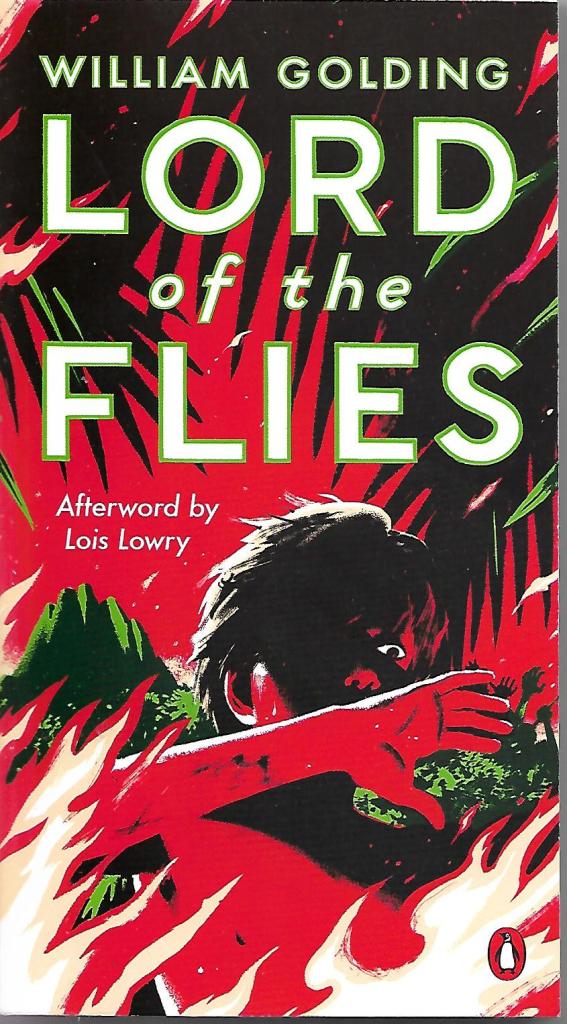
Lord of the Flies ~ A Capsule Book Review by Allen Kopp
Author William Golding was born in Cornwall, England, in 1911, and died in 1993. His most famous and enduring work is his 1954 novel, Lord of the Flies. In it, a group of about twenty British schoolboys, ranging in age from six to fourteen, crash-lands on an uninhabited and unnamed island in the Pacific. We learn nothing of where they come from, where they’re going, or of the crash that landed them on the island. Their world begins and ends on the island.
The first thing the boys must do when they find themselves alone (no adults) on the island is to figure out how to survive. There’s plenty of fruit (we never know what kind of fruit it is) on the island, so they aren’t going to starve to death. There are also wild pigs but they’re very difficult to catch and kill. The problem of food and fresh water solved, they build crude shelters to sleep in. They find a large shell (conch) which they blow into to call meetings. The shell becomes a symbol for law and order because, in the meetings, only the person who holds the conch can speak.
Their only hope of being rescued is to keep a smoky signal fire burning all the time, which they believe will be seen by passing ships. They can have fun on the island, but their top priority needs to be the signal fire, according to their elected leader, Ralph. He is the most sensible boy on the island and the one most likely to maintain a semblance of “civilization.” Ralph’s chief ally is Piggy, a chubby boy who uses bad English and is afraid of almost everything. The boys have no matches, of course, so they cleverly use Piggy’s glasses to kindle flames from the rays of the sun.
Months go by. The longer the boys remain on the island, the less chance they have of surviving their ordeal. A boy named Jack challenges Ralph’s authority as leader. He and his group of followers gradually break off from the group as a whole and begin doing things their own way, which is Jack’s way. They become less and less civilized and more like savages. So now we have two warring factions, Ralph’s small group (representing rules and a sensible approach to survival) and Jack’s group (chaos and savagery). They become the world in microcosm.
Lord of the Flies is an influential book that has influenced and inspired many writers—and readers—over the many years since it was first published. If you’ve never read it and you don’t know how it ends, you might be surprised and gratified (or disappointed) by its deus ex machina conclusion.
Copyright © 2019 by Allen Kopp



Reflections in a Golden Eye ~ A Capsule Book Review
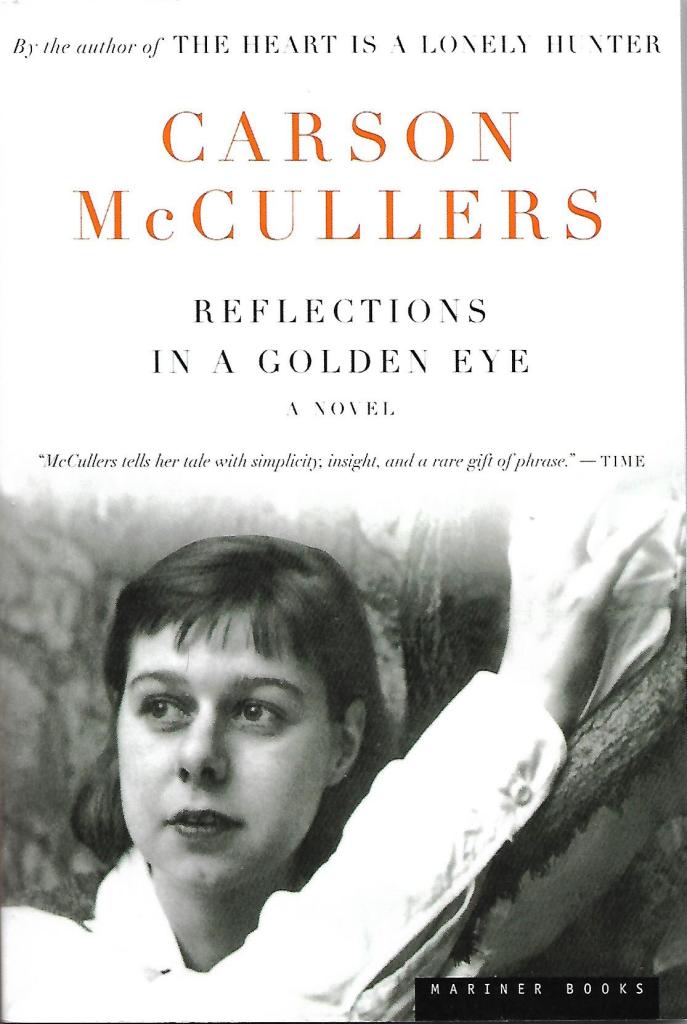
Reflections in a Golden Eye ~ A Capsule Book Review by Allen Kopp
Carson McCullers was an American writer who lived from 1917 to 1967. She published her first novel, The Heart is a Lonely Hunter, when she was only in her early twenties. It was a literary sensation that established her as an important American writer and one of the most gifted writers of her generation. Her second novel, Reflections in a Golden Eye, was published in 1941, when she was twenty-four. While it was not the critical and commercial success of The Heart is a Lonely Hunter, it is still a fascinating and highly readable book.
Reflections in a Golden Eye is set at a sleepy peacetime army base in Georgia in, let us say, the late 1930s. The story, the plot, is centered around five characters: Leonora Penderton is the wife of an officer. She is free-spirited, rather course and vulgar, attractive and not very smart. She is married to Captain Weldon Penderton and it is not a happy marriage. He is bitter, withdrawn, suspicious, and a closeted homosexual. He and Leonora have separate bedrooms. Major Morris Langdon is much more temperamentally suited to Leonora Penderton than her husband is. He drinks to excess, is jovial, likes a good time, and is having an affair with Leonora. Major Langdon’s wife is Alison, a nervous, sickly, neurotic woman who despises her husband and depends a great deal on her feminine Filipino houseboy, Anacleto, to make life palatable for her. The fifth character is private Ellgee Williams; he is a country boy who doesn’t know much of the world before enlisting in the U.S. army. He has never been around women much, being raised by a woman-hating father, and becomes obsessed (silently and secretly) with Leonora when he glimpses her naked. He takes to breaking into her house at night and, without making a sound, stands in her bedroom and watches her sleep.
Private Williams tends the stables on the base and, since Captain Penderton rides almost every day, the two of them come into contact frequently. Captain Penderton develops an infatuation (love and same-sex attraction mixed in with an unreasoning hatred) for private Williams, not knowing or not caring that private Williams is infatuated with his wife, Leonora. Of course, private Williams is only vaguely aware (or not aware at all) of Captain Penderton’s sexual longing for him. It might be that he is too unsophisticated to know of those things or to understand, even if he does know.
Reflections in a Golden Eye moves along almost in the way of a Greek tragedy toward its inevitable tragic conclusion. It’s a simple story with clear-cut themes of lust, longing, and isolation. All the characters are flawed in some way, misfits in some fundamental way. Happiness and satisfaction are qualities that don’t exist in this world. It’s a world of superficial, self-indulgent people, destructive to themselves and to their world. Keep those before-dinner cocktails coming and also the after-dinner ones. We must keep drinking to give ourselves the impression we’re happy.
Copyright © 2019 by Allen Kopp

 Literary Fictions