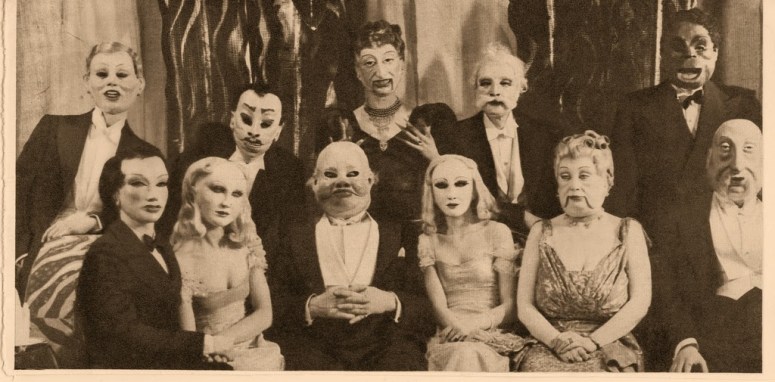


You May Know Him as a Ghoul ~ A Short Story
You May Know Him as a Ghoul
~ A Short Story by Allen Kopp ~
(This story has been published in The Literary Hatchet.)
Blaise DeBeulah awoke to the rising of the sun and switched on the radio beside his bed. Dark Eyes by the Vincent Lopez Orchestra was playing. The beautiful melody brought a smile to his face, making him forget for the moment that had to get out of bed, get dressed, and face another distasteful day. He was just drifting off to a warm, intoxicating dreamland awash in saxophones and violins, when Bertha DeBeulah came bursting into the room.
“Get out of that bed, you lazy slug!” she commanded. “Do you think the world owes you a life of comfort and ease?”
“No, mother. The world doesn’t owe me anything. I’m getting up now.”
“Your brothers and sisters are hungry! They want fresh meat! Now!”
“I’m doing the best I can, mother. I’m not feeling very well.”
“Well, isn’t that just too bad?
“I was out last night until dawn. Fresh meat isn’t so easy to come by anymore.”
“I don’t want to hear any of your feeble excuses! And when I say fresh meat, I mean fresh! The longer a body has been buried, the worse it tastes! After a body has been dead three or four days, the embalming fluid ruins the taste! The ones you’ve been dragging home have been anything but fresh!”
“I know mother. I’m doing the best I can. I hang around the cemetery all day long, waiting for a funeral, but they have been few and far between.”
“I told you I don’t want to hear any lame excuses! If there haven’t been any funerals, you have to do the killing yourself! How about some nice, juicy, muscular gravediggers?”
“Would those be for you to eat, or for the brothers and sisters, mother?”
“Don’t you get fresh with me! I’ll tell your papa, Benedictus DeBeulah, you smarted out to me and he’ll knock your block off!”
“Yes, I know, mother. I know. He has knocked my block off so many times that my head no longer sits straight on my shoulders.”
“Well, it serves you right! And if you don’t bring home some fresh meat—and I mean fresh—I’ll let the brothers and sisters eat you!”
“I’m not exactly fresh, mother. I’m two hundred and thirty-seven years old.”
“You don’t have to tell me how old you are, Mr. Smarty Britches! I brought you into this world and I can take you out of it any time I choose!”
“Yes, mother, I know. You’d be doing me a blessing.”
“What was that?”
“I said I’ll be on my way as soon as I find my shoes.”
Though he was two hundred and thirty-seven years old, Blaise DeBeulah could pass for nineteen whenever he wanted to. He wrapped himself in a long trench coat and a scarf that, thanks to the icy wind, allowed him to cover the lower part of his face. He topped off the invisible man look with a broad-brimmed hat worn low over the eyes. Dressed in this way, he could pass for anybody, anywhere, without attracting any particular kind of attention.
To get to the cemetery, he had to pass through downtown. Since it was a college town, there were always lots of interesting people around his own age (not two hundred and thirty-seven, but nineteen), and he enjoyed seeing them and walking among them. He might even pass for one of them: a tall, well-dressed, rather stately young man, dignified and poised, aloof and intriguing.
He liked to linger outside a malt shop where people his age gathered. It had a red-and-white awning and exuded attractive smells such as cinnamon, chocolate and peppermint. The thing that attracted him most, though, was the music that was piped out to the sidewalk: the romantic dance bands and orchestras, the velvet-voiced crooners, the bouncy girl singers, the snappy dance numbers. It was like nothing he had heard before in his two hundred and thirty-seven years of a ghoul’s life.
He longed to go inside the malt shop, to sit at the counter and order a drink, maybe strike up a conversation with someone and end up slow-dancing on the dance floor with everyone watching. It was not going to happen, though. He had a ghoul’s hands and a ghoul’s legs. When people saw his face, they would know it was a ghoul’s face and they would run screaming from the place in terror. He would be more embarrassed than he could possibly imagine. Somebody would call the police and they would come and take him away and lock him up. He couldn’t let that happen.
With a lump of regret in his throat, he passed on to the cemetery, the music sounding in his head long after he could still hear it.
One small, poor-looking funeral was in progress on a hillside. A dozen or so black-garbed mourners gathered around an open grave. A priest said a prayer and when he was finished the mourners dispersed and a man standing by with a shovel began filling in the grave.
Blaise moved on. He wasn’t going to dig in the dirt with his hands just to get a freshly buried body. It would taste like embalming fluid, anyway, he was sure, and the brothers and sisters would gag. They could always tell a body that had been embalmed from one that hadn’t. He’d have to look elsewhere.
He knew that if he didn’t find a really fresh corpse he’d have to kill a man or a woman, or maybe a child, on his own. He hated the killing; he didn’t even like killing animals. He’d almost rather die himself.
He came to another funeral, a much larger one this time. A prominent man, a person of some fame, had died. There were maybe two hundred mourners on their feet around a dark-wood casket that gleamed in the sun. Some of the mourners cried and some smiled and laughed as if they were at a cocktail party. A holy man gestured over the casket with his arms and when the service was finished the people let out a gasp of relief like children released from school. They moved away quickly, some of them lighting cigarettes, toward cars dispersed along a scenic hillside.
Blaise stood behind a tree and watched. After a few minutes, all the mourners were gone and the casket was left unattended in the sun. The gravediggers hadn’t appeared yet to finish their job. The funeral director was nowhere to be seen; he was off someplace, probably having a cigarette or a nip from a bottle.
Without thinking what he was doing, Blaise approached the casket and lifted the lid. The deceased was an old man with a mottled face and a bald head. He appeared to have been ninety years old or older.
He scooped the old man up in his arms and, balancing the body against his right shoulder, managed to reclose the lid with his left hand. If all went well, the gravediggers would come and bury the empty casket, never suspecting that the body inside had been purloined.
He couldn’t exactly walk back through the streets of the town carrying a dead body, so he took it to the designated hiding place, a scooped-out trench along the north wall, hidden behind some bushes. He covered the body with dead leaves as an extra precaution and when he was finished he left the cemetery.
From a payphone downtown he called Daedalus, Bertha DeBeulah’s factotum, with his usual message in code: Some lovely peaches are to be had at the north wall. Daedalus would go and collect the body as soon as it was safe, take it back to the house and drop it down the meat chute in the kitchen wall, to the brothers and sisters who dwelt below.
Blaise walked the rest of the way home, then, relieved that he had delivered a body without having to kill it on his own and relieved, also, that he wouldn’t have another confrontation with Bertha DeBeulah at least for a day or two. Maybe something cataclysmic would happen in the meantime, such as a meteor colliding with earth.
He spent the rest of the day locked in his room, catching up on his sleep and dreaming about what his life might have been like if he had been born into a real family instead of a family of ghouls. He might have been one of those sleek college boys popping up soda pop rickeys to his heart’s delight. He might have driven a car and carried books under his arm.
About nine o’clock that night, he was listening to music on the radio when he heard a terrible commotion downstairs. He went to the top of the banister and looked down. Bertha DeBeulah and Benedictus DeBeulah were fighting, yelling at each other, throwing objects across the room. It was nothing new. He went back to his room and shut the door.
The fighting was not to be ignored, though. Bertha DeBeulah and Benedictus DeBeulah were engaged in all-out war, causing the old house to quake on its foundations. Blaise went downstairs, thinking to separate them and get them to stop fighting, but he could see it was no use. They were mad with rage. When he tried to get between them to pull them apart, Benedictus DeBeulah pushed him so hard against the wall that he went through to the next room.
“Stop it!” Blaise cried. “If you don’t stop it, I’m going to call the people from the insane asylum to come and get you and lock you up, where you belong! Then where would the brothers and sisters be?”
“I’m sick and tired of her!” Benedictus DeBeulah roared. “I’m going to kill the evil old bitch once and for all! Satan will be happy when she finally arrives in hell!”
“Kill me?” Bertha DeBeulah screeched. “I don’t think so! Not if I kill you first!”
Blaise could see they meant to do each other seriously bodily harm. He was going to run to the neighbors for help, but then he remembered they lived in a swamp and there weren’t any neighbors for miles.
Bertha DeBeulah and Benedictus DeBeulah had each other around the neck. There is nothing on earth like two old ghouls fighting to the death. They may destroy the earth, but one of them will live and the other one die.
Benedictus DeBeulah’s strength proved superior in the end, however. He pried Bertha DeBeulah’s fingers from around his neck and reared back and knocked her block off with so much force that her head flew off her shoulders and hit the wall like a bloody cabbage.
Bertha DeBeulah wasn’t finished yet, though. Her headless body rose up from the floor and produced from the air a ball of flame, a gift from her beloved Satan. She directed the ball squarely at the midsection of Benedictus DeBeulah and he became the ball of flame. He ran through the house, arms flailing, but he wasn’t able to extinguish the flames that engulfed him. He grabbed the dining room curtains and pulled them down on top of him. The curtains helped to extinguish the flames and keep the rest of the house from catching on fire, but they were of no use to Benedictus DeBeulah. He was not only clearly dead, but really most sincerely dead.
When it was all over, Blaise gathered up the charred remains of Benedictus DeBeulah and the headless remains of Bertha DeBeulah and dragged them into the kitchen and threw them down the meat chute. The brothers and sisters wouldn’t know that they were eating their own mother and father, but if they did know they wouldn’t care. Fresh meat is fresh meat.
After Blaise rested and had a cooling drink of water and some onions and herbs (he was trying to take up a vegetarian diet), he became fully aware of his good fortune. For the first time in his life, he was free of family exigencies, free to do as he pleased rather than as he was told.
He would buy a phonograph and all the latest recordings. He would buy a car and learn to drive and find the best tailor in town and have some stylish suits made to order. He would get to know some of those young college students and invite them to parties. He would tell them of his experiences in some of the bloodiest battles of the Civil War. They would love him. They would find him fascinating.
Just as he was contemplating his life to be, he heard the brothers and sisters howling below-stairs like the wild animals they were. They were well-fed, so what was wrong with them now? He would just ignore them and tomorrow, or maybe the next day, he would have a special treat for them.
Copyright © 2025 by Allen Kopp
Today I Quit My Job at the Factory
~ A Short Story by Allen Kopp ~
The mother looked at the clock on the wall above the stove. Sloan was late. She worried about him driving home in rush-hour traffic. He was a safe driver, but other people weren’t so safe and something could always happen.
Finally she heard his car in the driveway and let her breath out that she had been holding in. She put the spaghetti in the boiling water and was facing the door when he came in from outside.
Her smiled faded when she saw that somebody had come in behind him.
“Mother,” Sloan said, taking off his hat and gloves. “This is my friend Gaston.”
Gaston stepped around Sloan to shake her hand.
“Gaston is going to be staying with us for a while.”
“Staying with us?”
“If I’m too much trouble,” Gaston said, “just say so.”
She was confused and shy. She hadn’t been expecting company.
“Why didn’t you call me and tell me you were bringing somebody?” she said to Sloan. “I would have at least dusted the furniture in the living room.”
“It’s all right!” Sloan said. “You can treat Gaston just like family.”
“Supper will be ready in a few minutes,” she called after them as they took their coats and hats into the other room.
During supper, Sloan and Gaston talked easily about the things they knew, but she couldn’t think of anything to say. When she looked at Sloan, the dearest and most familiar person in the world to her, she thought he looked different somehow, animated in a strange way with a spark in his brown eyes that she had never seen before.
“Did you have an interesting day today, son?” she asked.
“More interesting than most,” Sloan said, and then he and Gaston looked at each other and laughed.
“Why is that funny?” she asked.
“The spaghetti and meatballs are delicious!” Gaston said.
“I’m glad you like them.”
“Mother,” Sloan said, “I quit the factory today.”
“You what?”
“I said I quit my job today at the factory.”
“All right. What’s the joke?”
“No joke.”
“What are you saying?”
“I’m saying I quit my job today. What’s so hard to understand about that?”
“Why on earth would you quit the factory? It’s your future and your security.”
“Isn’t thirteen years in one hell hole long enough?”
“I thought you liked your job.”
“I always hated it!”
“You never told me that!”
“Well, I suppose it was all right in the beginning, but I came to hate it after a while. I want to do something else with the rest of my life.”
“Like what?”
“I don’t know yet, but it’ll come to me.”
She looked at Gaston, believing he had to have something to do with it. “Did you quit the factory today, too?” she asked.
“Gaston doesn’t work at the factory, mother,” Sloan said.
“Nope,” Gaston said. “I never worked in the factory.”
“What do you do, then? If you don’t mind my asking.”
“He’s a painter, mother,” Sloan said.
“He paints houses?”
“No, mother. Not that kind of a painter. He paints pictures.”
“What kind of a job is that?” she asked.
“It’s a job that most people would do if they could.”
“Do you have a wife?” she asked Gaston. “A family?”
“No, ma’am. I’ve never been married. My parents are still alive. They’re all the family I have.”
She wiped her mouth and pushed her plate aside. There would be no more dinner for her.
“Did the two of you just meet?” she asked.
“We’ve known each other for a while now,” Sloan said.
“Where did you meet?”
“Now, mother! Why are you asking so many questions?”
“I’m just trying to understand,” she said. “That’s all.”
“There’s nothing to understand.”
“Why would you quit your job after all these years? I’m afraid you haven’t put enough thought into it. You always were impulsive.”
“I’ve been thinking for years about quitting the factory,” Sloan said. “There’s nothing impulsive about it.”
“You might have at least told me you were thinking about quitting.”
“So you could tell me I shouldn’t do it?”
“How will you live? What will you do for money?”
“I have my savings. That will keep us happy for a while.”
Us?
“But now, though, I’m going to take a vacation.”
“For how long?” she asked.
“As long as I want.”
“And then what?”
“Don’t worry about it, mother. It’ll all be sorted out in the end.”
“What does that mean?”
“When we’re finished eating, Gaston,” Sloan said, “I’ll take you up and show you my room.”
Sloan stacked the dishes beside the sink and he and Gaston went upstairs, closing themselves up in Sloan’s room for the rest of the evening.
The next morning she was in the kitchen when Sloan came down alone.
“Where’s your friend?” she asked.
“He was a little late waking up. He’ll be down in a few minutes.”
“Good. I was hoping to have a chance to talk to you alone this morning.”
“What about?”
“You know what about. Who is that man and why did you quit your job?”
“His name is Gaston Pierce. He is my friend. I’ve known him for about five years. That’s all there is to say.”
“Did he have anything to do with your quitting your job?”
“No.”
“Why is he here?”
“I invited him. He’s my guest.”
“You never had a guest before.”
“Does that mean I can’t have one now?”
“Of course not!”
“This is my house, too, isn’t it? Just as much as yours?”
“If you put it that way, yes, it is.”
“Well, then. What more is there to say? Maybe I’m tired of always being alone.”
She was prevented from asking further questions by the arrival of Gaston from upstairs.
“I’ve starving!” he said, sitting down at the table.
She cooked the breakfast and set it on the table and busied herself while they ate. Sloan and Gaston sat at the table and spoke together quietly. She didn’t know what they were saying. Did they have secrets from her that she wasn’t supposed to know about? Her own son and his friend, about whom she knew nothing. In her own home. Things had certainly taken a disconcerting turn.
“It’s almost eight-thirty,” she said in a loud voice. “You’re going to be late for the factory, Sloan!”
“Did you forget, mother? No more factory for me.”
“Oh, yes. How could I forget? It must have slipped my mind for the moment.”
When they were finished with breakfast, Sloan and Gaston put on their coats and hats and left. “We won’t be here for lunch,” Sloan called to her. “Expect us for dinner, though.”
She went upstairs to Sloan’s room with the intention of tidying up, but everything was perfect. The bed was neatly made, the clothes all hanging in the closet, the shoes aligned side by side. The dresser and chest of drawers were straight and neat, not a sign of dust or clutter anywhere.
With no work to do, she sat down on the bed and ran her hands over the expensive light-green chenille bedspread that Sloan had picked out on his own.
Since there was only one bed in the room, it had to mean that Sloan and Gaston were sleeping together. What does it mean when two unrelated men sleep in the same bed together? She had heard of such things, of course, but had never been confronted with it in her own house.
She had to remind herself that Sloan was no longer a child. He was her boy and would always be her boy, but he was no longer a child of seven or eleven or seventeen. She knew she would one day lose him, but she thought it would be to marriage.
Should she ask him if he and Gaston were sleeping in the same bed? Of course not! He was thirty-five years old. She was sixty. Nothing was the same as it was when she was young. Younger people no longer cared what older people thought. They wanted to live their own lives.
She fixed fried chicken and mashed potatoes for dinner, things Sloan had always liked. She still had hope and her hope of the moment was that when Sloan came home he’d be alone. At a few minutes before six, the time Sloan would have arrived home from work if he had gone to work, the two of them came into the house, talking and laughing.
“Hello, mother,” Sloan said.
“Good evening, Mrs. Millett,” Gaston said.
“Did you go to the factory after all, Sloan?” she asked.
He gave her a sad look and shook his head. “You still don’t believe I quit, do you?”
“Where did you go all day if you didn’t go to the factory?”
“This morning we went to a museum. Then we had lunch in a restaurant and after that we went to a movie. Then we did some shopping.”
“I’m exhausted,” Gaston said, collapsing onto the chair. “This son of yours has a lot more energy than I do!”
“Is that what you plan on doing every day for the rest of your life?” she asked.
“I don’t know,” Sloan said. “I haven’t thought about it.”
That evening after dinner they left again without telling her where they were going or when they’d be back. This was the prerogative of the grown child, she told herself. She busied herself with paying bills and little jobs in the kitchen and went to bed early, having tired herself out.
She slept until nine o’clock the next morning and when she awoke and went downstairs, Sloan and Gaston were in the kitchen, putting away the groceries they had just bought.
“What’s all this?” she asked, pointing to the bags on the table.
“It was Gaston’s idea,” Sloan said. “He has some notion that he needs to contribute.”
“I can’t take without giving,” Gaston said.
“Isn’t that just too sweet?” Sloan said, laughing.
She wanted to object but could find nothing to object to. Without speaking, she set the water on the stove for tea and set about cooking breakfast.
After two weeks of Gaston in the house, she decided it was time to confront Sloan. Gaston was taking a bath and would be out of earshot at least for a few minutes.
“How much longer is he going to be here?” she asked.
“Who, mother? Who are you talking about?”
“How much longer is Gaston going to be here?”
“I don’t know. We haven’t discussed it.”
“Doesn’t he have home of his own to go to?”
“He does, but now he’s here.”
“I want this to end.”
“You want what to end, mother?”
“I want us back the way we were before he came here.”
“What are you saying, mother? Are you saying you want Gaston to leave?”
“I don’t want to have to force him to leave. There must be a tactful way to handle it.”
“You can’t stand to see me happy, can you?” Sloan asked.
“He makes you happy? How does he make you happy in a way you weren’t happy before?”
“Taking control of my own life is what has made me happy.”
“I thought we were happy before,” she said.
“Maybe you were.”
“If something was bothering you, you could have talked to me about it. I’m your mother. What exactly is he to you?”
“I know I would never be able to make you understand, mother. People grow up and change. It wasn’t possible for me to always remain an adolescent.”
“I always gave you the space I thought you needed. I kept house for you and cooked your food and kept your clothes clean. I thought you had all you needed and wanted in life. I hoped, of course, you’d find a nice young woman one day and get married and have children, but I accepted a long time ago that you weren’t inclined in that direction.”
“Oh, please, mother! You’re giving me a headache!”
The next morning Sloan and Gaston loaded their suitcases into the car. Gaston shook Mrs. Millett’s hand, thanked her for her hospitality and went out the door, leaving a hundred-dollar bill on the kitchen counter under the sugar canister.
“You’re leaving with him?” she asked Sloan.
“Yes, mother.”
“Where will you go?”
“I don’t know yet. I’ll let you know when we get there.”
She watched the car until it was out of sight and then she sat down at the table and had breakfast. He’ll be back, she thought, and when he comes back he will be alone. A boy will choose his mother over his friend every time.
And if he’s lonely (she reasoned), we’ll find a lovely young woman for him. I’ve noticed the girls looking at him when we’re out together. He’s a very striking-looking boy and so smart!
It was in a terrible moment of weakness that he quit his job at the factory. A couple of phone calls will fix everything. They will welcome him back with open arms. He’s such an asset to the company they won’t want to let him go. Everything will work out according to God’s plan, just as it always does.
Copyright © 2025 by Allen Kopp
Far Down the Hill ~ A Short Story
Far Down the Hill
~ A Short Story by Allen Kopp ~
The summer he was twelve, Seaton Knox had been visiting his grandparents on their farm. He was down in the far pasture to see the cows when a sudden thunderstorm blew up. He didn’t go back to the house the way he should have. He liked storms.
When the rain became so intense it hurt his skin, he took refuge under a huge oak tree growing along the fence row. Lightning struck the tree and split it in two. Half of the tree fell one way and the other half fell the other way.
Seaton didn’t see the lightning. When the tree split, he heard a tremendous cracking sound, but he didn’t know what it was. If he had known the tree was coming apart, he might have been able to get out of the way. One-half the tree came down upon him.
Nobody found him for six hours. It was almost dark when the people back at the house wondered why they hadn’t seen him for so long. His grandfather and his uncle went out looking for him and found him in the far pasture, underneath the fallen tree. They rushed into town to the hospital, but there was nothing to do; he was already one with the ages.
In the midst of life we are in death, they said, but it didn’t help. People who knew Seat0n Knox were terribly saddened by his unexpected death. Hundreds of people attended his funeral. The city was awash in tears.
Sparing no expense, his parents bought him a grave in the best cemetery in the city. It was a garden cemetery, known for its beauty, its statuary and its lush greenery. It boasted the remains of war heroes, celebrated writers, well-known musicians and politicians. And now it boasted the remains of Seaton Knox.
Lovely as Seaton’s grave was, it was in a very crowded part of the cemetery. It had other graves all around it on all sides. Someone’s feet touched the top of his head, while his own feet touched the top of someone else’s head—a person he didn’t know and didn’t care to know. If it had been up to him, he would have had acres and acres to himself, where he could stretch out without ever feeling another person nearby.
In the beginning, his family kept flowers on his grave almost all the time, to show how much he was loved and missed. There was flowers for Christmas, birthday, Decoration Day, a patriotic spray for the Fourth of July, and any other special occasion that presented itself, such as National Biscuit Day and Dominion Day.
But then, inexplicably, the flowers stopped. The little attentions to his grave stopped. There were no more trimming of the margins; no more pulling of extraneous weeds. He wondered what happened to his family. Why did they seem to just forget about him? Didn’t they miss him anymore? Didn’t they feel sorry that he was dead? Had they forgotten that he ever existed?
He became lonely, believing that nobody cared about him anymore. Why had his mother stopped visiting his grave, bringing flowers? Was she dead herself? Wouldn’t he have heard?
He began talking more to other spirits. Most of the other spirits had been dead longer than he had, so he didn’t have much in common with any of them. They wanted to talk about what the world was like when they were alive. They loved talking about wars they had fought in and things that happened to them long ago. He found their conversation singularly uninteresting. They were just weren’t good company.
One day, though, he heard some news that captured his attention. A lot of the graves were going to be moved to make way for a highway extension. Nobody knew yet which graves would be moved or when, but still it was disconcerting news. A grave should be permanent. A grave should never be moved. Graves are more important than highways. Doesn’t everybody know that?
The rumor, if rumor it was, turned out to be true. An army of workmen came and systematically dug up Seaton’s grave and hundreds of others, making a wide swath all the way through the cemetery. None of the spirits were happy about it, but what can a spirit do? No matter how much a spirit complains, nobody listens.
The old graves were moved to the new part of the cemetery, which had recently been cleared. It was a in a flat place without any of the Old World charm the cemetery was known for. The worst part was that it was perpetually soggy. No spirit likes lying in a wet grave.
Seaton tried to give the new location the old college try, but after a few nights of reposing in a puddle, he decided he was pulling out. It wasn’t conventional, but he would be unconventional and find a different location, a dry one. Didn’t he deserve at least that?
In the rich people’s part of the cemetery were some elaborate family mausoleums that looked like little chapels. They had been built at great expense by the wealthiest families in the city, serving as the final resting place for each new generation. They were private and exclusive. They were only for family.
Seaton shyly approached the most elaborate of the family mausoleums. Having been a spirit for so long, he knew how to get into a place where he didn’t belong. He insinuated himself and, in the politest of ways, pretended to belong.
There was an old man, the grandfather, who built the mausoleum, his wife, his sons and daughters, their sons and daughters and even a couple of family pets. It was a large and growing family, growing in the sense that somebody was always dying and joining the group. Seaton pretended to belong and it was easy for him. He met each family member in turn, and they were all welcoming and loving. Nobody asked him who he was or how he came to be there. Nobody asked to see his credentials. They were his family and he belonged. The only thing was they called him Frederick. He really didn’t mind. After a while he began to think of himself as Frederick. My name is Frederick. I’m so happy to see you again.
Copyright © 2025 by Allen Kopp
Single Man in Large House ~ A Short Story
Single Man in Large House
~ A Short Story by Allen Kopp ~
They both died in their rooms upstairs, first the mother and then the father, only six months apart. The father was eighty-eight and the mother ninety-one. They left behind their only son, Gunter, age fifty-four. He was a gray, colorless man, a man without attachments or issue. He was a man who, in certain respects, barely existed.
Now that his parents were dead, the fourteen-room house belonged to him and him alone. For the first time in his life, he had absolute freedom. He could stay in bed all day if he wanted to, or eat dinner in front of the television, watching cartoons or old westerns. He could indulge any whim, such as putting on lipstick or wearing his mother’s wig just to see what it looked like.
The top floor of the old house was very hot during the summer. He liked to go up to the small bedroom all the way at the top of the house, spread a blanket on the floor, and sleep naked in front of the open windows. With the lights turned off, it was like sleeping outside. He would listen to the nightbirds and small animals doing whatever they do at night. He could feel the scented breeze wafting through the trees. The best part was when there was a thunderstorm with lighting, wind and rain. He would feel a tingle all over his body, as if he was part of the storm without a single drop of water touching him.
After his mother died, he went on a spending spree. He had always wanted a tuxedo, so he bought one, even though he didn’t need one and had no place to wear it. He would be buried in it, if nothing else.
He bought an expensive couch and matching chair and had the trash collector take away the old couch and chair. He bought all new linens for bath and bed, all new underwear and socks. He bought himself six pairs of silk pajamas in a variety of colors, including pink. He bought wine glasses and an expensive set of china. The list went on and on.
He always hated going to the grocery store and buying food. He never knew what to buy. There were too many choices and he wasn’t good at making decisions. He would end up buying impractical items, such as a three-pound box of candy or four bottles of wine because he thought the labels were pretty. After one trip to the store, he realized he hadn’t really bought anything he could eat for dinner, so he sat down and made out a list and went back to the store and bought only the things he had written down.
One day when he was in the store, surrounded by crowds of people and at least two screaming babies, the idea came to him to hire a woman as cook and housekeeper. He could afford it. It would have to be an older woman, a motherly type. She could vacuum the stairs, wash the clothes, dust the furniture and buy all the food. Then after she had bought the food she could carry it home and cook it. It was a wonderful idea and it put a crazy smile on his face.
The next day he placed an ad in the newspaper: Single man in large house seeks experienced cook, housekeeper for light housekeeping duties. Since he hated talking to people on the phone, he asked interested applicants to respond to a post office box. Within a week, he received sixteen replies.
After carefully reviewing all the applicants, he chose one out of all the others. She was an overweight, forty-five-year-old widow, an Austrian woman named Alma Bergner. She had lots of experience and glowing references, but, above all, she knew how to make genuine apple strudel. She agreed to his terms, he offered her a generous salary, and she started to work the next day.
The first day he gave her a list of items he wanted from the grocery store. When she returned from the store, she put away the groceries, made a delicious stew for dinner and did all the laundry that had been piling up for weeks. She vacuumed the stairs, cleaned the upstairs bathroom, and organized the kitchen pantry. He was so impressed with her quietly effective way of working that he wondered why he had waited as long as he did to hire her. She was unlike his own mother as a pig is from a giraffe.
One night, in the middle of the night, he awoke with the feeling that he wasn’t alone. Startled, he came partly awake and sat up in the bed.
“Who’s there?” he said.
He heard a muffled voice but couldn’t make out any words.
“If there’s anybody there, you’d better identify yourself!”
“It’s me, Vera, your mother,” a raspy voice said, and when he focused his eyes on the space at the foot of his bed, he could indeed see his mother standing there.
“My mother’s dead!” he said.
“Yes, my body is dead,” she said, a little more coherently, “but I’ve never left your side this whole time.”
He reached out to turn on the lamp beside the bed, but the lamp had vanished. It was like a dream he had when he was eight years old.
“Go away and leave me alone!” he said.
He covered up his head, but her voice only became louder.
“Look who’s giving the orders now!” she said. “Mr. Big Shot!”
“I’m so glad you’re dead!” he said. “I thought you’d never die!”
“I want that woman gone!”
“What woman?”
“That foreign woman!”
“Do you mean Alma?”
“Do you know she’s stealing from you?”
“She wouldn’t do that!”
“I saw her take a stick of butter out of the refrigerator and put it in her purse as she was leaving. Another time I saw her steal a stamp from your desk.”
“Why don’t you stop spying on people and stick to the business of being dead?”
“She’s going to poison you when she gets the chance.”
“What? Why would she do that?”
“She’s going to get you to marry her and then she’s going to poison you so she can have the house.”
“Please believe me, mother, when I tell you I have absolutely no interest in being married to Alma or anybody else!”
“She’ll trick you.”
“She wouldn’t do that.”
“I know what she’s like!”
“All right. I’ll ask her tomorrow if she plans to marry me and then kill me so she can take the house.”
“You don’t think she’d tell you the truth, do you?”
“Not everybody’s a liar like you are, mother! Some people actually have some integrity.”
“I know how much you’re paying her and it’s far more than she deserves! You’re throwing my money away! Before you know it, there won’t be any left!”
“It’s my money now, mother! You have nothing to say about it!”
Just then, Tom, his father, came stumbling into the room. He looked disheveled and confused. He was wearing what looked like a choir robe.
“What’s all the turmoil about?” he said, rubbing his head. “You woke me from my nap.”
Gunter groaned. “Get out of here, both of you!” he screamed. “It’s the middle of the night. You’re both dead and you’re both crazy! Now that I’m finally free of the pair of you, I won’t have you intruding on my life and on my privacy! I won’t have you barging into my bedroom at all hours, interrupting my sleep!”
“You wouldn’t even have this house if it wasn’t for me!” his father said. “You wouldn’t even be alive if it wasn’t for me!”
“He’s right, as much as I hate to admit it!” his mother said. “You wouldn’t even be alive if it wasn’t for us!”
“You’ve both lived your lives and now it’s time for me to live mine!”
“I can cut off your money, you ingrate!” she said.
“How are you going to do that, mother? You’re dead!”
His mother and father both faded into the wall then, and that was the end of the dream, if a dream is what it was.
A few days later Gunter went downtown to see his lawyers. He was gone all morning and when he got home he had a terrible shock waiting for him. Alma was lying unconscious at the foot of the stairs. When he saw she was still breathing, he called an ambulance. They came and took her away and a few hours later she died at the hospital of a broken neck.
Nobody could be really sure what happened because she was alone at the time, but apparently Alma had tripped when she was vacuuming and fell the entire length of the stairs. After a thorough investigation, police ruled it an accident. Gunter wanted to tell them that there might be more to the “accident” than there appeared to be, but he knew that doing so would raise questions for which he had no answers.
Alma had no family living in the United States, so Gunter paid for her funeral and burial. He couldn’t help feeling at least partly responsible for her death.
Three days after Alma’s death, when Gunter got up in the morning, on his bathroom mirror was scrawled this message in lipstick: It was no accident. You’re next.
Now, why would a dead mother threaten to kill her living son? That was the foremost question in his mind. He had no answer, except that his mother and father were awfully strange when they were alive. Not like anybody else. Outside the norm. They wanted him dead, or gone, so they could have the house to themselves to haunt on their own. He, alive as he was, was in their way. He didn’t fit in with their future plans. His whole life, he had felt he wasn’t wanted, that he was an inconvenience. Looking back on his life, he wondered why one of them, his mother or his father, hadn’t killed him at some point in his childhood. It would have been so easy when he was a baby.
A few nights later he received a message in a dream: Look in the attic.
His mother never threw anything away. If there was something she no longer needed, she didn’t discard it the way most people would; she stored it in the attic.
He hadn’t been in the attic for years. When he opened the door, the cobwebs swirled and the mice ran for cover.
There were trunks, boxes, and barrels of stuff he had never seen before; shelves loaded with wrapped parcels. It was like opening the tomb of an Egyptian pharaoh. He didn’t know where to begin, so he started with the nearest thing at hand, an old-fashioned trunk, what they used to call a portmanteau.
The trunk was full of books and papers on the subject of Satan worship, witchcraft, demonology, spells and incantations, black sabbath. His mother’s name was on all the books. He never had an intimation that she was interested in any such subject.
In the next trunk he found photo albums containing pictures of his mother and father performing Satanic rituals with other people. Some of the pictures were taken in their basement, where they had constructed a kind of altar. The most embarrassing aspect of these photos was that all the people, including his parents, were naked. He didn’t know how anybody could ever get his father to pose naked; it was so unlike him. They were probably in their late fifties or early sixties at the time.
Other pictures included his father fellating a man wearing a devil costume and his mother slavering over a goat. He was embarrassed for them. Such undignified behavior. He supposed it was all part of what they were required to do, but it made him want to vomit.
So, his parents were Satan worshipers. He never suspected, although it made perfect sense. They used to host parties for special people when he was growing up, but his mother always made sure he went to the movies or spent the evening at a friend’s house. There were the weekend trips to some undisclosed location, mysterious phone calls at odd times, heavy packages arriving by messenger. One time his parents took him on a trip with them to Mexico. He was excited about seeing a foreign country, but he saw nothing of it because they left him locked in a hotel room.
As for the altar in the basement, it was still there, or at least part of it was. When he was a child, his mother wouldn’t let him go down to the basement. He never knew why.
He began seeing his mother and his father every night when he was awakened from sleep. They floated over his bed, made a clatter on the stairs, or moaned and rattled chains. They were definitely taunting him.
Now, the question was how he might make his mother and father depart from the house so he could go on living there? It was the only house he had ever known, and he wanted to stay. It was a comfortable, commodious house. It was home. Hadn’t his parents lived in the house long enough? Now it belonged to him.
Again, it came to him in a dream: consult a professional spiritualist who had experience dealing with people who linger on the earth plane after they’re dead. He didn’t have a lot of confidence in spiritualism, but he supposed it couldn’t hurt to try.
Not knowing where else to begin, he read the classified ads in the newspaper. Right away one ad jumped out at him. It was a woman named Beatrice Corn. She was, according to her ad, a licensed, certified, reputable spiritualist, with one-hour consultations starting at $175.
Beatrice Corn agreed to come the next day at ten o’clock. When he told her what he wanted, she said she had seen many cases like it before. It wasn’t always easy to get an entrenched spirit to vacate the premises that they knew so well in life. She preferred the house to be as quiet as possible while performing her consultation. Also, she liked to be paid in cash but would accept a check.
She was an eighty-year-old eccentric dressed in an army uniform from the First World War and a gentleman’s top hat. He showed her the pictures of his parents engaged in Satanic worship and the books with his mother’s name on them about witchcraft, demonology, and spells and incantations. She clucked her tongue and asked to see the rest of the house.
When she went into his mother’s room, she said she felt a very strong psychic presence.
“The mother is definitely present in the house. The father too. There are also at least two other spirits in residence.
“Who are the other two?”
“I’m not sure. A couple your parents met in the afterlife, possibly. They all want you gone. I think their intention is to kill you in a horrible way so they can deliver your soul up to Satan.”
“They killed my housekeeper. I don’t have any proof that they killed her, but I know they did. They wrote on my bathroom mirror that I was next.”
“How long did your parents live in this house?” she asked.
“Over sixty years.”
“Then they won’t leave willingly.”
“Is there any way to get them to leave?”
“Burn them out.”
“What do you mean?”
“Burn the house down.”
“I’m obviously not going to do that.”
“I’d advise you to sell your house and get far away from here, for your own good. Otherwise something terrible will happen. You’ve seen what they’re capable of.”
“If I leave, how do I know they won’t come after me?”
“From all you’ve told me, I would say they’re not interested in you. They want the house and they want you out of it. Spirits are always unpredictable. I would advise you to do what your instinct tells you to do.”
He thanked Beatrice Corn for her professionalism and her sensible advice. She gave him her business card and told him to call her any time, day or night. He paid her her fee and she left.
Two days later he put the house up for sale. Within a week, a funeral home agreed to his price of two million dollars. They had two funeral homes in other locations and wanted to open a third one. They were eager to close the deal and take possession of the house as soon as possible.
He made his new home in the Old World. He lived in Paris for a while and then in the Italian countryside. He could live in style wherever he wanted. The world was finally opening up for him.
Copyright © 2025 by Allen Kopp