

Author: allen0997

Young Mungo ~ A Capsule Book Review

Young Mungo
~ A Capsule Book Review by Allen Kopp ~
Mungo Hamilton is named after a saint. He lives in a tenement in present-day Glasgow, Scotland, with his irresponsible mother, Maureen Buchanan (Mo-Maw); his sympathetic but odd sister, Jodie; and his thuggish brother, Hamish (nicknamed “Ha-Ha.”)
Mungo is sixteen. He and his brother and sister frequently have to fend for themselves because Mo-Maw isn’t any kind of a mother at all. She is frequently absent, an unrepentant alcoholic. She is a slattern who cares more about attracting men than taking care of her three children. The men she attracts, of course, are hardly worth having. Her latest boyfriend’s name is Jocko.
Mungo’s sister, Jodie, is a sort of surrogate mother to Mungo. She cuddles Mungo as if he was a baby. She despises her mother, with good reason, and tries to protect Mungo from her ignorance.
Hamish, Mungo’s brother, is eighteen and a junior-league criminal. He is the head of a gang of boys who wreak havoc in the streets. He is violent, unpredictable, unsettling. It is easy for the reader to imagine that he will soon end up dead or behind bars. He is the father of a small child with his fifteen-year-old girlfriend. Mungo is afraid of Hamish and doesn’t want to be like him.
Mo-Maw gets a couple of men from her alcoholics’ group to take Mungo on a hellish weekend fishing trip. She hardly knows the two, so she couldn’t know that they are convicted child molesters. This is just one example of her egregious parenting skills. The fishing trip turns out to be predictably traumatic for Mungo.
Mungo meets an older boy in his neighborhood named James Jamieson. James owns a “doocot” (a large pen or a small shed for keeping pigeons) and welcomes Mungo’s friendship. They begin spending a lot of time together at the doocot and make plans after a while to run off and effectively escape their unhappy lives. With James, Mungo experiences happiness for the first time in his life.
Young Mungo is a coming-of-age story that might be set anywhere, in any country, but this one happens to be set in Scotland. It features a young protagonist who is better, finer somehow, than the circumstances of his life. He has a sensitive nature but is misunderstood by all those around him, who only believe he should be more like other boys. The only person who understands Mungo is his sister Jodie, and she has problems of her own, including getting pregnant by one of her teachers.
Young Mungo is a very effective, very readable, novel by Scottish writer Douglas Stuart. One of the most remarkable things about Young Mungo is that it comes just a year or so after Douglas Stuart’s previous novel, Shuggie Bain. They are a most impressive one-two punch by a new, young writer. (My review of Shuggie Bain is here: https://literaryfictions.com/2021/12/09/shuggie-bain-a-capsule-book-review/)
Copyright © 2022 by Allen Kopp

Otherlands ~ A Capsule Book Review
Otherlands
~ A Capsule Book Review by Allen Kopp ~
The earth is around four billion years old. Humans have been around, in some form or another, for about a million years. One million years (1,000,0000) compared to four billion years (4,000,000,000) is just a tiny speck of time. Humans are not really that important in the scheme of things. The earth existed for a long, long time before humans came onto the scene and will exist for a lot longer after humans are gone.
Since the human lifespan is, optimistically, only about eighty to a hundred years, the concept of a billion years, or a ten billion years, or a hundred billion years is difficult for the human mind to fathom. Yet, the history of the Earth, (without humans, of course) is told in these fantastically long periods of time. Earth’s past, going all the way back to the dawn of creation, is told in Eons, Eras, Periods, and Epochs. The Mesozoic Era, for example, is made up of the Cretaceous, Jurassic, and Triassic Periods. The Paleozoic Era contains the Permian, Carboniferous, Devonian, Silurian, Ordovician, and Cambrian Periods.
The earth’s history is one of violent change. Mountains come and go. Oceans dry up. Rivers change their course or disappear altogether. Lush rainforests become frozen wastelands or deserts. What’s here today is gone tomorrow, or, if not gone, then radically changed. All the continents of the earth used to be clustered together in a supercontinent called Pangea. Every feature on earth has always been subject to the forces of nature. Change is constant and inevitable, although so slow that it might take tens of millions of years, or hundreds of millions.
The first animal life on earth was one-celled organisms in the water. After a fantastically long period of time, one-celled animals because multi-cellular. Each step was a building block of a fantastic master plan, conceived and orchestrated by a Super Being or God Spirit. There are many names for the Creator of all Things, whether it’s God or Ancient of Days or any one of dozens of other names. Every thinking person recognizes that there had to be some kind of creative force or plan. The world and every living thing in it did not come about by accident.
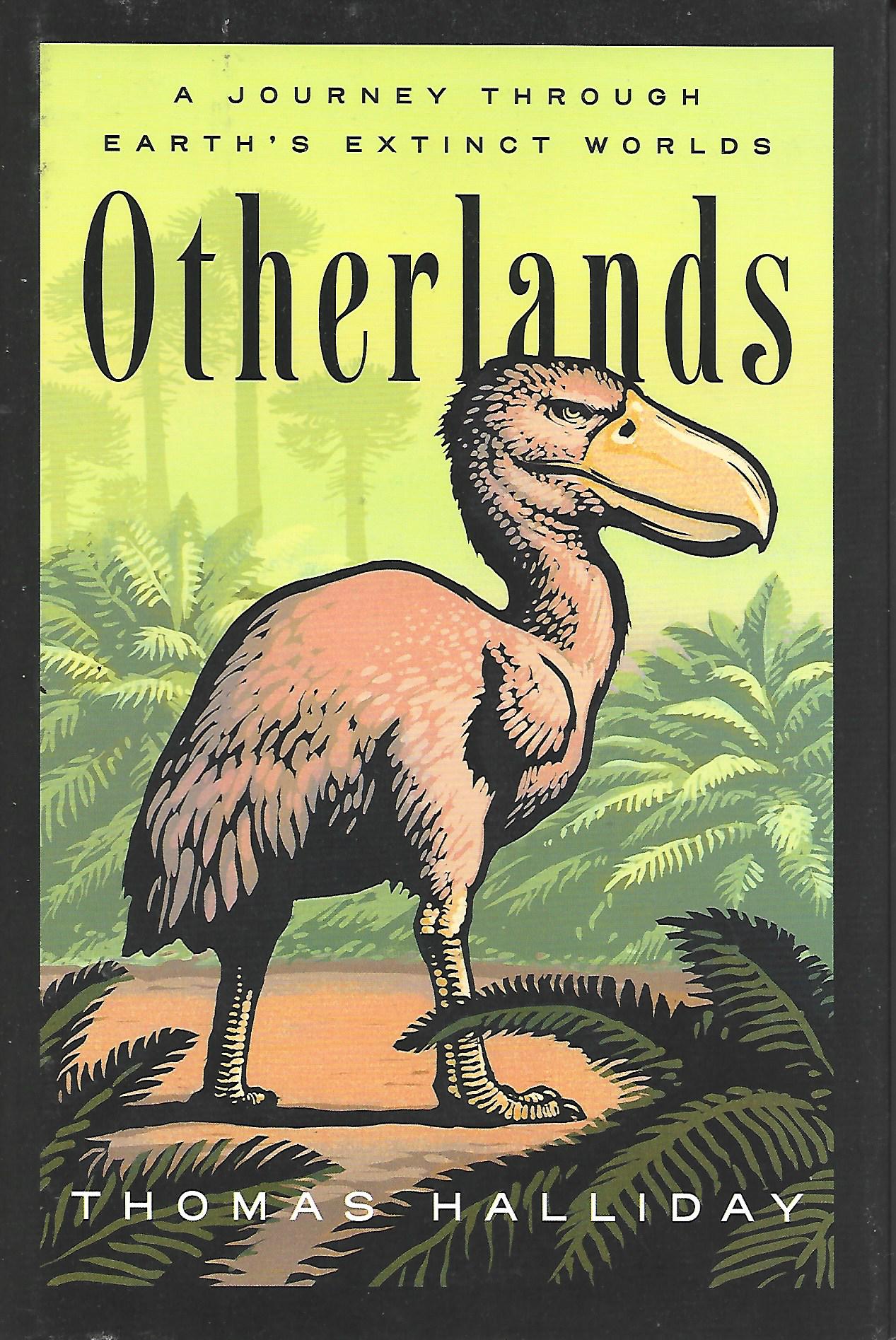
As fascinating (and complex) as the history of animal life (and man) is on earth, the nonfiction book, Otherlands, by Thomas Halliday, is about the history of Planet Earth. Each chapter in the book examines a certain time and place:
- Northern Plain, Alaska ~ 20,000 years ago
- Kanapoi, Kenya ~ 4 million years ago
- Gargano, Italy ~ 5.33 million years ago
- Tinguiririca, Chile ~ 32 million years ago
- Seymour Island, Antarctica ~ 41 million years ago
- Hell Creek, Montana ~ 66 million years ago
- Yixian, Liaoning, China ~ 125 million years ago
- Swabia, Germany ~ 155 million years ago
- Madygen, Kyrgyzstan ~ 225 million years ago
- Moradi, Nigeria ~ 253 million years ago
- Mazon Creek, Illinois ~ 309 million years ago
- Rhynie, Scotland ~ 407 million years ago
- Yaman-Kasy, Russia ~ 435 million years ago
- Soom, South Africa ~ 444 million years ago
- Chengjiang, Yunnan, China ~ 520 million years ago
- Ediacara Hills, Australia ~ 555 million years ago
Otherlands is not an easy book to read. It’s full of technical and scientific words that the general reader will not be familiar with. Nevertheless, I enjoyed the book and read every word, even if I didn’t always know what I was reading. I found it helpful to just forge ahead and not be too concerned about the parts I don’t grasp (including metric measurements). Full steam ahead.
Copyright © 2022 by Allen Kopp

 Literary Fictions