Happy Starfish ~ A Short Story

Happy Starfish
~ A Short Story by Allen Kopp ~

(This short story was published in Halfway Down the Stairs.)

Did I tell you how I hate school? This morning in zoology I had to dissect a starfish. The inside of the starfish is green. That’s disgusting enough, but the thing that got to me is the fishy smell. It’s a smell that lingers in my head and my nose. I don’t think I’ll ever be able to eat any kind of fish or seafood again for as long as I live without being reminded of the green insides of a starfish.

The world is very cruel. That little starfish was probably just minding its own business on a beach somewhere when somebody picked it up and put it in pickling solution where it instantly died. One minute a happy starfish and the next minute a laboratory specimen to be cut open and have its insides probed. If I was a starfish, I would want to live on a faraway island where there were no people and I could die of old age.

After zoology was American history, but I skipped. I thought I was going to vomit and I didn’t want anybody to see me. I went to the boys’ toilet on the third floor where it was quiet and went into a stall and latched the door. I put my hands on my knees, leaned forward and closed my eyes, trying not to think about that starfish.

In a minute somebody came into the toilet whistling. I hate to hear people whistle. It spoiled my concentration, so I just spit into the toilet and flushed without vomiting. I opened the stall door and went to the sink and started to wash my hands.

“What do you think you’re doing?” somebody to my left said.

I turned and saw it was Claude Qualls. If there’s anybody in school I hate, it’s Claude. He’s the class president and a snitch. Mr. Do-Gooder. Mr. Over-Achiever. Mr. Perfect. He has somehow taken it upon himself to keep the rest of us in line. Probably someday he’ll be a congressman or a senator or something if somebody doesn’t kill him first.

“Washing my hands,” I said. “What does it look like?”

“That’s not what I meant, smartass! What are you doing out of class?”

“I’m sick.”

“You don’t look sick.”

He took his eyes off himself in the mirror and leaned in close to me, sniffing.

“Get away from me!” I said. “What I have is probably contagious.”

“Aren’t you supposed to be in American history?”

“What business is it of yours?”

“As class president, I’m supposed to report anybody skipping class.”

“Go to hell!” I said.

He grabbed me by the collar and pulled me toward him, holding his right arm back like he was going to hit me in the face. “What did you just say to me?” he said.

“You heard me. I said: Go to hell, bitch!

He roughed me up a little bit but didn’t hit me. He finished by pushing me into the sink. The fingers on my left hand bent back painfully.

“You stupid little baby!” he said. “You can be sure that this little episode will be reported.”

“You’re the big man, aren’t you?” I said. “The big man will always be there to tell the rest of us what to do, won’t he?”

“Shut up, you little freak!”

“No, you’re the freak, Claude! Not me! Everybody hates your guts!”

“I’m going down to Mr. Ludlow’s office right now and write up a report stating that you’re loitering in the bathroom when you’re supposed to be in class.”

“I hope you break your leg going down the steps,” I said.

I went to the library to hide out for the rest of the period. I knew that if I sat at one of the tables out front, anybody coming in would spot me right away, so I wandered around in the dusty stacks for a while and then went all the way to the back where nobody ever ventured and sat down on the floor in the corner. I opened a book on my knees so if I heard anybody coming I’d pretend to be reading.

I was starting to feel a little less like vomiting. The quiet and the smell of old books made me sleepy, so I leaned my head against the wall and dozed off like a bum sleeping it off in an alley.

“Here he is!” I heard somebody say in a loud voice.

I jerked awake and saw Claude Qualls looking down at me. Behind him was Mr. Ludlow, the principal.

“I was sure he’d be hiding out somewhere!” Claude said.

“What do you think you’re doing?” Mr. Ludlow scolded. “Sleeping on the floor in the library!”

“I was feeling sick,” I said, standing up.

“You haven’t been drinking, have you?”

“Of course not!”

“Aren’t you supposed to be in class?”

“American history class,” Claude said.

“I was going to vomit,” I said. “I didn’t want to be in class when it happened.”

Mr. Ludlow took hold of my arm above the elbow and squeezed. I was sure I would have a bruise there and I was sorry that Claude was the only one present to witness this rough treatment.

“Skipping class will not be tolerated in this school,” Mr. Ludlow snarled in his best warden-of-the-big-house voice. I could smell his cologne and it was worse than the starfish. “Do you want a suspension?”

“No,” I said. “I just want my high school years to be over.”

“Do you need me to help you with him?” Claude asked.

“No, thanks, Claude,” Mr. Ludlow said. “I can take it from here.”

“Before you tell somebody else to go to hell,” Claude said to me with his demonic smile, “think about who you’re talking to.”

“That’s fine, Claude,” Mr. Ludlow said. “You may go now.” To me Mr. Ludlow said, “Proper disciplinary action will be taken at the appropriate time but, for now, you may go to your next class, and if you even think about skipping class again you’ll be faced with a three-day suspension. Think what that will do to your scholastic record and to your chances of getting into a good college.”

My next class was gym class, which I hated more than all my other classes put together. I went to the locker room and changed out of my “street clothes” into the ridiculous gym togs: baggy red shorts that hung down to my knees, a stretched-out tee shirt and grass-stained high-top tennis shoes that were too small for me and made my toes hurt.

While we were all standing around waiting for the teacher to arrive so the class could begin, I spotted Claude Qualls about twenty feet away, bouncing a basketball. When he saw me, he gave me a look of bemused hatred and I mouthed the words go to hell. There wasn’t any way he could not know what I was saying.

The physical education teacher was Mr. Upjohn, or “coach,” as he liked to be called. He was four feet, eleven inches tall and he looked like a troll in a fairy story who hides under a bridge.

“All right now, everybody!” he yelled and blew his whistle. “Time for warm-up!”

As bad as the warm-up was, it wasn’t as bad as the game of volleyball or basketball that followed. We stood in rows as Mr. Upjohn faced us and directed us in the knee bends, sit-ups, pushups, and jumping jacks.

It was during the jumping jacks that I vomited on the floor, a thick green mass that looked exactly like the insides of the starfish. Everybody stopped jumping up and down and looked at me. I bent forward to vomit again and fainted face down in what I had just deposited on the floor. It was only the second time in my life that I had ever fainted. The first time was when I was eight and had the flu.

When I regained consciousness, they were all standing around in a circle watching me. I had really spiced up their boring old gym class. Mr. Upjohn was kneeling beside me, waving a bottle of smelling salts under my nose.

“He’s coming around,” he said.

“I want to go home,” I said.

“Can you make it to the nurse’s office?”

“She doesn’t like me. I pushed her down the stairs once.”

As I stood up, Mr. Upjohn took hold of my arm. “Go get dressed,” he said, “and go see the nurse.”

“I don’t know,” I said, wobbling for effect. “I feel like I’m going to faint again.”

“Claude!” he barked. “Go with him and help him get dressed!”

Claude stepped forward, ready once again to fulfill his role as student leader.

“I don’t need any help from him!” I said. “Just give me time!

I went down to the deserted locker room, cleaned the vomit off my face and out of my hair and put my clothes back on. As I was leaving the locker room, I noticed the door to Claude’s locker was partway open. I approached the locker, pulled the door open all the way and looked inside. There, on the top shelf, was Claude’s expensive gold wrist watch. I slipped the watch into my pocket and deposited it in a trashcan on my way to the nurse’s office.

I walked into her office and vomited again, all over the floor. Now, I have to tell you, there’s nothing like vomiting to get people’s attention. You can say you’re sick, but dramatic vomiting leaves no room for doubt.

The nurse dropped what she was doing and came running with a kidney-shaped metal pan. She told me to lie back on the cot and she put a wet cloth on my head. When she took my temperature and saw I had a fever, she called my mother and told her to come and get me.

When I got home, I kicked off my shoes and got into bed. My mother stood in the doorway and harangued me, as usual.

“Why did you choose today of all days to be sick?” she asked.

“I figured it was time,” I said.

“Algebra test today?”

“No, I failed that last week.”

“Well, I have to tell you,” she said, “sometimes when you say you’re sick I don’t believe you, but today you look sick.”

“Thank you,” I said.

She called the doctor and described my symptoms. From my bed, I could hear her yapping into the phone in the other room for a good ten minutes. After she hung up, she came back into my room. I pretended to be asleep until I heard her breathing and opened my eyes.

“He said it sounds like you have a virus that’s making the rounds,” she said. “It’s contagious and he said to keep you at home in bed for a few days.”

“I always liked Dr. Fain,” I said.

“He said that after the nausea passes I’m to give you anything you want to eat or drink.”

“I want a champagne cocktail,” I said, “and a steak medium rare.”

“But the main thing,” my mother said, “is to keep you quiet and in bed.”

I groaned for good effect and my mother went out of the room and closed the door.

I remembered my conversation earlier in the day with Claude Qualls in the boys’ toilet. He had stuck his snoot in my face and I hope he caught what I had, only ten times worse. He would be distraught at the thought of missing any school, while I, on the other hand, loved it better than anything.

Copyright © 2023 by Allen Kopp

The Million-Year Experiment ~ A Short Story

The Million-Year Experiment
~ A Short Story by Allen Kopp ~

(This short story has been published in The Literary Hatchet.)

The struggle now is over. Everything else will be easy. Hidden away in my room I have food for five days. When it’s gone, I’ll be gone too. I could probably go on longer than five days, but I don’t want to go on. I’m tired and I’m sick. I’ll be ready to go in five days. And I have no more fear. There’s comfort in knowing exactly when and how I will die.

I have my euthanasia pill that people from the hospital were passing out on street corners. I’ve had it for three months. I could have taken the pill right away—it was entirely up to me—but I still had hope back then that something—I don’t know what—would happen and somebody would emerge as a savior and come up with a way to save the few of us remaining. Of course, it didn’t happen. It was never going to happen. Go ahead and take the pill. And may God have mercy on your soul.

Speaking of God, He has decided in His infinite wisdom to end the human species on earth, after about a million years. When you think that the Earth is billions of years old, a million years is really nothing. Now God has decided it’s time to extinguish the humans, make them extinct, and try something else. Something better and wiser, let us hope. I can’t say I blame Him.

So, those of us still remaining have the unique distinction of being the last humans on Earth. After the countless billions who have lived and died, it all comes down to us. Close the door and turn off the lights. Nothing more to be said. All of human history has been written in books, but there’ll be nobody around to read it anymore. No more Mozart or Beethoven, no more Mona Lisa, no more Shakespeare, no more Leonardo Da Vinci or Michelangelo, no more Agatha Christie, Tennessee Williams or Charles Dickens. No more Superman, Chevrolets or lemon meringue pies. I could go on and on, but I won’t.

I get up from the bed and walk over to the window and look out. I’m on the fifth floor of this old building. The building still stands, while a lot of other buildings have been burned or torn apart. I still have the glass in my window because it’s up too high to be broken easily by somebody on the street. A lot of people seem to have this instinct to destroy, if only because they can.

I don’t pay rent anymore because there’s nobody to pay it to and nobody to care. Money doesn’t mean anything anymore. Most of the people in the building are already gone. There are so few people left that when I hear somebody on the stairs, it scares me because I think somebody knows I have a little bit of food and water left and have followed me home to kill me for it.  That doesn’t scare me as much as it makes me mad.

I’ve been collecting rainwater on my little balcony at the back of the building in a washtub. Luckily there has been quite a lot of rain lately. I use this water mostly for bathing. Yes, I still like to keep myself clean, whereas most people have given up on this pursuit entirely. I just can’t stand being filthy, but what does it matter now? Just let everything go, they say. It’s only for a little while longer.

The government—what’s left of it—has been handing out drinking water at distribution sites around the city. The last time I picked up drinking water was a couple of weeks ago at a place about six blocks from my building. I’m not sure if they have any water left, but I leave my building and begin the walk over there.

I don’t have a gun or a weapon, but I have what used to be called a Billy club. If anybody tries to mess with me or bother me, I can at least hit them in the head to deter them. If I hit them hard enough, I might kill them. I’ve never killed anybody, but I can see myself doing it under the right circumstances.

I only go out during daylight hours. After dark, roving gangs go around killing strangers they come across, just because they can and there’s nobody to stop them. Nobody will come to your aid if you find yourself in trouble. You either run or you fight them, in which case you’ll lose because you’ll be outnumbered. Some of the gangs are made up of children ten years old or younger: vicious killers who will laugh at you while you’re bleeding to death or writhing on the ground in pain. What kind of a world has the world become?

There are bricks and debris in the road. You can hardly tell where the road is. There are no sidewalks anymore. Glass storefronts are smashed in. People have done this looking for food, of which there is none. If we could eat bricks and glass and old boards, we’d have all the food we could ever need.

I climb over one pile of bricks, to the top, and down the other side. Then I do it again with the next pile over. My shoes are practically worn out, but so is everything else. My feet hurt. I’m moving so slow I’m hardly moving at all. I meet a few other people, but they are intent on their own business, as I am intent on mine, and pay no attention to me.

I meet an old man who comes toward me with his hand out. He wants me to give him something that I am sure not to have. I raise my club up over my head and let him know I will smack him with it if I have to. He recoils with a  hurt look and I feel sorry for him. If I had anything to give that would help him, I’d gladly give it, but I’m just as bad off as he is.

Finally I come to the place where people were giving out water before, but there’s nobody there. The makeshift stand they were using as a little shelter has been broken up for firewood. All that’s left is a hand-lettered sign: No Water! Go to Steeple Church on Carolina Street at Top of Hill.

I’ve lived in the neighborhood for seven years, so I know where the steeple church is. It’s about six blocks farther on. If I go there, that means I’ll be twelve blocks from my building. I don’t know what time it is. My legs feel weak. I’m not sure if I can make it twelve more blocks, and, if I do, I’m not sure I can get back home before dark. But does it really matter, anyway? I’m going to die, everybody’s going to die, and I don’t mean die eventually but in a very short time, a matter of hours or days. How could it possibly matter in what manner I die? All I ask is that my death be quick, and I believe it will be. God will grant me that one final grace, I’m sure.

I rest for a while and then I trudge on in the direction of the steeple church. I don’t see anybody else. I could be the only person left alive. I wield my club in case anybody is watching me without my knowing it.

When I get to the steeple church, the doors are open, but I don’t see anybody. I hear faint organ music coming from inside. It’s not church music; it isn’t anything I recognize. I like the way it sounds. It sounds welcoming.

The church is cavernous; after the sunlight it seems dark; it takes time for my eyes to adjust. I stand at the back for a couple of minutes and then I walk down the aisle and take a seat. Several people turn and look at me. I look at the floor.

There are about thirty people in the church, some together but mostly by themselves. Some are here, I think, seeking solace, while others just want a place where they can come in off the street and sit down. One woman, I see, holds a tiny baby. She’s too old to have a baby that young, so she must be the grandmother.

The organ music stops and the man doing the playing gets up and walks slowly to the altar at the front of the church. He is gaunt and dressed all in black. He looks out over the small crowd and then looks away, as if deciding what to say.

Finally he speaks: “I won’t see any of you again after today. I’m going away tonight. When anybody asks me how I feel, I tell them the peace of the Lord is upon me. I hope the peace of the Lord is upon you also, now and forever.”

Amen!” an old woman shouts at the front of the church, lifting her arms. “The peace of the Lord be upon you!” Now and forever!”

“We have come now to an end,” the man in black says quietly. “The dark days are behind us. Our suffering is over. The only message of hope I have for you is for the next life. You have only to ask God for the forgiveness you seek. You have nothing to gain but eternal life.”

Eternal life!” the old woman screams, and then she stands up and moves down the rows, but, instead of passing the collection plate, she begins handing out little bottles of water to everybody in the church.

Peace be with you, Brother!” she says with every bottle. “Peace be with you, Sister!

The man in black disappears at the back of the church behind the altar. I take the bottle from the old woman and when I stand up to leave the church, I pitch forward onto the floor, hitting my head on the back of the pew in front of me. I’m aware of people lifting me off the floor and placing me in a reclining position on the pew, and then I lose consciousness. It feels like being dead.

When I wake up, all the people have left. The church is dark except for some lighted candles on the other side of the nave. I sit quietly for a couple of minutes with my head in my hands, trying to summon the strength to walk the twelve blocks home.

I must have been unconscious longer than I thought, because when I open the door to leave the church, it’s completely dark outside and the street is deserted. There are no streetlights anymore, so when I say dark, I mean as dark as a night can be, with no moon and low-flying clouds in the sky, a smell of rain in the air.

The night feels momentous to me, significant in some way. My skin prickles. I feel a chill, even though it’s a warm night. My hands are shaking. I drink half the bottle of water, replace the lid and carry the bottle in my hand. The water has somehow revived me. I believe now I can make it all the way home.

I walk three or four blocks away from the church. I don’t see those who attack me in the dark. They come up behind me. I don’t know how many there are, but it feels like five or six. They pull me backwards off my feet. They hit me with their fists, in the face and the stomach, and when that’s not enough they begin kicking me. They steal my shoes and the half-bottle of water I’m carrying. They scream a high-pitched animal scream, or maybe it’s something I don’t hear but only believe I hear.

For the second time in a few hours, I’m unconscious. It’s funny, because I don’t remember ever being unconscious in my life before, not even when I was sick with pneumonia or when I had surgery for appendicitis. I lay on the sidewalk like a dead man; maybe my assailants, when they leave me, believe I am dead.

But I wake up again—this time to a brilliantly blue sky with a few fleecy clouds. There are beautiful birds wheeling in the sky. They have spotted me. They call to me. They fly down to me. Before I know what’s happening, they pick me up in their gentle claws and bear me skyward. I feel nothing now except the most exquisite joy.

Copyright 2023 by Allen Kopp

The Most Beautiful Suicide ~ A Short Story

The Most Beautiful Suicide
~ A Short Story by Allen Kopp ~

Angela McNeill traveled down by train to see Harry Vance and they spent that last Sunday together. They walked in the park, holding hands, and sat for a long time watching the swans gliding back and forth across the lake. It was a day in April and the weather could not have been finer.

He took her hand and said he wanted to marry her in June.

She avoided looking directly at him. “That doesn’t give me much time,” she said.

“Time for what?” he asked.

“A wedding takes a lot of planning,” she said.

“It’s going to be a small wedding,” he said.

“Yes, but I want everything to be just right.”

It was a conversation they had had many times before. She was in “no hurry” to get married, while he couldn’t get it done fast enough. He was a college student and wanted to get the wedding out of the way in June, between semesters. Then, by the beginning of the fall semester, they would have found a place to live and would be “settled.” His parents were giving them a thousand dollars as a wedding gift to “get started” on.

“I don’t think your parents like me very much,” she said.

“Of course they like you! Why wouldn’t they?”

“They think I’m not right for you.”

“Nobody said any such thing! You’re just looking for complications that don’t exist.”

“I just want everything to be right, that’s all.”

“You’re thinking about your parents, aren’t you?” he said.

“No. Why should I?”

“You’re afraid you’ll have a bad marriage just because they did.”

“I didn’t say that.”

“You don’t have to say it. I know what you’re thinking.”

“Let’s not talk about it,” she said. “Let’s not spoil the day.”

Angela hadn’t told Harry the whole truth about her mother. When Angela was little, her mother cast a pall over her family with her dark moods and sudden emotional shifts. In one evening or one afternoon, she would go from laughing and happy to raging and accusing. She’s just high-strung and emotional, Angela’s father used to say. She doesn’t mean anything by it.

Angela thought for years her mother was evil but then she found out the truth: she suffered from hereditary mental illness, passed down to her from her mother and grandmother. Feckless doctors gave her pills that were supposed to “calm her down,” but they only seemed to make her worse. When the pills didn’t provide the kick she wanted, she began supplementing them with whiskey. Soon she was an alcoholic in addition to being a drug abuser. She smoked countless cigarettes and had started at least two small fires in the house.

A divorce followed soon after. Angela and her brothers and sisters (nine all together) went with their father and moved to another city to make a fresh start. Angela’s mother, unable to take care of herself, went to live with her sister, who ran a kind of boarding house.

Angela was certain she was following in her mother’s footsteps. She would not escape the mental illness. She felt it, like a cancer inside her, that would one day consume her: the black moods, the despair, the hopelessness, the days when she couldn’t get out of bed. Could she marry Harry Vance and let him find out too late what she was going on inside her? The answer was no. She wasn’t going to inflict such pain on Harry or any children they might have.

That last Sunday evening they had a lavish, candlelit dinner together, paid for by money that Harry’s father gave him. When they were finished eating, it was almost time for Angela’s train.

“You can spend the night if you want to,” Harry said.

“I have a job to go to in the morning, dear,” she said. “I have to get up early.”

“When we’re married, you’re going to quit that job.”

“And what will we do for money until you graduate and get a job?”

“I don’t know. I can always rob a bank, I guess.”

“I don’t think that’s a very practical idea.”

He got her to the station just in time. She boarded her train and waved to him from the window. It was the last time they would ever see each other.

The next morning she arose at the usual time and ate a light breakfast. She dressed herself with care, making sure everything was exactly right. Before she was ready to go, she sat down at the kitchen table and wrote out a quick note. She didn’t even have to think before she wrote because she had thought it all out beforehand.

When it was time to leave for work, she put the note in her purse, put on her new spring jacket, slipped on her shoes and left her apartment. She didn’t go to her job, though, and didn’t bother to call to say she wasn’t coming.

She took a cab to the tallest building in the city, about twelve blocks from where she lived. She tipped the driver generously and he helped her out of the car and wished her a good day.

As usual, there were lots of people everywhere. Always a busy city. She took the crowded elevator to the eighty-sixth floor. She had been there before and knew there was an observation deck on that floor.

The people on the observation deck were so enthralled by the exhilarating view at more than eight hundred feet (it was like looking down from the top of a mountain) that nobody looked at her.

After standing at the rail for a few minutes, looking down, she took off her coat, folded it neatly and placed it over the rail, putting her purse on the floor underneath the coat. She then swung her legs over the rail, first the left and then the right, until she was sitting on the rail. Before anybody had a chance to see what she was doing and try to stop her, she let go of the railing and leaned forward slightly. Gravity did the rest.

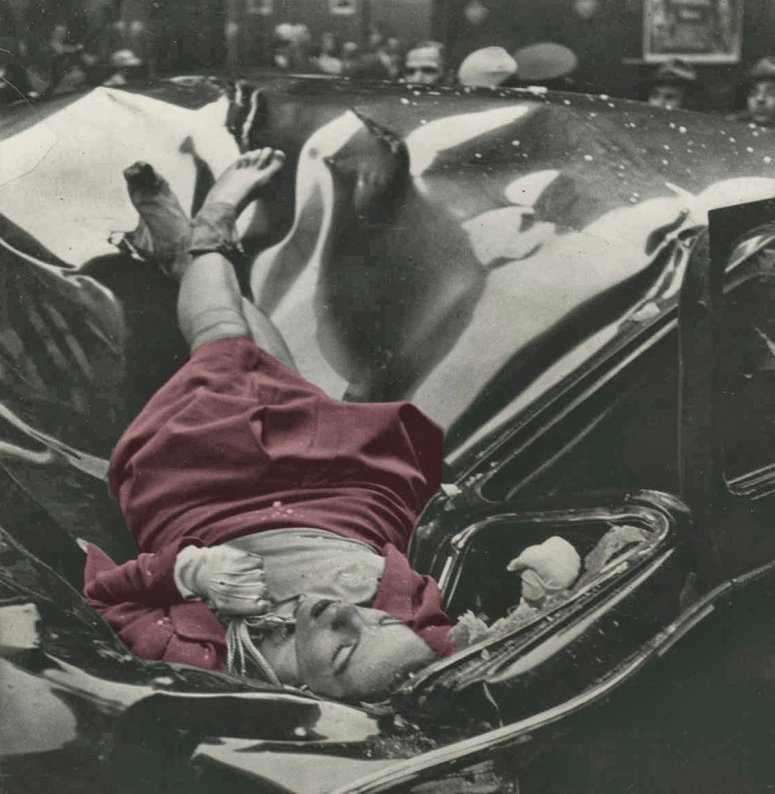
She landed, feet first, on the roof of a parked limousine. Hardly anybody saw it. It happened so fast. Somebody called for an ambulance. In a minute or two, a couple hundred people knew that something had happened and wanted to see what it was.

A student photographer happened to be nearby with his camera. Approximately four minutes after Angela died, the student photographer took her picture. Instead of a grisly, horrifying scene of a smashed body, the picture was of a young woman with her shoes off, her stockings down around her ankles, her clothing barely disarranged. The expression on her face was one of peace and composure. The picture, when printed in the newspaper, bore the caption: The Most Beautiful Suicide.

In her purse was the note she had written right before leaving her apartment: I don’t want anyone in or out of my family to see any part of me. Could you destroy my body by cremation? I beg of you and my family—don’t have any service for me or remembrance for me. My fiancé asked me to marry him in June. I don’t think I would make a good wife for anybody. He is much better off without me. Tell my father I have too many of my mother’s tendencies.

Harry Vance saw no hint (he told everybody), not the slightest suggestion, in all the time he spent with her on Sunday, that she was contemplating such a move. If he had known, he would never have let her out of his sight. She was the one he wanted to marry. The only one. There would be nobody else. Sixty years later, when he went to his grave, it was as a man who had never married.

Copyright © 2023 by Allen Kopp

At the Rise of the Hill ~ A Short Story

At the Rise of the Hill
~ A Short Story by Allen Kopp ~

(This short story has been published in The Literary Hatchet.)

Freddy Chickwell’s mother called him at seven o’clock on Sunday morning, before he was even out of bed.

“I need you to come over right away!” she said.

“I can’t, mother!” Freddy said. “It’s too early. I don’t even have my eyes open yet.”

“You’re going to want to see this.”

“What is it?”

“I can’t tell you on the phone. You have to see for yourself.”

“I’m going back to bed, mother. Please don’t call me until the sun is all the way up.”

“I never ask you for anything,” she said pitifully. “I’m asking you this one thing politely.”

“I’ll come, but only if there’s bacon and French toast.”

“How can you think of food at a time like this?” she asked.

“A time like what?”

He lay back on the bed and groaned. He had planned on going back to sleep but now that he was wide awake, he got up and dressed himself. He hated jumping out of bed and driving someplace first thing in the morning, but it appeared he had no other choice.

As he drove the six miles to his mother’s house, he thought of the different things that might have elicited such a call at an early hour: a large rat (spider) in the basement (bathtub); a bill that came in the mail for a large sum that she says she doesn’t owe and has no intention of paying; Aunt Jeanette has a tumor on her gallbladder; a large crack has appeared overnight in the foundation.

He pulled into the driveway and his mother came out the front door and down the steps, toward his car in a pink terrycloth bathrobe and fuzzy slippers; her hair was sticking out in spikes.

“Prepare yourself!” she said.

“For what?” he asked.

“He’s come back!”

“Who has?”

“Need you ask?”

Freddy walked into the house behind her and there, sitting in the living room in the middle of the couch, was his father, who had been dead for a year. Freddy looked at his father and his father looked at him. There were no words.

His mother motioned Freddy into the kitchen. “What do you suppose is going on?” she asked.

“Who is that?” Freddy asked.

“Who do you think it is?”

“Well, I know who it looks like!”

“He’s been raising all kinds of Cain with me ever since he came back.”

“Why?”

“He says I went off and left him.”

“Left him where?”

“I told him I would never do that.”

“Mother, something’s not right here,” Freddy said. “People don’t just come back from the dead after a year.”

“Apparently some of them do!”

“Is he a ghost?”

“I don’t think so. He ate a big breakfast and then had to go to the bathroom. I don’t think ghosts do that.”

“If he’s not a ghost,” Freddy said, “it must mean he was never dead in the first place. How do you account for it?”

“I don’t account for it! I saw him go into his grave.”

“The only other explanation I can think of is that he’s a zombie come back to eat our flesh.”

“Oh, I don’t think he would ever do that!”

“I’m calling the police,” Freddy said.

“And what could they do?” mother asked. “They’d never believe he was dead in the first place. They’d just think we were a bunch of lunatics.”

“Then call his doctor.”

“He died, too. Right after your father.”

“Maybe he’s a hallucination that we’re both having,” Freddy said. “We were both so poisoned by the man all the years he was alive that we’re being affected by him from beyond the grave.”

“I just don’t know,” mother said. She sat down at the table with her cup of tea, lit a Pall Mall cigarette, and sniffled back tears. “I cared for your father while he was alive—truly I did—and I missed him after he was gone, but now that I’ve become used to having my freedom, I just don’t think I can go back to the way things were before.”

“I’m hungry,” Freddy said. “I haven’t had any breakfast.”

He ate quickly, pushed the plate back when he was finished eating, and fanned away his mother’s cigarette smoke. “Now that I’ve had a little time to think about this dispassionately,” he said, “I’ve decided on a plan of action.”

“What is it?” she asked anxiously.

“We’ll kill him. It’s as simple as that.”

“Oh, Freddy! Your own father?”

“Well, he’s already dead, isn’t he? If you kill somebody who’s already dead, it’s not really wrong, is it? Not really a crime?”

“I’m not sure how the law would look at it,” mother said. “Killing is killing, whether the person you kill is already dead or not.”

“I don’t expect you to do any killing. I’ll do it.”

“But how? I don’t want a mess in the house that I’ll have trouble explaining later.”

“Remember Echo Hill?”

“That old place? I haven’t been there for years.”

“I haven’t, either. If it’s like it was when I was in high school, it would be the perfect place to kill a person that’s already dead.”

“Oh, Freddy, I just don’t know about this.”

“Remember how they used to tell us kids how dangerous it was to go up there because of the air holes?”

“What are air holes?”

“It’s places where you can fall through the earth down into the old mine if you’re not careful. There are probably some new ones that have formed since.”

“That sounds dangerous!”

“Yes, but it’s the perfect place to hide a body. If a body falls down an air hole, it would never be found. The old mine is as big as the whole town and there’s deep water in places.”

“It sounds very forbidding.”

“We can take him for a Sunday drive up to Echo Hill. We’ll get him out of the car and walking around, and—boom!—he’s gone down an air hole. Just like that.”

“And what if somebody sees us?”

“They won’t, and if they do they won’t know what they’re seeing.”

“While I’m getting dressed,” she said, “you go in and visit with your father.”

Freddy went into the living room and sat down in the chair facing the couch. “How have you been doing?” he asked father.

“There’s some weeds growing along the back fence,” the old man said. “Somebody needs to get out there and pull them up, and I guess that somebody is going to be me.”

“I wouldn’t worry about any weeds, if I were you,” Freddy said.

“The whole place is goin’ to hell!”

“So, tell me. What have you been doing this past year?”

“What do you mean?”

“Well, you’ve been…away, haven’t you? I just wondered what things were like where you were.”

The old man looked at Freddy with something like contempt. “What things?” he asked. “I don’t know what you’re talking about.”

Mother came down from upstairs wearing a yellow pantsuit and matching wig that made her look like Doris Day. “Well!” she said brightly. “How are we getting along?”

“About like always,” Freddy said. “Not much in the way of communication.”

She bent over toward the old man and said very loud, as if being dead for a year might have made him partially deaf, “We thought it would be lovely to go for a little drive! It’s such a beautiful day!”

“Huh?” the old man said.

“Remember Echo Hill? We used to go up there for picnics with Betty and Waldo when we were young.”

“I don’t know what you’re talking about,” the old man said. “I never did.”

“Wouldn’t you like to get out of the house? Go for a little drive?”

The two of them together helped the old man off the couch, out the door and into the car. With him installed in the back seat, mother got into the front seat with Freddy.

“I just don’t know about this,” she said as Freddy started the car.

“It’ll be all right,” he said. “I think I know what I’m doing.”

He drove out to the edge of town, past the bowling alley, the abandoned funeral home, the roller rink, a used car lot, a couple of taverns, and into farm country, where there were barns, silos, cows and young horses grazing in fields.

“Not much traffic today,” Freddy said.

He looked in the rearview mirror and saw that the old man was asleep in the back seat, his head lolled to the side.

“Isn’t this fun?” mother said. “I just love going for a drive in the country on a pretty day!”

Freddy came to the turnoff to go to Echo Hill, and it was exactly as he remembered it. “Won’t be long now!” he said.

He took a couple of turns onto old country roads that became narrower and more tree-encroached. Finally, he came to the end of the blacktop and turned onto a dirt road. There was a gate across the road, long-since fallen into disuse.

“Just like pioneering days!” mother said. “This reminds me of my childhood!”

At the big hill, the road was very rough; Freddy slowed to ten miles an hour to prevent any damage to the tires.

Mother rolled down the window. “Just smell that country air!” she said. A bumble bee flew in and she screamed.

After what seemed a very long, slow climb, Freddy came to the top of the hill from which one could see into the next state. The dirt road ended there, so he pulled the car onto a little rise off to the right that seemed dry and firm and didn’t have a lot of weeds growing on it. It was a place where he could easily turn around when the time came.

“How about if we get out here and scout around a bit?” Freddy said, giving mother a wink.

He started to open the door but was arrested by a sound that he didn’t identify, a sound of dirt sifting. Then the front end of the car lurched forward significantly.

“What on earth!” mother said.

Freddy wanted to see what was happening to the front end but, as he put his hand out to open the door, the ground gave way and the car slid downward, front end first, into a hole just big enough to admit one mid-sized car.

Down, down, down went the car, into darkness complete. Mother gasped and grabbed onto the dashboard as if she could arrest the car in its flight. The old man in the back didn’t make a sound. Freddy had a few seconds before the car hit the water in which it all became clear, all the pieces of the puzzle fit into place. Everything that had ever happened—his whole life—had been preparing him for this moment when it would all come to end.

Copyright © 2023 by Allen Kopp

Sanctuary ~ A Capsule Book Review

Sanctuary book cover

Sanctuary
~ A Capsule Book Review by Allen Kopp ~

William Faulkner (1897-1962) was the supreme American literary stylist of the twentieth century. Some of his books are notoriously difficult to read. His 1930 novel, Sanctuary, is one of his more accessible books, but still not always easy to read.

Temple Drake is an affluent college girl around 1929. She loves to remind people that her father is a powerful judge. She has a date with Gowan Stevens to go to a dance. Gowan is a high-powered lush. When he stops off with Temple to buy some bootleg hooch, that’s when Temple’s problems begin.

Gowan’s bootlegger operates out of the shattered remnants of a Civil War-era mansion.  (Southern Gothic to the hilt.) Inside the bootlegging operation are several unsavory characters that Temple would have been better off not to meet. Chief among them is Popeye, one of Faulkner’s most memorable villains. Popeye is malformed (his mother had syphilis before he was born) and he’s impotent (can’t perform sexually). While Temple’s escort, Gowan Stevens, lies in a drunken stupor, Popeye overpowers Temple Drake and rapes her with a corncob.

A kind black man named Tommy (said to be a halfwit) tries to protect Temple from Popeye. Popeye kills Tommy and blames it on the bootlegger, Lee Goodwin. Lee Goodwin’s long-suffering common-law wife, Ruby Lamar, is also in residence in the broken-down mansion. She apparently loves Lee Goodwin and will stand by him in the face of a false murder accusation. She has an ailing baby, who doesn’t seem long for this world.

Popeye takes innocent, young Temple Drake to Memphis, and sets her up in a whore house, run by a fat whoremeister known as Miss Reba. Miss Reba provides lots of comic relief at this point in the dark story. She loves her beer and her two yapping little dogs.

Since Popeye is unable to perform sexually, he brings in a “stud,” a man of his acquaintance named Red. He forces Temple to have sex with Red while he watches. Finally he becomes jealous of Red and murders him.

In the meantime, Lee Goodwin has been put in jail for the murder of Tommy the halfwit (which he didn’t do). Horace Benbow has been hired as Lee Goodwin’s lawyer. Lawyer Benbow has problems of his own including an unhappy marriage. He knows that Lee Goodwin won’t be able to pay him, but he takes the case anyway. He and Ruby Lamar discuss the possibility that she will pay him by having sex with him.

Lee Goodwin is tried for the murder of Tommy the halfwit. Public sentiment in the town is decidedly against him when people learn that he raped Temple Drake with a corncob. (He didn’t do it, of course; Popeye did it.) Lee Goodwin refuses to defend himself. This is not going to end well for him.

This is a dark story with dark elements: rape, abduction, prostitution, plenty of sex, a sensational murder trial. Only the brilliant Southern writer William Faulkner could have written such a story in 193o and make it artful instead of tawdry.

Copyright © 2023 by Allen Kopp