

Author: allen0997

Blanche and Jane and the Hollywood Vampire ~ A Short Story

Blanche and Jane and the Hollywood Vampire
~ A Short Story by Allen Kopp ~
I worked for the movie studio in the 1920s and ‘30s. I knew Blanche and Jane on a professional level. Blanche started in movies in the late ‘20s, when she was about eighteen. She had her first movie role around 1927. Of course, this was still the silent era. She didn’t become a star overnight, but she did well enough to get offers in other silent pictures. When sound pictures came in, she made the transition easily enough. That’s when she became a star. Every picture she made was a hit, and everybody liked her. She was going places. She was young, beautiful and talented.
Her sister Jane, though, was another story. She was a big deal in Vaudeville, with her singing and dancing, but after she became too big for her little girl act, she was headed for obscurity. Sure, she tried the movies, certain she could match Blanche’s success, but it just didn’t happen for her. Producers and directors hired her as a favor to Blanche, but they soon regretted their generosity. She was drunk all the time, couldn’t remember her lines and cues, and kept everybody waiting and wondering where she was and what she was doing. She was fired from three pictures in a row. She was finished as an actress.
Remembering her success as a child performer, though, Jane believed she was destined for stardom, if not in the movies, then on the stage. She had already had her run in Vaudeville, and Vaudeville was dead. People preferred movies to the corny Vaudeville fare, but that didn’t stop Jane. She practiced her old act night and day. If it worked for her as a child, it would work for her as an adult. The problem was that by this time she was just plain grotesque. The heavy drinking had spoiled her figure and her once-youthful face. Her beautiful blond hair now looked like a mop that had scrubbed too many floors. The more tactful agents told her she didn’t have what they were looking for. The ones who weren’t so kind called her a has-been and booted her out the door.
It was the mid-1930s, and Blanche was riding high. She had just been signed by the studio to a multi-million dollar, seven-year contract. She received sacks full of fan mail every day. She had to hire a secretary just to take care of her mail.
And then, on New Year’s Eve, it all came crashing down.
Blanche was invited to a party at the home of Chester Siler, the director of her latest cinematic triumph. Hating to leave Jane all alone on New Year’s Eve, she phoned Chester and asked if she might bring Jane along. “Of course,” he said. “Anybody you want to bring along will be most welcome.”
Jane was reluctant to go to a party of Blanche’s friends, but after she thought about it for a while, she saw how it might benefit her professionally. There would be producers and directors at the party and she might make some important showbiz connections. If nothing else, she might be able to humiliate Blanche.
The party was a glittering affair, filled with Hollywood luminaries. Everybody wanted to talk to Blanche and sit next to her. Some of the handsomest men in Hollywood waited to dance with her.
Jane was well-behaved at first. She sat with the older ladies, and when a gentleman asked her to dance, she smilingly complied. After hours of steady drinking, though, she became raucous. She stood on a table and announced to everybody that she was Blanche Hudson’s sister, and that she too was an actress. She was just as good as her damn sister, and she wanted the world to know it. She just hadn’t had all the lucky breaks.
When Blanche tried to calm Jane down and stop making a spectacle of herself, Jane socked her in the jaw and began calling her whore and slut and tramp and any other name she could think of. She implied that Blanche only became a success in pictures because she had no morals and would spread her legs for anybody who might further her career.
Finally Blanche got Jane down off the table and, with several of the other women guests, got her into the kitchen, where they had a pot of coffee brewed for her. Blanche was humiliated. The party was ruined for her.
Right after the countdown to midnight, Blanche got Jane into her coat and corralled her out the door and into the car. Jane slept the whole way home, snoring and sputtering, trying to talk but making no sense.
At their home, finally, Blanche got out of the car to open the gate, letting the car idle. That’s when Jane got behind the wheel of the car and ran Blanche down in the driveway, nearly killing her.
Blanche lay in the driveway screaming. Neighbors heard the commotion and called an ambulance. Police came. They tried to piece together what happened, but it made no sense to them. Blanche was apparently by herself. Jane was nowhere to be found. She was located ten days later in a skid row hotel under an assumed name.
Blanche was in the hospital for many months. Her back was broken. Every spinal specialist in the state reviewed her case; they all said there was no chance she would ever walk again. When she was released from the hospital and sent home, she had to have somebody in her family to take care of her. Her only family was her sister, Jane.
Jane moved into Blanche’s big house with her. (Jane insisted the house belonged to her.) Since Blanche could no longer walk, she was confined to her upstairs bedroom. Jane prepared the food in the kitchen downstairs and carried it up to Blanche’s room. She did all the cooking, shopping, laundry, cleaning, etc., that needed to be done. With the tidy fortune Blanche had made in the movies, they could have hired a housekeeper, but Jane didn’t want any strangers in “her” house.
Blanche was allowed one extravagance, her maid Elvira. Besides being a maid, Elvira was also a friend and confidante. She came in two or three days a week and helped Blanche with her letter-writing and with anything else that needed to be done. Blanche paid her a small salary, but Elvira would have done it free of charge.
Elvira’s plan was to get Jane “put away.” She saw how unstable she was and how she was habitually drunk. She believed that Jane would someday “hurt” Blanche in some vengeful way, maybe even kill her. Elvira envisioned Jane setting the house on fire and leaving Blanche upstairs to burn to death.
Elvira and Jane disliked each other with equal fervor. Jane was always looking for a reason to fire Elvira, but it was out of her hands. Blanche paid Elvira’s salary and all the rest of the bills for the household. Jane didn’t have a dime to her name except what Jane gave her. It was just another humiliation added to all the other humiliations she had had to endure.
Elvira was never shy about giving her opinions.
“That sister of yours is like a volcano waiting to erupt,” she said to Blanche one rainy Saturday afternoon when the two of them were alone in Blanche’s room.
“She’s not as bad as she seems,” Blanche said. “I’ve talked to her many times about her drinking. She tries to control it, but sometimes it’s too much for her.”
“You’re too easy with her. If she was my sister, I’d slap her in a mental hospital where she belongs.”
“Life hasn’t been easy for her. She showed great promise as a young person, but she’s been disappointed so many times.”
“I know all that, but it doesn’t excuse her behavior. She’s got a barrelful of liquor bottles in the corner of the kitchen.”
“I know, but we have to be kind with Jane.”
“She’s bad for you! She shouldn’t be taking care of you! You could afford to hire a real nurse and a good housekeeper to boot.”
“Jane and I get along quite well.”
“You could have her committed! You are the only person in the world to do it.”
Blanche laughed merrily. “Have Jane committed! Don’t you think that’s a little drastic, Elvira? Who would treat their own sister that way?”
“Do you know she’s hired a pianist? She’s been rehearsing her act night and day, just the way she did it when she was a little girl!”
“Yes, she still dreams of being a star.”
“It just isn’t healthy.”
“Well, I suppose we must indulge her in her whims.”
“Speaking of whims, I have one I want you to indulge me in.”
“What is it?”
“I have somebody I want to you to meet.”
“Another movie fan?”
“No. This is somebody who can really help you!”
“Another doctor? I think all the doctors agree I’m a hopeless cripple.”
“No. Not a doctor in the way you mean.”
“It’s not a faith healer, is it?”
“No, not a faith healer.”
“What is it, then?”
“All right, now, honey! Get ready for this! He’s a vampire!”
“Oh, Elvira! Not a vampire! You know how I feel about supernaturals.”
“Yes, but you need to keep an open mind.”
“Absolutely not! I will not agree to see a vampire!”
“What have you got to lose?”
“Will he want to drink my blood?”
“Not if you don’t want him to.”
After a sustained argument, Blanche agreed to meet the vampire for ten minutes.
The next week on a Tuesday evening, Jane went nightclubbing with her pianist friend. She might not be back home until morning, she said. It was the perfect chance for Blanche to meet the vampire.
Elvira was waiting for him downstairs. He arrived punctually at seven o’clock. She took his coat and hat and escorted him upstairs to meet Blanche.
She was sitting in her wheelchair in the middle of the room, waiting for him. He advanced toward her and took her hand in his.
“So this is the divine Blanche,” he said. “In preparation for this evening, I watched all your movies, even the silent ones. You have a special radiance that’s unique to the screen.”
“Thank you,” Blanche said. “Won’t you sit down?”
He was not what she expected. He was old Hollywood. He was more Adolphe Menjou than Bela Lugosi. He was dressed in a dark, old-fashioned, double-breasted suit. He wore a white carnation in his buttonhole. His eyes were piercing and his skin white, but there wasn’t anything frightening about him. His name was Ramon Valentino. No doubt a Hollywood alias.
He pulled the guest chair closer so that their knees were almost touching. Again he took her hand.
“I can help you,” he said. “If you’ll let me.”
“How can you help me? Every doctor has told me I’m a helpless cripple.”
“You’re withering here. You’re wasting away. I see it in your eyes.”
“My sister Jane takes care of me.”
“Where is this sister?”
“She’s out for the evening.”
“I believe your sister is a large part of your trouble. She is not good for you. You need to get away from her.”
“How am I going to do that? She takes care of me. She’s the only family I have in the world.”
“Why not take care of yourself?”
“I’m not able.”
“What if I told you I could make you able?”
“I wouldn’t believe you.”
“With your permission, I’m going to give you an injection.”
“An injection of what?”
“Vampire blood, among other things.”
“Will it turn me into a vampire?”
“No need to worry about that now.”
He wheeled Jane’s chair over to the bed and helped her onto the bed. When she was settled comfortably, he administered the injection.
“This shot will make you sleep soundly and peacefully. You’ll wake up in the morning feeling better than you’ve felt in a long time. I will return in one week and give you another injection. There are ten in all. At the end of the ten injections, you will see a miraculous difference.”
“How much is this going to cost me?”
“I don’t care about money. If you’re not happy with the results, you pay me nothing.”
“It sounds too good to be true.”
“You must embrace the fantastic!”
After ten injections, Blanche’s spine fused and healed and she was able to walk again, to dance again if she cared to. She was young and beautiful again. She would be able to resume her screen acting career again that was so cruelly interrupted. When people heard about her miraculous recovery, she would be the toast of the town. Every producer would want her for his next film. People all over the world would be enthralled by her story and would eagerly anticipate her return to the screen.
Jane also benefited from Blanche’s recovery. She wouldn’t have to take care of Blanche anymore, but, better than that, her career was also revived. Introduced to vampire audiences by Mr. Ramon Valentino, she began dancing and singing in vampire theatres all over the world. Vampire audiences loved her act. What’s better than a worn, middle-aged, white-faced woman singing and dancing to songs from a bygone era, in the style of a woebegone child? What a sensation she created!
Copyright © 2023 by Allen Kopp
Where Men Are Men ~ A Short Story

Where Men Are Men
~ A Short Story by Allen Kopp ~
The new gardener came in late summer. His name was Geoff Tallis. He wasn’t like the others. He wasn’t a grizzled old man with a sour smell, dirt under his fingernails and hair coming out of his nostrils. He was trim and light on his feet, like a boxer who knew all the moves. He hardly ever spoke and when he did his voice was quiet and confident. He cleaned up the lawn in record time, after a summer of neglect, without complaint and without excuses. And when he was finished for the day, he put away the tools and left without fanfare; never left anything out to get rained on.
Roddy was fifteen and just starting tenth grade. Summer was over and school had taken up again. Sitting in class all day long listening to people talk about things that didn’t interest him left him with a lot of pent-up energy. After depositing his books in his room, he liked to spend time outside, breathing pure air, walking around in the yard or just sitting quietly underneath the trees in the front yard listening to the birds twitter.
When Roddy saw Geoff working in the side yard, he approached him shyly, not knowing how he would take to being disturbed. Realizing Roddy was nearby, Geoff looked up from his work and smiled and gave a little wink. It was the wink that lifted Roddy’s heart and made him smile for the first time all day. Nobody had ever winked at him before.
Emboldened by these outward signs of friendliness, Roddy began speaking to Geoff whenever he got the chance. Roddy opened up to Geoff in a way that was rare for him. Geoff listened when Roddy spoke, never interrupting him or seeming impatient. They talked about clouds, animals, mountains, South America, Mars, the War of 1812, and anything else that came into Roddy’s head. He was amazed at how the words poured out of him and he didn’t have to worry about sounding stupid or being embarrassed. And, when all other subjects were exhausted for the moment, the talk inevitably turned to Roddy’s family.
“Watch out for my mother,” he said. “She’ll smile to your face and then stab you in the back. She fired the last gardener for cutting back the hibiscus bush too much. She didn’t even give him any warning. He was here and then he was gone. There were no goodbyes.”
“I’ll try to keep her from stabbing me,” Geoff said.
“Have you met my sister?”
“I’ve seen her.”
“She’s a viper. You don’t want to have anything to do with her. Her name is Janice. She’s seventeen and a senior this year. She’s ten times worse than my mother.”
Geoff laughed. “She can’t be as bad as all that!”
“You’ll find out if you’re here long enough. And then there’s my father. He’s a lawyer. He works all the time. He doesn’t want to be bothered with little domestic details. He leaves everything to my mother. He might come out of the house and fire you, but he’ll be polite about it.”
“I’ll try not to give him any reason.”
“Well, how about you? What about your family?”
“I don’t have any to speak of. My father died when I was five years old. My mother got married again and moved away. I had one older brother but he died.”
“What made you become a gardener?”
“I don’t know. I like being outside and watching things grow. I don’t plan on being a gardener forever.”
“What will you do then?”
“I don’t know. I’m open to all possibilities. I can do carpentry, house painting, and I’ve worked as a machinist.”
“Do you like doing those things?”
“I have to make a living. I like it as long as it pays me money.”
Another time Roddy talked to Geoff about school. He never talked to his parents about school. They only lectured him about applying himself and getting good grades. Geoff spoke to him as an equal, never talked down to him and never gave out with platitudes about staying in school and becoming a success in life.
“I don’t like school very much,” Roddy said. “I don’t fit in very well.”
“Why not?” Geoff asked.
“I don’t know. I guess I’m not like other people. I can’t wait to finish with school and get away from my family and everybody in this town.”
“Where will you go?”
“Out West somewhere, I think.”
“Where men are men?”
“Yeah. Wide-open spaces.”
Roddy began looking forward to seeing Geoff in the afternoons after school and was disappointed when he wasn’t there. He was afraid his mother would fire him or he’d quit without saying anything, and he’d never see him again. He didn’t know where Geoff lived or anything else about him, so that would be the end of that.
On a Friday afternoon, Roddy found Geoff in the yard with his hand bleeding.
“Why didn’t you knock on the door and ask my mother for help?” Roddy asked.
“I didn’t want to bother her.”
“You need to wash that out.”
He took Geoff into the kitchen and held his hand under the faucet. Then he gave him a cold root beer out of the refrigerator and told him to sit at the table while he went to get some antiseptic and a bandage.
The next day Geoff gave Roddy a little gift. It was an insect trapped in a nugget of amber.
“It’s for helping me yesterday,” Geoff said. “I’ve had it since I was twelve years old. I thought you’d like it.”
“It’s beautiful!”
He held it up to the light so he could see the insect better.
“It’s just between you and me,” Geoff said. “Don’t tell the others.”
“No, I won’t.”
He put the nugget in his pocket and went into dinner with a happy smile on his face. Janice couldn’t stand for him to be happy.
“When you’re smiling, you’re up to something and I bet it isn’t anything good,” she said.
“Mind your own business,” he said.
“I saw you out there talking to the gardener.”
“So what? I’m the only one in the family who treats him like a human being.”
“What were you two talking about?”
“Wouldn’t you like to know?”
“Mother, I think you should fire that gardener,” Janice said.
“Why?”
“I don’t like his looks. He looks at me funny.”
“He doesn’t look at you,” Roddy said. “He looks through you.”
“We’ll only fire the gardener,” father said to Janice, “if you’ll do all his work after school and do it as well as he does.”
“Has he said anything to you, Janice?” mother asked.
“No, he hasn’t said anything, but he looks at me funny.”
“Funny how?”
“Like he’s thinking things.”
“Well, if he says anything inappropriate, you let me know.”
“He would never look at you!” Roddy said. “He has better taste than that. You’re only jealous because he doesn’t look at you!”
“Neither one of you should be associating with him on a personal basis,” mother said. “He’s a grown man and we don’t know anything about him.”
A few days later, Roddy’s mother accosted him in the hallway when he came inside after spending a half-hour or so talking to Geoff.
“What is that man saying to you?” mother asked.
“What man?”
“The gardener.”
“He’s not saying anything! We’re just talking!”
“He’s not trying to get you to do drugs, is he?”
“Of course not! Do you know how ridiculous that is?”
“Is he telling you dirty stories?”
“Why would he do that?”
“I want to know what he says to you!”
“He doesn’t say anything! We’re just talking!”
“We’ve all noticed how much time you’re spending with him. Even the neighbors have noticed. You need to stop hanging around him. You’re keeping him from his work!”
Roddy the next day told Geoff what his mother had said.
“I have to stop talking to you so much,” he said. “My sister is jealous if she thinks I have a friend. She sees me talking to you and then she goes and tells my mother made-up stories. She’s a natural-born troublemaker.”
“I get it,” Geoff said. “I don’t want to be the cause of any trouble.”
“I didn’t want you to think I stopped talking to you because I was mad at you.”
“I’d never think that,” Geoff said.
“If she fires you, please don’t go away without saying goodbye.”
Roddy began having trouble in school. He was caught cheating on a geometry test. When he got into an argument with a history teacher and she told him to shut up, he threw a book across the classroom and went outside and smoked a cigarette.
When quarterly grades came out, it was worse than he expected. He was failing geometry and almost failing two other classes. If he didn’t get himself “straightened out,” as his father said, he was going to “flunk out” of school, and then where would he be? He’d end living at the city dump, a worthless hobo, without family and friends.
His father engaged a tutor, a former college professor named Mr. Hatley. Two evenings a week Roddy spent three hours with Mr. Hatley in his “study” in the basement of his home. Mr. Hatley believed the only way to save a slacking boy was through hard work and military discipline. He drilled Roddy relentlessly on the finer points of higher mathematics. Roddy hated him instantly.
One evening when Roddy was returning home from a tutoring session, his heart gave a leap when he saw Geoff standing in the front yard close to the house.
“Are you looking for me?” he asked.
“I need a place to stay tonight,” Geoff said. “I thought I’d stay in the storeroom of your father’s garage, but I wanted to tell you about it first.”
“You can have the guest room.”
“The storeroom is good enough and I’ll be gone in the morning before anybody even knows I was here.”
“You’ll get cold.”
“I don’t mind.”
“You can stay in my room with me.”
“And how do you think that’ll go down with your parents?”
“They won’t have to know about it.”
“I don’t want to get you in any trouble.”
“You won’t. It’ll be all right.”
“No. I don’t think so.”
“My parents go to bed at ten. Come to the kitchen door at ten-thirty and I’ll let you in.”
“Are you sure?”
“I’m sure.”
Roddy went to his room at ten o’clock when his parents went to bed and, true to his word, he went downstairs to the kitchen at ten-thirty and opened the back door. Geoff was standing outside in the dark.
Roddy held his finger to his lips to indicate silence and the two of them, with Roddy leading the way, crept up the stairs in the dark and along the hallway to Roddy’s room.
“You can relax,” Roddy said, after locking the door. “Nobody comes in unless I say.”
Geoff took off his coat and sat down in the chair and untied his shoes. “If you have an extra blanket,” he whispered, “I can sleep on the floor.”
“Nothing doing,” Roddy said. “You’ll sleep in my bed.”
“I’m not taking your bed.”
“I meant both of us.”
Roddy turned off the light and they both got into the bed. They went to sleep to the sound of the rain on the roof and the wind gently pressing against the windows.
When Roddy awoke in the morning, Geoff was gone; there was no sign he had even been there.
In school all day long Roddy was more calm and courteous than usual. He smiled at the history teacher with whom he had been feuding and admired her expensive leather bag. He passed a geometry quiz and was hating geometry a little less. A girl in his class invited him to a party on Saturday night; he didn’t want to go but was pleased to be asked.
When he got home, his mother was out for the afternoon and Janice was waiting for him.
“I know what you’ve been up with to the gardener,” she said. “I can’t say I’m a bit surprised.”
“What are you talking about?”
“You know what I’m talking about! I know you sneaked him into your room last night. How many other nights have you sneaked him in? I can only imagine what’s going on in there!”
“It’s none of your business!”
“I heard you creeping past out in the hallway last night and when I opened my door to see what was going on, I saw you take that man into your room in the dark.”
“What of it? It’s none of your business!”
“Do you know that what you’re doing is a crime? They’ll put you in jail for it!”
“Oh, shut up! You don’t know the first thing about it.”
“I suppose you just ‘talked’!”
“I don’t have to explain anything to you!”
“I’m going to tell mother and father! They’ll be appalled that such a thing is going on in their own house after they’ve gone to bed!”
“Nothing is going on! He’s my friend, that’s all. You’re just jealous because he doesn’t want you!”
“Mother will call the police and they’ll come and take your ‘friend’ away and lock him up for the rest of his life. You’re a minor and he isn’t. Do you know what a serious crime that is? There are names for men who do that sort of thing!”
He pretended to shrug off the conversation with Janice, but in truth he was badly shaken. She could cause all kinds of trouble if she wanted to. He had always hated her but never more than now.
At the dinner table she looked at him smugly but didn’t say anything. He knew she was waiting for the right time to ruin his life.
He didn’t see Geoff for three days. When he asked his mother where he was, she told him he needed to forget Geoff. He wasn’t an appropriate friend for a high school boy.
On the fourth day, when Roddy was walking home, Geoff was waiting for him on the corner down the street from the school.
“Where have you been?” Roddy asked. “She fired you, didn’t you?”
“No, she didn’t have to fire me. I quit.”
“Do you have another job?”
“I’m going away. I wanted to say goodbye. You’ve been a real friend to me.”
“I’m coming with you!” Roddy said.
“Do you know how far we’d get? They’d come and get you and they’d lock me up. They’d say I abducted you.”
“I’d tell them the truth!”
“It wouldn’t make any difference. You’re a minor.”
“Will I ever see you again?”
“When you’re older.”
“Do you know…”
“What?”
“Never mind. I won’t say it now, but I’m sure you know what it is.”
“I wanted to give you this.”
He reached into his pocket and took out a small object and placed it in Roddy’s palm.
“What is it?”
“It’s an 1877 fifty-dollar gold piece.”
“You’re always giving me things. I’ve never given you anything.”
“Keep it to remember me by.”
“I’ve never had such a wonderful thing. Thank you.”
“I’ll write and let you know where I am.”
“I hope you will.”
They shook hands and then Geoff walked away quickly.
Father hired an old Italian man to take Geoff’s place. Janice never mentioned Geoff’s name to Roddy again.
Roddy never stopped thinking about Geoff. He knew they would see each other again, that Geoff wouldn’t forget him. He kept the gold coin and the amber nugget in the drawer by his bed and took them out and looked at them almost every night before going to sleep. He never told anybody about them.
The high school years passed in a blur. In his senior year he turned eighteen right before his graduation. While his classmates were excited about going to college, getting married or starting jobs, he was silent about his future plans. He told his parents he had booked passage to North Africa to join the Foreign Legion. He was going away for good and they would never see him again.
A week after graduation, he received a letter postmarked Denver, Colorado. He always knew the letter would come at the right time.
He took the gold coin to a gold merchant and was surprised to discover it was worth a lot more than he thought. After he bought his bus ticket, he had enough left over to buy himself a sturdy suitcase, some warm clothes and a pair of cowboy boots.
Geoff met him at the train in Denver. He still looked amazingly the same—the same dark eyes and thick hair—but Roddy had changed from boy to man.
Roddy and Geoff lived together for the next sixty years. Geoff died in late winter, an old man, and was buried under the wide western sky, with an empty grave beside him for when Roddy needed it. They had both known from the beginning that this was how things were always going to be.
Copyright © 2023 by Allen Kopp
Bath Haus ~ A Capsule Book Review

Bath Haus
~ A Capsule Book Review by Allen Kopp ~
Oliver Park and Nathan Klein are two gay men living together in a six-million-dollar home in the ritzy Georgetown section of Washington D.C. Oliver is a recovering addict from a small town in Indiana. Nathan is a successful surgeon from a wealthy family. Nathan has been Oliver’s savior, rescuing him from a life of addiction.
Oliver is always painfully aware that he and Nathan are of two different social classes. It’s Nathan’s family’s house he and Nathan are living in. He feels he doesn’t belong there. Nathan’s family, especially his mother, doesn’t like Oliver and feels that he is beneath Nathan.
Oliver is always struggling with his past, and most especially with his drug addiction. As much as he has benefited from Nathan’s kindness and generosity, he isn’t happy. When Nathan is out of town, he decides to seek some action on his own. He goes to a gay male bathhouse, called, oddly enough, Bath Haus. He finds some action, sure enough, but of a kind he would have been better off without.
In the dark and steamy confines of a gay male bathhouse, he meets up with a man who calls himself Kristian. He’s Scandinavian, or something, and devilishly attractive. When Kristian gets Oliver alone in a private room, he tries to strangle him with his bare hands, and there is no one who might help him. The only way he can get out of Kristian’s stranglehold is to slash at this face with a key.
Oliver has visible marks on his throat. He can’t pretend the attack never happened. He must think of a convincing cover story to keep Nathan from knowing where he was and what he was doing. This circumstance sets up the story to follow, a story of lies, deception, confusion and fear. Did Kristian choose Oliver at random, or is there something more sinister afoot?
Oliver knows that, with his visit to Bath Haus, he is jeopardizing everything he has, including his relationship with Nathan. The price he will pay is going to be a steep one.
Bath Haus, by P. J. Vernon, frequently veers into melodrama, but it’s an engaging and tightly plotted mystery with many surprising twists. It will keep you guessing right up to the end.
Copyright © 2023 by Allen Kopp

Haunt, Part 2 (All the Spirits in the Place) ~ A Short Story

Haunt, Part 2 (All the Spirits in the Place)
~ A Short Story by Allen Kopp ~
I always liked staying in a good hotel, even one that was falling apart and hadn’t seen a paying guest in fifty years. The Hotel Argyle was on the riverfront, in a cluster of other derelict buildings. It was twenty stories tall and could be seen from a long way off because the hotel name had been painted in huge letters on the side of the building. It stood as a symbol of urban blight. There’s nothing spirits love more than urban blight.
I walked into the lobby of the Argyle and was surprised to see a ghostly apparition at the registration desk. He seemed to be made of purple-and-green smoke. He gestured to the registration book and I knew what to do. It must have been somebody’s idea of a joke because spirits don’t use the names they had when they were alive. I made a little mark on the book. That seemed to satisfy him because he smiled his grotesque smile and gestured for me to take the stairs.
There were many vacancies at the Argyle. I would venture to guess that I could pick almost any room, on any floor, and it would be vacant. I went all the way to the top floor, the twentieth, and found the room I wanted at the end of the hall. It showed no signs of occupancy, so I took it as my own.
I was a tired old spook. I had traveled a long way to get here. I needed a rest, so I was happy for that reason that the hotel was quiet. The other spirits in residence were probably sleeping, since it was the middle of the day and the sun was shining brightly. If there’s anything a spirit hates, it’s bright sunlight.
I stared out the window at the skyline of the city for a while and then, hovering near the ceiling, I went into a trancelike state, which was as near as I ever came to sleeping. As long as I’m not disturbed, I can stay in this state for years at a time, but, of course, when you’re a spirit, a year means nothing. We think in terms of eternity. Time has no meaning.
In this trancelike state, I thought of—dreamed of—many things. I had been in the spirit world now for eighty years. I was only thirty-five when I crossed over. I had two wives when I was alive. I regret that I wasn’t very kind to either of them. I had a drinking problem. Luckily there were no children. I would have been a terrible father.
After my divorce, I had no job and no money, so I went back home to live with my mother. She and I never understood each other. We fought constantly. I should have known better, even if she didn’t. She nagged me about my drinking; she thought I could stop if I only tried. She wanted me to go to church with her the way I did as a child. She thought if I just read my Bible I’d be the kind of man God wanted me to be.
I got a part-time job driving a truck. I was never that keen on driving. I hated it. All my organs were pickled in alcohol. One hot July afternoon, my hundred-proof heart stopped when I was parked on a street downtown. I took off my shoes, put them side by side, laid down on the seat, and died. I knew I was dying and I didn’t care. I thought it was the best thing that could happen to me.
When I found myself in the spirit world, I was surprised there was any kind of existence after death. I thought it was punishment for all the bad things I had done. Everybody else went to heaven, I thought, but not me. That, of course, wasn’t true. The spirit world is teeming with spirits who never made it to heaven.
That night I met two of them. I was going out for a little city night life when I met them in the lobby of the hotel. I remembered them from before, a long time ago, in another incarnation. They went by the names Jocko and Howdy. They recognized me immediately and I them.
“We heard you were here,” Jocko said. “When did you get in?”
“A few days ago. I’ve been resting up in my room on the top floor.”
“We were just going out to do the town,” Howdy said. “Why don’t you join us for old time’s sake?”
“I’ll go if you promise not to scare me too much,” I said.
“Hah-hah-hah!”
On our way downtown, Jocko, Howdy and I walked side by side, as if we were living instead of dead. Howdy made a show of knocking people out of the way but, of course, they didn’t know he was there because he was invisible to them and, also, they were solid and he wasn’t. It’s only fair to mention that we met a few other spirits, but they were mostly in haughty groups and didn’t pay any attention to us. Howdy would get into a brawl with some of them if he could. He was a brawler and a mischief-maker.
On the way downtown, I asked Jocko and Howdy if the Hotel Argyle was a good place for a spook to live.
“It’s dead most of the time,” Jocko said.
“What do you mean?”
“Not much action there, man,” Howdy said.
“It seems perfect to me,” I said. “An abandoned hotel on the riverfront of a major city. Doesn’t it abound with ghosts?”
“Yeah, but ghosts are boring if they’re not doing anything,” Jocko said.
“So, you’re saying the ghosts in the hotel are all retired?”
“Well, something like that.”
“Don’t they like to scare little girls? Make them scream?”
“Yeah, but that’s the point. There aren’t any little girls to scare. What’s the fun of having the ability to scare people if there aren’t any people to scare?”
“You have to find out where the people are and scare them where they live,” I said.
“The people who own the hotel should turn it into a haunted-house attraction for Halloween,” Jocko said. “A lot of people would pay good money to tour a vintage hotel full of real ghosts instead of fake ones.”
“The people who own the hotel are dead,” Howdy said.
“The city owns the hotel,” Jocko said. “They’re just waiting for the right time to bring in the wrecking balls.”
“If they tear it down, they’re going to put a lot of ghosts out of a home,” I said.
“Not so many. Most of the spirits moved on a long time ago. Only losers stay at the Argyle now.”
“I was just beginning to like the atmosphere,” I said. “I had to leave my last home because a vengeful witch started throwing fireballs and burned the place down.”
“You have to watch out for those fireball-throwing witches!” Howdy said.
“The best way to deal with them is to cut off their heads and then burn their bodies,” Jocko said. “You have to be sure to remember to burn their bodies because some of them can go on living without a head.”
“Here, now!” Howdy said. “Let’s stop talking about witches and have some fun!”
Howdy was one of those spirits who engage in mayhem. He caused two cars to collide and then doubled over with laughter. When I asked him how he did it, he said it was a secret he learned during the war.
“What war was that?” I asked, but he didn’t answer me.
We couldn’t go to a bar or a restaurant and sit at a table the way other fellows do, so we walked all over downtown. We went into a movie theatre and watched part of the movie that was playing.
“I don’t like this movie!” Jocko said after a while. He then caused the projection equipment to break down when the movie was halfway through.
“That’s the way it’s done,” he said, laughing hysterically.
We entered a library and did some moaning and then we pulled down some shelves of books. Pretty tame stuff, but spirits have to make their own kind of fun.
Next we went to a dance hall where men buy tickets and use them to dance with weary-looking dames. It was a sorry-looking spectacle. I don’t know which was worse, the men or the women. What fools these mortals be.
We stood apart from the crowd against the wall. Knowing we were watching him, Howdy made as if to cut in on certain dancing couples, but he only brushed up against the ladies. They could feel it, of course, but not see it, so they were confused about what was happening to them. Some of them thought somebody was playing a trick on them. Maybe some of them knew it was spirits, but I doubt if any of them were smart enough to figure that out.
After the dance hall, we went to the oldest and biggest cemetery in the city. There were some really old corpses there—Civil War and before. The place needed some livening up. We built a small fire and joined hands and danced around it. We moaned and sang and chanted. Soon we had a couple of dozen spirits gathered around. They were delighted we were there. They were happy to join in any kind of foolishness. They danced and sang and were happy.
Howdy, always the smooth operator, found himself a lady spirit. She was wearing a long, flowing white dress and a tiara on her head. She looked like a queen. She made eyes at Howdy, he made eyes at her, and then they joined hands and went off together into the darkness.
“How will we find him when it’s time to go?” I said to Jocko.
“Don’t worry about Howdy. He’ll make short work of her.”
We made merry in the cemetery until the first traces of dawn began to light up the eastern sky. Then the spirits reluctantly began to drift back to wherever they came from. Surprised that the night had passed so quickly, Jocko, Howdy, and I went back to the Argyle. It had been a most enjoyable evening.
We returned often to the cemetery, where we made some good friends. The spirits there were always happy to see us. We brought the good times with us. I had never had so much fun before.
I began spending all my evenings with Jocko and Howdy, resting in my room at the Argyle during the daylight hours. We took in all the attractions that the city had to offer. We spooked people left and right, sometimes causing them to doubt their own sanity. Howdy was a spirit who enjoyed mayhem, such as causing traffic lights to malfunction or streets to flood for no reason. Because we were with him, Jocko and I were more often than not willing to go along with him.
In the winter we had some excitement at the humdrum Argyle. A team of paranormal investigators set up shop in the old ballroom on the tenth floor. They were investigating the existence of life after death. It gave us all a good laugh.
All the spirits in the hotel were excited at the prospect of proving, beyond a shadow of a doubt, that they had lived and that they went right on living after they died.
The psychic investigators (or ghost-hunters as they came to be called) had ultra-sensitive sound-recording equipment that would pick up the sound of a mouse breathing. They all left to go home at night but left their sound-recording equipment running to pick up every infinitesimal (ghostly) sound. In the mornings when they returned, they listened to what had been recorded during the night.
From the first night, all the spirits went to the ballroom with messages for the ghost-hunters. Some of them sang songs or recited poetry. Others laughed, moaned, or gave out with nonsense words of their own devising. Some of the spirits swore or made farting sounds. It was a lot of fun for everybody and a way to express our disdain for the living.
Regardless of what they said about the Argyle, I was beginning to like to and to think of it as home. And then something bad happened, and it wasn’t the wrecking balls, either. A fire started on one of the lower floors and soon spread to every floor. When all the spirits in the place realized what was happening, they all escaped out the windows. We all gathered outside and watched the place burn like a torch and collapse in on itself, all twenty stories. Whatever the cause of the fire, it saved the city a lot of trouble.
Jocko, Howdy and I bucked up the other spirits and urged them not to be downhearted. We had a plan.
We took them all, a procession of two hundred spirits or more (like a parade of the dead), to the cemetery, where we had been made to feel welcome before. All the spirits in the cemetery were delighted we had returned and had brought along lots of new friends. Everybody was welcome. The old cemetery had everything a spirit could want, and more.
Copyright © 2023 by Allen Kopp
Haunt ~ A Short Story

Haunt
~ A Short Story by Allen Kopp ~
A spirit needs a house to haunt. I’ve haunted a church, a theatre, a department store and a graveyard, but there’s nothing like a house. A house is where people have lived. Where things have happened. Where tears have been shed. Where people have been born and people have died. A spirit can feel all of it and more.
After looking at thirty or forty houses, I found one I liked. It was large, with many rooms, three floors, built in the old style. It was abandoned, in an advanced state of neglect, but still plenty sturdy. The cellar was like a dungeon with chains hanging from the beams. Behind the house was an old cemetery. All in all, the house had much to recommend it.
As a spirit, all I needed to do to claim a house as my own was to move in and take possession. If anybody else was haunting it, all I had to do was kick them out.
I soon discovered other spirits in residence. There was a woman who committed suicide every night at midnight, with piercing shrieks, by hanging herself from the upstairs banister. I don’t know why she did it every night since she was already dead, but I suppose she enjoyed the drama. One night, just before midnight, I grabbed her by the throat and threw her out of the house. She didn’t see me, not knowing of the existence of other spirits, and didn’t know what had happened to her. She wandered around on the outside of the house, not knowing how to get back in. Finally she flew up into the trees, and as far as I know she’s still there.
Then I found an eight-year-old female spirit haunting the attic. When she was alive, her cruel mother locked her in the attic with the mice and spiders to punish her. She was deathly afraid of the dark. While locked in the attic and unable to free herself, her mother was stabbed to death in a quarrel with her young lover. The girl never knew what happened to her mother. She starved to death, waiting for her dinner.
The girl in the attic wasn’t as annoying as the woman who hanged herself every night. I didn’t know what to do about her. I didn’t think it was right to just throw her out. I opened the attic door so she could come out if she wanted to, but she stayed where she was. She had been in the attic so long it was all she knew.
The spirit of a very old man haunted the cellar. He owned the house when he was alive. After he died, he didn’t want anybody else living in the house. He rattled chains and moaned at night to try to keep anybody away, living or dead. He didn’t scare anybody except maybe himself. He was the kind of spirit other spirits laughed at.
There were two boys, twins, who haunted the whole house but most especially the upstairs rooms. They had both died there of scarlet fever. They didn’t know yet that they were dead, even though it had been over a hundred years. They were constantly playing tricks, trying to scare each other. I heard them laughing all the time. Anytime they saw me, they ran as if we were playing a game. I wanted to grab one of them in each hand and throw them out of the house.
I was an old spirit; I had been in the spirit world for eighty years or more. I had seen everything and done everything a spirit could do. Now I longed for the quiet, pastoral life, and I didn’t want a lot of other spirits around me. I came to this house hoping to escape the clamor of the spirit world, hoping to be alone.
At night when I tried to rest instead of haunt, I could hear the old spirit in the cellar kicking up a fuss. He knew there were other spirits in the house besides himself and he wanted to scare them away. He thought the louder he became, the scarier he would be. He didn’t scare me, though. He did annoy me, however, and I wanted him gone.
Through most of the night, I could hear the twins laughing and running up and down the stairs. I wondered why they never slept. Then I realized they slept during the daylight hours. That would be the best time to catch them and run them out of the house, but first I’d have to find out where they slept. Even though they were children, they had been in the spirit world longer than I had and they knew all the ways to protect themselves.
Then I started finding dead, rotting bodies all over the house. Some were only skeletons and others still wore part of their human bodies. All were long dead. I knew right away they were from the graveyard behind the house. Many of them still wore remnants of the fine clothes they had been buried in: men in white-tie-and-tails and women in ball gowns or wedding dresses. Oh, what a world!
First there were one or two bodies and then eight or ten and then dozens and then hundreds. Finally they filled the downstairs parlor from floor to ceiling. I was past the point of pretending they weren’t there. Even though I was a spirit myself, I didn’t like dead bodies. They were part of the physical world that I left behind long ago. A rotting body was an affront to me. Hundreds of rotting bodies were an abomination!
After two or three days of observation, I discovered the twins sleeping during the daylight hours in a barely noticeable niche in the wall of their bedroom. I stormed in on them, waking them from a stupor, and was able to grab each of them by the neck. Before they knew what was happening, I clapped their heads together like cymbals. While they were stunned and nearly immobile, I threw them out of the house.
While I was brushing my hands off and congratulating myself on a job well done, I realized somebody was standing on the stairs looking at me. It was the little starveling girl from the attic. Her face was a glowing white and her eyes completely engulfed in black circles. She surprised me by speaking.
“It wasn’t them,” she said.
“What?” I asked.
“They weren’t the ones who brought the bodies from the graveyard into the house.”
“Who was it, then?”
She mimed hanging herself, and I knew right away what she meant.
Every night there were more bodies in the downstairs rooms. I could hardly go into any of these rooms without becoming ill. I had seen many vile things during my existence, but now I had seen the worst.
I waited until the middle of the night, three hours past midnight and three hours before sunup. I went quietly downstairs at this unholy hour and, standing on the stairs about halfway down, I saw her come in from outside, dragging her burden of dead bodies, as many as she could manage at one time. It was the hanging woman. I wanted to throttle her. I wanted to finish her off. I wanted to make sure she was gone for good and would never come back.
“Just what do you think you’re doing?” I said, although it was obvious.
“It’s you!” she said. “What do I have to do to get you to leave my house?”
“Leave it yourself! It’s my house now! And make sure you clean up this mess before you go!”
She came at me then, teeth bared, but I was able to sidestep her. She hit her head on the banister with a crack that split the wood, but, without missing a beat, she got up and came at me again. Again I sidestepped her.
“You’re wasting your time!” I said. “I’m younger than you, stronger and smarter. You’re just a worn-out old hag of a spook. I think you were in your prime about the time of the Revolutionary War!”
“I’ll show you!” she said.
She hurled an unexpected fireball at me. I hadn’t counted on her being a witch, in addition to everything else.
The fireball was directed at my face and chest, but I was able to get out of the way just in time. It hit the wall behind me and set fire to it.
“You’re going to have to do better than that!” I said.
Next came a barrage of fireballs, more fireballs than I could count. Soon the wall and stairway behind me were a wall of fire. With her out-of-control emotions, she had set fire to the entire house in just a few seconds. All I could do was get out.
“Now look what you’ve done, you horrible old witch!” I said as I ran past her for the front door. “Now it’s nobody’s house!”
I went out to the road and watched the house as it burned all the way down to the foundation. I figured the hanging woman burned up in the house because I didn’t see her come out. Nobody can blame that one on me.
I stayed and haunted the cemetery for a few days, not knowing what else to do. Then I went to the city again and took up residence in a waterfront hotel. I had some friends there that I had known before. It was a good time for me.
Copyright © 2023 by Allen Kopp
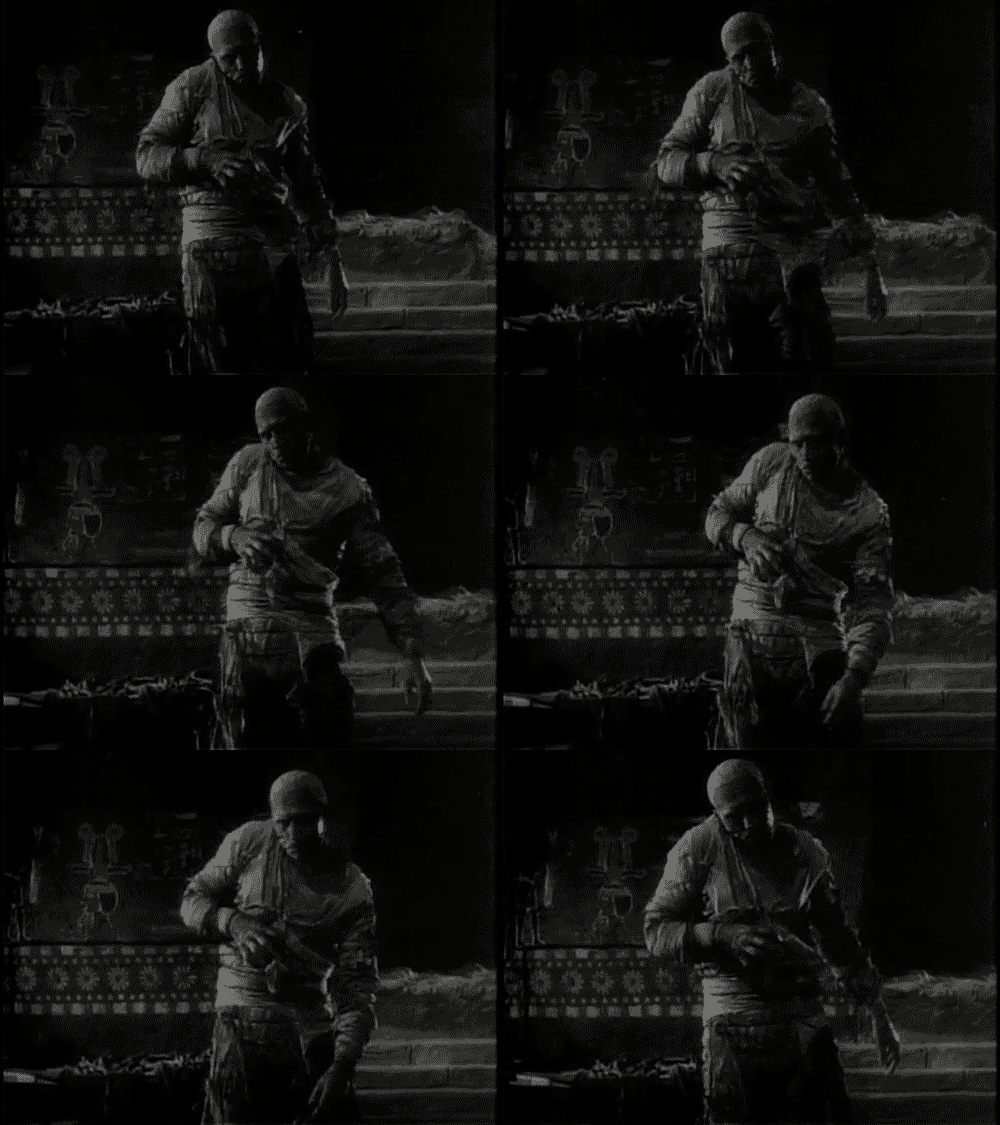
Without Sin ~ A Short Story

Without Sin
~ A Short Story by Allen Kopp ~
(This short story has been published in Paranormal Horror Anthology.)
The service ended. All the mourners departed, and the caretaker, whose name was Lemon, was left alone. He stood beside the open grave, his hands in his pockets, looking off into the distance. He was waiting for the two grave diggers to come and finish the job.
He approached the coffin. The lid had not yet been secured; he lifted it and looked inside. The deceased was a woman with artificial-looking red hair, about fifty years old. He wondered, as he always did, what had taken her. She looked healthy enough. He had heard of many suicides—something inexplicable in the air, perhaps, that made people melancholy and want to do away with themselves. Maybe she was one of those.
She was wearing a necklace with one fairly large red stone, apparently a ruby, and several smaller ones. It could be a real ruby or it could be colored glass. Her family looked prosperous enough. They wouldn’t want her to go to her eternal glory wearing fake stones. She was also wearing a wedding ring with a medium-sized diamond and some smallish earrings, no doubt worth a lot of money. He shook his head in amazement, as he had many times before, at the foolishness of people. Burying precious jewelry forever in the ground where it will never do anybody any good.
He heard someone coming and closed the lid. He looked up and saw the two gravediggers coming toward him. Drexel was the older of the two and out in front. He walked with a swagger wherever he was, even when no one was around. He thought he was cock of the walk and wasn’t bothered one bit that he displaced dirt and buried dead people for a living. The profession, for him, had certain advantages. He had few rules and could always do the job no matter how drunk he was.
The other gravedigger was as much a boy as a man. His name was Lanier. He lived with his mother in town. People believed him simple-minded but he was a good worker and never complained or caused trouble. He was happy to work as a gravedigger and looked up to Drexel, who was his third or fourth cousin. The two of them got along well because Drexel didn’t mistreat Lanier and Lanier always did as he was told without question.
“Where the hell have you been?” Lemon asked.
“Around,” Drexel said. “We’re here now.”
“I could have you fired in a flash for not being here when you’re supposed to be.”
“Well, we’re here now,” Lanier said in the cheeky tone he used only when he was backing up Drexel.
“What have we got here?” Drexel asked, pointing toward the coffin.
“A good lady, waiting for you to send her off to her eternal slumber,” Lemon said.
Drexel raised the lid and looked inside. “Looks like she’s already started on that,” he said with a little laugh.
Lanier looked away when the lid was opened. He didn’t like looking at dead people.
“That’s a ruby necklace she’s wearing around her neck,” Drexel said. “Must be worth something, if I know my jewelry.”
“Not this time,” Lemon said.
“What do you mean ‘not this time’?”
“I mean the good lady keeps her jewelry.”
“How is it that you get to say? You’re not the only one here.”
“Every living thing on earth is part of a hierarchy,” Lemon said.
“Part of a what?”
“In the hierarchy of things, the caretaker of the cemetery is above the gravedigger in all matters.”
“That’s crazy talk.”
“Nevertheless, it seems this woman is a distant relative of my mother’s. I don’t want to defile her person at a time when she is most unable to prevent it.”
“You haven’t got a mother.”
“Very well, then. We’ll let a coin toss decide the matter.” He reached into his pocket and took out a coin. “Call it,” he said.
“Tails,” Drexel said.
“Very well. If the coin lands on its tail, we take the goods, bury the lady, and nobody is any the wiser. If, however, the coin lands on its head, the lady goes to her eternal slumber fully equipped.”
He flipped the coin into the air and made no attempt to catch it when it came down. It landed at his feet.
“Hah!” Drexel said. “It’s tails! I want the ruby necklace. I have a dear friend that it would look very good on.”
“I saw it first!” Lemon said. “The necklace is mine. And I’m not so stupid as to give it to somebody who might wear it in public and have it recognized.”
“Oh, and what are you going to do with it?”
“I’ll sell it to the acquaintance of mine in the faraway city who pays a good price and doesn’t ask questions, as with the other stuff. You see, there’s a way to remount a stone like that so the lady herself would never recognize it.”
“Says you!”
“A worthy rejoinder, if I ever heard one!”
“You talk like a damn fool. Let’s get the goods before somebody comes and get the old dame in the ground and get it over with.”
Lemon opened the coffin again and took hold of the necklace and gave it a tug. He couldn’t see how to get it off and didn’t want to break it, so he slipped it off over the dead woman’s head. Once he had the necklace in his hands, he held it up to his own neck, waggled his hips and took a few mincing steps.
“Oh, what a lovely girl!” Drexel said with a sneer.
Lanier had turned his back on Drexel and Lemon and didn’t want to think about what they were doing. He knew they were doing something bad and he wanted no part of it, although he did nothing to stop it.
“I’m going over there,” he said and walked quickly away out of sight.
“That boy is without sin,” Lemon said, “rather like those three little monkeys: Hear no evil, see no evil, speak no evil.”
Drexel removed the woman’s wedding ring with a devilish chortle and put it in his pocket. When he tried to remove the earrings, though, he couldn’t see how to get them off.
“There’s a little thing in back that releases them,” Lemon said.
He helped Drexel turn the woman partway over so they could see the backs of her ears. She was as stiff as a pillar of salt and didn’t bend at the joints.
“She’s really truly dead,” Lemon said.
“I think I hear someone coming,” Drexel said.
He let the woman fall back into place and took out the pruning shears. He cut off the woman’s earlobes neatly and wrapped them, earrings and all, in a rag and put it in his pocket along with the wedding ring.
“The good woman will arrive at the gates of heaven with her earlobes missing,” Lemon said. “St. Peter will take one look at her and believe she has met with an accident.”
“It doesn’t matter,” Drexel said. “When you’re dead, nothing matters.”
“Nevertheless, she shall be welcomed with open arms!”
Drexel whistled for Lanier to come back and began to secure the lid of the coffin.
“One moment!” Lemon said. “I wish to bid the good lady the fond farewell that she so richly deserves.”
He bent over and kissed the dead woman full on the lips. Drexel did the same and, not to be outdone, licked her lips and squeezed her breast.
“Ah-ah-ah!” Lemon said. “There’ll be no necrophilia in my presence.”
“As if you yourself don’t engage in the practice every chance you get!”
Lanier returned and they secured the lid and lowered the coffin into the grave. Before they were finished replacing all the dirt, another service began in another part of the cemetery. They tidied up the gravesite, cleared away their tools and left unnoticed.
Two days later Lemon and Drexel were both dead.
When Lemon failed to appear to perform his duties as caretaker, the cemetery owner and his assistant went looking for him, expecting to find him in a drunken stupor. Instead they found him in the caretaker’s cottage, lying on the bed in full woman’s rigging, including dress, stockings, shoes and curly red wig. Around his neck was the ruby necklace he filched from the dead woman. They thought to revive him but on closer inspection discovered he had been dead long enough to stiffen. His tongue was swollen out if his mouth and his eyes and ears were seeping old blood.
As for Drexel, an old farmer saw him standing in the middle of an empty field with his arms outraised. When the farmer went to him to find out who he was and what he was doing, Drexel was babbling and insensate. While the farmer was asking Drexel useless questions, he fell dead at the farmer’s feet. The farmer looked through Drexel’s clothing to try to find some clue to his identity and discovered the handkerchief containing the earlobes with the diamond earrings attached and the wedding ring.
The woman with the ruby necklace had sickened and died with alarming suddenness. Her doctors didn’t know how to treat her illness because they didn’t know what the illness was. How or where she contracted it was never known. It was obviously an illness that came about through contact with one infected, rather than through the air. Had the lady led a secret life of some kind?
Lanier never touched the woman or her jewelry, so he escaped the illness. His mother forced him to abandon his profession as grave digger, however, as she suspected that Lemon’s and Drexel’s deaths had something or other to do with acts they performed on a dead body when nobody was around. The thought sickened her.
When Lanier was asked what Lemon and Drexel were doing on that last day in the cemetery that might have made them sick, he shrugged his shoulders and smiled his benign smile. They were always doing and saying things that didn’t interest him, he said. He was in another part of the cemetery tending to some flowers he had planted, minding his own business while other people minded theirs.
Copyright © 2023 by Allen Kopp
 Literary Fictions