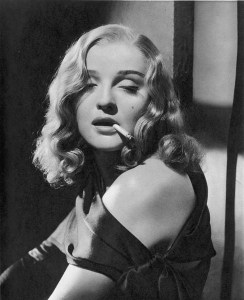
See a Show, Smoke a Lucky

See a Show, Smoke a Lucky ~ A Short Story by Allen Kopp 

Miss Bobbie Bouchard lived in an air-conditioned apartment on the fifteenth floor in an apartment building in the city. When her mother went into the hospital for an extended stay during the summer, she sent Bobbie to stay with her aunt and uncle on their farm a hundred miles from the city. Bobbie rode all that way on the bus by herself, feeling very grown-up and wishing she had bought along a pack of cigarettes to smoke on the way. When the bus stopped midway through the trip for a rest stop at a little café, she went inside and sat at a booth by herself and ordered a tuna salad sandwich and a Coke just like a seasoned traveler.

Uncle Floyd and Aunt Bernice had two children of their own, cousins of Bobbie Bouchard. Bobbie liked them well enough, even though they were younger than she was and they seemed awfully naïve. There was a girl named Freda, who was fourteen, and a twelve-year-old boy named Floyd Junior, who was just called Junior. Neither of them had ever gone to a show, smoked a cigarette or kept a secret from their mother. The only family secret was that Junior occasionally wet the bed, still, at his age. The doctor said it was an adolescent phase and that Junior would eventually stop doing it. In the meantime he advised Aunt Bernice to buy a rubber sheet.

Bobbie was just as naïve about the farm as Freda and Junior were about the way things were done in the city. She thought chickens were strange, exotic creatures and a pig was a kind of dog that might bite her if she got too close. She could hardly believe that you could go all day on the farm and not see any people or cars and hear nothing except the wind in the trees and the sounds the farm animals made. At night the crickets kept her awake, but after three or four nights she didn’t notice them as much.

When Bobbie saw in the newspaper that there was a show in the town of Delford, about ten miles from the farm, and that they had a two o’clock matinee on Saturday, she asked Aunt Bernice if she and Freda and Junior might go. Wanting Bobbie to have as much fun as possible during her stay on the farm, Aunt Bernice agreed.

Saturday was the day that Aunt Bernice had to see her doctor in the city for her female trouble; Uncle Floyd would be driving her in his pickup truck. They left at nine o’clock in the morning and wouldn’t be back until evening. Before she left, Aunt Bernice gave Bobbie a wad of bills from her egg money and put her in charge of the trip to Delford to see the show, since she was the oldest. She was to watch out for Freda and Junior and make sure they were careful and that nothing bad happened to them.

After breakfast and after Uncle Floyd and Aunt Bernice had left, Bobbie and Freda were still sitting at the kitchen table. Bobbie was telling Freda a funny story about a family of midgets that lived in her apartment building in the city. There was a write-up about them in the newspaper. They had tiny furniture made especially for them, a tiny bed, table, sofa and chairs just a little bit larger than doll furniture. They had a special-made door on their apartment, with the knob and the lock about knee-high to a normal-sized person.

Bobbie stopped mid-sentence and looked appraisingly at Freda. “You have hardly any eyebrows at all,” she said.

“What?” Freda asked. She had difficulty making the transition from midgets to eyebrows that fast.

“Hold on a minute!” Bobbie said.

She ran into the bedroom she shared with Freda and when she came back she was carrying a makeup kit. She unzipped it and took out an eyebrow pencil and gently penciled in where Freda’s eyebrows would be if she had any.

“You look just like Joan Crawford!” she said when she was finished, handing Freda a mirror.

“Like who?” Freda asked.

When Bobbie saw the effect of a little eyebrow pencil, she wasn’t going to stop there. She endowed on Freda’s face a full complement of makeup, including rouge, lipstick, mascara and eye shadow. Not too much but just the right amount; if she had learned anything at all in the city, it was how to apply makeup. Freda had never worn makeup before and was amazed at the way it made her look. When she looked at herself in the mirror, she saw a much older, more sophisticated girl looking back at her.

“Mother would die if she saw me like this,” she said.

“You look great!” Bobbie said. “Your hair ruins it, though.”

She seemed to have a solution for everything. She just happened to have a curly blond wig in her suitcase. She went to the bedroom and brought it back to the kitchen and put it on Freda’s head, covering up her own lank, colorless hair with it, tugging it until it was in place and pushing the stray strands underneath.

“There!” she said, handing Freda the mirror. “Now you look like somebody.”

“That’s not me,” Freda said.

Junior came into the kitchen with his hair slicked back, wearing his favorite blue plaid shirt. When he saw Freda, he said, “Who are you supposed to be?”

“Doesn’t she look glamorous?” Bobbie said.

“Daddy is going to kill her!”

“He’ll never know about it,” Bobbie said.

“And you’d better not tell him!” Freda said. “If you do, I’ll tell him and mama about how you skipped Sunday school.”

“I didn’t skip Sunday school,” he said. “I just didn’t go.”

“I hope I don’t see anybody at the show who knows me,” Freda said. “They’re bound to tell on me.”

“You look so different nobody would ever know who you are,” Bobbie said with a laugh.

They walked half-a-mile up the highway to the crossroads to catch the bus to Delford. Bobbie carried a big patent leather handbag that contained the money to ride on the bus and see the show, along with a headscarf, cough drops, lipstick and some other things she might need. She still had not been able to come by any cigarettes since she had been on the farm, though. Freda felt funny at first in the wig and makeup, but after a while when she realized people weren’t staring at her she felt more comfortable.

The bus ride to Delford, at about fifteen minutes, was all too short for Bobbie Bouchard. After being on the farm for several days, she was happy to be moving again and to see people. There were hardly any people on the bus and they were very quiet, absorbed in their own thoughts. Nobody paid any attention to Bobbie, Freda and Junior. Junior sat in a seat by himself and looked out the window at the passing scenery as if he had never seen it before. Bobbie talked the whole time about motion pictures she had seen and about her favorite motion picture actors and actresses. She found it very nearly incredible that Freda and Junior had gone their entire lives and hadn’t seen a motion picture. She felt sorry for them and didn’t know how they could have stood such a life.

The bus let them out at a little gas station on the edge of the Delford downtown business district. It was an easy walk to get to the show and the stores that lined the two streets, Main Street and First Street. Bobbie told Freda and Junior to wait for her for a minute while she went into the gas station. They thought she needed to use the restroom, but when she came out they saw that she had bought a pack of Lucky Strike cigarettes, with a complementary book of matches, which she ostentatiously placed inside the patent leather handbag.

Bobbie was a little disappointed that the movie that was playing was a western—she much preferred musicals or love stories—but she was willing to see the western for Freda and Junior’s sake and not complain about it. If she had been in the city, she would have had four or five movies to choose from. In a little town like Delford, though, when a western was playing, a western is what you saw.

There was lots of action in the movie, lots of riding and shooting. When the characters in the movie, mostly men, weren’t sitting around in the saloon talking and drinking beer while they played poker around a big table, they were riding horses through the desert or getting into fights or shooting at each other from behind big rocks. The sheriff of the town had a red-haired girlfriend with big breasts who was always crying and begging him to take her away and marry her. She had a brother with a big scar on the side of his face that gave him a lopsided grin. He was a cattle rustler and a murderer and the mortal enemy of the sheriff. The red-haired, big-breasted woman was torn between her love for the two men, one her brother and the other her sweetheart. In the end there was the inevitable showdown between them, the struggle between good and bad.

When the show was over, they still had plenty of time before their bus back to the farm, so they went to the Idle Hour Café across from the courthouse. They sat at a booth next to a window. After an elderly waitress in a black-and-white uniform came and took their order, Bobbie opened her purse and took out her cigarettes and lit one as if it was the most natural thing in the world.

“Did you like the show?” she asked Junior.

“I liked it fine,” he said. He never seemed to have too much to say about anything. “Can we go again sometime?”

“I don’t think your mother would like it if she knew you were smoking,” Freda said, looking over her shoulder to make sure nobody was looking.

“She’s not here, though, is she?” Bobbie said. “Would you like to try one?”

“No.”

“I’d like to try one,” Junior said.

“You’re twelve years old,” Freda said.

“Go ahead and take a puff,” Bobbie said. “Nobody’s looking.”

“Only if Freda does it first,” he said. “Then she can’t tell on me if I do it.”

“I’m not going to do it,” Freda said.

“Then I won’t either,” Junior said.

Bobbie placed the cigarette on the ash tray and slid it across the table to Freda. “Nobody’s looking,” she said.

“Go ahead,” Junior said.

Freda picked up the cigarette and took a small puff and blew the smoke out as quickly as she took it in.

“It doesn’t count if you don’t inhale,” Bobbie said.

Bobbie took the cigarette back from Freda and showed how to take the smoke into the mouth and draw it down into the lungs before letting it out. Freda tried doing what Bobbie had done but started coughing.

“It tastes terrible,” she said, “and it burns my throat.”

“You get used to it after a while,” Bobbie said.

“Now let me try,” Junior said.

He took a couple of preliminary puffs before making a show of trying to inhale.

“I don’t think you did it right,” Freda said.

“Close enough for twelve,” Bobbie said.

“Can they put you in jail for smoking?” Junior asked.

“Smoking is silly,” Freda said. “I don’t know why anybody wants to do it.”

“It’s very sophisticated,” Bobbie said. “All the best people do it.”

While they were eating, an older gentleman with a big belly and a toupee stepped up to the table and snapped Freda’s picture with a camera he had hanging around his neck. “Pardon me,” he said. “I wonder if I might have a word with you.”

Freda looked at him, bewildered. She thought it had something to do with the cigarette. “Yes?” she said. She put down her hamburger and wiped her fingers. She half-expected to be handcuffed and led away.

“I couldn’t help noticing you sitting there in front of that window. Your face stands out above all the others.”

“What?” she asked. “I was just sitting here.”

“The way the light shines through the window behind your head, I think you would photograph very well.”

“I, uh—“

“What are you talking about, mister?” Bobbie asked. “You’re scaring the poor girl.” She had learned how to deal with his type in the city.

“May I?” the man asked, stepping closer to Freda. He put his finger under her chin and lifted her face. “You have a very interesting physiognomy,” he said.

In the excitement of riding on the bus, seeing the show and eating in a restaurant, Freda had forgotten she looked like somebody completely different from who she was. “I, uh, this is not me,” she said.

“I’m a casting director for a motion picture production company,” he said, handing her his card. “We’re shooting a picture locally and want to hire some non-professional actors for some of the smaller speaking parts. I think you might be right for one of the parts.”

“A part in a movie?” Bobbie asked.

“Well, perhaps,” he said. “That is, if she’s available and interested.”

“I, uh, I don’t know,” Freda said.

“Are you a minor?”

“What?”

“He’s asking you your age, dumbbell,” Bobbie said.

“I’m fourteen,” Freda said.

The man took a step back. “You look older than that,” he said. “You look about sixteen or seventeen.”

“That’s what I’ve been telling her,” Bobbie said.

“No matter,” he said. “Since you are a minor, have your parent or guardian call us at the number on that card and we’ll arrange a time for you to come in and talk to us.”

“She sure will, mister!” Bobbie said. “And thanks.”

The man tipped his hat and walked away.

“What just happened?” Junior asked.

“Imagine that,” Bobbie said. “A part in a movie!” She didn’t know whether to be jealous or terribly happy for Freda, so she was both.

Freda laughed. “They wouldn’t want me if they knew what I really look like underneath.”

“Don’t be silly,” Bobbie said. “They don’t care about underneath. They care about what they can see.”

“It’s just about the silliest thing that’s ever happened to me,” Freda said, flushing with embarrassment.

“I told you you looked great and you didn’t believe me.”

“Are they going to make you a movie star?” Junior asked.

“It’s too ridiculous,” Freda said.

“You’ll call, won’t you?” Bobbie asked. “Just as soon as you get home?”

“No,” Freda said. “I can’t call. It’s not me they want. It’s somebody who doesn’t even exist.”

“Have Aunt Bernice call.”

“I can’t have her know about this. She’d just about die.”

“So does that mean you’re not going to call?”

Bobbie considered calling herself and saying she was the girl the man saw in the restaurant, but she didn’t know if she would be able to pull it off. He would know as soon as he saw her that she was somebody else, the “other girl” who didn’t even rate a second look.

When they left the Idle Hour Café, they still had more than an hour before their bus, so they walked around, looking in store windows. Bobbie smoked on the street and tried to get Freda and Junior to light up, but they refused. They had smoked once already and that was enough. All the fun had gone out of it.

Bobbie tried repeatedly to talk Freda into calling the number on the card, but Freda wanted no part of it and she refused to let Bobbie call on her behalf and pretend to be Aunt Bernice. She wanted to forget all about it, she said, but, above all, she wanted to keep Uncle Floyd and Aunt Bernice from ever knowing about it. She made Junior promise not to ever mention it. If he should forget and let it slip, she would tell them he had smoked. Never mind that she had smoked, too.

Bobbie believed that Freda was passing up the chance to be a big star, maybe even bigger than Linda Darnell, Rita Hayworth, or Susan Hayward. She believed a chance like that only comes along once in a lifetime. A part of her, deep down, though, was glad. She wouldn’t have to go through life seeing Freda a movie star while she herself was something less. She believed that things always work out for the best.

A few days later, Bobbie received a call from her mother. She was going home from the hospital and she wanted Bobbie to come home and help take care of her while she recuperated from an operation. Bobbie hated the thought of being cooped up at home taking care of her mother, but she promised to come back to the farm as soon as she could. For the next trip, she would think of all kinds of fun things for the three of them to do. She had some secret pictures she would bring along next time to show them.

Copyright © 2012 by Allen Kopp 

Abraham Lincoln: Vampire Hunter ~ A Capsule Movie Review

Abraham Lincoln: Vampire Hunter ~ A Capsule Movie Review by Allen Kopp

Abraham Lincoln: Vampire Hunter is based on the genre-bending (part horror, part historical fiction, part fantasy) novel of the same name by Seth Grahame-Smith. In the movie and the book, Abe Lincoln is an intrepid vampire killer, due in part to the notion that his mother was killed by vampires when he was at the impressionable age of only nine years. He soon discovers that vampires are everywhere, waiting to become the dominant species.

Abe is assisted in his hunt for vampires by one Henry Sturgess, who, Abe discovers, is a vampire himself but also a sworn enemy of all vampires. It seems that vampires can’t kill each other, so Henry uses Abe as his instrument in bringing down select vampires. Abe doesn’t use firearms against vampires, but instead prefers a silver-edged axe. There is much severing of heads and spurting of blood.

As Abe grows into manhood, he meets and marries Ann Todd from Springfield, Illinois. He becomes a lawyer and becomes interested in politics. He abhors slavery and sees the growing struggle between the North and the South as a struggle between vampire and non-vampire. Vampires want a nation of their own, it seems, and the vampire nation will become the separate nation formed if the South is victorious over the North in the epic War Between the States. When Abe becomes president, he has the monumental task of keeping the Union together and making sure the vampire nation does not become a reality.

I was a fan of Abraham Lincoln: Vampire Hunter, the novel, when I read it a couple of years ago. For my money, the movie version doesn’t work as well as the book. We don’t really feel Abe’s anguish and experience his personal misfortune the way we did in the book. We don’t feel the threat the vampires pose (to Abe, his family and the country at large). Also, the ending in the movie seems rather flat, as if they squandered the book’s ironic ending. It could have been a great movie but isn’t. Still, it’s not a bad summertime movie if you like that kind of movie, a toss-away, that you see and forget about. It could have been a lot more than that.

Copyright © 2012 by Allen Kopp 

Tomorrow and Tomorrow and Tomorrow

From Macbeth, Act 5, Scene 5, 19-28


by Willliam Shakespeare (1564-1616) 


To-morrow, and to-morrow, and to-morrow,
Creeps in his petty pace from day to day,
To the last syllable of recorded time;
And all our yesterdays have lighted fools
The way to dusty death. Out, out, brief candle!
Life’s but a walking shadow, a poor player,
That struts and frets his hour upon the stage,
And then is heard no more. It is a tale
Told by an idiot, full of sound and fury,
Signifying nothing.


Never Marry

Never Marry ~ A Short Story by Allen Kopp 

Mrs. Shockley had been a widow for many years. Just when she was thought to be past such things, she began “keeping company” with an old man named Wallace Timpkins, who worked as a janitor at the grade school. Nobody was more chagrined at Mrs. Shockley’s recent flowering than her forty-year-old unmarried daughter, Edith. She watched in disbelief as her mother and Wallace sat on the couch on the evenings when he came for dinner, whispering and grappling together like a couple of adolescents. Edith was embarrassed for her mother. She knew that she, of all people, had to rescue her from the spell that Wallace seemed to have cast over her.

When Wallace Timpkins proposed marriage to Mrs. Shockley and she told him she needed a few days to think about it, Edith knew the situation was spiraling out of her control. Having dinner together and sitting on the couch afterwards was one thing, but talk of marriage seemed to be taking it a step too far. She had hoped her mother would come to her senses about Wallace but, if she married him, it would be too late; she would be stuck with him for as long as she lived and where would that leave Edith? She had no intention of being put out of her home.

One rainy Saturday morning when Edith had washed Mrs. Shockley’s hair at the kitchen sink and was putting it up in rollers at the table, she broached the rather sensitive topic of a union with Wallace.

“You wouldn’t really marry him, would you?” she asked.

“I don’t know why not,” Mrs. Shockley said. “He’s free and I’m free. We’re both of age.”

“Yes, but why would you even want to marry him?”

“Why does anybody get married?”

“I know why he wants to marry you.”

“Why?”

“He needs a cook, laundress and housekeeper and he can’t afford to hire one.”

“What a terrible thing to say!”

“How do you know he isn’t already married?”

“His wife died. He told me all about it.”

“How did she die?”

“She was hit by a train.”

“How do you know he didn’t push her?”

Mrs. Shockley sputtered with laughter and turned around so she could see Edith’s face. “Why would he do that?”

“So he would be free to marry you.”

“Oh! This conversation is getting out of hand!”

“You know nothing about him.”

“I know enough.”

“How long as he worked at the school?”

“Six years.”

“Where was he before that? Has he ever been in prison?”

“Why don’t you ask him yourself? He’s coming over tonight for dinner.”

With that revelation, Edith went upstairs to her room and locked herself in, refusing to finish rolling up her mother’s hair. Let her do it herself for once and see how she likes it, she thought.

For the rest of the morning and most of the afternoon, Edith remained in her room. She didn’t come down for lunch but instead sampled generously from a box of chocolate candy she kept in her dresser drawer. After that she took a long nap, waking up to a pounding headache and the smell of cooking food. She went downstairs silently and set the dining room table for three.

Wallace arrived just as dinner was ready. He seemed, Edith thought, to have a sixth sense where food was concerned. As she brought the chicken in from the kitchen and set it in the middle of the table and Wallace pulled out her chair for her to sit down, she thought: the dinner is already ruined for me. Mrs. Shockley was giggling like a schoolgirl and Wallace had only been there for five minutes.

Edith sat and nibbled at her food (what appetite she had was gone), looking coldly at her mother and Wallace. Mrs. Shockley spread some butter on a roll and held it up to Wallace; when he took a bite of it, the butter rolled down his chin. He began laughing to himself and when Mrs. Shockley asked what was so funny, he leaned over and whispered something in her ear, which caused her to erupt into a fit of laughter. When Wallace’s left hand wasn’t engaged in stuffing food into his maw, it was usually someplace or other on Mrs. Shockley’s body. Edith thought she was going to be sick. She needed to say something to remind them that she was also in the room.

“Being a janitor at a school must be terribly exciting,” she said, with an archness that Wallace and her mother both missed.

“What was that?” he asked, taking his eyes off Mrs. Shockley to look directly at Edith.

“I said it must be so exciting to be a janitor.”

“No, it’s not exciting,” he said. “It’s a living, that’s about all I can say. There are the good days and the bad days.”

“How long do you intend to be a janitor?” Edith asked.

“Until I retire, I guess.”

“And when might that be?”

“I don’t know yet.”

“Why all the questions?” Mrs. Shockley asked.

“I don’t know,” Edith said. “I guess I’m just trying to get better acquainted.”

“Yes, that’s a good idea,” Wallace said, “since we’re all going to be living in the same house together.”

“Why do you say that?” Edith asked.

“I haven’t told her yet, dear,” Mrs. Shockley said.

“Told me what?” Edith asked.

“I’ve accepted Wallace’s proposal of marriage. We’re going to be married in about six weeks, when school is out.”

Edith wasn’t even mildly surprised. She had been expecting the news. “This is rather sudden, isn’t it?” she asked.

“We decided the time is right,” Wallace said. “We neither one of us are getting any younger.”

“Do you think it’s wise for two people of your age to get married?” Edith asked.

“You’re beginning to sound rude,” Mrs. Shockley said, reaching over and taking Wallace’s hand in hers. “I was hoping you would be happy for us.”

“I am happy for you,” Edith said. “I just think there are some practical considerations that must be taken into account.”

“Like what?” Mrs. Shockley asked.

“Where are you going to live?”

“Wallace is going to move in with us, dear,” Mrs. Shockley said. “He lives in a rented place. We own our home.”

“I see,” Edith said. “And where does that leave me?”

“Why, what do you mean?”

“Where am I supposed to live?”

“You’ll live here with us, of course.”

“Why would I want to do that?”

“This has always been your home. I never thought of having it any other way.”

“I see,” Edith said, tears forming in her eyes. “While the two of you are mooning around, giggling and pawing at each other in a nauseating fashion, I’ll be doing all the housework, all the cooking, cleaning, washing and sewing. I’m to be relegated to the role of unpaid servant, is that right?”

“Well, of course not!” Mrs. Shockley said. “What a ridiculous notion!”

“I think she just needs some time to get used to the idea,” Wallace said. “It’s a bit of a shock for her.”

“I just might be getting married myself,” Edith said defiantly.

“Who would marry you?” Mrs. Shockley said with a laugh.

“Do you realize how insulting that is?” Edith asked. “As if nobody in the world would ever want to marry me!”

“I didn’t mean it that way,” Mrs. Shockley said. “It’s just that we’ve already gotten so used to the idea that you will never marry. It seems your time has come and gone.”

“Oh!” Edith said. “So that’s what you think of me, is it?”

“I think we just need to calm down and take a deep breath and watch what we say,” Wallace said.

“You don’t need to be giving me orders in my own house!” Edith said.

“There’s no need to be so touchy about everything!” Mrs. Shockley said.

“Let’s talk about something more pleasant,” Wallace said, “and talk about the marriage stuff later. There’s no hurry.”

“My mother and I own this house,” Edith said. “If she dies, the house belongs to me. If she marries you, does that mean you own the house?”

“We haven’t thought about anything like that,” Mrs. Shockley said.

“We can work out those details later,” Wallace said. “Let’s not spoil this lovely dinner.”

They sat in silence for a few moments, with Edith snuffling back tears. When it was time to serve the dessert, Mrs. Shockley started to get up to go into the kitchen.

“You just stay put,” Edith said, “and keep Mr. Timpkins company. I’ll get the dessert and make the coffee.”

“All right, dear,” Mrs. Shockley said.

Edith went into the kitchen and squeezed the tears out of her eyes. She took the banana cream pie out of the ice box where it was chilling and sliced three big pieces. While she was waiting for the coffee to brew, she took the flashlight out of the drawer and went quietly down the basement steps.

She went to the far corner of the basement—shining the light in the murk—behind the furnace and past the hot water heater, to the little shelf where her father used to keep paint cans. Now the shelf was empty except for a box of rat pellets that her mother had bought when she mistakenly believed she saw a rat under the basement steps. She shook two of the pellets into her hand and went back upstairs.

The pellets were hard like stale cookies. She crumbled them up with a butter knife and, after she had poured three cups of coffee, dissolved the rat pellets into one of the cups. She put the three slices of pie and three cups of coffee on a tray—the cup with the rat pellets in it separated from the other two—and took them into the dining room.

Her mother was talking about a murder case she had been reading about in the paper and Wallace was, as usual, hanging on her every word. After Edith set the coffee and pie in front of Wallace, she resumed her seat and watched him closely after he began taking small bites of the pie and sipping the coffee. She didn’t know how many pellets it would take to kill him but, if he was going to die, she hoped he would not die until later, until after he had gone home. Maybe the small amount she had used would only make him sick. Maybe it would have no effect at all.

When they were finished eating, Mrs. Shockley began clearing the table, but Edith told her to take Wallace into the living room and have a nice “visit” with him while she washed all the dishes herself and put everything away. Mrs. Shockley readily complied, believing that Edith was over the “unpleasantness” that had occurred earlier.

While Edith was in the kitchen, she could hear her mother and Wallace talking and laughing in the front room. He played the piano while she sang in her quivery soprano. After a while she heard nothing, so she was sure they were locked in an intimate embrace on the couch. In that way did all their evenings conclude.

She went upstairs to her room and read for a while and then readied herself for bed. She was aware when Wallace Timpkins left to go home about eleven-thirty. She heard her mother come upstairs a short time after that and go into her bedroom and shut the door.

She slept well and soundly and was awakened at dawn by the ringing of a bell. It took her a few seconds to realize the ringing was the phone in the hallway, halfway between her room and her mother’s room.

After several rings, her mother opened her door and come out into the hallway to answer the phone. Edith listened carefully to the voice of her mother as it went from a barely audible murmur to a gasp and a cry of distress. She turned over on her side and covered up her head. When her mother came into her room to tell her the news, she would pretend to be asleep and would not be smiling.

Copyright © 2012 by Allen Kopp

The Borgias, Season Two ~ A Capsule Review

The Borgias, Season Two ~ A Capsule Review by Allen Kopp  

The Borgias, on Showtime, is nearing the end of its second season. Anybody who has seen any part of The Borgias knows it is a lavish and beautifully photographed series about the Borgia family during the time of the Italian Renaissance. The Borgia family is not billed as “the original crime family” for nothing; it seems there is nothing they won’t do to get what they want or to hold onto their considerable power.

Pope Alexander VI (played by Jeremy Irons), whose name is Rodrigo Borgia before he becomes pope, is the patriarch of the Borgia family. To achieve his ends and to maintain his position on the papal throne, he is aided by his loyal son, Cesare, who becomes a cardinal when his father becomes pope. Like his father, Cesare will stop at nothing to achieve his ends (or his family’s). Also like his father, he seems driven by the belief that he is always right and always justified in his actions, no matter how brutal or ruthless they might seem. More often than not, he is aided in his dirty work by his faithful friend, Micheletto, who was bred on the streets of Rome and who has some secrets of his own.

Pope Alexander’s beautiful daughter, Lucrezia Borgia, started out as a young innocent but was soon disillusioned when she was married off to a boorish nobleman in an alliance that was supposed to help her family (it didn’t). She has a dalliance with a handsome, illiterate stable boy, Paolo, that results in a son. Paolo meets a violent end at the hand of Lucrezia’s brother, Juan.

Juan Borgia, Cesare’s younger brother, is an oversexed hellion who is, more often than not, an embarrassment to his family. He is cruel, arrogant and foolish, frequently caught up short by his rash actions. When he is sent away to Spain for a while to get him out of the way, he returns with a wife and a case of syphilis, for which there is no cure.

Pope Alexander was never married to the mother of his children (played by Joanne Whalley), so, to avoid the appearance of impropriety when he becomes pope, he sends her to live elsewhere. She remains a player in the family, however, even though Pope Alexander has taken up with the beautiful Julia Farnese, whom he quickly installs in the papal palace as his mistress.

Pope Alexander has an arch-enemy, one Cardinal Della Rovere (played by Colm Feore), who seems motivated entirely by his hatred of the Borgia family and by his desire to see Pope Alexander removed from the papal throne. He will rally the pope’s enemies against him if he can, or he will see the pope poisoned (or otherwise murdered) if there is no other way.

Another enemy of the Borgias is the religious zealot Savonarola. He despises Pope Alexander (and what he sees as his excesses and extravagance) as much as Cardinal Della Rovere does. He travels around the country preaching fiery, anti-Borgia sermons to anybody who will listen. He and Pope Alexander are destined to clash in one way or another. Pope Alexander will burn him at the stake as a heretic if he has his way.

There’s no shortage of sex and violence in The Borgias, sometimes in the same scene. (In one telling scene, Lucrezia Borgia tries to murder her brother Juan by letting a chandelier tall on him while he is engaged in a sex act with a prostitute). There is also spurting blood, severed heads and limbs, stuffed cadavers, torture and ceaseless warfare. It’s TV for grown-ups. It’s also fascinating to watch, intelligently acted and written, and beautiful to look at. The sets and costumes are lavishly detailed and amazing to see. The photography, especially in the outdoor scenes, is gorgeously reminiscent of Italian Renaissance painting. The Borgias is a feast for the eyes.

Copyright © 2012 by Allen Kopp

Prometheus ~ A Capsule Movie Review

Prometheus ~ A Capsule Movie Review by Allen Kopp

The new movie, Prometheus, is a highly speculative (don’t take it too seriously) story about the search for the origins of human life on earth, the premise being that humans on earth originated on another planet in a distant galaxy. It was directed by Ridley Scott, whose impressive credits include the sci-fi classics Alien and Blade Runner and the Oscar-winning Gladiator.

As the movie begins, a spectacular spacecraft called Prometheus is nearing its destination, an alien planet (with an atmosphere sort of like earth) so far away that it has taken nearly two and a half years to get there. The human crew has been asleep, or in a state of suspended animation, during the long flight. Only David, the creepy human-like android, has been awake to keep the ship in order. David (played by Michael Fassbender) is my favorite character in the movie. He is unflappable because he doesn’t have human emotions, but he has a fey quality about him not unlike Peter O’Toole in Lawrence of Arabia. With his perfectly combed blond hair and his soft voice, he is probably up to something, but we don’t know right away what it is.

When some of the crew members leave the Prometheus to investigate an enormous pyramid-like structure on the alien planet, they find the remnants of a humanoid race that seemed to have died out precipitously for some reason. Did they (the humanoids) sew the seeds of their own destruction with their secret “weapon” that was supposed to help them subdue their enemies? It seems the crew members have stumbled on something they hadn’t bargained for and don’t understand. There is the same sense of creepy foreboding as in the classic Alien. The body count begins to mount. Who will live and who will die? Are the humans a match for what they have uncovered? Wouldn’t they have been better off to remain on earth?

Prometheus is a great-looking movie in 3D. It has some eye-popping visuals, as you would expect from a movie like this. We have plenty of opportunity to see the interior of the spacecraft Prometheus and we see it wouldn’t be a bad place to spend a few years, as long as you’re guaranteed a safe return, which, of course, the characters in the movie are not. My one quibble is the mix of accents. A lot of the dialogue, especially during the action sequences, is indistinguishable. I’m a person who likes to hear every word that’s said. When Prometheus is shown on TV, I’ll turn on the closed captions (or subtitles if it’s DVD) and hear what I missed. I look forward to seeing it again in a year or so.

Copyright © 2012 by Allen Kopp

“The Lumber Room” by Saki (H. H. Munro)

Saki (1870-1916)

The Lumber Room ~ A Classic English Short Story by Saki (H. H. Munro)

The children were to be driven, as a special treat, to the sands at Jagborough. Nicholas was not to be of the party; he was in disgrace. Only that morning he had refused to eat his wholesome bread-and-milk on the seemingly frivolous ground that there was a frog in it. Older and wiser and better people had told him that there could not possibly be a frog in his bread-and-milk and that he was not to talk nonsense; he continued, nevertheless, to talk what seemed the veriest nonsense, and described with much detail the coloration and markings of the alleged frog. The dramatic part of the incident was that there really was a frog in Nicholas’s basin of bread-and-milk; he had put it there himself, so he felt entitled to know something about it. The sin of taking a frog from the garden and putting it into a bowl of wholesome bread-and-milk was enlarged on at great length, but the fact that stood out clearest in the whole affair, as it presented itself to the mind of Nicholas, was that the older, wiser, and better people had been proved to be profoundly in error in matters about which they had expressed the utmost assurance.

“You said there couldn’t possibly be a frog in my bread-and-milk; there was a frog in my bread-and-milk,” he repeated, with the insistence of a skilled tactician who does not intend to shift from favourable ground.

So his boy-cousin and girl-cousin and his quite uninteresting younger brother were to be taken to Jagborough sands that afternoon and he was to stay at home. His cousins’ aunt, who insisted, by an unwarranted stretch of imagination, in styling herself his aunt also, had hastily invented the Jagborough expedition in order to impress on Nicholas the delights that he had justly forfeited by his disgraceful conduct at the breakfast-table. It was her habit, whenever one of the children fell from grace, to improvise something of a festival nature from which the offender would be rigorously debarred; if all the children sinned collectively they were suddenly informed of a circus in a neighbouring town, a circus of unrivalled merit and uncounted elephants, to which, but for their depravity, ther would have been taken that very day.

< 2 >

A few decent tears were looked for on the part of Nicholas when the moment for the departure of the expedition arrived. As a matter of fact, however, all the crying was done by his girl-cousin, who scraped her knee rather painfully against the step of the carriage as she was scrambling in. “How she did howl,” said Nicholas cheerfully, as the party drove off without any of the elation of high spirits that should have characterized it.

“She’ll soon get over that,” said the soi-disant aunt; “it will be a glorious afternoon for racing about over those beautiful sands. How they will enjoy themselves!”

“Bobby won’t enjoy himself much, and he won’t race much either,” said Nicholas with a grim chuckle; “his boots are hurting him. They’re too tight.”

“Why didn’t he tell me they were hurting?” asked the aunt with some asperity.

“He told you twice, but you weren’t listening. You often don’t listen when we tell you important things.”

“You are not to go into the gooseberry garden,” said the aunt, changing the subject.

“Why not?” demanded Nicholas.

“Because you are in disgrace,” said the aunt loftily.

Nicholas did not admit the flawlessness of the reasoning; he felt perfectly capable of being in disgrace and in a gooseberry garden at the same moment. His face took on an expression of considerable obstinacy. It was clear to his aunt that he was determined to get into the gooseberry garden, “only,” as she remarked to herself, “because I have told him he is not to.”

Now the gooseberry garden had two doors by which it might be entered, and once a small person like Nicholas could slip in there he could effectually disappear from view amid the masking growth of artichokes, raspberry canes, and fruit bushes. The aunt had many other things to do that aftemoon, but she spent an hour or two in trivial gardening operations among flower beds and shrubberies, whence she could watch the two doors that led to the forbidden paradise. She was a woman of few ideas, with immense powers of concentration.

< 3 >

Nicholas made one or two sorties into the front garden, wriggling his way with obvious stealth of purpose towards one or other of the doors, but never able for a moment to evade the aunt’s watchful eye. As a matter of fact, he had no intention of trying to get into the gooseberry garden, but it was extremely convenient for him that his aunt should believe that he had; it was a belief that would keep her on selfimposed sentry-duty for the greater part of the aftemoon. Having thoroughly confirmed and fortified her suspicions, Nicholas slipped back into the house and rapidly put into execution a plan of action that had long germinated in his brain. By standing on a chair in the library one could reach a shelf on which reposed a fat, important-looking key. The key was as important as it looked; it was the instrument which kept the mysteries of the lumber-room secure from unauthorized intrusion, which opened a way only for aunts and such-like privileged persons. Nicholas had not had much experience of the art of fitting keys into keyholes and turning locks, but for some days past he had practised with the key of the schoolroom door; he did not believe in trusting too much to luck and accident. The key turned stiffly in the lock, but it turned. The door opened, and Nicholas was in an unknown land, compared with which the gooseberry garden was a stale delight, a mere material pleasure.

Often and often Nicholas had pictured to himself what the lumber-room might be like, that region that was so carefully sealed from youthful eyes and concerning which no questions were ever answered. It came up to his expectations. In the first place it was large and dimly lit, one high window opening onto the forbidden garden being its only source of illumination. In the second place it was a storehouse of unimagined treasures. Tne aunt-by-assertion was one of those people who think that things spoil by use and consign them to dust and damp by way of preserving them. Such parts of the house as Nicholas knew best were rather bare and cheerless, but here there were wonderful things for the eye to feast on. First and foremost there was a piece of framed tapestry that was evidently meant to be a fire-screen. To Nicholas it was a living, breathing story; he sat down on a roll of Indian hangings, glowing in wonderful colours beneath a layer of dust, and took in all the details of the tapestry picture. A man, dressed in the hunting costume of some remote period, had just transfixed a stag with an arrow; it could not have been a difficult shot because the stag was only one or two paces away from him; in the thickly growing vegetation that the picture suggested it would not have been difficult to creep up to a feeding stag, and the two spotted dogs that were springing forward to join in the chase had evidently been trained to keep to heel till the arrow was discharged. That part of the picture was simple, if interesting, but did the huntsman see, what Nicholas saw, that four galloping wolves were coming in his direction through the wood? There might be more than four of them hidden behind the trees, and in any case would the man and his dogs be able to cope with the four wolves if they made an attack? The man had only two arrows left in his quiver, and he might miss with one or both of them; all one knew about his skill in shooting was that he could hit a large stag at a ridiculously short range. Nicholas sat for many golden minutes revolving the possibilities of the scene; he was inclined to think that there were more than four wolves and that the man and his dogs were in a tight corner.

< 4 >

But there were other objects of delight and interest claiming his instant attention; there were quaint twisted candlesticks in the shape of snakes, and a teapot fashioned like a china duck, out of whose open beak the tea was supposed to come. How dull and shapeless the nursery teapot seemed in comparison! And there was a carved sandalwood box packed tight with aromatic cotton-wool, and between the layers of cotton-wool were little brass figures, hump-necked bulls, and peacocks and goblins, delightful to see and to handle. Less promising in appearance was a large square book with plain black covers; Nicholas peeped into it, and, behold, it was full of coloured pictures of birds. And such birds! In the garden, and in the lanes when he went for a walk, Nicholas came accross a few birds, of which the largest were an occasional magpie or wood-pigeons here were herons and bustards, kites, toucans, tiger-bitterns, brush turkeys, ibises, golden pheasants, a whole portrait gallery of undreamed-of creatures. And as he was admiring the colouring of the mandarin duck and assigning a life-history to it, the voice of his aunt in shrill vociferation of his name came from the gooseberry garden without. She had grown suspicious at his long disappearance, and had leapt to the conclusion that he had climbed over the wall behind the sheltering screen of the lilac bushes: she was now engaged in energetic and rather hopeless search for him among the artichokes and raspberry canes.

“Nicholas, Nicholas!” she screamed, “you are to come out of this at once. It’s no use trying to hide there; I can see you all the time.”

It was probably the first time for twenty years that any one had smiled in that lumber-room.

Presently the angry repetitions of Nicholas’s name gave way to a shriek, and a cry for somebody to come quickly. Nicholas shut the book, restored it carefully to its place in a corner, and shook some dust from a neighbouring pile of newspapers over it. Then he crept from the room, locked the door, and replaced the key exactly where he had found it. His aunt was still calling his name when he sauntered into the front garden.

< 5 >

“Who’s calling?” he asked.

“Me,” came the answer from the other side of the wall; “didn’t you hear me? I’ve been looking for you in the gooseberry garden, and I’ve slipped into the rain-water tank. Luckily there’s no water in it, but the sides are slippery and I can’t get out. Fetch the little ladder from under the cherry tree–”

“I was told I wasn’t to go into the gooseberry garden,” said Nicholas promptly.

“I told you not to, and now I tell you that you may,” came the voice from the rain-water tank, rather impatiently.

“Your voice doesn’t sound like aunt’s,” objected Nicholas; “you may be the Evil One tempting me to be disobedient. Aunt often tells me that the Evil One tempts me and that I always yield This time I’m not going to yield.”

“Don’t talk nonsense,” said the prisoner in the tank; “go and fetch the ladder.”

“Will there be strawberry jam for tea?” asked Nicholas innocently.

“Certainly there will be,” said the aunt, privately resolving that Nicholas should have none of it.

“Now I know that you are the Evil One and not aunt,” shouted Nicholas gleefully; “when we asked aunt for strawberry jam yesterday she said there wasn’t any. I know there are four jars of it in the store cupboard, because I looked, and of course you know it’s there, but she doesn’t, because she said there wasn’t any. Oh, Devil, you have sold yourself!”

There was an unusual sense of luxury in being able to talk to an aunt as though one was talking to the Evil One, but Nicholas knew, with childish discernment that such luxuries were not to be over-indulged in. He walked noisily away, and it was a kitchenmaid, in search of parsley, who eventually rescued the aunt from the rain-water tank. Tea that evening was partaken of in a fearsome silence. Tne tide had been at its highest when the children had arrived at Jagborough Cove, so there had been no sands to play on–a circumstance that the aunt had overlooked in the haste of organising her punative expedition. The tightness of Bobby’s boots had had a disasterous effect on his temper the whole of the afternoon, and altogether the children could not have been said to have enjoyed themselves. The aunt maintained the frozen muteness of one who has suffered undignified and unmerited detention in a rain-water tank for thirty-five minutes. As for Nicholas, he, too, was silent, in the absorption of one who has much to think about; it was just possible, he considered, that the huntsman would escape with his hounds while the wolves feasted on the stricken stag.

Indie Trigger Short Story Anthology


 Indie Trigger – Short Stories [Kindle Edition]

Joe Clifford (Author), Adam Moorad (Author), Dan Nielsen (Author), Stephanie Becerra (Author), Tom Pitts (Author), Jim Meirose (Author), Allen Kopp (Author), Jerry Levy (Author), Bobbi Lurie (Author), Elle Pryor (Editor)

Thirteen writers with an impressive list of writing credits from the American Independent Press scene. Tom Pitts and Joe Clifford, two writers who once lived on the streets, focus on the desperation of drug addiction. Dan Nielsen writes about a drifter in need of more beer. Adam Moorad and Jim Meirose transport us to surreal worlds where everything is unexpected. Mental health and therapy, in all its complexity, is explored by Bobbi Lurie and Stephanie Becerra. The vulnerability of old age is laid bare by Allen Kopp and Phyllis Humby. There is dark humor from James Valvis plus dysfunctional relationships from Michael C. Keith, Jerry Levy and Elle Pryor.

Kubla Khan

Samuel Taylor Coleridge (1772-1834)

Kubla Khan ~ A Classic English Poem by Samuel Taylor Coleridge (completed in 1797, published in 1816)

In XANADU did Kubla Khan
A stately pleasure dome decree:
Where Alph, the sacred river, ran Through caverns measureless to man
Down to a sunless sea.

So twice five miles of fertile ground
With walls and towers were girdled round:
And there were gardens bright with sinuous rills,
Where blossomed many an incense-bearing tree;
And here were forests ancient as the hills,
Enfolding sunny spots of greenery.

But Oh! that deep romantic chasm which slanted
Down the green hill athwart a cedarn cover!
A savage place! as holy as enchanted
As e’er beneath a waning moon was haunted
By woman wailing for her demon-lover!
And from this chasm, with ceaseless turmoil seething,
As if this earth in fast thick pants were breathing,
A might fountain momently was forced:
Amid whose swift half-intermitted burst
Huge fragments vaulted like rebounding hail,
Or chaffy grain beneath the thresher’s flail:
And ‘mid these dancing rocks at once and ever
It flung up momently the sacred river.

Five miles meandering with a mazy motion
Through wood and dale the sacred river ran,
Then reached the caverns measureless to man,
And sank in tumult to a lifeless ocean:
And ‘mid this tumult Kubla heard from far
Ancestral voices prophesying war!
The shadow of the dome of pleasure
Floated midway on the waves;
Where was heard the mingled measure
From the fountain and the caves.
It was a miracle of rare device,
A sunny pleasure-dome with caves of ice!

A damsel with a dulcimer
In a vision once I saw:
It was an Abyssinian maid,
And on her dulcimer she played,
Singing of Mount Abora.
Could I revive within me
Her symphony and song,
To such a deep delight ‘twould win me,
That with music loud and long,
I would build that dome in air,
That sunny dome! those caves of ice!

And all who heard would see them there,
And all who should cry, Beware! Beware!
His flashing eyes, his floating hair!
Weave a circle round him thrice,
And close your eyes with holy dread,
For he on honey-dew hath fed,
And drunk the milk of Paradise.

What’s in the Bill of Rights?

What’s in the Bill of Rights? 

The other day I heard a commentator on TV say something about the First Amendment to the Bill of Rights. I consider myself a patriotic American, but I have to admit I don’t know—or don’t remember—much about the First Amendment or the other nine Amendments that make up the Bill of Rights. It has been a long time since I was in school, and even when I was in school, I was much more interested in other things.

The first Ten Amendments to the U.S. Constitution are known as the Bill of Rights. There were sixteen other amendments added to the Constitution later, but they are not part of the Bill of Rights; they are part of the Constitution. James Madison introduced the Bill of Rights to the First United States Congress in 1789 as a series of legislative articles. The Bill of Rights came into effect as Constitutional Amendments on December 15, 1791, when they had been ratified by three-fourths of the states.

As a refresher for all you long-out-of-school people, like me, I’m listing the Bill of Rights below. You will see that they are simply written, brief, to the point, and easy to understand. There is nothing mysterious or ambiguous about them. They are a gift to every American.

So, here they are—the Ten Amendments to the United States Constitution that make up the Bill of Rights:

First Amendment: Congress shall make no law respecting an establishment of religion, or prohibiting the free exercise thereof; or abridging the freedom of speech, or of the press; or the right of the people peaceably to assemble, and to petition the Government for a redress of grievances.

Second Amendment: A well regulated Militia being necessary to the security of a free State, the right of the people to keep and bear arms shall not be infringed.

Third Amendment: No Soldier shall, in time of peace be quartered in any house, without the consent of the Owner, nor in time of war, but in a manner to be prescribed by law.

Fourth Amendment: The right of the people to be secure in their persons, houses, papers, and effects, against unreasonable searches and seizures, shall not be violated, and no Warrants shall issue, but upon probable cause, supported by Oath or affirmation, and particularly describing the place to be searched, and the persons or things to be seized. 

Fifth Amendment: No person shall be held to answer for any capital, or otherwise infamous crime, unless on a presentment or indictment of a Grand Jury, except in cases arising in the land or naval forces, or in the Militia, when in actual service in time of War or public danger; nor shall any person be subject for the same offence to be twice put in jeopardy of life or limb; nor shall be compelled in any criminal case to be a witness against himself, nor be deprived of life, liberty, or property, without due process of law; nor shall private property be taken for public use, without just compensation.

Sixth Amendment: In all criminal prosecutions, the accused shall enjoy the right to a speedy and public trial, by an impartial jury of the State and district where in the crime shall have been committed, which district shall have been previously ascertained by law, and to be informed of the nature and cause of the accusation; to be confronted with the witnesses against him; to have compulsory process for obtaining witnesses in his favor, and to have the Assistance of Counsel for his defense.

Seventh Amendment: In suits at common law, where the value in controversy shall exceed twenty dollars, the right of trial by jury shall be preserved, and no fact tried by a jury, shall be otherwise re-examined in any court of the United States, than according to the rules of the common law. 

Eighth Amendment: Excessive bail shall not be required, nor excessive fines imposed, nor cruel and unusual punishments inflicted. 

Ninth Amendment: The enumeration in the Constitution, of certain rights, shall not be construed to deny or disparage others retained by the people. 

Tenth Amendment: The powers not delegated to the United States by the Constitution, nor prohibited by it to the States, are reserved to the States respectively, or to the people.

Copyright © 2012 by Allen Kopp