~ One Boy Real, One Boy Not ~
My brother and I spend our days tilling the soil in our rumpled bib overalls. He isn’t much for conversation, but he sure is pretty to look at.
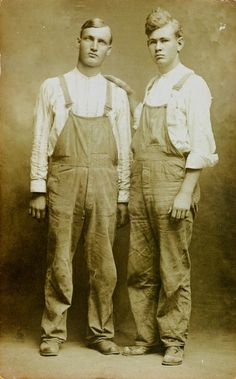

~ One Boy Real, One Boy Not ~
My brother and I spend our days tilling the soil in our rumpled bib overalls. He isn’t much for conversation, but he sure is pretty to look at.
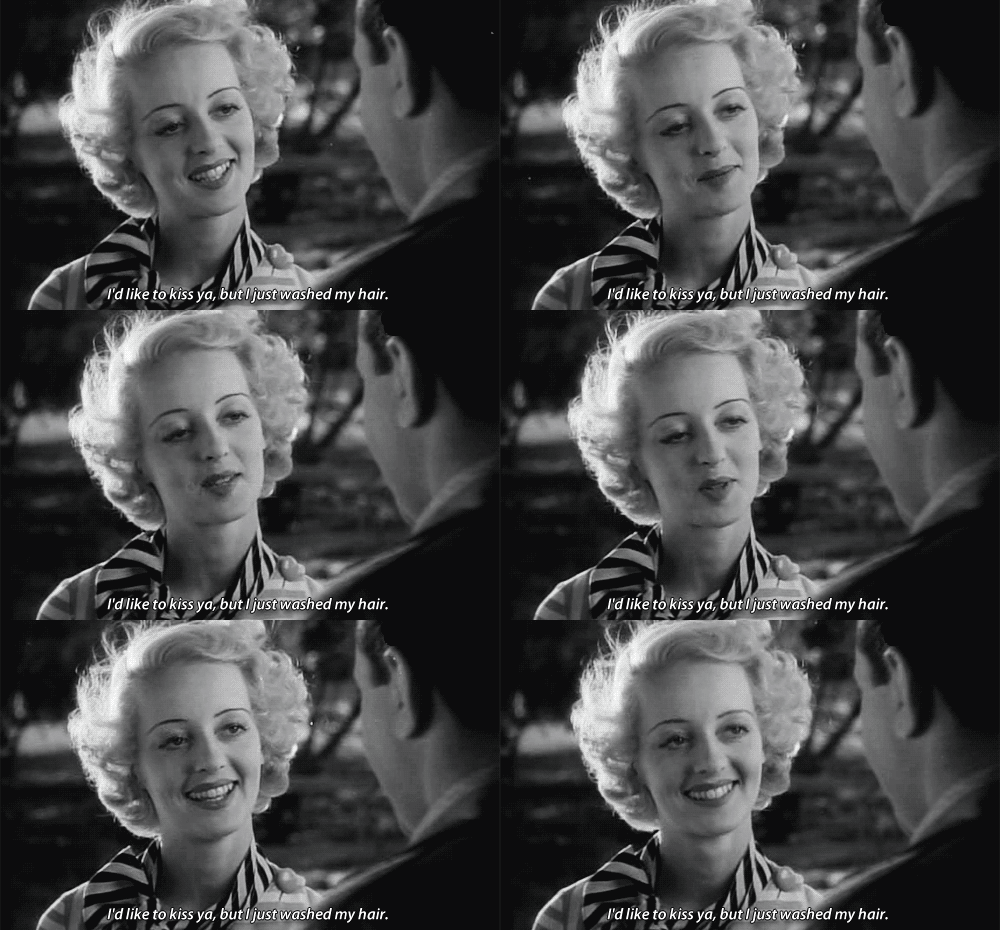
Bad girl Bette Davis and working boy Richard Barthelmess in Cabin in the Cotton (1932)
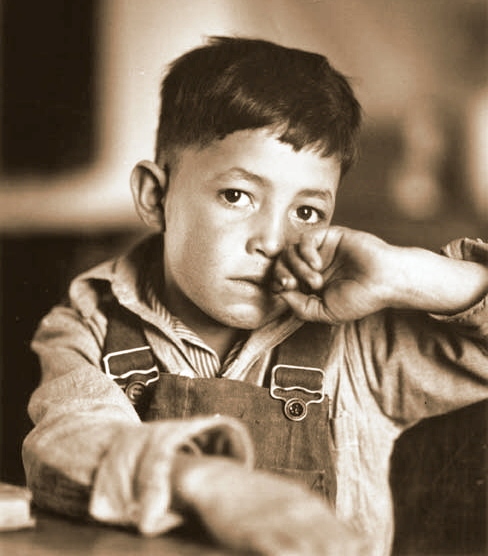
Pink Eye ~ A Short Story by Allen Kopp
Alvin Fritchie lived on a farm a few miles outside of town. He had so many brothers and sisters that nobody knew exactly how many. He missed a lot of school because he had to depend on his mother or some other family member to drive him in and sometimes their car was broken down or the creek was up and they couldn’t get across the little bridge that separated their property from the highway. I thought Alvin was lucky that he got so much time off.
One day in our fourth grade class we noticed that Alvin kept rubbing his eye, first one eye and then the other. When you looked right at him and he looked back, he looked “sick out of his eyes,” as my grandmother would have said. Finally our teacher, Miss Meeks, called him out into the hallway to have a word with him. When Miss Meeks came back in and Alvin wasn’t with her, we knew she had sent him to the nurse’s office.
In a little while the nurse, Miss Bullard, knocked on the door. Miss Meeks stopped what she was doing and went to the door and the two of them talked for a couple of minutes in voices too low for us to hear. We were sure it had something to do with Alvin, but, of course, Miss Meeks didn’t tell us what it was. She was too good at keeping secrets.
The next day two other people had eye trouble and were sent home. The day after that, there were three others. After conferring with the nurse, Miss Meeks informed us that it was an epidemic (or starting to become an epidemic) of something called the pink eye (the very mention of which reminded me of white rabbits). Not exactly the plague but something you didn’t want to catch, no matter how bad you wanted to miss school.
Miss Bullard wanted us to believe she was on top of the situation. She had the janitor bring in scrub brushes, rags and disinfectants and watched him as he went over every inch of Alvin’s desk and the desks on either side. She showed us a film on the proper way to wash one’s hands by using plenty of soap and hot water, frequently throughout the day, but especially after using the toilet. She sent a letter home with each of us, informing our parents of the existence of pink eye in our school but assuring them it wouldn’t be a problem as long as proper sanitation was observed.
“Above all,” Miss Bullard said, her enormous breasts jutting out in front of her like guided missiles, “if your eyes itch and start to get red, don’t scratch them! Don’t even touch them!”
“Roo-roo-roo!” a boy named Leonard Scallion said from the back of the room, but everybody ignored him.
That evening at the dinner table, my mother examined my eyes with a magnifying glass until I was squirming in the chair to get away from her.
“Leave me alone!” I said.
“I don’t see any sign that he has the disease,” she said to my father. “As far as I can tell.”
“Do your eyes itch?” he asked me.
“Not yet.”
“But you think they will?”
“Just about everybody in my class has it,” I said. This was an exaggeration, of course, but, like everybody else in my family, I was prone to exaggeration.
“What do you want to do?” my father asked my mother. “Keep him at home until this passes?”
“That sounds like a good idea to me!” I said.
“No,” she said. “We’ll just let him go to school and check his eyes every day.”
“Thanks a lot!” I said.
I didn’t get the pink eye, but the next Monday morning when I woke up and started to get dressed for school, I had spots on my chest that extended up to my neck and shoulders. When I showed my mother, she took my temperature and, finding I had a fever of a little over a hundred, called the doctor. He said it sounded like the three-day measles. I was to stay in bed and rest and keep away from other people because it was contagious.
“How on earth did you get the measles?” she asked.
“How should I know?” I said.
Having the measles wasn’t as bad as having a cold or the flu. I could have anything I wanted to eat and everybody left me alone to do as I pleased. The only thing I didn’t like about the measles was that I had to stay away from the TV.
My spots (or my fever) didn’t go away after three days, so I ended up getting the whole week off from school. When I went back on the following Monday, a few people were still out with the pink eye (taking full advantage, I knew). I learned that two others besides me (so far) had the three-day measles. One had returned and the other was still out.
I noticed that Alvin Fritchie, the one who started the whole pink eye thing, hadn’t returned to school yet. I asked several people what happened to him, but nobody knew. I figured he got the three-day measles on top of the pink eye. He might have died and nobody would even know or care. I wouldn’t have been surprised if they had given his desk to somebody else.
Finally Alvin returned without fanfare after more than two weeks. I looked for him at recess and found him standing by himself, as usual, over by the fence.
“How do you feel, Alvin?” I asked.
“I feel all right.”
“Get over the pink eye?”
“Yeah.”
“Why were you gone for so long?”
“My mother died.”
“Oh? Did she have the pink eye, too?”
“I came back just for today to tell everybody I’m leaving and I won’t be back.”
“Where are you going?”
“I’m going to live with my aunt in Kansas. I guess I’ll be going to school there.”
Those were the last words I ever heard him say. He left at the end of the day without saying a word to anybody. No goodbyes or anything else. Nobody ever mentioned him again. He just faded away like something you thought was there that really wasn’t.
Copyright © 2015 by Allen Kopp
~ Their Thousand Friends, Part 2 ~
(A Short Story by Allen Kopp)

Part 2 of my short story “Their Thousand Friends” published in the current issue of Circus Book. Click on this link:
https://circusbook.org/2015/allen-kopp-their-thousand-friends-2/

Chappie ~ A Capsule Movie Review by Allen Kopp
If Chappie has the same look and feel as District 9, it’s because both movies have the same director (Neill Blomkamp) and same creative team. Both are science fiction stories set in and around Johannesburg, South Africa. Both have a gritty, grungy look to them (unlike similar American movies that have a slick, over-produced look). Some of the same actors (with difficult-to-understand accents) appear in both movies. The non-American actor Sharlto Copley, who played the lead in District 9, also plays the lead in Chappie, but he’s unidentifiable because he’s a robot.
In Chappie, the robot officers used by the Johannesburg police force are highly effective in fighting crime. The whiz who developed the robots, Deon Wilson (played by Dev Patel), believes he can take the robots another step—he can make them think and feel, just like humans, but without human failings. It’s a no-go, though. His employers won’t let him do it.
When a group of thugs (led by the ultra-strange Ninja and Yolandi, with the most exotic hairdos you’ve ever seen) hear about the robot technology, they hatch a plot to use it to their own evil ends. When Deon Wilson is on his way home with one of the robots in his van that’s damaged beyond repair, the thugs intercept him, take him to their lair, beat him up, and force him to work on the damaged robot so they can use it to commit crimes. The result is Chappie, a shy (at first) machine with human thoughts, feelings and emotions. It seems that Yolandi isn’t quite as creepy as we first thought. She becomes a sort of mother figure to Chappie and helps him adapt to the world. Ninja, though, is all bad (not to mention gross and despicable). He mistreats Chappie and forces him to be a criminal like himself, much to the dismay of Chappie’s maker, Deon Wilson.
The emotional core of the movie is Chappie’s relationship with Deon Wilson and with Yolandi, whom he calls “mommy.” She is protective of him (he needs to be protected from the evils of the world) and decides at some point that he is more important as a being that she can love than as an instrument for perpetrating criminal acts. I suppose it could be said that Chappie brings out the mother instinct in her.
Of course, there always has to be villain (as if Ninja isn’t enough of one). The villain here is Hugh Jackman (speaking in his native Australian accent). He is bent on destroying Chappie and making sure the “thinking/feeling” technology of robots doesn’t go any farther. (I think I must have missed what is motivation is.) The Hugh Jackman character seems unnecessary and adds to the cluttered feel of the movie. But, then, if it hadn’t been for him, there wouldn’t have been the dramatic conclusion that opens the way for a possible sequel.
Copyright © 2015 by Allen Kopp
Deep in the Arms of Love ~ A Short Story by Allen Kopp
(This is a story I posted earlier.)
We were lost again. We had a roadmap but didn’t seem to know how to use it. I had been driving earlier but now Drusus was driving. His wife, Pearline, sat between us, and I sat next to the window. Mama and Adele were in the back.
The seat wasn’t long enough for mama to stretch out all the way so when she needed to lie down she used Adele’s lap as a pillow. We were all a little worried about mama. We had to stop every now and then for her to get out and walk around. She was carsick and sometimes she vomited. I couldn’t help but notice there was some blood coming up. I had to look away.
We were on our way to the city, which was a lot farther away than we had thought. Adele was going to sing in a radio contest and mama was going to see a specialist.
Mama had been asleep and when she woke up, she said, “Sing me a song, honey.”
“I don’t feel like singing,” Adele said. “I feel like throwing up.”
“Give us just one song,” I said. “You can entertain us while you practice up for the contest.”
“I don’t need any practice. I know those songs backwards and forwards. I sing them in my sleep all night long.”
“I know you’re going to win,” Pearline said. “It’s a feeling I have, deep down.”
“I wouldn’t be so sure of it,” Drusus said. “There’s hundreds of other people with that same deep-down feeling.”
“I have as much chance as anybody,” Adele said.
“We leave it in the hands of the Lord,” mama said.
The hick singing teacher giving Adele lessons thought she had great promise. She could sing any kind of music—opera, even—but she was best at popular tunes like “Makin’ Faces at the Man in the Moon” and “Love, You Funny Thing.” She was as good as anybody on the radio or in the movies.
“And I have a good feeling about the new doctor you’re going to see, Mrs. McCreary,” Pearline said. (She and Drusus were so newly married that she still couldn’t bring herself to call her mother-in-law Hazel.)
“You and your feelings,” Drusus scoffed.
“She has a positive attitude,” I said.
“I try not to fret about it,” mama said. “It’s in the hands of the Lord. He has already ordained what will be.”
We didn’t like to talk about it, but mama’s doctor at home had just about given up on her. We called him a horse doctor because he didn’t seem to know very much. If you went to him with anything more serious than a cold or a sore toe, he was in over his head. The specialist in the city was just about her last chance to be well again.
Mama groaned a couple of times and when she was finished groaning, she said to Adele, “You still got the name and address of that doctor I’ve got the appointment with on Friday, don’t you, baby?”
“It’s in my bag,” Adele said. “You saw me put it in there.”
“Don’t you lose it.”
“I won’t.”
“Dr. Ficke says he’s one of the best doctors in the state and you don’t have to be rich to get in to see him.”
“I bet it helps, though,” I said.
We came to a tiny town with a cutoff to a different highway. Drusus took the cutoff going a little too fast. Mama almost fell onto the floor and let out a little yelp. Pearline fell over against me and righted herself as if I was poison to the touch.
“Be careful, honey!” Pearline said.
“Well, this is it!” Drusus said. “This is the right way now. I just know it. We are officially not lost anymore.”
“Happy days are here again,” sang Adele. “The skies above are clear again. So, let us sing a song of cheer again. Happy days are here again!”
As if to confirm that we were finally going in the right direction, we passed a sign that you couldn’t miss if you were alive. “Only two hundred and thirty-seven more miles,” I said.
“Seems like we already came about a thousand miles,” Adele said.
“How about you, Wynn?” Drusus asked me. “Do you want to drive for a while?”
“No thanks,” I said. “You’re doing fine.”
I went to sleep with my head against the door and woke up when we had a blowout and Drusus pulled off the highway to change the tire.
We all got out of the car, including mama. She took a few wobbly steps and smoked a cigarette and said she was feeling a little better. She wanted to know what state we were in. When we told her, she laughed for some reason.
We took advantage of the unscheduled stop to have a drink of water and a bite to eat. We still had some bread left over, Vienna sausages, fruit, and other stuff. Mama didn’t want anything to eat but she drank a little bit of water and some coffee. Pearline spread a blanket on the ground for her and Adele to sit on. Mama sat for a while and then lay down and looked up into the trees.
“This is nice,” she said, “lying still on the ground and not having tires turning underneath me.”
“I think mama’s sicker than she lets on,” I said to Drusus when we were changing the tire.
“That doctor in the city will fix her up,” he said.
“She’s trying to put a good face on it for Adele’s sake. She doesn’t want to spoil her chance of singing on the radio.”
“Everything will be all right,” he said, as if trying to convince himself as much as me.
Mama went to sleep on the blanket and we had to wake her up to get her back in the car. I took over driving from there, even though I liked it better when Drusus drove and I could just sit and think.
We were all tired and we knew we were going to have to stop someplace for the night. We hadn’t made very good time, what with our getting lost and mama being sick and all.
At dusk we stopped at an auto court where, according to their sign, they had clean cabins and cheap. I went inside and engaged the room and then we drove around to our cabin, which was cabin number twelve in the back. With the shade trees, the two rows of trim white cabins, and the azalea bushes everywhere, it was a pretty place and plenty inviting.
We tried to get mama to eat something, but she just wanted to go to bed. Pearline and Adele helped to get her out of her clothes and into bed while Drusus and I sat on the front step and smoked.
“If Adele wins that prize money,” he said, “we can pay back Uncle Beezer the money he advanced us for this trip.”
“We can’t expect her to give up the prize money for that,” I said. “If she wins, the money is hers to do with as she pleases.”
“And what would she do with it, anyhow?” he asked.
“I don’t know. Maybe it would be her one chance to get away from home, out into the real world. She might get a real singing career going for herself.”
“Do you really think she has a chance?”
“You’ve heard her sing,” I said. “Isn’t she as good as anybody you’ve ever heard?”
“Yeah, she’s good,” he said.
“If she wins the money, it’s hers. We can’t touch it.”
“Maybe she’ll offer it. At least part of it.”
“We can’t ask her for it, though.”
After a couple of minutes in which neither of us spoke, Drusus said, “Pearline thinks she’s going to have a baby.”
“A baby!” I said. “That was fast work. You’ve only been married a month.”
“The curse of the married man,” he said.
“What do you mean? Don’t you want it?”
“We’re poor,” he said. “We don’t have anything. Even the car I’m driving belongs to somebody else.”
I laughed. “How do you think other people manage?” I asked. “How do you think mama and daddy managed? They were dirt poor and they had eight kids.”
“The poorer they are the more kids they have, and the more kids they have the poorer they are.”
“You’re not sorry you married Pearline, are you?” I asked.
“Well, no. Not exactly. I probably wouldn’t do it again, though, if I had it to do over.”
“I’ll be sure and tell Pearline you said that.”
“Don’t tell anybody any of this,” he said. “She doesn’t want anybody to know about the baby just yet, because it makes it look like we had a shotgun wedding. I swear the baby wasn’t on the way yet when we got married.”
“You don’t have to convince me of anything,” I said.
“Not a word to mama or Adele yet. Pearline wants to make sure about the baby before she tells anybody.”
“Mum’s the word,” I said.
Drusus and I had to sleep on the floor in the cabin but I didn’t mind. I was just glad to be able to stretch out and rest my weary bones. I laid down near the screen door where I could feel a cool breeze and hear the trees rustling. After being on the dusty road all day, it felt like heaven.
As I drifted off to sleep, I could hear Adele softly singing mama’s favorite song: “Deep night, stars in the sky above. Moonlight, lighting our place of love. Night winds seem to have gone to rest. Two eyes, brightly with love are gleaming. Come to my arms, my darling, my sweetheart, my own. Vow that you’ll love me always, be mine alone. Deep night, whispering trees above. Kind night, bringing you nearer, dearer and dearer. Deep night, deep in the arms of love...”
I woke up in the morning to the sound of the birds singing. I stood up to slip into my shirt and pants and that’s when I saw Adele and Pearline sitting quietly in chairs at the foot of the bed. Pearline was smoking a cigarette.
“What’s the matter?” I asked.
“We can’t wake mama,” Adele said.
“Is she breathing?”
“I don’t think so.”
“We’d better get a doctor,” I said.
Pearline looked at me and shook her head and that’s when I knew that mama was dead.
I shook Drusus gently by the shoulder to wake him up. When I told him what had happened, he, of course, had to see for himself. He went over to the bed and put his ear to mama’s chest. Hearing nothing but silence, he then held a mirror to her nose. He looked at the mirror and threw it down on the bed like a little boy with a toy gun that no longer works.
“What should we do?” I asked.
“I don’t want to go another mile farther from home,” Adele said.
“We’d better call somebody and tell them what happened,” Pearline said.
“No,” Drusus said. “We’re not calling anybody. They’ll ask us a lot of questions. They’ll hold us here until they know what happened. They’ll make Adele miss her chance to sing on the radio.”
“We can’t go off and leave mama here,” I said.
“Of course not,” he said. “We’re taking her with us.”
After Adele and Pearline got mama into her clothes, Drusus carried her out to the car in his arms. I opened the door for him and he slid mama into the corner of the back seat where she was propped up and her head was not lolling to the side. He then took a length of rope and tied it around mama’s chest so she would stay upright and not fall over from the movement of the car. Adele gave mama’s dark glasses to Drusus to put on her and we found a straw hat that belonged to Uncle Beezer in the trunk and put it on her head. With the hat and the glasses and in her regular clothes, she didn’t look like a dead person.
“I’m glad she died in a pretty place like this instead of on the road,” I said.
“We’ve come this far,” Drusus said. “She would want us to keep going as far as we can. She wouldn’t want Adele to miss her chance to sing on the radio because of her.”
We all got into the car and Drusus started her up. As we were pulling out of the place, the manager stopped us and leaned into the window and looked at all of us, including mama. He smiled in a friendly way and said he hoped we enjoyed our stay and God grant that we should come back that way again.
When we were on the highway again and going at full speed, Adele began singing mama’s favorite hymn: Blessed assurance, Jesus is mine! Oh, what a foretaste of glory divine! Heir of salvation, purchase of God, born of his Spirit, washed in His blood. This is my story, this is my song, praising my Savior all the day long; this is my story, this is my song, praising my Savior all the day long. Perfect submission, perfect delight, visions of rapture now burst on my sight; angels descending bring from above echoes of mercy, whispers of love…”
Nobody said anything for a long time after Adele finished singing. We all had the feeling, though, that nothing was going to stop us now. That old car of ours was sure burning up the miles.
Copyright © 2015 by Allen Kopp
~ Marlene Dietrich in Shanghai Express (1932) ~
After an unhappy love affair, she becomes a prostitute, known as Shanghai Lily, the notorious White Flower of the Orient. (“It took more than one man to change my name to Shanghai Lily,” she says.) On a memorable train trip from Peking to Shanghai with a group of disparate passengers, she reunites with her lost love and is willing to sacrifice herself to a despicable warlord to save his life. In this picture, she is enjoying a more contemplative moment on the train with a cigarette.


I Liked Her Better When She was Ugly ~ A Short Story
by Allen Kopp
She set her battered suitcase on the bed and began putting things in it: a dress and then another dress, a pair of shoes, stockings, a hairbrush.
“How long are you going to be gone?” Freda asked.
“Two days,” her mother said. “Now, we’ve already been all through that. I’ll be back on Sunday night.”
“I want to go with you.”
“You’d hate it. Funerals are terrible.
“I’ve never been to a funeral, so I don’t know if it’s terrible or not.”
“Take my word for it.”
“If I have to stay here by myself, I might not be here when you get back.”
“Where will you be?”
“I haven’t decided yet.”
“I really don’t need any trouble from you right now.”
“What am I supposed to eat while you’re gone?”
“I spent my entire paycheck on food. I don’t think you’ll starve.”
“But I don’t know how to cook!”
“Get Squeak to cook something for you.”
“Squeak’s a mess. She doesn’t know how to cook, either.”
“I thought you liked Squeak.”
“Why does she have to stay with me? I’m old enough to take care of myself.”
“No, you’re not. Squeak likes staying with you. It makes her feel grown up.”
“You pay her, don’t you?”
“Yes.”
“You can just save your money and let me stay by myself. I’ll invite some friends over and we’ll have a party.”
“Now you’re talking nonsense.”
“When you talk about having a party or Squeak talks about it, it’s fine, but when I talk about it, it’s nonsense.”
“That’s because I’m an adult and you’re a child.”
“Squeak’s not an adult. Not yet, anyway.”
“Well, she’s closer to it than you are.”
“It’s terrible being a child, isn’t it?”
“Not everybody thinks so.”
Her mother left and, while Freda waited for Squeak to arrive, she sat in the middle of the couch facing the TV and had her dinner, which was a cold hot dog right out of the refrigerator, a piece of pimiento cheese, a couple of dill pickles and a piece of lemon pie, not baked but out of a box from the grocery store.
One show ended and another began. When she looked at the clock and saw it was after seven-thirty, she hoped that Squeak had decided not to come and she would be staying by herself after all, in which case it would Squeak’s fault and not her own.
Squeak finally showed up, though, with an overnight bag in one hand and her school books in the other.
“You’re late,” Freda said.
“My mother made me wash every dish in the house before I left.”
Squeak was a big girl with a broad face and a high forehead. Her pale skin and very fair hair gave her the appearance of having no eyebrows. She was one of the less popular girls in school, although she tried hard.
“Have you had your dinner?” Squeak asked.
“Hours ago,” Freda said.
“Go to bed, then.”
“I never go to bed this early on Friday night!”
“If you’re not going to bed, then, I want you to do something for me.”
Squeak gave to Freda a picture of a woman’s face she had cut out of a magazine. “I want you to draw my eyebrows on just the way they are in this picture.”
She handed Freda the eyebrow pencil, turned all the lights on in the room and lay down on the couch. After she adjusted her hips and crossed her ankles, she snapped her fingers to let Freda know she was ready.
Freda studied the picture, eyebrow pencil poised in hand. “I’m going to make you look so glamorous!” she said.
She leaned heavily on the eyebrow pencil, almost breaking it a couple of times. After she drew the first eyebrow on with some difficulty, the second one was easier.
“There!” she said with satisfaction.
“How do I look?” Squeak asked.
“Less surprised.”
Squeak sat up and studied herself in the hand mirror. “You’ve made them too dark,” she said. “I look like a prison matron.”
“I like prison matrons,” Freda said.
“You got anything to eat in the house?”
“You don’t think my mother would go away for two whole days and not leave food for me to eat, do you?”
They went into the kitchen. Freda sat at the table while Squeak looked in the refrigerator. She took out the pickles, cheese and butter.
“How about a grilled cheese sandwich?” she asked.
“I’d like one,” Freda said.
“I thought you said you already ate.”
“I did but it was hours ago.”
“Well, I haven’t eaten since lunch at school today and I’m starved,” Squeak said. “It was some kind of slop on toast. I couldn’t even eat it.”
“You need to diet anyway.”
“That’s not very nice,” Squeak said.
“Only speaking the truth.”
“Well, you have to be careful and not hurt a person’s feelings, you know.”
Squeak put the pickles on the table. Freda took off the lid and stuck her fingers in the cold green liquid.
“You got a boyfriend?” Freda asked.
“Hell, no!” Squeak said. “I don’t want one.”
The skillet heated while she slathered butter on the bread.
“Why not?”
“They’re a pain in the butt is why not.”
“Wouldn’t you like to have a boyfriend that looks like Rock Hudson?”
“Rock Hudson is a total fake. There are no people in the world who look like him.”
“My mother says the guy at the gas station looks like Rock Hudson.”
“I know who you mean. He’s got black hair. He sort of looks like Rock Hudson a little bit, but he’s got broken-off teeth and he walks with a limp.”
“He smokes cigarettes, too, when he’s pumping gas,” Freda said. “He’s going to blow his ass clean off.”
“You shouldn’t say words like ‘ass’.”
“Why not?”
“You can say it in front of me because you know me but you shouldn’t say it in front of just anybody. It’s not refined.”
“What’s ‘refined’ mean?”
“You know what ‘refined’ means. It means doing and saying the right things so you meet the right people and find yourself a good husband.”
“I don’t want a husband,” Freda said.
“Of course you don’t! Not yet, anyway. You’re only ten years old.”
“I won’t ever want a husband, even when I’m eighty-five. I’m not ever getting married.”
“You’ll change your mind when the right one comes along,” Squeak said.
“If I can’t have one like Rock Hudson, I don’t want any at all.”
“Do you want some chicken noodle soup to go with your grilled cheese?”
After they were finished eating and Squeak had stacked the dishes in the sink to wash later, they went into the living room and sat side-by-side on the couch. The movie Now, Voyager was just starting.
“Oh, I love Bette Davis!” Squeak said. “I want to be just like her!”
“I’ve heard she’s had about six husbands,” Freda said, “and they all beat her.”
“Be still and listen.”
A homely Boston heiress named Charlotte Vale wears orthopedic shoes and matronly dresses. She doesn’t wear any makeup and her eyebrows meet in the middle like an immigrant longshoreman. She stays in her room all the time, smoking cigarettes and carving ivory boxes, because her elderly mother is cranky with her and obviously doesn’t like her very much. When a sympathetic sister-in-law arranges for Charlotte to meet a pipe-smoking psychiatrist, he sees right away that she isn’t right in the head. Her mother, of course, believes there is nothing wrong with her and she is only putting on an act to try to get attention.
Charlotte has a nervous breakdown (who wouldn’t?) and spends several months in the clubby, resort-type mental institution that the pipe-smoking psychiatrist runs in the country. When he says that Charlotte is once again ready to mingle in society, she goes, by herself, on a luxurious cruise to South America—not, however, before undergoing a physical transformation that can only be found in the movies: she loses thirty pounds, plucks her eyebrows, throws away the unattractive glasses she wears, starts using makeup, and develops a taste for high-fashion clothes. How could we have known there was a beautiful swan waiting to emerge from the ugly duckling?
On the boat, the newly beautiful Charlotte Vale meets a man (what else?) to whom she is irresistibly drawn. His name is Jerry and he is strangely attentive to her in a way that no man has ever been. (“Nobody ever called me dahling before,” she says.) They spend a lot of time together seeing the sights in South America. When there is a problem with their car, they spend a night together in a shed, doing something called bundling, which, Charlotte says, is an old New England custom.
Charlotte learns from someone who knows Jerry that his life hasn’t been especially happy, either. He has a clinging, possessive wife who won’t give him a divorce. He also has a crazy daughter named Tina who is like a younger version of Charlotte, unwanted by her mother in much the same way that Charlotte was unwanted by hers.
The boat lands back in Boston and Charlotte says goodbye to Jerry, believing she will never see him again. All Charlotte’s friends and family, including the servants, are surprised at the extent to which she has changed. Everybody thinks she looks better, of course, except her mother, who has nothing good to say to her. She is offended by Charlotte’s new spirit of independence and threatens to take away all her money.
Charlotte becomes engaged to a Boston blueblood like herself, but she doesn’t love him and can’t forget about Jerry. She wants to break off her engagement, and it is while she and her mother are arguing on this very subject that her mother dies of a stroke. Charlotte, of course, blames herself for her mother dying that way, right in the middle of an argument. Just as she is about to descend once again into madness, Jerry reappears, as much in love with her as he was on the cruise.
In the end, Charlotte has her mother’s money and the enormous Boston house to herself. We know she could probably go crazy again at any time, but she is, for the moment anyway, oddly contented. She has Jerry with her and also Tina, Jerry’s crazy daughter.
In the final scene, Charlotte and Jerry are standing at an open window in the library. Jerry lights two cigarettes at once in his mouth and hands one of them to Charlotte, in that odd way of his.
“Do you think we can ever expect to be happy?” Jerry asks.
Charlotte, her eyes wet with tears, says, “Oh, Jerry. Let’s not ask for the moon. We have the stars.”
The Max Steiner music swells and the camera pans upward to the summer sky, which has about as many stars in it as one might expect.
Squeak blew her nose loudly and dabbed at her eyes. “A sweet, sad ending,” she said. “The kind that always makes me cry.”
“I thought the whole thing was silly,” Freda said.
“Don’t you think I look a little like Bette Davis?”
“No. You look more like the Bride of Frankenstein.”
“Remember what I said about hurting people’s feelings,” Squeak said. “You need to work on that.”
“There’s nothing wrong with looking like the Bride of Frankenstein. It’s better than looking like Bette Davis any day.”
“A lot you know! You’re still just a little kid.”
“If somebody told me I looked like the Bride of Frankenstein, I’d be happy.”
“I think it’s time for you to go to bed.”
“I’m thinking about staying up all night as an experiment.”
A loud knock at the door just then made Squeak scream.
“Don’t answer it!” Freda said. “It might be the police.”
Squeak stood up and went to the door, put her hand on the knob and said, “Who is it?”
“Open the door!” a voice said.
Without hesitation, Squeak swung the door open, and Stinky, her friend from high school, came inside. Behind Stinky was her boyfriend Ellison.
“What are you doing here?” Squeak asked.
“Your mother told me you were staying over here until Sunday,” Stinky said. “We thought we’d drop by and get a little party going.”
Ellison made himself at home, sitting on the couch and putting his feet on the coffee table. “Got anything to eat?” he said.
“I’m babysitting Freda,” Squeak said. “I was just about to put her to bed.”
“I can put myself to bed,” Freda said.
“Well, hello there, little chickie!” Ellison said, taking hold of Freda’s arm. “Why don’t you come and sit down beside Uncle El on this here ol’ couch?”
“Leave her alone, jerkface,” Stinky said. “Can’t you see she’s only a child?”
“Nobody ever said I don’t like a little chicken now and then! Hah-hah-hah!”
“I think you’d both better leave,” Squeak said.
“You got any liquor in the house?”
Ellison had white-blond hair and a porkpie hat seated on the back of his head. He told people he was a jazz musician but he couldn’t play a note on any instrument. He was over twenty and always chose his girlfriends from the high school crowd. He and Stinky had been going around together for about a year.
If Squeak was in the middle of the social hierarchy in high school, Stinky was all the way at the bottom. She lived with her mother and retarded sister in a residential hotel. She belonged to a girl gang, smoked cigarettes and drank hooch. The worst, though, was that she had been arrested for shoplifting costume jewelry and cosmetics.
“Let’s get this party going!” Stinky said. “It’s still early!”
“My mother wouldn’t like it if you had a party with her not here,” Freda said.
“Where is she?” Ellison asked.
“She had to go out of town.”
“Out of town where?”
“She took the bus to the city to go to a funeral.”
“Uh-oh!” Ellison said. He put his hand over his mouth.
“What’s the matter?” Freda asked.
“I’m sorry to have to be the one to tell you this.”
“Tell me what?”
“There was a terrible wreck about twenty miles out of town. A bus on its way to the city collided with a tanker truck. The truck exploded and everybody on the bus burned to death. I’ll bet it’s the same bus your ma was on.”
“Don’t listen to him,” Stinky said. “He’s making that up. If he doesn’t watch himself, I’m going to have to slap the shit out of him.”
“Why don’t one of you baby dolls go into the kitchen and rustle up some grub?” he said. “I’ll stay here and get better acquainted with the little chicken.”
“The two of you are going to have to leave,” Squeak said. “Freda’s mother is paying me to make sure nothing like this happens. You’ll have to take your party someplace else.”
“I always thought you were a fun girl!” Stinky said. “I never knew you were such a tight ass!”
“Come and give your lovin’ daddy a great big old kiss,” Ellison said to Stinky, holding out his arms to her like a mammy singer.
“Always ready to accommodate my man!” she said. She sat on the couch next to him and soon they were entwined in a passionate embrace.
“Oh, brother!” Freda said.
“Go to bed, Freda!” Squeak said.
“I don’t want to miss any of this!”
Stinky and Ellison were smacking their lips together and moaning. Stinky was pulling at Ellison’s back, trying to get him on top of her.
“I never saw anything like this before,” Freda said.
“I think they need to cool off, don’t you?” Squeak said.
She went into the kitchen and filled the dishpan with cold water and carried it into the front room and poured it over Stinky and Ellison.
“You crazy bitch!” Stinky said, pushing Ellison away and jumping up. “What’s the matter with you? I just had my hair done!”
“I warned you and you wouldn’t listen,” Squeak said. “If you don’t go now, I’m calling the police.”
“Well, I’ll be damned!” Stinky said. “I thought you were my friend!”
“All right,” Ellison said. “We’ll go. It’s no fun here, anyway. I want something to eat.”
“You haven’t heard the last of this,” Stinky said to Squeak. “I just can’t stand to see a good time wasted.”
After they left, Squeak said, “I think that’s the way Bette Davis would have handled the situation, don’t you?”
“I don’t know,” Freda said.
“Go get some rags and let’s get this water cleaned up.”
“Do you think my mother really burned to death?”
“No,” Squeak said. “If there had been an accident, don’t you think somebody would have called?”
Freda ran into her room and closed the door, jumped into bed with her clothes on and pulled the covers over her head. She would have to wait until Sunday night to find out if her mother had burned to death. It was going to be an awfully long weekend.
Copyright © 2015 by Allen Kopp
~ Their Thousand Friends, Part 1 ~
(A Short Story by Allen Kopp)
Part 1 of my short story “Their Thousand Friends” published in the current issue of Circus Book. Click on this link:
https://circusbook.org/2015/allen-kopp-their-thousand-friends-1/

The Immoralist ~ A Capsule Book Review by Allen Kopp
French author André Gide lived from 1869 to 1951. His novel The Immoralist, published in 1902, is one of his most famous and enduring works. Gide was known for his homosexuality, and, not surprisingly, his protagonist in The Immoralist, Michel, is also homosexual, although it is never referred to in those words. (There are no descriptions of sexual activity here, but Michel’s attraction to members of his own sex is repeatedly implied throughout the novel.) Michel is the first-person narrator. He is telling his story to some old friends, not so much to explain himself but to help him to better understand his own nature. He is, after all, a seeker after truth.
Michel seems to be independently wealthy, although he mentions several times about not having enough money. He is some kind of a scholar or philologist but this is never fully explained. He marries a woman named Marceline, who loves him much more than he loves her. They leave their native France and travel to Tunis in Northern Africa (we are never told why Tunis in particular of all the places in the world they might have gone). Michel is entranced by Tunis and particularly by Arab boys, some of whom he pays to stay with him to keep him company. When he realizes he is the early stages of tuberculosis and is spitting blood, he believes he will die. It’s up to Marceline to take care of him the best she can.
After Tunis, Michel and Marceline travel restlessly from place to place in foreign lands. Michel’s health worsens, improves and then worsens again. During one of their happier moments, Michel and Marceline begin sleeping together for the first time. Marceline soon becomes pregnant, but the pregnancy doesn’t go well and she ends up losing the baby. Michel is torn between his tender regard for her and the selfish pursuit of his own ends.
At one point, Michel and Marceline return to France, where he manages some farms that he owns, inherited from his family. He discovers he doesn’t care about the day-to-day running of a farm, which involves dealing with tenant farmers and other mundane tasks. He finds during this time that what he most enjoys is spending time with the “handsome, well-built” young men who work for him. He begins spending all his time with them, while leaving Marceline alone to her own devices.
When Michel decides he no longer likes living on a farm and managing it, he and Marceline begin traveling again in foreign lands. His health has miraculously improved and he wants to pursue pleasure and discover the truth about himself that has for so long eluded him. (While traveling in Sicily, he tells a young carriage driver how beautiful he is and impulsively kisses him.) Michel finds that he prefers “low” people (men), people without breeding and customary “good manners,” to people of his own “class.” They are much more authentic and are not bounded so much by convention and rules of acceptable behavior.
While Michel’s health improves, Marceline’s health declines. As they continue to travel, she becomes sicker and more dependent on Michel. Her failed pregnancy took its toll and she develops tuberculosis that she caught from Michel when she was nursing him back to health. Eventually she dies in a foreign land. We don’t know what happens to Michel after Marceline’s death, but we assume he continues his quest for self-knowledge on his own, or possibly with a male companion he picks up along the way (now that he is no longer burdened with a wife). Will he ever find what he’s looking for? Does he even know what it is?
The Immoralist is a fascinating study of one man’s psyche. If that sounds boring, it isn’t. Gide’s style (translated from French to English, of course) is accessible and easy to read. In the hands of a lesser writer, it could have been ponderous and bloated. On another level, it’s frank for the time in which it was published (1902). It’s impossible to imagine an American novel of this time with the same tone and subject matter.
Copyright © 2015 by Allen Kopp

