
Author: allen0997



In Memoriam ~ A Capsule Book Review

In Memoriam
~ A Capsule Book Review by Allen Kopp ~
It has been said that the “Great War” (World War I) wiped out an entire generation of young men in England. We meet a few of these (fictional) young men in the novel In Memoriam by Alice Witt.
(Sidney) Ellwood and (Henry) Gaunt are students at a boys’ boarding school in England. (The students at this school go mostly by their last names.) Gaunt, it seems, joins the army at the beginning of the war with Germany because of his same-sex feelings for Gaunt. (We have to remember that homosexuality is a crime in England at this time.) Whatever feelings Gaunt has for Elwood, they are enthusiastically reciprocated.
Soon, Ellwood also “signs up,” along with many of the other “boys” (men) from the school he and Gaunt have attended. They cannot pass up the chance to experience the excitement and exhilaration of fighting in a war. They will all soon discover, however, that war experienced first-hand is not quite the same as they envisioned. The death toll mounts, as does the list of the grievously injured.
Ellwood and Gaunt are soon together at the front, but it’s not the same as it was at school, of course. Hell, even when experienced with one’s beloved, is still hell. Ellwood is present when Gaunt is shot in the chest. Ellwood is sure Gaunt is dead, but he himself is under fire, so he can’t stay behind to see. He runs for cover, believing that Gaunt has died.
So, Ellwood is left alone, to grieve for his beloved Gaunt. However, he has other, more immediate, problems on the front lines. He sees many of his friends and acquaintances killed or horribly injured. Soon, he himself is shot in the face. He loses one eye and part of his jawbone. Will he live, or will he join his beloved Gaunt in death?
In Memoriam engaged me fully, from the first page. It is a novel with an early-twentieth century sensibility. It might have been written in the 1920s or ‘30s by E. M. Forester or Evelyn Waugh. The gay angle of the story is downplayed and very tastefully handled. Homophobes needn’t be alarmed. In Memoriam is highly recommended, especially if you are interested in the War to End All Wars, as I am.
Copyright © 2024 by Allen Kopp
Mother Witch, Father Ghoul ~ A Short Story

Mother Witch, Father Ghoul
~ A Short Story by Allen Kopp ~
Jock and Lena had been married for eighteen years when their first child came along, a boy they named Finley. They had resigned themselves to being childless, so Finley was something of a surprise. Lena was sick the whole time she was carrying Finley and she wondered secretly if childbirth was worth all the trouble and fuss. She had been happy without children and wondered if she would ever be happy again.
Always a reader, she read book after book on child-rearing and parenting, hoping that the words on the printed page would make her feel inspired, but they had no effect in that direction. She woke up every morning during her pregnancy hoping that the little thing growing inside her would—if not exactly die—just not be there at all.
When Lena told Jock she was going to have a baby that neither of them expected, he was so dismayed he couldn’t speak. He shook and felt weak and had to sit down. When he recovered his senses, he demanded a scotch and soda and a steak medium-rare and accused Lena of having a secret affair with the obese man who cleaned the carpets.
The birth was a difficult one and Lena thought she would die. When the nurse at the hospital placed Finley in Lena’s arms for the first time, Lena fainted and fell out of bed; the nurse caught Finley just in time before he hit the floor. When Lena woke up from her faint, she had temporarily lost her senses.
Jock and Lena readied an upstairs room in their spacious house for the baby. They bought all the requisite furniture and all the little things they thought a baby would like. They had the room painted a cheerful yellow color and bought new curtains with elephants and giraffes on them; they spared no expense.
On the day Lena brought Finley home from the hospital, a few curious neighbors dropped in to see him. Lena wore a tight smile and welcomed the visitors graciously. Jock locked himself in his study and drank whiskey and wrote atrocious poetry.
Finley was a beautiful, perfect child with abundant light-brown hair and a full set of teeth. It was his strange, green-and-amber eyes, though, that people noticed first. He looked searchingly at any visitor who came into the room, as if he were studying them and knew things about them that nobody else knew. When people talked, he moved his lips and smiled, pretending he too was talking. Frequently he pointed at something across the room and when people turned to look at what he was pointing at, there was nothing there except the blank wall. He was seeing things that nobody else saw.
At about three weeks old, Finley began moving objects around the room by pointing at them with his tiny index finger and pursing his lips. If a floppy yellow bunny was sitting on the chest of drawers, he could make it fall to the floor or float across the room and fall into his bed, at which time he would grab it and stick it in his mouth. When a wasp came into this room, he pointed at it and flicked his tongue and the wasp fell dead in mid-flight.
“I don’t see anything of myself in him,” Jock said. “Nobody in my family ever had eyes that color.”
Lena was hurt anytime Jock suggested that somebody else was Finley’s father. The marriage, which before had been tolerable, was strained to the breaking point. Jock went out of the room when Lena entered and spoke to her only when it couldn’t be avoided. He blamed her for Finley’s existence and came to see their marriage as a mistake. He tried to warm up to Finley but believed that the two of them would only ever be strangers. He couldn’t visualize Finley living in his house for twenty or so years until reaching adulthood.
Despite Lena’s misgivings about parenthood, she tried to be a good mother to Finley. She fed him, bathed him and spent most of her waking hours looking out for him. There was always something about him, though, that to her didn’t seem right. It seemed he didn’t need her. He was attuned to something or someone else besides her. At times he would look longingly outside the window and point his finger and warble at something that only he could see.
At six months, Finley was walking and at nine months talking in complete sentences. He asked for pencil and paper and began drawing pictures of birds, castles, airplanes and elephants.
“How could you know about such things?” Lena asked.
When Finley was less than a year old, a relative gave him a picture book with farm animals and jungle animals. He looked appreciatively at all the pictures and then asked for a book with words.
“What kind of a book would you like?” Lena asked, stunned that a baby would make such a request.
“It doesn’t matter,” Finley said. “Just something I can hold in my tiny hands and turn the pages.”
She didn’t want to give him anything too “adult,” so she gave him a juvenile book about the Pilgrims and the first Thanksgiving. He read the book in one afternoon and asked for another one.
“Where did you learn to read?” Lena asked. “You haven’t been to school yet.”
“Some people are just born knowing things, I guess,” he said.
At one year, Finley was dressing and bathing himself and getting his own food. Lena kept a little stepstool within easy reach of the refrigerator. He never dropped any crumbs or spilled anything on the floor, and when he was finished eating he washed his own dishes, standing on a chair at the sink.
He learned to turn on the TV when nobody was around and watch on his own. He wasn’t interested in anything where people were talking. He wanted to hear music and see movement: pictures of animals, cars, airplanes, trains—anything but people.
One day, when Finley was one year and two months old, someone knocked on the door in the middle of the afternoon. Opening the door, Lena saw a strange-looking man and woman standing on the porch peering in at her. The man was very thin and pale and dressed in formal attire. (He seemed like a holdover from the Third Reich.) The woman was taller and broader than the man and wore a very old-fashioned kind of lady’s hat with a red feather and a veil. The chimpanzee she held by the hand wore an aviator cap with goggles and a little leather coat.
“You have the wrong house,” Lena said.
“I’m Mrs. Miggles and this is my husband, Julian.”
“Charmed,” Julian said.
“Whatever you’re selling, I’m not interested.”
“We’re not selling anything, but we would like to speak to you.”
“I’m very busy right now.”
“You’re going to want to hear this,” the woman said. “It concerns your son.”
When Mrs. Miggles said the words your son, she inclined her head toward the chimpanzee.
Lena allowed them into the living room and asked them to sit down. The woman began by saying, “The boy’s name is Armand. Say hello to the lady, Armand.”
The chimpanzee took two steps toward Lena and held out his hand for her to shake.
“How do you do?” Lena said.
Armand rolled his lips back over his teeth and gave a little squawk.
“Is your husband at home?” Mrs. Miggles asked. “We really wanted to speak to both of you.”
“He’s out right now,” Lena said. “Just what is this about?”
“I don’t know quite how to say it.”
“Just say it. Isn’t that usually the best way?”
“Well, you can probably tell we’re not like anybody else. I’m a witch and my husband here is a ghoul.”
“A ghoul?”
“Yes, a ghoul.” Mrs. Miggles faltered and then continued. “You had a son on the last day of August last year, I believe.”
“How do you know that?”
“I also had a son on that day.”
“And you’re a witch?”
“Yes, ma’am.”
“Witches have children?”
“Sometimes they do.”
“All right. So you had a son on the same day as me. How does that concern me?”
“Well, to put it bluntly…”
“Yes.”
“I have your child and you have mine.”
“What?”
“The child that you have that you think is yours is really mine. He’s half-witch and half-ghoul.”
“All right, if that’s true, then where is my child?” Lena asked.
“This is him,” Mrs. Miggles said, picking Armand up and setting him on her lap.
“You’re telling me I gave birth to a chimp?”
“Oh, no, no, no! You gave birth to a human child on the same day that I gave birth to my child, who isn’t really human in the sense that you mean it.”
“Then where is my child?” Lena asked.
“I just told you! Your child is Armand!”
“I’m going to have to ask you to leave my house now.”
“Well, perhaps I should backtrack and explain a little further.”
“I think you must!” Julian said in his odd croaking voice.
“When your attention was diverted for just a tiny second, my sister, who is also a witch, stole your baby and replaced him with mine.”
“That’s not possible.”
“Oh, witches can trick you very easily, I assure you!”
“I don’t believe a word of this!”
“She switched babies, and then do you know what she did? To get back at me for something I did to her a long time ago, she turned your baby into a chimp!”
Mrs. Miggles and Julian both laughed heartily.
“Nobody took my baby,” Lena said. “If such a thing had happened, I would have known.”
“It has taken me all this time to find you!” Mrs. Miggles said. “Of course, I had to torture my sister to get it out of her!”
“I’m going to call the police,” Lena said.
“And what do you think they’ll do, my dear!”
“My husband is behind all this, isn’t it? He’s playing an elaborate Halloween hoax on me because he never wanted a baby in the first place.”
“I’ve never spoken to your husband.”
Lena looked down at Armand who was sitting at Mrs. Miggles’ feet. When he realized he was being looked at, he smiled sweetly and yawned.
“So, if your sister turned my child into a chimp,” Lena asked, “why can’t she turn him back again?”
“That is a very reasonable question, my dear,” Mrs. Miggles said. “The truth is that the spell was hers and I don’t know how to reverse it.”
“Can’t you get her to reverse it?”
“Oh, no! I had to kill her!”
“You killed your own sister?”
“Oh, my, yes! She was a terrible trickster! If I hadn’t killed her, she would have killed me in the end!”
“She was a poor jealous thing,” Julian said. “She couldn’t have children of her own.”
“So, if you’ll just go and get your little fellow, whatever his name is,” Mrs. Miggles said, “we’ll make the switch and be on our way!”
“Do you think I’m going to turn my baby over to a couple of crazy people and take a chimp in return?” Lena asked.
“We prefer that you didn’t call him that,” Julian said.
Finley, who had been standing at the top of the stairs the whole time hearing every word, came running into the room.
“Mother! Father!” he said. “I knew you’d come for me on Halloween!”
During the embraces and kisses, Mrs. Miggles turned to Lena and said, “Now do you believe me?”
Armand went and stood beside Lena and took her by the hand. She reached down and picked him up in her arms and he kissed on her cheek, the way Finley was doing with Mrs. Miggles and Julian.
“At last, everything is right in the world!” Mrs. Miggles said.
Copyright © 2024 by Allen Kopp
Miss Wessel ~ A Short Story

Miss Wessel
~ A Witching Short Story by Allen Kopp ~

Rain had threatened all day but no rain came. Ragged horizontal clouds took on strange shapes in the sky and then merged with other shapes and moved on. The sun showed its face every now and then but mostly kept hidden. A gentle breeze blew into the third-floor classroom like a sigh, ruffling some papers, barely noticed.
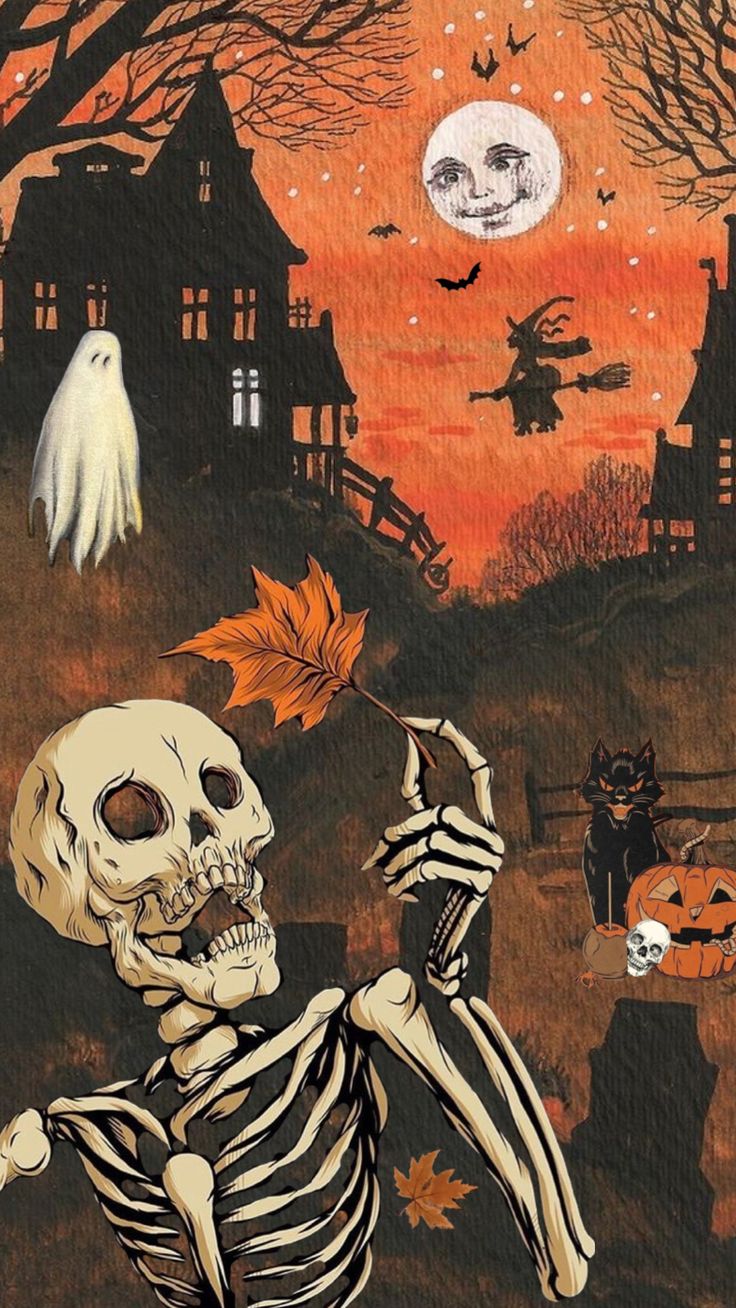
It was Friday, the last day of October, Halloween. The children were restless. They wanted to be released from their bondage so they could don their ghost, devil, or cowboy costumes and go out into the world and make mischief and collect enough candy to last them through the winter that was coming.
Their teacher, Miss Wessel, also longed to be released. It was her day. She had been teaching ten-year-olds for decades. She was leaving for good, once and for all, at the end of the day. The time had come for her to fly off and live the rest of her life the way she wanted to live it. The children didn’t know they’d have a new teacher come Monday morning. That was the way Miss Wessel wanted it. Say good-bye to no one.
There was no need on this day to do any work, to put on a good face. She had designated this, her last afternoon, as a time for silent meditation. This meant reading, thinking, looking out the window, or whatever one wanted to do, as long as one did it quietly. If one wanted to sit and doze at one’s desk, so much the better.
All was quiet, but there seemed to be an unwritten rule that says a roomful of ten-year-olds cannot be perfectly still for more than a few minutes at a time, no matter what. An unusually large number asked to be excused to go to the restroom. Miss Wessel was inclined to tell them to hold on to it, but in every case she let them go because she simply didn’t care. If they didn’t come back right away she didn’t get up to go see what was keeping them. If they were wandering around the halls doing things they weren’t supposed to be doing, some other teacher would see them and send them back; if they never came back, that was all right, too.
A boy named Terry Hughie got up to sharpen his pencil and fell on his backside like the clown he was, causing everybody to laugh uproariously, which was exactly the response he was hoping for. A little while later, two boys were scuffling in the back of the room, apparently trying to strangle each other. When Miss Wessel threw a blackboard eraser at them, somehow managing to hit them both, they immediately desisted and sat back down in their seats.
With order restored, Miss Wessel slumped down at her desk and was just about to go to sleep when she heard footsteps approaching and someone standing beside her, breathing audibly. Opening her eyes, she saw Francine Quince standing inches away, looking at her with her strange dark eyes.
“Yes, Francine,” she said. “What is it? Can’t you see I’m busy?”
“I need to talk to you,” Francine said.
“What’s stopping you?”
“In private.”
“Can’t it wait until Monday?”
“No.”
With a sigh Miss Wessel stood and motioned for Francine to follow her into the cloakroom. She turned and faced Francine beside the fire extinguisher, clasping her hands in front of her to resist the urge to slap her. Of all the students in her class, she liked her the least.
“Did one of the boys draw an unflattering picture of you again?” she asked.
“Yes,” Francine said, “but that’s not what I wanted to talk to you about.”
Standing close to Francine, Miss Wessel realized—and not for the first time, either—what an odd child she was. She was taller than the other children and seemed older in some unidentifiable way; more worldly, somehow, than her years would have allowed her to become. She had a very long neck and pale skin and, in spite of the pinched-up features of her face, enormous dark eyes that were like pinpoints zeroing in on all she saw.
“I’m listening,” Miss Wessel said, when Francine seemed to hesitate.
“I don’t know quite how to say this,” Francine said.
“Did you have a naughty accident? Do you need to go home?”
“No, nothing like that. I just wanted to tell you that I know what you are and I know what you’re going to do at the end of the day today.”
“I don’t know what you’re talking about!” Miss Wessel said, mustering as much indignation as she could on such short notice.
“I want you to take me with you.”
“Now why would I take you anywhere?”
“Because I’m one of your kind.”
“And what kind is that?”
Francine laughed her grown-up laugh. “I’ve seen,” she said. “I know.”
“Francine,” Miss Wessel said sternly, not caring if the other children heard, “I don’t have the time or the inclination for this kind of nonsense! Please return to your seat and don’t talk of this again!”
“Everybody who knows me would be glad if I went away and never came back. They’d look for me, of course, because that’s what they’re supposed to do, but after a while when they didn’t find any trace of me they’d figure I ran away or was abducted by aliens or something.”
“Would you like to spend the rest of the day in the principal’s office?” Miss Wessel asked, not knowing what else to say.
“No.”
“Then return to your seat.”
“All right. I will. But I still want you to take me with you.”
The afternoon continued to its inevitable conclusion without further incident. When the bell rang to go home, Miss Wessel stood at the classroom door and handed everybody a paper bag of candy as they left. She made a point of looking them all in the face and calling them by name, as she would never see any of them again, and wishing them all a happy Halloween.
When everybody had left and there was one bag of candy left, Miss Wessel realized that Francine Quince was still in the room with her, sitting quietly at her desk. She had forgotten for the moment about Francine. She held the bag of candy above her head and smiled.
“There’s one bag left, Francine,” she said, “and it’s got your name on it. Happy Halloween!”
“I don’t want it,” Francine said.
“Then take it and give it to your little brother.”
“He doesn’t want it either.”
“Go home, Francine! School is over for the day and it’s time for all of us to leave. Your mother will be expecting you.”
“My mother’s a drunk and a whore who doesn’t even know what day it is.”
“Suit yourself. If you’re still here when the janitor comes in to straighten up, he’ll make you leave.”
“I’m going with you.”
“Francine, do you think I want to be responsible for the disappearance of a young girl? I think that’s a fairly serious charge.”
“It shouldn’t matter to a witch.”
“Witch or not, I have some scruples.”
“I’ll bet you’ve cast many spells on people and turned lots of men into toads!”
“It isn’t like that!”
“Then take me with you so I may know what it’s really like. You can make me your protégé.”
“Francine, I don’t even like you. Why would I want you with me all the time?”
“If you don’t take me with you, I’ll go to the police and tell them everything I know about you.”
“Why should that make any difference? I’ll be so far away they’ll never find me and they wouldn’t even know where to look.”
“Then take me with you.”
“I’m leaving now, Francine, and you’re leaving, too, but not with me.”
“I’ll kill myself if you don’t take me.”
“Do you know what it’s like to fly a broom? It takes skill and coordination, not to mention balance.”
“I can learn. You can teach me.”
“Good-bye, Francine. You have my sincere good wishes.”
Miss Wessel went out of the room, turning off the lights and closing the door. She knew that Francine was still inside, but she didn’t care; she was finished with her. When she walked down the hall to the seldom-used door to the attic, she knew that Francine was right behind her.
“You’re not supposed to be in the building after school hours, Francine,” she said.
She went up the dark, narrow steps to the attic, brushing away cobwebs. Francine was right behind her like a shadow. At the top of the steps, the fluttering of bat wings caused Francine to let out a little scream.
“If a few little bats scare you,” Miss Wessel said, “you’re not really a witch.”
“I just wasn’t expecting them,” Francine said.
“If you’re going to be a witch, you’ll learn to expect anything.”
Miss Wessel changed into a long, flowing black dress. After she had fastened all the buttons and smoothed the dress over her bony hips, she put on a black pointed hat with a wide brim. Her face, at that moment, took on a different look. Her nose and chin became more pointed, more prominent; her skin, always the color of ivory, took on a greenish tint. The wart on her chin that was barely visible before became enormous, complete with a tuft of bristling hair.
With her preparations complete, Miss Wessel pointed a long index finger at Francine and laughed a cackling laugh. “Are you quite sure you want to do this, my dear?” she asked.
Francine, in spite of herself, drew back. “Yes, I’m sure,” she said.
“Then follow me.”
She picked up her broom and climbed the ladder that was built into the attic wall and pushed open the trap door that led to the roof. After they had both gone through the trap door and were standing on the roof, Miss Wessel let the door slam back into place. Then, with Francine watching her closely, she straddled the broom with her legs.
“Get on,” she said, “and hold on. I would advise you not to look down until you get used to flying.”
Francine got onto the broom behind Miss Wessel and wrapped her arms around Miss Wessel’s waist.
“Are you ready?” Miss Wessel asked.
“Yes,” Francine said.
“Do you want me to put a curse on your mother before we go?”
“No. Her life is already cursed enough.”
“Very well, then. We’re off!”
The broom lifted, carrying its two passengers. Miss Wessel flew in a broad sweep over the school and the town so they could take one last look at the place that had been their home for so many years. Then, with the full moon as a backdrop, they flew away to points unknown, never to be seen or heard from again.
Copyright © 2024 by Allen Kopp




 Literary Fictions