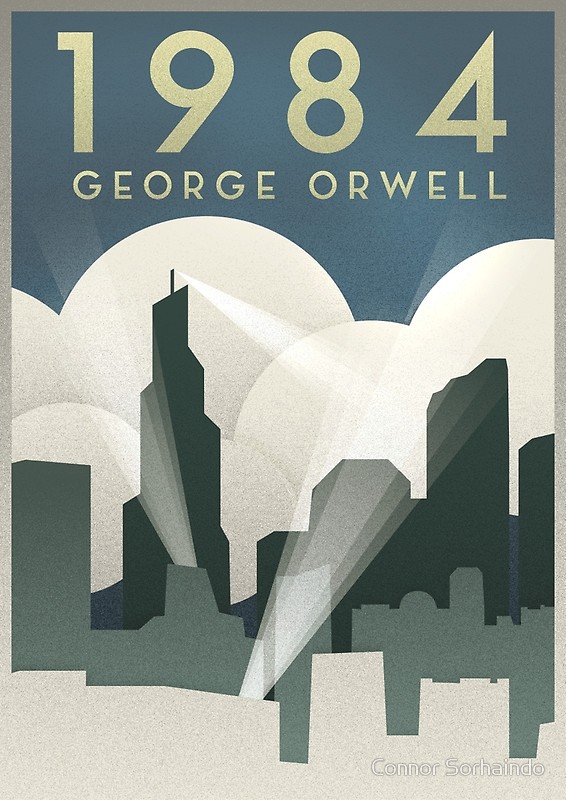
1984 ~ A Capsule Book Review by Allen Kopp
George Orwell’s celebrated novel about a bleak dystopian future, 1984, was first published in 1949. It’s set in London, but it’s not called London anymore; it’s now called Airstrip One and it’s part of the landmass known as Oceania. There are three superpowers in the world: Oceania, Eastasia and Eurasia. A constant state of warfare exists between Oceania and either Eastasia or Eurasia (first one and then the other). We learn later in the book the cruel reason that warfare—or at least the idea of warfare—is perpetuated. As long as the subjugated people believe their country is at war, they have somebody to hate and hate is what drives them and ensures absolute loyalty to the Party.
The Party is all and everything in 1984. The slogans of the party are: WAR IS PEACE, FREEDOM IS SLAVERY, AND IGNORANCE IS STRENGTH. There are no laws and no religion and no government to speak of. Owning property of any kind is not allowed. People live in cheerless “flats,” each of which has its own “telescreen” that can’t be turned off. Everything a person does or says is heard and seen by the telescreen: BIG BROTHER IS WATCHING YOU!
Winston Smith is the “every man” main character in 1984 who puts the story on a personal level for the reader. He’s thirty-nine years old and works in what is called the Ministry of Truth. His job is to change the historical record (books, magazines, newspapers, etc.) to conform to the current propaganda. There is no historical record of any past event that the Party doesn’t control: what is now has always been and will always be. The Party believes that whoever controls the past controls the future and whoever controls the future controls the past.
On the surface, Winston Smith tries to be a good Party member. He does what he’s told, but inside he’s rebelling. Inside, he hates the Party, Big Brother and everything they stand for. He knows these thoughts could get him killed, so he must keep them to himself at all cost. He hears about a resistance movement called the Brotherhood. He isn’t sure if the Brotherhood really exists or if it’s just hearsay. If it really exists, it might be a way to overthrow the Party. Does he dare hope that such a thing is possible?
He meets Julia, younger than him by almost fifteen years. She is more of a “free spirit” than he is, if such a thing is possible in this world. When he discovers that Julia shares his loathing of the way things are, they begin a secret love affair. They rent a room in the proletarian section of the city where they might be alone (they think) and discuss their subversive views.
A man named O’Brien comes to play an important part in the story and in Winston Smith’s life. Without words being spoken, Winston feels a connection to O’Brien that he can’t explain. Is O’Brien what he seems to be or is he something else? Might he lead Winston and Julia into the resistance movement (the Brotherhood) or might he lead them in another direction? Is it safe to trust anybody in this world?
The brilliance of 1984 is that it’s wholly believable and still so relevant. As our freedoms are slowly being eroded, we come closer and closer to the kind of world we see in 1984. In high levels of the U.S. government, there are enemies of the right to bear arms, of freedom of speech, freedom of religion, who would gladly remove those cornerstones of the Constitution if only they could find a way. There are also many people who would remove God and religion from public discourse and change the historical record to make it conform to today’s standards of political correctness. That’s what removal of Civil War monuments is all about: WE will change the past to make it what WE think it should be. The all-important WE, embodying Groupspeak and Groupthink. You think as we think or you die. This is exactly what happens in 1984.
And then there’s video surveillance. If you are in a clothing or a hardware store, at the library or at a gas station, or sometimes just walking along the street or crossing a parking lot, you are being watched in case you decide to do something you shouldn’t do. And if the cameras don’t catch you, there are always the snitchers, the do-gooders with their cell phones at the ready who will inform on you, whether there’s any reason to or not. “I just saw this man walking down the street wearing a long-sleeved shirt in July! That’s awfully suspicious if you ask me. I think he’s planning an attack of some kind.” BIG BROTHER IS WATCHING YOU!
Copyright © 2018 by Allen Kopp