Roman Soldiers in the Circus (1640) by Anielo Falcone
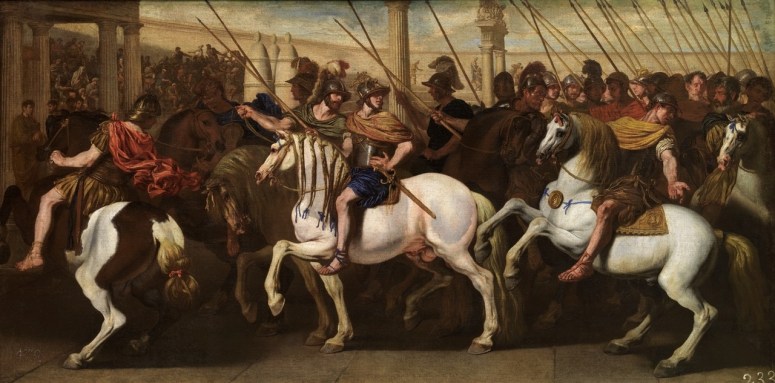

Roman Soldiers in the Circus (1640) by Anielo Falcone
Colorful poster for 1936 Grande Prix auto race in Tunis, Northern Africa.


Jordan County ~ A Capsule Book Review by Allen Kopp
Shelby Foote was an American writer and historian who lived from 1916 to 2005. He is best known for his monumental, three-volume The Civil War: A Narrative, but he also wrote works of fiction, including Jordan County, called a novel but really a collection of novellas, short stories and sketches, all set in or around the fictional town of Bristol, Mississippi.
The collection begins with “Rain Down Home,” a story about a disturbed World War II veteran returning to his hometown after the war. He just got off the train; it’s early morning and rain is falling. He seems all right when he goes into a café and orders breakfast but before the story ends he is unexpectedly moved to violence.
Since “Ride Out” is fifty pages long, it’s more a novella than a short story. It’s about a young, disadvantaged black man named Duff Conway. He has no father and a decent mother who loves him but is barely able to provide for him. At an early age, he discovers a talent and a love for music, which he apparently inherited from his wayward father. He teaches himself to play rustic instruments and begins hanging out at night spots where jazz is played. He ends up in reform school and when he finally gets out and goes home, he pursues his music earnestly. He has some early success playing the cornet professionally, but he gets mixed up with the “wrong” kind of woman and jealously murders a rival for her affections. He is sentenced to be executed in the electric chair, but here irony intervenes. He has contracted tuberculosis from breathing “bad air” for years in nightclubs where he has played and would be dead soon anyway, even without being executed.
“Child by Fever” is a novella or short novel (150 pages) comprising half the length of Jordan County. It is the story of one Hector Sturgis, child of a wealthy family. He is dominated by his grandmother and, when she dies during an epidemic of yellow fever, his mother (who almost dies in the epidemic but doesn’t) becomes the dominating force in his life (it’s a matriarchal family). He is lonely and isolated from the rest of the world and looks for love in all the wrong places. He marries an unsuitable woman named Ella and, after the initial sexual attraction grows thin, he realizes what a mistake he has made. Ella dies tragically while committing adultery with another man (the man dies too), and Hector lapses into insanity. He stays isolated in his room all the time, imagining that his dead wife Ella has returned to him.
“Pillar of Fire” is the story of one Isaac Jameson, a soldier who fought with Andrew Jackson in the War of 1812 and who is still alive, a very old man, when the Civil War is fought. His life story is the story of much of the history of the South. When Union soldiers burn his lifelong home over his head, he has no other choice but to stand by and watch.
Jordan County is not the best of Southern writing, but if you’ve read all the Flannery O’Connor, William Faulkner and Carson McCullers you can lay your hands on, don’t count it out. It’s engaging and thoughtful writing (if second-tier) that’s worth your time and effort, if you, like me, are a compulsive reader of anything that’s good.
Copyright © 2019 by Allen Kopp
Bile Beans was a laxative and tonic first marketed in the 1890s, found to be a fraud, but still sold in the U.S. until the 1980s. It works for you only if you think it does.

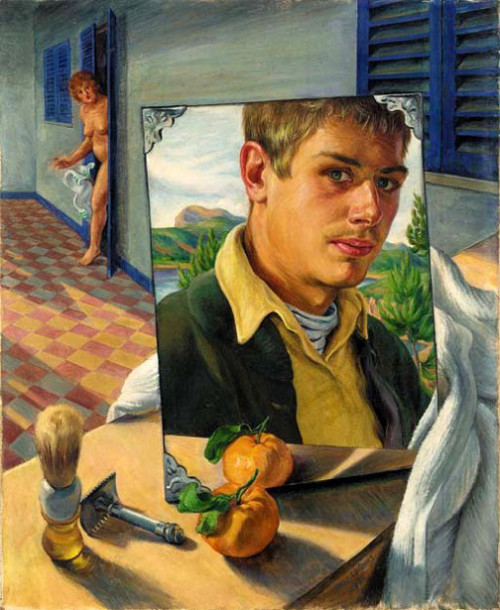
Self-Portrait (1965)
by Paul Cadmus
Paul Cadmus was an American painter who lived from 1904 to 1999. His paintings combined elements of eroticism and social critique to produce a style known as “magic realism.”
On the Terrace (1881)
by Pierre-Auguste Renoir (1841-1919)


Welcome to the Neighborhood ~ A Short Story by Allen Kopp
A moving van pulled up at the house across the street and three bear-like men got out and began unloading furniture. A late-model red car pulled into the driveway from which four people emerged: a gangly boy wearing a backwards baseball cap and an older man from the front and a girl and a middle-aged woman from the back. The man had white hair and walked with a limp. The girl looked like a younger version of the woman, obviously mother and daughter.
“Looks like a girl about my age,” Carmen said. “She’s fat and ugly but I’ll bet she has her driver’s license. Probably even her own car.”
“You’d better quit spying on the neighbors,” Zane said from his spot on the couch, where he was reading a story in True Romance magazine about a woman with four husbands at the same time. “They’re going to see you and know what a crazy person you are.”
“You ought to see this old couch they’ve got. It looks like it’s about a hundred years old. If it was mine, I’d set it out in the yard and douse it with kerosene and set fire to it.”
“Maybe they’re just waiting for the right moment to do that very thing.”
“And there’s a big glass thing that looks like a fish tank. I always wanted a fish tank.”
“Why don’t you go over there and ask them if they’ll give it to you?”
“If they can afford a fish tank, that must mean they have lots of money and that girl must have her own car. I wonder what her name is. I’m sure she’ll have an ugly-girl name like Mabel or Bertha.”
“When she sees you, she’ll think the same thing about you.”
“Hey, look at this! They’ve got a big thing that looks like a sun lamp and a huge dining room table and one, two, three, four, five, six chairs that go with it. They must have a lot of people over for dinner if they need six dining room chairs.”
“Who cares?”
“Now here comes a dresser with a big round mirror and a bed and some mattresses and a chest of drawers and—wait a minute!—here’s another bed and some more mattresses. The mattresses look brand new. They haven’t been peed on yet. Now they’re bringing out a couple of big upholstered chairs and some more boxes and—oh, my gosh!—here’s another bed and another set of mattresses. How many beds do they have, anyway?”
“Your interest in their beds is a little disturbing.”
“Now, what do you suppose that thing is? It looks like a big square washing machine.”
“Why do you care what it is?”
“I have natural curiosity. I want to know what’s going on around me. Oh, wait a minute! The girl is standing on the sidewalk looking up at the roof with her hands on her hips. She just pulled her underpants out of her crack. That’s the kind of thing people do when they think nobody’s looking at them. Come and take a look!”
“I don’t want to see any ugly girl messing with her crack or anybody else’s,” Zane said, but he put the magazine aside and stood up from the sofa and went over to the window. He took the binoculars from Carmen and adjusted them to his own eyes.
“She’s ugly all right,” he said. “Her hair looks like a fright wig you’d wear on Halloween.”
“What did I tell you? Wait until she turns around and you get a look at her face.”
“She’s turning around now and she’s saying something to one of the moving men. She’s telling him where to take some boxes. I can almost read her lips because her mouth is so big.”
“What are you talking about?” Carmen said. She snatched the binoculars back from him. “That’s not the girl, you goof! That’s the mother! Oh, wait a minute! Here’s the girl now, just coming out of the house.”
“Oh,” he said. “The mother and the daughter look just alike. They’re both horribly freakish.”
“Well, the mother is middle-aged and has on a ton of makeup and the girl is about my age. That’s how you tell them apart.”
“What do I care how to tell them apart? Maybe I just want to ignore them and mind my own business.”
“I think we should go over there and welcome them to the neighborhood. That’s what you’re supposed to do when somebody new moves in.”
“Not me!”
“You won’t go with me?”
“No.”
“I might just have to tell mother about the collection of questionable magazines hidden in your room.”
“I don’t have any magazines in my room.”
“Don’t you know there isn’t anything that goes on in this house that I don’t know about?”
“I think you should mind your own damn business and stop snooping around!”
“So you will admit that you have magazines hidden in your room?”
“I admit nothing.”
“Just the suggestion of those magazines in the house would probably kill mother. You know she’s not a well woman.”
“Could we please talk about something else, or not talk at all?”
“Then you’ll go with me?”
“I’ll go because you’re a sick person who needs help, not because I have any magazines in my room.”
Carmen put on grandma’s widow’s hat with black feathers. The almost-opaque veil resembled a mosquito net that hung down past her chin. She got her baton out of the closet and held it in the crook of her arm, ready to twirl. Zane put on his steampunk goggles and his Trader Horn pith helmet. Arm in arm, they went out to the front yard.
The woman and the girl were taking boxes out of the back of the red car and didn’t look up when Carmen and Zane appeared. The moving men were moving something heavy out of the back of the van, keeping up a steady patter of invective.
“They look busy,” Zane said. “Maybe we’d better wait and go over later when they’re finished moving.”
“I know how to get them to notice me,” Carmen said. She began marching up and down in front of the house like a soldier on sentry duty with the baton as her gun. She marched until she was out of breath.
When they still didn’t pay any attention to her, she went into her drum majorette routine. She had auditioned for drum majorette two years earlier and, even though she hadn’t been chosen, she still knew all the moves. She kicked her left leg as high as her head, and then her right leg. She threw the twirling baton six feet into the air and caught it with the tips of her fingers.
“I saw a woman doing this on TV with both ends of the baton flaming,” she said. “She was blindfolded, but she never burned her hands. I’d like to try that sometime.”
While Carmen was twirling frenetically, Zane began doing experimental cartwheels on the grass. His pith helmet fell off every time, so he began doing them much faster. When he was able to do a cartwheel and not have the helmet fall off, he congratulated himself effusively.
The baton twirling and the cartwheels still garnered no attention from the new people, as they continued to be absorbed in the business of moving furniture, boxes and barrel-like cartons into the house.
“Am I going to set off an explosion to get them to notice me?” Carmen said. She threw the baton down and began walking on her hands on the sidewalk and then up the steps of the porch and down again, all the time maintaining her superb balance.
Zane left off doing cartwheels and began walking on his hands too, but he wasn’t as accomplished a hand-walker as Carmen. When he tried going up the steps to the porch, his arms weakened and he fell on his head.
“You’ll never be able to do that,” Carmen said. “There are some things I’m just naturally better at than you.”
“I could do it with more practice,” he said.
“This isn’t working,” Carmen said. “They haven’t looked over here a single time. I think I should sing a showtune.”
“Please don’t do that!”
“How about ‘Seventy-Six Trombones’?”
“No, I hate that song!”
“I know! I’m going to get grandpa’s wheelchair out of the basement.”
It was in a corner underneath some old clothes and a box of fur pieces and hats. Carmen brushed away the cobwebs and rolled the chair to the door and out into the yard.
They took turns riding the wheelchair down the slope of the yard toward the street, stopping just short of the sidewalk. The chair didn’t move very well on the grass, so Carmen sat in the chair and Zane got behind and pushed.
On one run, he pushed a little too hard and the chair didn’t stop at the sidewalk but kept on going and jumped the curb and went out into the street, out of Carmen’s control. She put her hands on the wheels to try to stop them but she was going too fast.
Up the hill, half a block away, Milton Sills the midget was working on his classic Cadillac-with-no-engine in front of his house. He was lying on his back and, as he was coming out from underneath, he accidentally kicked the jack loose that was holding up the front end of the car. It began rolling backwards down the hill at about fifteen miles an hour.
Carmen was on a collision course with the Cadillac but she couldn’t stop the chair. She tried dragging her feet but it didn’t help; she was going too fast. She screamed and closed her eyes and threw her arms up over her head.
The wheelchair grazed off the rear bumper of the Cadillac and turned over. The Cadillac continued down the hill until it came to rest against a tree in the yard of an old woman who wore a white pageboy wig named Mrs. Franchetti.
Carmen was half in and half out of the wheelchair. She had hit her head on the pavement and was dizzy. She was bleeding from her the bump on her head and skinned places on her arm and leg. She was certain the people across the street would have seen what happened to her, but they had all gone inside and hadn’t seen a thing.
She spent five hours in the emergency room at the hospital waiting to get fixed up. When the doctor finally saw her, he had her admitted to a semi-private room overnight, where she had to listen to the all-night moaning and gurgling of an elderly roommate. In addition to contusions and bruises, she had a mild concussion and a fractured wrist. The doctor asked her why she was playing around with old an old wheelchair. She was lucky she wasn’t killed.
When mother found out, she called Carmen a dangerous fool. She ought to be ashamed of herself for dishonoring grandpa’s memory by using his wheelchair as a toy. She was confined to the house for the rest of the summer. It was a setback to her mad desire to get her driver’s license before school started. Since she was twelve, she had dreamed of having her own car to drive to school and anyplace else she wanted to go.
After a few days, the headaches lessened and she was able to come out of her room. She sat in the living room with the TV on, looking out the window, when Zane came in, looking pleased with himself.
“Leave me alone,” Carmen said, before he had said a word.
“I heard some news that might be of interest to you,” he said.
“What is it?”
“No, if you don’t want to be bothered, I’ll just keep it to myself.”
“You’d better tell me and tell me quick.”
“I’ve been over at Kent Collier’s house all morning.”
“How could that possibly interest me? Kent Collier is a weasel.”
“His mother knows those people.”
“What people?”
“Don’t be coy.”
“You know that old thing about appearance versus reality?”
“I don’t think I’ve heard that one.”
“To bring it down to your level: appearances can be deceiving.”
“What are you talking about?”
“That ugly girl’s name is Gwennie Bell.”
“So?”
“You won’t be going to school with her and you won’t have to suck up to her so she’ll take you places in her car.”
“Why not?”
“Every morning she’ll be walking the three blocks down the hill to catch the retarded bus to take her to retarded school.”
“Oh, my gosh! She’s retarded?”
“You catch on fast.”
Mother came in from the kitchen and stood in the doorway so she could hear every word. Carmen and Zane knew she was there but pretended she wasn’t.
“And that’s not all,” Zane said. “That skinny ‘boy’ in the backward baseball cap is really a woman, thirty-three years old.”
“Are you making this up?” Carmen said.
“She’s a lesbian.”
“A what?”
“It gets better. That middle-aged woman that you thought was the mother of the ugly girl is really her sister and she’s also a lesbian. She and the ‘boy’ in the backward baseball cap are lesbian lovers.”
“Hey!” mother said. “We don’t use that kind of language in this house!”
“Who is the old man?” Carmen asked, continuing to ignore mother. “Are you going to tell me he’s really a woman, too?”
“No, he’s the father of the middle-aged woman and retarded Gwennie. So, you have an old man, two lesbian lovers and a retarded girl living in the house, making up the family. It’s a story of sexual deviancy and mental retardation.”
“You’d better not be spreading gossip,” mother said, “or you’re going to be confined to the house for the rest of the summer like your sister.”
“If you don’t believe me, call Kent Collier’s mother and ask her.”
When Carmen and Zane were out of hearing, she called the Collier home, spoke to Kent’s mother, an old friend from her school years, and confirmed all that Zane had said.
As part of Carmen’s punishment for the wheelchair, mother had the “really good idea” of making Carmen take a small gift to retarded Gwennie across the street, introducing herself and asking her to go with her to the outdoor concert in the park on Friday night. It was a lesson that would help teach Carmen humility and having respect for other people’s feelings.
“I’d rather die that be seen out in public with her!” Carmen moaned.
“That’s all the more reason for you to do it, then,” mother said.
The next day, Carmen, holding a potted philodendron as a gift, went and knocked on the door of the house across the street. The old man, the father, came to the door and when he saw Carmen he frowned and the corners of his mouth turned down.
“Is Gwennie at home?” Carmen asked, swallowing hard.
“Who are you?” the old man asked.
“I live across the street.”
“Just a minute. I’ll see if she’s busy.”
The old man went away and in less than a minute, Gwennie appeared in his place. When Gwennie saw Carmen, she had an I-don’t-know-you look on her face but then she managed a small smile. Carmen held out the potted plant; Gwennie took it from her and invited her in.
“She’s in!” Zane said, watching from the window across the street. “I just know they’re going to be the best of friends!”
Copyright © 2019 by Allen Kopp
The Meals (1923) by Andre Masson
André Masson was a World War I-era French painter who lived from 1896 to 1987. He alternately embraced cubism and then surrealism.


 Literary Fictions