

Author: allen0997
Every Word on Every Page
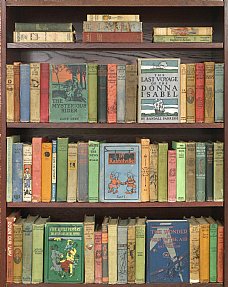
Every Word on Every Page ~ A Short Story by Allen Kopp
His name was Mr. Crimm. He was a man in his fifties with the bulk of a gorilla. There was something about him not quite savory; he was missing a finger on his right hand and he had bristly hairs growing out of his nostrils. He looked more like an auto mechanic than a book dealer. He knocked savagely on the door. Mrs. Fairleigh went to let him in, disliking him at once.
“You got some books?” he said, baring his yellow monkey teeth.
“You’re the book expert?” she asked.
“That’s what they tell me,” he said. “You called for somebody to come and take a look at some books?”
She opened the door for him. She took two steps ahead of him and then stopped and turned to look at him. “My late husband was the book collector. He loved books, mostly novels and books on history. The Renaissance and Magellan and that sort of thing.”
“Uh-huh,” Mr. Crimm said, obviously not impressed.
“I don’t know much about them myself. The books, I mean.”
“Are you going to show me the books,” Mr. Crimm said, “or are we going to stand here all day and gab?”
She took him up the stairs, along the hallway to the last door on the left. She opened the door and stepped inside, Mr. Crimm following her.
“This is a bedroom, but all it has in it now is books,” Mrs. Fairleigh said.
Shelves from floor to ceiling were loaded with all manner of books, old books and newer books, every shape, size and color. Where the shelves were overflowing, books on their sides were laying on books standing upright. Books were stacked on the floor in front of the shelves, in corners and in every available space. Cardboard and wooden boxes full of books allowed only a narrow path through the room.
Mr. Crimm made a sound in his throat of disapproval, as if about to discharge a ball of phlegm.
“They’re not very well organized, I’m afraid,” Mrs. Fairleigh said. “Ever since my husband died, I thought I’d go through them and organize them in some way but I never seemed to find the time.”
Mr. Crimm selected a book at random from the shelf, opened it and turned a few pages. Putting the book back, he did the same thing with another one.
“Not worth much,” he said.
“What?”
“I said nobody wants books like these. They’re not worth anything.”
“You’ve hardly even looked at them.”
“I’ve been in business for a long time. I know what people want and what they don’t want.”
“It seems you’d look at each book individually and establish a price for each one.”
“I ain’t got time for that. That’s not the way I do business.”
“Well, I’m sorry to have wasted your time, but I don’t think…”
“I give you two hundred dollars for the lot.”
“What?”
“I said I give you two hundred dollars for every book in this room. That’s very generous. I might even buy the shelves if the price is right.”
“They’re worth a lot more than that, I’m sure!” Mrs. Fairleigh said.
“You just said you don’t know nothing about no books,” Mr. Crimm said. “Believe me, this is a lot of junk and it’s not worth anything. A thing is only worth as much as somebody is willing to pay for it. This is a lot of crap, I can tell, and I’m offering you two hundred dollars to take the whole mess off your hands this very day.”
“No, I’ve changed my mind. I’m going to call somebody else.”
Mr. Crimm gave an exasperated sigh and leaned his monkey-like paw against the door frame. “You can call any book seller in the city and they’ll all say the same thing. Do you want me to give you a little time to think about it? That’s what people always say.”
“No, I’ve already made up my mind. I’m not going to sell to you.”
“Do you mean to say you got me all the way out here for nothing?” Mr. Crimm asked.
“I’ll give you fifty dollars for your time and effort and that’s the best I can do.”
Mr. Crimm looked at her as if she was a very difficult case. “I give you two hundred fifty dollars,” he said. “That’s the best offer you’ll get anywhere.”
“No, that’s not enough for this many books. There are thousands of books in this room. I’m sure they’re worth more than that.”
“You won’t do no better, believe me.”
“I’m sorry your time had been wasted. I’ll write you a check for fifty dollars and we’ll call it even.”
“Three hundred! That is my last and final offer!”
“No! Don’t you understand English? I’m not going to sell to you!”
“That’s no way to treat a businessman, you know!” Mr. Crimm said. “You get me all the way out here in good faith and then you back out of the deal? I don’t think I’m going to let you treat me in this way! There’s such a thing as ethics in business, you know! Don’t you have no ethics?”
“I’m not going to stand here and argue with you!” Mrs. Fairleigh said. “I want you out of my house this very minute!”
“I think we can work something out.”
“There’s nothing to work out!”
“You have a very bad attitude, you know that?” Mr. Crimm said. “You can’t treat people like dirt and expect them to take it lying down!”
“Is there any way I can make it any clearer? I want you out of my house! Right now!”
“I’m not leaving until we’ve concluded the transaction.”
“The transaction is concluded!”
“I’ll make it four hundred dollars but only if you throw in the shelves. That is a very generous offer and I know I’ll never make a cent of it back.”
“That’s not enough for this many books. Some of these books might be worth four hundred dollars on their own!”
“My driver is outside in the truck. His name is Paolo. I’ll get him to come in and help me and we’ll have this room emptied out in no time at all.”
“I don’t believe you’re an expert on books, at all,” Mrs. Fairleigh said. “I think you’re a junk dealer.”
“You don’t have to insult me on top of everything else!” Mr. Crimm said.
“A person who knows books would take the time to look at each book separately and assess its value. I’m sure some of these books are rare. Some of them alone may be worth thousands of dollars!”
“I’ve already told you what they’re worth, and they ain’t worth diddly squat!”
“You think I’m only a stupid woman. You’re trying to cheat me, but I’m not going to let you do it! I knew the second I saw you that you didn’t know a thing about books.”
“I know as much as anybody else and I know these books ain’t worth shit!”
“Well, they’re my books and I’m going to keep them!”
Mr. Crimm was no longer listening. He had been writing out a check. He tore it from his book and handed it to her.
“What’s this?” she asked.
“It’s your check for four hundred dollars for the books! Did you think I wouldn’t pay you what I said?”
She looked at the check and tried to give it back. “I don’t want it!” she said.
When he wouldn’t take the check from her, she tore it up in little pieces and threw them in his face.
“I see you are a very unstable woman,” he said.
“Get out of my house now or I’ll call the police!”
Ignoring her, Mr. Crimm called his driver, Paolo, on his two-way radio and instructed him to come inside. Paolo was no more than a boy, but in less than two minutes he and Mr. Crimm were hefting boxes over their shoulders, carrying them down the stairs and out the door.
“I’d advise you to stop with that right now!” Mrs. Fairleigh said, but she knew they were ignoring her. She had no other choice but to stand by and watch them.
She was going to call the police but she believed she needed more immediate help than they could offer. She went to her bedroom and got her husband’s loaded gun out of the dresser drawer. Holding the gun to her side, she went outside.
Mr. Crimm was loading boxes into the dark interior of the nearly empty truck and didn’t see Mrs. Fairleigh standing at the curb looking in at him. Paolo was still inside the house.
“Unload those boxes from your truck and set them here on the sidewalk!” Mrs. Fairleigh commanded.
Mr. Crimm was pointedly ignoring her. His face was inscrutable. “I’ll mail you a check for four hundred dollars,” he said, “since you tore the other one up.”
She pointed the gun at him. He didn’t bother to look at her until he heard the gun cock.
He laughed. “You going to shoot me?” he said.
“You think I won’t?”
“You going to shoot me over a load of old books?”
“No, I’m going to shoot you because you’re robbing me.”
“Put the gun down and stop acting like a child,” he said.
She fired the gun one time above his head. The bullet hit the far wall of the truck and made a hole clean through to the outside.
Mr. Crimm threw his arms up in surprise. “You shoot me, you crazy bitch!” he said. “What’s the matter with you? Are you insane?”
“No, I wasn’t trying to shoot you that time, but next time I will.”
“Wait just a minute!” he said. “You don’t have to shoot again! We’ll talk about this thing!”
“There’s nothing to talk about. Unload those boxes and set them here on the sidewalk and then get into your truck and drive away and forget you were ever here.”
“You crazy woman!” he said.
“Unload the boxes! Now!”
“All right! All right! It just ain’t worth it!”
He set the boxes on the sidewalk as he was told and when he was finished he stood looking at Mrs. Fairleigh as he rubbed his hands together. “You going to shoot me now?” he asked.
“Get back up in the truck!” she said.
“What?”
“I said get back up into the truck!”
“Why?”
“You’ll see why.”
He did as he was told. About halfway to the back of the truck, he turned and looked down at her. He put his hands on his hips and smiled. If he had been afraid of her before, his fear had passed.
“I don’t like you,” she said. “I didn’t like you from the moment you first knocked on my door.”
“Let’s just say it’s mutual,” Mr. Crimm said.
She shot him in the thigh of his right leg. He grabbed the leg, looked at her in surprise, screamed and fell back, cursing her in a language she didn’t recognize. Still holding the gun in her right hand, she slammed the doors of the truck, effectively shutting Mr. Crimm off from the light and air and out of her life.
Paolo came out of the house carrying a carton of books under each arm. When she saw him, she smiled.
“I don’t know if you understand English,” she said, “because I haven’t heard you speak a syllable, but I want you to listen very carefully to what I’m about to say.”
He smiled, nodding to show he understood. He set the cartons down alongside the others on the sidewalk, took a cigarette from behind his ear and lit it.
“I don’t know what relation this man is to you,” Mrs. Fairleigh said, “but I hope for your sake he isn’t somebody important to you because I just shot him in the leg. You probably heard the gun fire. Take him to the nearest hospital. Tell them a stray bullet hit him in a violent neighborhood you were passing through. You didn’t see exactly where the bullet came from. If you don’t follow these instructions to the letter, I have another bullet for you, with your name on it, and I have to tell you I’m not a very good shot. If I aim for your leg, I might hit something more vital.”
Paolo shrugged and smiled again and tossed his cigarette into the street. He climbed into the driver’s seat and slammed the door. He started the truck, grinding the gears and, pulling away from the curb, rattled away down the block and disappeared from view.
While Mrs. Fairleigh was still standing on the sidewalk, her next-door neighbor Mrs. Bushmiller came out and stood beside her. She had a cigarette hanging from the corner of her mouth and her hair was pinned up in bobby pins, making her appear to be wearing a tight-fitting brown cap.
“What was that noise?” Mrs. Bushmiller asked.
“I didn’t hear anything,” Mrs. Fairleigh said.
“It sounded like a car backfiring.”
“That’s probably what it was, then, dear.”
“Why are these cartons sitting here on the curb?”
“They’re some books I had delivered. I need help carrying them in the house and up the stairs.”
“Don’t worry,” Mrs. Bushmiller said. “I’ll get my sixteen-year-old son, Trippy, to help you. All he does is lay around the house anyway.”
“I’d be glad to pay him.”
“You won’t pay him a cent. What are neighbors for?”
Mrs. Fairleigh stood and waited while Mrs. Bushmiller went to get Trippy. In no more than a minute, he came running out of the house, eager to help a neighbor lady with a lifting job. How kind people are, Mrs. Fairleigh thought, as Trippy leaned over to get a good grip on the first box and she stared intently at the elastic of his underwear.
Copyright © 2019 by Allen Kopp
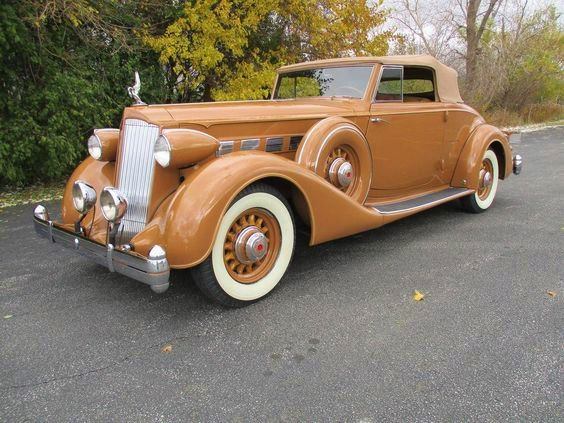
1936 Packard Super 8
1936 Packard Super 8
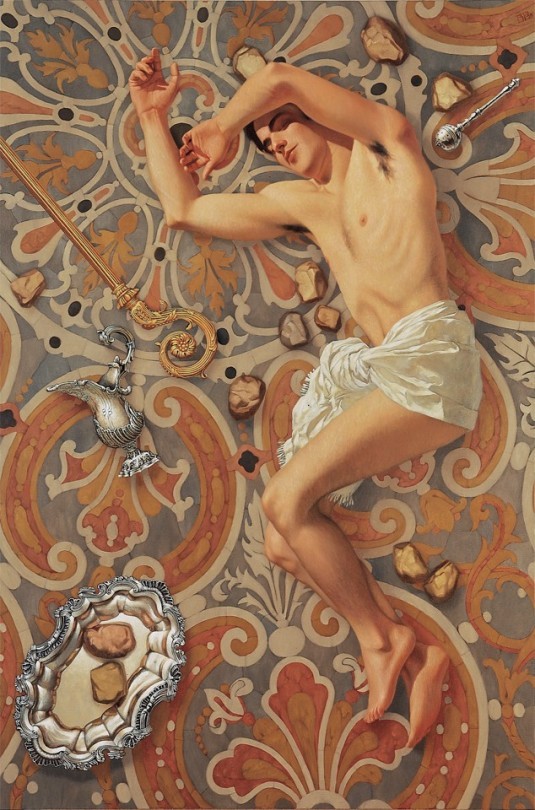
St. Stephen’s Soul Beholding His Dormant Body ~ A Painting by Carlos Barahona Possollo
St. Stephen’s Soul Beholding His Dormant Body (1995)
by Carlos Barahona Possollo (born 1967)
The Martian Chronicles ~ A Capsule Book Review

The Martian Chronicles ~ A Capsule Book Review by Allen Kopp
The Martian Chronicles, by Ray Bradbury, was first published in 1950 and is set in a future time in the early 21st century, a time that we have now exceeded and passed. It is a collection of interrelated short stories that are almost but not quite a novel. The stories are all set on the planet Mars and are about earth people traveling to Mars, living on Mars and trying to survive on Mars. Mars may be the one planet in our solar system that is most like earth but, as the people in the book discover, living on Mars is not quite the same as living on earth.
In The Martian Chronicles, tens of thousands of people from earth are traveling to Mars because—you guessed it—mankind has defiled and annihilated earth and, for people to go on living, they must find a new planetary home. Mars, as we see it, is an eerie, lonely planet, with dried-up oceans, deserts and canals, and remnants of Martian cities that are thousands of years old.
Earth people on Mars, as you might imagine, are not good for Mars. They set about destroying Mars the same way they destroy earth and there’s nobody to stop them. The once-proud Martian race has all but died by the time the bulk of earth people arrive. There may be a few Martians still living, but they keep themselves hidden in the hills and are rarely seen.
The stories in The Martian Chronicles are divided into three parts. The first part is about the attempts of men from earth to reach Mars and the methods Martians use to keep them away. In the second part, humans from earth set about colonizing Mars, having all but wiped out the Martians with earth diseases, and are preoccupied with making Mars as much like earth as they can. However, as earth is about to be destroyed in a nuclear war, most of the earth colonists on Mars pack up and return home. The third part deals with the aftermath of the destructive war on earth and the few earth people still remaining who will become the new Martians because earth is gone and they have no place to return to.
The Martian Chronicles is intelligent, inventive and engaging, with just a touch of creepiness to enlighten the proceedings, as when an inventor, whose wife and children have died on Mars, makes look-alike robots to replace them, or when the Martians eliminate one of the expeditions from earth by using telepathy to make the men of the expedition think their long-dead relatives are alive and well on Mars. It’s classic sci-fi fantasy as only Ray Bradbury can do it.
Copyright © 2019 by Allen Kopp
Doris Day (1922-2019)
She always seemed like a good person.

Tolkien ~ A Capsule Movie Review

Tolkien ~ A Capsule Movie Review by Allen Kopp
Thirty-year-old, blue-eyed actor Nicholas Hoult plays English fantasy writer John Ronald Reuel (J. R. R.) Tolkien in the film biography of Tolkien’s life, called, appropriately, Tolkien. J. R. R. Tolkien’s work is probably more popular now than it was during his lifetime due, in large part, to the two popular film trilogies (six movies in all), based on his works The Lord of the Rings and The Hobbit.
J. R. R. Tolkien lived from 1892 to 1973. Both of his parents check out early, so he and his younger brother are left under the guardianship of a priest. He attends a traditional boys’ boarding school, where he, as usually the case with creative people, occupies his own world, in this case the world consisting of sketching fantastic creatures, creating his own language, and dreaming of a fantasy world of his own making. (His early preoccupation with fantasy is fueled mostly by his soon-to-be-dead mother.) While still in school, he develops an infatuation for a young girl named Edith, who is the “paid companion” of a wealthy woman named Mrs. Faulkner. His love affair with Edith doesn’t work out right away and she announces she’s marrying somebody else, but eventually they end up together and marry.
While still at school, Tolkien develops a close relationship with several other boys, who are all unique in their own way. This friendship is very intense and lasts presumably for a lifetime or until death. The theme of friendship (“fellowship”) becomes an important theme in Tolkien’s yet-to-be written fantasy works. Other important themes would be questing for something that is lost and the titanic, never-ending battle between good and evil.
Tolkien experiences The Great War (“The War to End All Wars”) firsthand, on the front line of battle. He survives the war, while so many others do not, marries, has four children, and goes on to become a college professor and a prolific writer. We have to presume he would be surprised by the continuing fascination with his life and work 46 years after his death.
Tolkien covers roughly the first half of J. R. R. Tolkien’s life. The movie ends before he came to write the books that would make him famous. It’s a fairly standard movie biography, well-made, but not as compelling as films based on the lives of other famous Britishers, Alan Turing (The Imitation Game) and Stephen Hawking (The Theory of Everything.) The British accents in Tolkien are sometimes difficult to comprehend, but that’s usually the case with British movies (some English subtitles for American audiences might not be amiss).
Copyright © 2019 by Allen Kopp
1934 Duesenberg Model J, “Queen of Diamonds”
1934 Duesenberg Model J, “Queen of Diamonds”

 Literary Fictions