
Author: allen0997
The Dirty Parts of the Bible ~ A Capsule Book Review
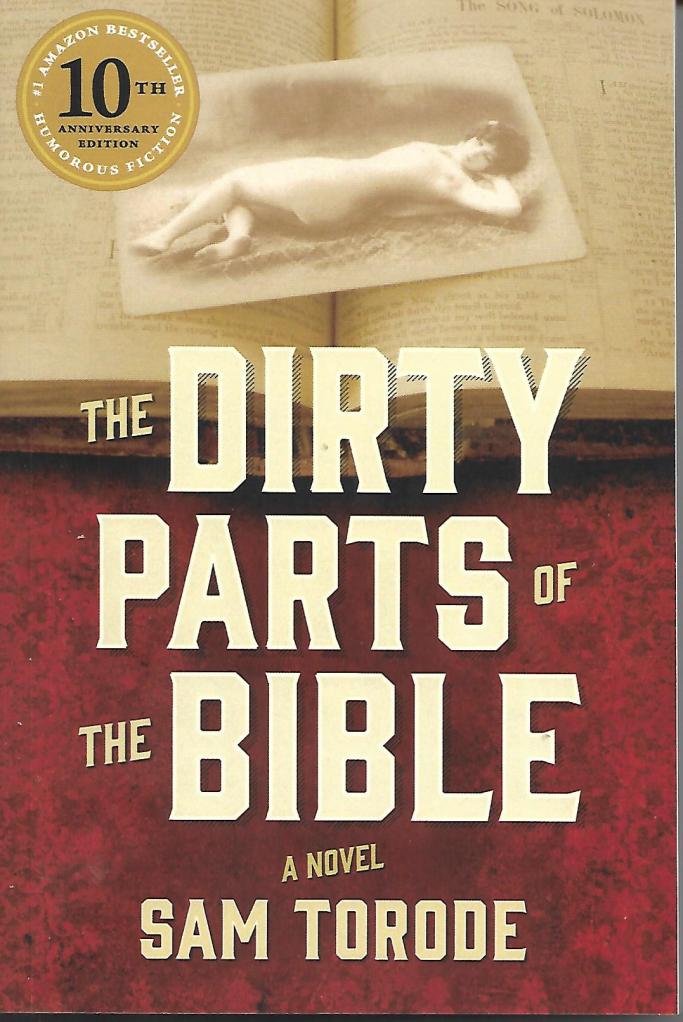
The Dirty Parts of the Bible ~ A Capsule Book Review by Allen Kopp
The time is 1936. Tobias Henry is twenty years old, but sometimes he acts like he’s twelve or thirteen. He’s a Baptist preacher’s son from Michigan who has led an altogether sheltered life. (His one goal in life is to have sexual intercourse with a girl before the “Rapture.”) While Tobias’s pious father spouts scripture whenever it suits him, he skillfully avoids mention of the “dirty parts of the Bible,” namely The Song of Solomon, where breasts are openly and frequently discussed.
When Tobias’s father gets drunk and smashes his car into the church, the Baptists decide they no longer want him to be their preacher. They give him his walking papers; he has sixty days to clear out. The Henry family is about to become destitute. Wait one damn minute, though! Tobias’s father hid a bag of money—a lot of money—in a well in Texas some twenty years earlier. He draws a map where he left the money. If Tobias can go on his own to Texas and find the money and bring it back, the family will be saved.
Right away, Tobias’s trip to Texas doesn’t go as planned. He ends up in a whorehouse in St. Louis, where he has a not-very-pleasant encounter (not a sexual one) with a jaded whore, whose only interest is in stealing Tobias’s money. From that point on, things only get worse. He loses his suitcase, along with the map to find the money, and ends up living the life of a hobo, living in a “Hooverville,” eating “Hoover steaks” (sardines), and riding the rails in boxcars. An old, philosophical hobo with a hook for a hand, named Cornelius McCraw (“Craw” for short), becomes his mentor and protector and teaches him some of the tricks of survival, such as how to catch a catfish when you’re starving and how to run from the law.
Eventually Tobias and Craw make it to Texas and the home of Tobias’s uncle and aunt. The uncle gives them a place to stay and puts them to work but won’t allow Craw into the house because he’s a black man. Tobias meets Sarah, a strange girl who believes (and everybody else believes it, too) that she is under an ancient Indian curse that makes her boyfriends die young.
In a roundabout way, Tobias finds his way to the lost money in the well, but it’s not the lifesaver his family hoped it would be. There’s money forthcoming, however, from another, unexpected source that will keep the Henry family from ending up on the poor farm. More importantly, Tobias discovers love—and sex—with the Texas girl Sarah. “Where did you learn to swear?” Sarah asks Tobias. “From my mother,” he says. “I can’t wait to meet her,” Sarah says.
The Dirty Parts of the Bible, by a writer named Sam Torode, is a too-cute, coming-of-age story with a simplistic plot and predictable characters. What I’m saying is, there’s not much depth here, although it is well written and engaging. It’s light summer reading if that’s what you’re looking for. It’s pleasant, fast, easy reading that will not require you to use your brain. Try not to roll your eyes too much while you’re reading it.
Copyright © 2019 by Allen Kopp

The Overstory ~ A Capsule Book Review
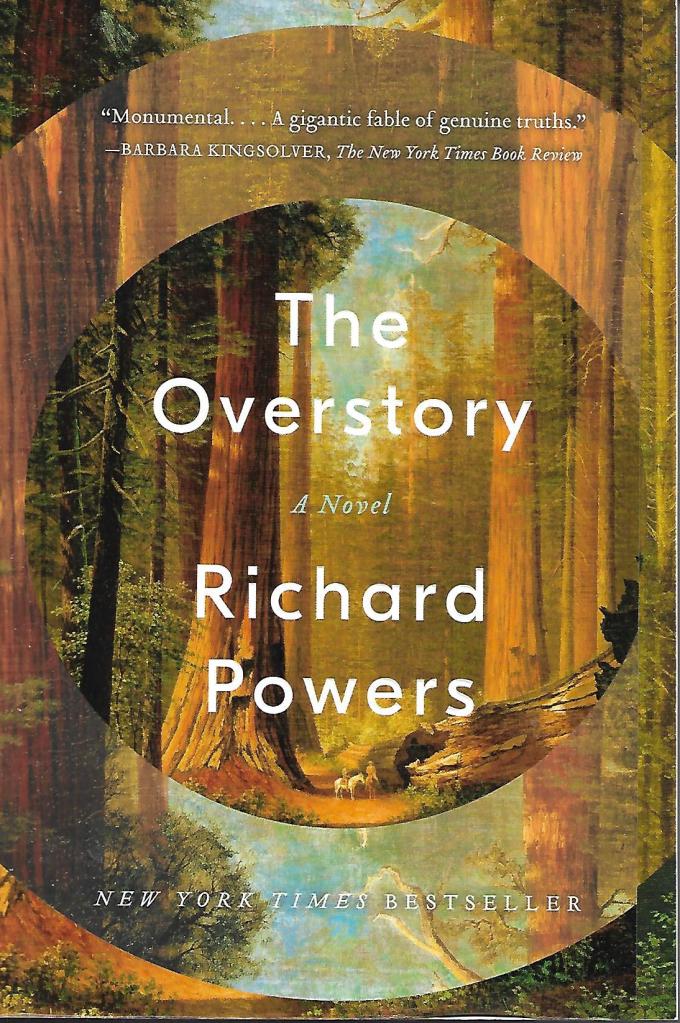
The Overstory ~ A Capsule Book Review by Allen Kopp
Richard Powers’ novel, The Overstory, is this year’s Pulitzer Prize winner for fiction. It’s a big novel, 500 dense pages, that took me almost three weeks to read. It’s a big story about big ideas. People don’t matter much where big ideas are concerned. You see, the earth has grown too overcrowded. The earth has to sustain seven billion (and counting) people. Trees are something that most people don’t ever think about. Trees play an important part in keeping the world functioning the way it’s supposed to. They replenish the air we breathe. Their roots keep the soil from coming apart. They provide food and medicine. Birds and small animals live in trees and rely on them for their livelihood. Trees are beautiful and capable of inspiring awe in insignificant humans—that is, those humans who are able to put aside their cell phones long enough to pay attention.
The world’s forests are dwindling at an alarming rate. The human race is an insatiable beast that must be fed. People must be kept happy and comfortable, oftentimes at the expense of the earth’s resources. People don’t seem to be aware of what’s going on, or, if they are aware, they don’t much care. Many species of trees in the world are extinct and more are becoming extinct every year. A few dedicated souls are establishing seed banks where seeds can be stored and replanted at a later time but, if the human race is dead, who is going to plant the seeds? Aliens from outer space?
All the characters in The Overstory come to see the importance and significance of trees, each in his or her own way and in ways that most people don’t ever imagine. Nick is a lonely Iowa boy-man. He’s a sketch artist who sketches trees. His legacy is a gigantic and unusual tree that graced his family farm for generations. His life lacks meaning until one day Olivia comes along and changes it for him. She’s a self-absorbed college girl, a self-described “bitch,” who is electrocuted in her room at school and brought back to life. After she is revived, she hears “voices” that tell her to travel across the country to California because ancient trees there are being sacrificed to “progress.” Armed with nothing but their “cause,” Olivia and Nick set out across the country to California, where they become “environmental activists.” They “tree sit” in a California redwood that is marked for destruction; it’s a thousand years old and hundreds of feet high. The idea is that the tree can’t be cut down while people are living in it. Nick and Olivia live in the tree for almost a year until they are forced out and the tree is cut down. The lesson here is simple: When you fight the law, the law always wins. From being an “environmental activist,” it isn’t a very large step to being an “environmental terrorist.” Nick and Olivia make the step easily enough, along with others.
There are also other interesting and compelling characters in The Overstory. Dr. Patricia Westerford is a tree scientist. If anybody in the novel can be called the “lone voice in the wilderness,” it is her. She advances the theory that trees communicate with each other, help each other, know how to heal themselves, and know when they are going to die. She sounds the alarm about the number of species of trees that are vanishing, but most people are not willing to listen. These environmental people are very passionate, willing to give up everything they have, to die, even, for their cause.
Neelay Mehta is an Indian-American who, from an early age, is a computer whiz. As a high school student, he falls out of a tree he is climbing and breaks his back. From that point on, he is a paraplegic. His stunted body doesn’t keep him from achieving success, however. He starts a software computer company that makes wildly successful computer games. Despite his wealth and success, happiness eludes him. He wants always to create bigger and better programs that mirror the diversity and complexity of life on earth. In this way, he is God in miniature.
The Overstory is long, involved, and mostly involving. Reading it through to the end takes a considerable amount of time and effort but, despite its environmental subject matter, it never seems preachy, condescending, or pretentious. As long as it is, it’s not difficult to grasp for the, let us say, casual or unscientific reader. I would never have read it if it hadn’t won the Pulitzer Prize. I’m glad now that I did. I learned some things and it opened my eyes on the subject of trees and forests and the few people who will do anything, go to any lengths, to protect and preserve them.
Copyright © 2019 by Allen Kopp
 Literary Fictions