
Author: allen0997
Prentiss Peckinpaugh Prefers Pornography

Prentiss Peckinpaugh Prefers Pornography ~ A Short Story by Allen Kopp
Miss Sullivan belched quietly into her handkerchief; the hamburger steak with onions she had for lunch didn’t quite agree with her. With the handkerchief over her mouth, she looked out over the thirty-two lost souls in her care until five minutes to the hour. They were all fifteen years old and most of them she would happily strangle if she could. She had been in the teaching profession for too long and was overdue for retirement.
Since it was Friday afternoon and everybody was waiting to be unleashed and unfettered until Monday morning, this group of ninth graders was engaged in what was called silent reading. Everybody must know that silent reading was serious business. You couldn’t write or giggle or daydream or think about what you were going to do when you got home or work on your algebra problems (it wasn’t study hall) or pass notes or whisper or gaze out the window or thumb through a magazine. You had to read a “good book,” preferably one from the reading list or one that Miss Sullivan herself had approved. You had to put the fifty-five minutes to good use, reading every word on every page, and absorbing what you read as if you would be tested on it.
Halfway through the hour, Miss Sullivan launched a surprise attack, suddenly standing up from her desk and walking the aisles between the desks, down one aisle and up another. If anybody was doing anything they weren’t supposed to be doing—reading a comic book or concealing a paperback of some kind behind a library book—she would catch them before they had a chance to hide it.
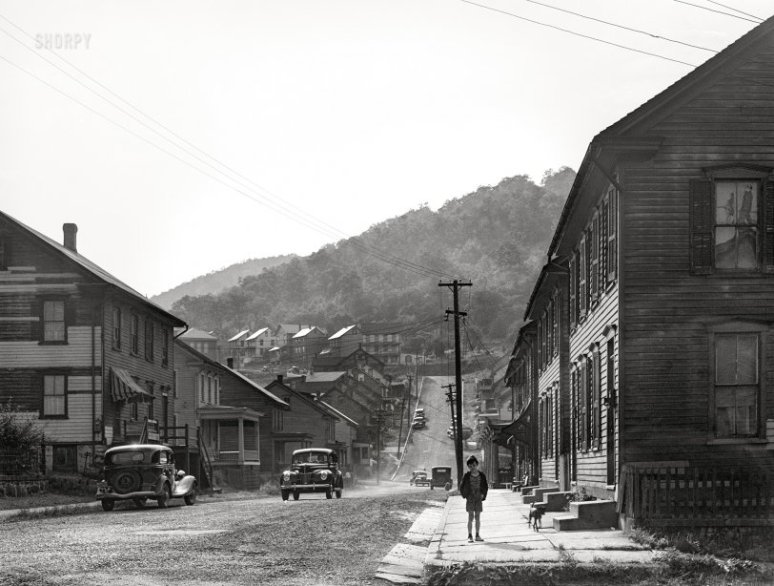
Prentiss Peckinpaugh was an odd boy from an odd family. He lived on a farm with his family; he had many brothers and sisters. His clothes always looked too big for him as if they had belonged to somebody else before he wore them. He always kept the top button of his shirt done up, even in warm weather. He walked with a cautious, forward tilt as if he had something wrong with his back.
Prentiss was sitting in the row of chairs against the wall. Miss Sullivan came upon him from behind, from the left, and her eyes fell upon the book he was reading, a paperback with a pink cover.
“What is that you’re reading?” she asked.
He closed the book so she could see the front cover. The title of the book was The Passionate Orphan.
“Where did you get that book?”
He shrugged his shoulders.
“May I see it?” she asked.
He handed her the book and she flipped through the pages and read several passages, standing there in the aisle between desks.
“You’re reading this book?” she asked.
“Yeah,” Prentiss said.
“It’s ‘yes, ma’am’.”
“Yes, ma’am.”
“How far along are you in the book?”
“Almost to the end.”
“Do you know what this book is about?”
“Yes, ma’am.”
“What is it about, then? Would you care to tell me?”
By now everybody in class had their attention focused on the conversation between Miss Sullivan and Prentiss Peckinpaugh.
“I don’t think I can say it,” Prentiss said.
“Don’t you know this book is not appropriate reading material for ninth grade English?”
“No, I didn’t know.”
“Who gave you this book?”
“Nobody gave it to me. It’s my book.”
“You don’t know where it came from?”
“No.”
“Did you steal it?”
“Why would I steal it when it already belonged to me?”
“Did a grown man give it to you? Maybe a friend of your father’s?”
“No. I already said nobody gave it to me. It’s my book.”
“Do you know the meaning of the word ‘pornography’?”
“No.”
“Well, that’s what this book is. It’s pornography and if somebody in this school gave it to you, we need to know who it was. This is a book that certainly doesn’t belong in a school, in a classroom, where other people can see it. Do you know what I’m saying?”
“I don’t see anything wrong with it.”
“How about if we go downstairs and show the book to Mr. Ball?”
“I have the feeling I don’t have a choice.” Prentiss Peckinpaugh said.
“Right you are,” Miss Sullivan said.
Miss Sullivan put the class in charge of Mavis Blaylock, a know-it-all, holier-than-thou toady who would stop at nothing to gain favor with the teacher and would take down names of those who misbehaved. Mavis smirked with superiority and took her place at teacher’s desk.
After an admonition to the class to continue their silent reading, Miss Sullivan escorted Prentiss Peckinpaugh down the three flights to the principal’s office.
Principal Ball was engaged on the phone, so Miss Sullivan and Prentiss had to wait for about five minutes until he was free. When at last they were ushered into the carpeted, wood-paneled office, Mr. Ball took one look at them, frowned and said, “What’s this?”
“Well, we’ve been having silent reading this hour,” Miss Sullivan said, “and I found this boy reading this book.”
She handed the book to Mr. Ball.
“Just what is this?” he asked.
“Well, as I was just saying to him…”
“What’s your name, boy?” Mr. Ball asked.
“Prentiss Peckinpaugh.”
“Say ‘sir’ when you’re speaking to me.”
“Prentiss Peckinpaugh, sir!”
“I was just saying to Prentiss here that this book doesn’t belong in school and should never see the light of day,” Miss Sullivan said.
Mr. Ball laid the book on the desk and turned over several pages, reading as he went.
“Who gave you this book, Mr. Peckinpaugh?” Mr. Ball asked.
“Nobody gave it to me. It’s my book.”
“Where did it come from?”
“It didn’t come from anywhere. It’s my book.”
“Don’t you know that a book like this is not allowed in school?”
“I don’t see anything wrong with it. Nobody sees it but me.”
“Do you have other books of this nature?”
“I don’t know.”
“You don’t know.”
“No, sir.”
“Well, we’ll let you off with a warning this time because you’re young and you didn’t know, but I want you to know that if you ever bring pornographic material into this school again, we will take disciplinary action that will include a three-day suspension. Now, do you understand what I’m saying to you?”
“Yes, sir.”
“When you’re on your own free time at home, you can read whatever you want, but in a school like this with hundreds of other students, you must follow our guidelines for what is acceptable and what is not. Am I getting through to you?”
“Yes, sir!”
“Take him to the library, to the fiction section, Miss Sullivan, and have him check out Of Mice and Men by John Steinbeck. That’s a good book and, more importantly, it’s an appropriate book.”
“I’ve read it,” Prentiss Peckinpaugh said.
“Well, read it again!”
“Are you going to give me back my book, sir, that you took from me?”
“No! I want to absorb it more thoroughly. I need to know what the students in this school are up to.”
The library’s one copy of Of Mice and Men was checked out, so Miss Sullivan suggested The Old Man and the Sea by Ernest Hemingway.
“I’ve read it,” Prentiss Peckinpaugh said.
“Well, read it again! And after you’ve finished, I want a solid book report on it.”
“Okay.”
“That’s ‘yes, ma’am’.”
“Yes, ma’am.”
During study hall next hour, Prentiss Peckinpaugh went back to the library and checked out Lady Chatterley’s Lover by D. H. Lawrence. He wanted to choose for himself what books to read. He liked The Old Man and the Sea fine, but he didn’t want to read it again.
While reading Lady Chatterley’s Lover, he could easily hide it behind The Old Man and the Sea and nobody would ever know the difference.
Copyright © 2020 by Allen Kopp


The Ground My Bed, the Leaves My Blanket
The Ground My Bed, the Leaves My Blanket ~ A Short Story by Allen Kopp
(I posted a different version of this story previously.)
The vast cemetery was many splendid acres of hills, trees, ponds, statues, winding roads, mausoleums, columbaria (for cremated remains), crypts, and walk-in burial chambers gouged out of the sides of the hills. For those inclined to notice, there was every shape, style (a century and a half of changing styles) and description of grave marker known to man, from no bigger than a shoebox to magnificent enough for a Roman emperor.
It was a sprawling city of some one-half million departed souls, but also home, on any night of the year, to dozens of indigents who didn’t have the price of a room or an acceptable flop and so found themselves with no other place to rest their weary (living) bones than among the unsuspecting dead.
Anybody who ever took up residence in the cemetery, if only for one night, knew it afforded many excellent and discreet hiding places where one might sleep, copulate, administer drugs, perform bodily functions, eat, bathe, think, drink, cry—or do any number of other things—away from the prying eyes of man.
As with every person in reduced circumstances who found himself or herself residing in the cemetery, Vicki-Vicki Novak had a story. After graduating from high school, she believed she had everything she needed to find herself a good job, so she left her rancorous mother and her unhappy home and spent six nausea-inducing hours on the bus and moved to the city. Life for her had always been hard, but it wasn’t until she came to the city that she discovered how cruel and unforgiving it is.
She would have taken any job she could find but the truth was there were no jobs of any kind to be had. She was turned away repeatedly because she had no experience of any kind. It didn’t matter that she was good at figures, was a stellar reader, and made better-than-average grades in school. She couldn’t get a job as a cafeteria worker because there were already seventy-five girls on the list ahead of her. She applied for a job in a laundry but was told she was too young and too slightly built to carry heavy loads. The sad truth was she didn’t make a good impression on those who might have hired her; she was too diffident and naïve; she knew too little of the world.
She spent her first two weeks in the city in an old hotel but, when she saw how fast her money was being used up, she took what little she had left and moved to a cheap boarding house where she slept in a tiny, box-like room and ate two small meals a day.
Finally even the boarding house was too expensive for her and she ended up living on the streets, where she met a coterie of other down-and-outers just like her. They gave her advice about how to survive and where she might get a bite to eat or a place to flop for the night. More than once she engaged in sexual congress with nefarious men in exchange for a small amount of cash, a package of cigarettes, an orange, or a couple of pills that were guaranteed to make her feel wonderful and forget all her troubles. She abhorred these couplings at first but after a time didn’t mind them so much because she disconnected herself from the proceedings and felt nothing.
Vicki-Vicki was fortunate in one respect because when she first began living on the streets of the city, it was May and the cruel and dreadful winter was past and wouldn’t be coming around again for a while. During a police crackdown on the street people, she sought refuge in the cemetery on the advice of a friend, one Chester Burnside, a man who might at one time have been a woman (one of those aberrations of nature all too abundant in the large city). The number-one piece of cemetery advice that veterans like Chester Burnside had to offer to newcomers like Vicki-Vicki was this: Don’t get caught because if you do you might get your brains knocked out or you might end up in jail. All the veterans had horror stories about people getting their brain matter literally knocked out of their heads onto the ground by leering, sadistic cemetery guards.
On a Friday afternoon in October, Vicki-Vicki was washing up at one of the cemetery’s fountains. She trailed her hands in the water and brought them to her face. The water was fresh and clean. She wished she might take off all her clothes and get down in the water naked and give herself a good scrubbing, but if she dared to do such a thing, somebody was sure to come along and see her, so she just contented herself with rinsing her arms and face.
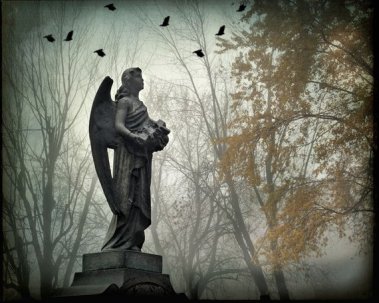
Towering above the fountain was a seven-foot tall lady angel. Her wings were only marginally chipped and bird-splattered; she looked down with a benevolent and loving expression.
“What are you doing here?” the angel asked, bending her head in Vicki-Vicki’s direction.
“I was washing myself,” Vicki-Vicki said.
“You might drown yourself if you have any sense.”
“Why would I do that?”
“It’s October. Winter’s coming. Are you going to go home while you still can?”
“I don’t have a home.”
“Everybody has a home.”
“My mother said she’d kill me if she ever saw me again.”
“When did you last eat?”
“I don’t know. Yesterday, sometime, I think.”
“Life is hard, isn’t it?”
“My life is. I don’t know about anybody else’s.”
“You must do better.”
“Tell me how.”
Somebody was coming. They both heard the footsteps moving through the leaves at the same time. The angel went back to being mute and immobile, while Vicki-Vicki ran and hid behind the nearest large tree.
When she peered cautiously around the tree, she was relieved to see it was the old wino Eulah Knickerbocker and not a cemetery guard.
“Hey! You!” she said, stepping out into the open.
Eulah Knickerbocker jumped and only kept from screaming by placing her filthy hand over her mouth. “You shouldn’t scare people like that!” she said. “My nerves is shot all to hell!”
“Why? What’s the matter?”
“I’m going around telling everybody I see. It’s lucky I found you. There’s going to be a purge tonight.”
“What’s a purge?”
“They’ve took on extra guards. They’re going to go through the cemetery and round up everybody who doesn’t belong. Some of us will end up dead.”
“Just hide,” Vicki-Vicki said. “That’s what I do.”
“No, dear! You won’t be able to hide from them this time. If you’re here, they’ll find you. You’d better get out before dark.”
“Where would I go?”
“How on earth should I know? Go back to the city.”
“But I came here to get away from the city!”
“I know! It’s terrible, ain’t it? But if they find you here tonight, it will go very bad for you. They might throw you in jail, and if they do you might never get out again.”
“They don’t scare me,” Vicki-Vicki said.
“Take it from somebody who’s been there, dearie. I’ve been living on the streets for seventeen years. I know how these things go.”
“You haven’t seen that fella they call Diego, have you?” Vicki-Vicki asked.
“If I did, I’d try to forget it.”
“He owes me money.”
“You’ll be lucky to get a nickel out of him, even if you do find him.”
“No, he’s been working, clearing brush. If I can catch him before he spends all his pay, I can get my money and have enough for a decent room for the night.”
“Say, you wouldn’t mind me coming along, would you, darling? Two can stay in a room for the same price as one.”
“Not this time, Eulah. I just need to be alone tonight.”
“Well, all right. I figure it don’t hurt to ask.”
“No, it don’t. Have you got anything to eat?”
“If I did I’d share it with you.”
“I know you would, Eulah.”
“Have you seen my twin sister, Beulah?”
“No, I don’t think I have.”
“She’s the great beauty of the family. Have I ever told you about her?”
“I believe so.”
“She’s coming to get me and take me home with her to live. I don’t know if it’ll be tonight but any day now.”
“I hope it all works out for you, Eulah.”
“It’s bound to, this time.”
The sun was going down and the air suddenly had the feel of late autumn. It would be about the time that normal people who live in houses would be sitting down to dinner. She needed to think about where she would spend the night in case she didn’t find Diego and get her money. The important thing was to find a snug little place out of the wind that hadn’t already been claimed by somebody else.
She went to the oldest part of the cemetery, the part she liked best and the part where she was mostly likely to see a ghost if there were any about. The trees were sheltering; the gravestones were large and close together. She began piling up dry leaves to make herself a bed in a secure little spot between stones when she heard someone coming. She started to hide but it was too late; she had already been spotted.
“Hey, there, little chicken!” a man’s voice said.
Right away she recognized the voice as that of Julius Orange. He was tall and rather handsome but his face and hands were crusted with dirt all the time as if he never washed them and one of his eyes was permanently half-closed.
“I thought you were one of the guards,” she said breathlessly.
“No, but I could have been. Have you heard the news about the raid tonight?”
“Eulah Knickerbocker told me.”
“You’d better get out while you can.”
“No, I’m going to stay,” Vicki-Vicki said. “I’m cold and I’m sick and I don’t feel like walking all the way back to the city tonight.”
“It’s your funeral.”
“I don’t think the guards will come all the way over here. They’re afraid of ghosts.”
“You’re cold, aren’t you?”
“I have ice water in my veins.”
“I know a way to warm you up.”
“You got a bottle of whiskey?”
“No, I don’t mean that,” he said. “I was wondering if you’re open for business. I got four dollars.”
“You’d spend your four dollars on me?”
“And a lot more.”
“Save your money. Tonight I’m not worth four cents.”
“Well, if you change your mind…”
“Say, you haven’t seen Diego around anywhere, have you?” she asked.
“Not that I remember.”
“He owes me money.”
“You can have my four dollars and catch yourself a bus back to town.”
“Thanks. That’s awfully sweet, but I’m just going to bed down here for the night and see how things go.”
“It’s your funeral,” he said, and then he was gone.
It was fully dark now. She kicked at the leaves and shivered in the rising wind. She looked up at the sky anxiously, hoping to forestall any rain, but the sky wasn’t telling any tales. She burrowed into the leaves like an animal and gathered the leaves around her like a warm comforter.
The smell of the leaves was earthy and good, an uncorrupted smell, untouched by human filth. She was completely hidden from view, she believed, but she could still breathe and could still see up into the trees as far as the darkness would allow. This is not so bad, she thought. If only life could be like this always.
She felt the cold rising from the ground. She shivered and her teeth chattered but soon she felt warmer and went to sleep. She dreamed she was in a big bed in a warm room in a snug house and those who cared for her were within the call of her voice and there was nothing to be afraid of.
She jerked awake to the sound of men’s voices. They were far away but coming closer. There might have been as many as ten of them and they might have been at a drunken party for all the fun they seemed to be having.
She lay still and breathed deeply. There were so many leaves on the ground and she was sure they wouldn’t bother looking through all of them. They would just make a quick sweep and, finding no one, move on. She would laugh later at how close they had been but still missed her.
She was right. They did move on, but one of the men had detached himself from the others and was searching through the leaves between the gravestones. She heard his slow, decisive steps and then felt a rush of cold air on her face as he scraped the leaves away that were covering her.
“Come out of there!” a deep voice said.
She gave a little yelp and covered her face with her hands but knew there was no use resisting.
“Leave me alone!” she whimpered. “I didn’t do anything!”
“You’re not supposed to be here!”
“I’m leaving. Please don’t hit me with your stick!”
“Nobody’s going to hit you. Get up and talk to me.”
She stood up. The man, towering over her, shone his flashlight in her face. She couldn’t get a good look at him, but she knew from his voice and his bearing that his face, if she could see it, would be beautiful beyond believing.
“How did you know I was here?” she asked.
“Magic,” he said.
“Please don’t take me to jail.”
“It’s where you belong. Don’t you know you’re trespassing?”
“I’m going, I swear!”
“It’s dangerous for you to be here.”
“I know! I’ll leave right now.”
“People freeze to death out here all the time. Last winter we picked up thirty frozen dead bodies.”
“I was looking for someone, but he’s not here now so I’ll just go.”
“If I turn you over to the others, you’ll go to jail.”
“Please don’t do that!”
“I’ll let you go this time, but only one condition.”
“Anything!”
“Promise me you’ll get out and don’t come back. If I see you again, I’ll remember you and I’ll turn you in. You don’t want to end up in jail, do you?”
“No!”
“Go home. Don’t you have a home?”
“No.”
“Go to a shelter in town, then. There are people there who will help you.”
“I will. I promise.”
He handed her a small paper sack, which she took unquestioningly. Switching off his flashlight, he took off his coat and dropped it on the ground beside her. He gave her one last look and then he was gone.
“Wait a minute!” she said. “I was…”
She could still here his voice after he was gone. If I see you here again, I’ll remember you and you’ll go to jail.
“Take me with you!” she called out, but he was already gone and couldn’t have heard.
She remembered the paper bag she held in her hand and opened it. Inside were a ham sandwich wrapped in paper and a little carton of milk.
She ate the sandwich and drank the milk as if tasting those things for the first time and when she was finished she vomited, bending over at the waist and leaning against a tree.
When she was finished, she wiped her mouth on her sleeve and then as she was turning away from the tree she remembered the coat lying on the ground and picked it up and put it on. It was much too big for her, going almost to her knees, and it still held the warmth of the man’s body and traces of his man smell.
She hugged her arms to her body and, like a princess in a fairy story, was transformed. A celestial light appeared above her head and shone down on her, entering her brain and settling around her heart. She heard the sweetest music she had ever known, coming from a faraway place. She trembled all over and fell to the ground in a kind of religious ecstasy, having looked, at last, upon the face of the one and only God.
Two hours later, by which time she could no longer remember she was supposed to hide herself, she was taken into custody by a second wave of guards making their way through the cemetery. Nobody hit her with a stick or beat her, but she was taken to jail and locked up.
She spent the night sitting up in a filthy, stinking cell with about two dozen other women. In the morning at seven o’clock, she was given an egg sandwich and a cup of coffee and released. When she stepped out onto the sidewalk, the sun blinded her and she didn’t know where she was or where she was supposed to go.
A sympathetic soul, someone who knew the kind of person she was, gave her a ride back to the cemetery. She wept when she found herself back in the familiar place. It was like going home.
It was a much warmer day than the day before. The sun shone and the breeze was refreshing instead of chilling. After the night in jail, she wanted only to sleep.
She went to what she thought was the most secluded part of the cemetery and found an ideal sleeping spot under some bushes. It was like a little cave or animal’s lair. The ground was dry, covered with soft needles, and there was just enough sunlight filtering through the leaves to create a soporific warmth.
Knowing she would not be disturbed, she slept comfortably throughout the day. When she awoke, it was just turning dark. She pulled herself out of the bushes, trying to remember the last thing that happened to her. Oh, yes, there was Diego. She would find him and get the money he owed her. She would get herself a roast beef sandwich, a bottle of wine and a room for the night, and it would be just like heaven.
Copyright © 2020 by Allen Kopp
The Day of the Locust ~ A Capsule Book Review

The Day of the Locust ~ A Capsule Book Review by Allen Kopp
Nathanael West’s classic American novel, The Day of the Locust, was first published in 1939. It’s set in 1933 in Hollywood, California, and is about the seedy underside of Hollywood (no glamour and glitz here) and the “people who go to California to die.” Nearly everybody who lives in Hollywood has gone there from some other part of the country.
Tod Hackett works in a movie studio as an artist. We don’t get a clear notion of exactly what he does, but he seems to “conceptualize” movies on paper before they are made. Like a lot of other people in Hollywood, he hopes to be a big success. When he meets Faye Greener, he is taken with her, as a lot of other men are. Faye is only seventeen years old but old beyond her years. She calls herself a movie actress but has only ever appeared as an “extra.” She is more of a floozy than anything else and doesn’t mind working as a whore if it’s the only way she can get money.
Faye lives with and takes care of her father, Harry Greener. He is an alcoholic bum, a broken-down vaudevillian who makes furniture polish in his own home and then goes around selling it to unwitting customers. Times are hard. He remains a performer, though, and will do his vaudeville schtick when compelled to do so. Harry provides a lot of the comic relief in the novel.
Tod continues to pine for Faye, but he is a smart young man and sees that it is hopeless. She is just a superficial flake who will never be seriously true to anybody. When she meets a strange, older man named Homer Simpson, she latches on to him because he lives in his own house and encourages her in her hopeless acting career. After Harry dies, she moves in with Homer. Tod is jealous at first, but after he sees how Faye flits around from man to man indiscriminately, he seems to change his opinion and becomes ambivalent toward her.
And then there is Adore, the androgynous child actor who is a neighbor of Homer Simpson’s. Adore has a “stage mother” and is a rising child star in Hollywood. At the conclusion of the novel, Adore meets a tragic and violent end at the hands of Homer Simpson.
Nathanael West (1903-1940) had a spare writing style that might almost be called minimalist. He didn’t waste space or words. The Day of the Locust is a decidedly pessimistic view of Hollywood and the human race. The concluding scene in the novel takes place outside a Hollywood movie premiere, where an unruly mob demonstrates the worst of human nature. People are as mindless and swarming as a plague of locusts.
A memorable 1975 movie version of The Day of the Locust starred a 36-year-old Karen Black playing seventeen-year-old Faye Greener and Burgess Meredith playing her father. Why is it never shown on television? I for one would love to see it again after these many years.
Copyright © 2020 by Allen Kopp



 Literary Fictions