
Author: allen0997

The Strange Case of Dr. Jekyll and Mr. Hyde ~ A Capsule Book Review

The Strange Case of Dr. Jekyll and Mr. Hyde ~ A Capsule Book Review by Allen Kopp
Robert Louis Stevenson published his famous Gothic novel about man’s dual nature, The Strange Case of Dr. Jekyll and Mr. Hyde, in 1886. The story and its characters entered the public consciousness when the novel was first published and has never left it. Who hasn’t heard of Jekyll and Hyde? They (he) rivals Sherlock Holmes, Frankenstein, Dorian Gray and Dracula for name recognition among all classes of people.
The Strange Case of Dr. Jekyll and Mr. Hyde is set in Victorian London in the 1880s, most of it on the fog-shrouded, gas-lit streets of the teeming metropolis of London. Dr. Henry Jekyll is a respected, middle-aged doctor. His friends know him as a staid, decent, sensible fellow, but there’s a side of him they don’t know about, an evil side. In his laboratory, he experiments with drugs and potions that will cause him to set aside his inhibitions and become another person entirely.
When we are first introduced to Mr. Hyde, we see his as a small, ugly, deformed man whom people instinctively dislike. We believe at first that he is an eccentric associate of Dr. Jekyll’s. People wonder why a man like Dr. Jekyll would tolerate a creepy person like Mr. Hyde. After a while it is revealed to us (we knew it all along) that Mr. Hyde is Dr. Jekyll. When Dr. Jekyll undertakes his experiments with his potions in his laboratory, he turns into Mr. Hyde. (You know, a “Jekyll and Hyde” personality?)
Dr. Jekyll switches back and forth between himself and Mr. Hyde, until the change becomes harder to effect and requires more drugs, which are increasingly difficult to get. The situation gets out of hand when Mr. Hyde kills an old man on the street for no apparent reason and Dr. Jekyll must bear the responsibility. This is not going to end well for Dr. Jekyll, as we can see.
In typical Hollywood fashion, with the various movie versions of the story (Fredric March in 1931 and Spencer Tracy in 1944), Dr. Jekyll’s female love interest becomes an integral part of the story. In both movies, he has a good (pure) lady of his own class whom he plans to marry and a trampish street woman whom he carouses with—and terrorizes—when he goes out at night and becomes Mr. Hyde. Not surprisingly, the female relationships that are such an important part of the movie versions are not explored in the book. Hollywood always takes many liberties when turning a classic novel into a movie.
Any way you look at it, The Strange Case of Dr. Jekyll and Mr. Hyde is a pleasure to read, a fascinating story, a solid classic that must be read and enjoyed. I tried reading it when I was in the eighth grade and found I was a little too young to understand it. Now I must be at the ideal age because I understand it perfectly.
Copyright © 2021 by Allen Kopp


Red Planet ~ A Capsule Book Review
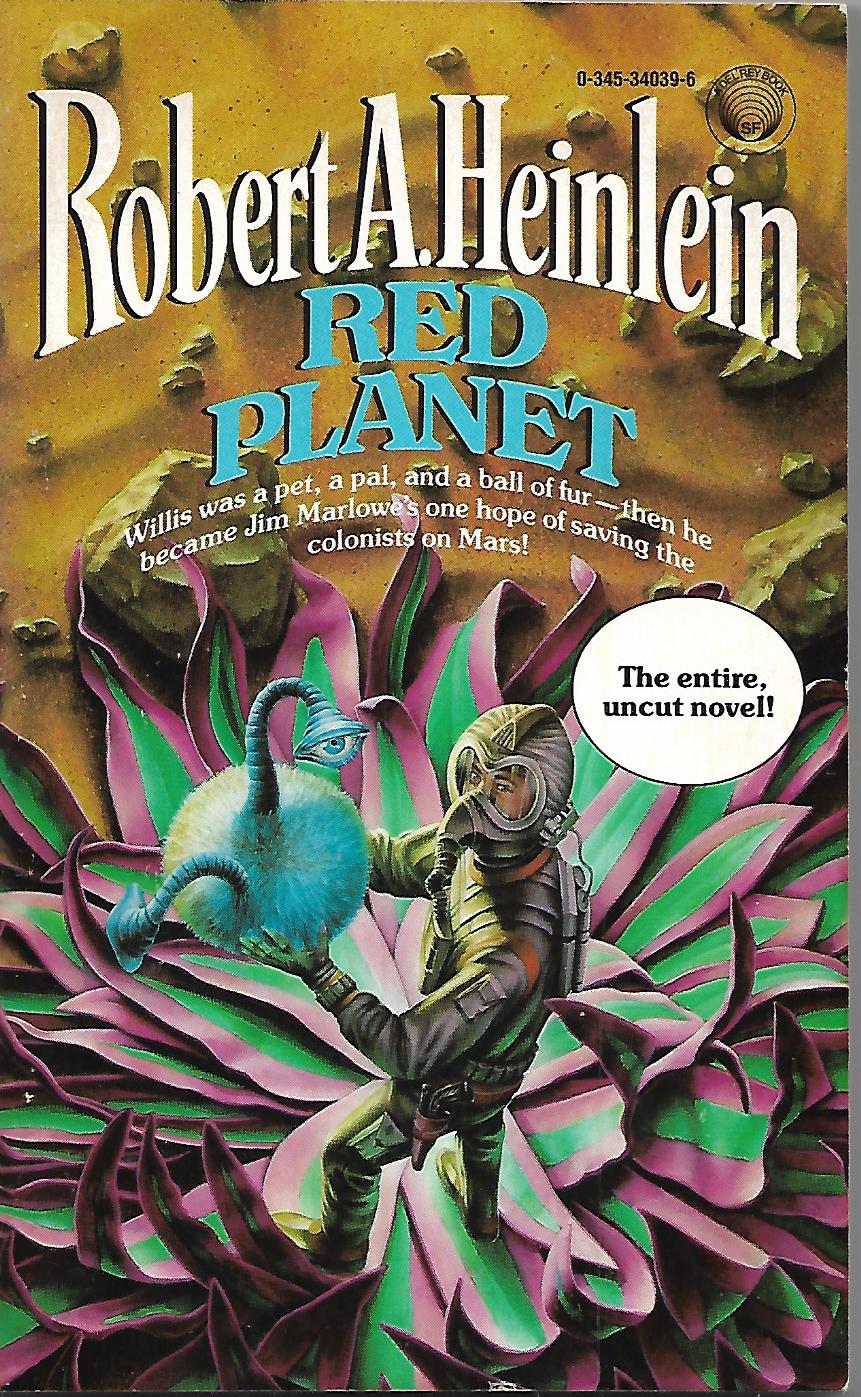
Red Planet ~ A Capsule Book Review by Allen Kopp
Missouri-born author Robert Heinlein (1907-1988) was the premiere American science-fiction writer of the twentieth century. He wrote many novels and short stories that, no matter how fantastic, were always believable and grounded in scientific fact. His 1949 novel, Red Planet, is about people from Earth living on Mars and the problems they face with the inhospitable climate (200 degrees below zero in winter), with Martian natives, but most of all with others of their own kind. (Yes, people from Earth are devious, self-serving and corrupt, no matter what planet they’re on.)
The main character in Red Planet is a young lad named Jim Marlowe. We are never told his age, so let us assume he is about sixteen. He is one of the colonists on Mars, living with his mother and father, his younger sister and brother in “South Colony.” Jim’s best friend is a boy named Frank Sutton but, more importantly, his best Martian friend is a “roundhead” that he has named Willis. Willis is a lovable ball of fur with “eyepods” for seeing and little “footpods” for mobility; he talks, but, more importantly, he can mimic and record any voice or any conversation he has overheard, sort of a living tape recorder.
When Jim and Frank go away to Lowell Academy, Jim must take Willis along with him because they are inseparable. The authoritarian headmaster of the school, Mr. Howe, confiscates Willis and locks him up, making Willis and Frank both extremely unhappy. Mr. Howe claims the school doesn’t allow “pets,” but the truth is he is going to sell Willis to a zoo because—don’t you know?—Martian roundheads are rare and valuable.
Jim and Frank break into Mr. Howe’s office to free Willis late at night when no one is around. It seems that Willis, during his captivity, has overheard (and recorded) a conversation between Mr. Howe and Mr. Beecher, the unscrupulous colonial administrator of Mars. These two villainous dogs have a secret plan, to save money, to prevent the annual migration of the colonists, which is necessary for them to avoid twelve months of killing winter weather. The boys must leave school and travel the thousand miles home to warn their parents and the rest of the colony. No transportation is available to them, so they skate on the frozen Martian canals, encountering unimagined perils, including being pursued by the villains and spending a freezing night inside a giant Martian cabbage (where they run the risk of being smothered as the cabbage closes up for the night).
Red Planet is an imaginative science fiction adventure, set in some future time when people from Earth find the courage and the technical know-how to go live on an unknown planet that still holds a lot of surprises for the uninitiated. Unless mankind destroys itself (which seems a distinct possibility), people will undoubtedly venture to Mars and even farther, at which time science fiction becomes reality.
Copyright © 2021 by Allen Kopp