The Martian Chronicles ~ A Capsule Book Review

The Martian Chronicles ~ A Capsule Book Review by Allen Kopp

The Martian Chronicles, by Ray Bradbury, was first published in 1950 and is set in a future time in the early 21st century, a time that we have now exceeded and passed. It is a collection of interrelated short stories that are almost but not quite a novel. The stories are all set on the planet Mars and are about earth people traveling to Mars, living on Mars and trying to survive on Mars. Mars may be the one planet in our solar system that is most like earth but, as the people in the book discover, living on Mars is not quite the same as living on earth.

In The Martian Chronicles, tens of thousands of people from earth are traveling to Mars because—you guessed it—mankind has defiled and annihilated earth and, for people to go on living, they must find a new planetary home. Mars, as we see it, is an eerie, lonely planet, with dried-up oceans, deserts and canals, and remnants of Martian cities that are thousands of years old.

Earth people on Mars, as you might imagine, are not good for Mars. They set about destroying Mars the same way they destroy earth and there’s nobody to stop them. The once-proud Martian race has all but died by the time the bulk of earth people arrive. There may be a few Martians still living, but they keep themselves hidden in the hills and are rarely seen.

The stories in The Martian Chronicles are divided into three parts. The first part is about the attempts of men from earth to reach Mars and the methods Martians use to keep them away. In the second part, humans from earth set about colonizing Mars, having all but wiped out the Martians with earth diseases, and are preoccupied with making Mars as much like earth as they can. However, as earth is about to be destroyed in a nuclear war, most of the earth colonists on Mars pack up and return home. The third part deals with the aftermath of the destructive war on earth and the few earth people still remaining who will become the new Martians because earth is gone and they have no place to return to.

The Martian Chronicles is intelligent, inventive and engaging, with just a touch of creepiness to enlighten the proceedings, as when an inventor, whose wife and children have died on Mars, makes look-alike robots to replace them, or when the Martians eliminate one of the expeditions from earth by using telepathy to make the men of the expedition think their long-dead relatives are alive and well on Mars. It’s classic sci-fi fantasy as only Ray Bradbury can do it.

Copyright © 2019 by Allen Kopp

Tolkien ~ A Capsule Movie Review

Tolkien ~ A Capsule Movie Review by Allen Kopp

Thirty-year-old, blue-eyed actor Nicholas Hoult plays English fantasy writer John Ronald Reuel (J. R. R.) Tolkien in the film biography of Tolkien’s life, called, appropriately, Tolkien. J. R. R. Tolkien’s work is probably more popular now than it was during his lifetime due, in large part, to the two popular film trilogies (six movies in all), based on his works The Lord of the Rings and The Hobbit.

J. R. R. Tolkien lived from 1892 to 1973. Both of his parents check out early, so he and his younger brother are left under the guardianship of a priest. He attends a traditional boys’ boarding school, where he, as usually the case with creative people, occupies his own world, in this case the world consisting of sketching fantastic creatures, creating his own language, and dreaming of a fantasy world of his own making. (His early preoccupation with fantasy is fueled mostly by his soon-to-be-dead mother.) While still in school, he develops an infatuation for a young girl named Edith, who is the “paid companion” of a wealthy woman named Mrs. Faulkner. His love affair with Edith doesn’t work out right away and she announces she’s marrying somebody else, but eventually they end up together and marry.

While still at school, Tolkien develops a close relationship with several other boys, who are all unique in their own way. This friendship is very intense and lasts presumably for a lifetime or until death. The theme of friendship (“fellowship”) becomes an important theme in Tolkien’s yet-to-be written fantasy works. Other important themes would be questing for something that is lost and the titanic, never-ending battle between good and evil.

Tolkien experiences The Great War (“The War to End All Wars”) firsthand, on the front line of battle. He survives the war, while so many others do not, marries, has four children, and goes on to become a college professor and a prolific writer. We have to presume he would be surprised by the continuing fascination with his life and work 46 years after his death.

Tolkien covers roughly the first half of J. R. R. Tolkien’s life. The movie ends before he came to write the books that would make him famous. It’s a fairly standard movie biography, well-made, but not as compelling as films based on the lives of other famous Britishers, Alan Turing (The Imitation Game) and Stephen Hawking (The Theory of Everything.) The British accents in Tolkien are sometimes difficult to comprehend, but that’s usually the case with British movies (some English subtitles for American audiences might not be amiss).

Copyright © 2019 by Allen Kopp

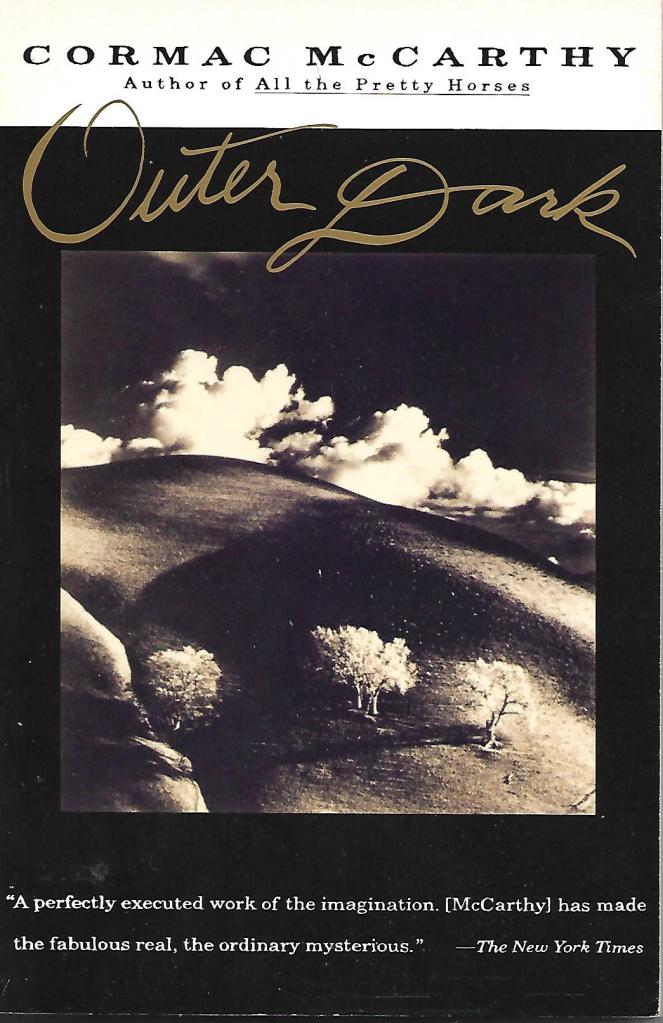
Outer Dark ~ A Capsule Book Review

Outer Dark ~ A Capsule Book Review by Allen Kopp

The two main characters in Cormac McCarthy’s novel Outer Dark, brother and sister Culla and Rinthy Holme, are victims of poverty and ignorance. (She has no shoes, while he wears stolen boots.) Rinthy is nineteen. Culla is some older. Rinthy has a baby and Culla is the father. Apparently because he is ashamed of impregnating his own sister, Culla takes the nameless baby, a boy, and leaves him alone in the woods to die. The baby is picked up by a ragtag, itinerant tinker who travels around with his cart. Where the tinker takes the baby or for what reason is never made quite clear, but it can’t be for any good or because he is concerned for the baby’s welfare.

Rinthy and Culla undertake separate journeys, Rinthy to find the baby (her “chap”) and Culla to find Rinthy, or maybe he’s just looking for work. Wherever Rinthy goes in her quest to find her baby, she is mostly met with kindness, with people who feed and shelter her. With Culla it is just the opposite. Death and disaster follow in his wake. The people he encounters are menacing and more than once threaten him in some way. (Does the trio of despicable desperadoes who seem to be trailing him really exist, or have they been called forth by his sin?) Even nature is unforgiving for Culla. When he is crossing a ferry on a river, the cable holding the ferry in place inexplicably breaks and Culla nearly drowns. He survives, but would have possibly been better off to have drowned, considering what happens to him afterwards.

Can we say, then, that Rinthy is a child of light and Culla a child of darkness because of his sin of engaging in incestuous relations with his sister and then trying to destroy the evidence of the relationship? His biggest sin, however, is possibly his lack of awareness of his sin and his failure to seek redemption. (At the end of the book, Rinthy finds herself in a glade and Culla in a swamp.)

Cormac McCarthy, now 85 years old, is one of America’s greatest living writers, the only writer we have comparable to William Faulkner. Outer Dark is a fascinating exploration of sin and retribution (or the absence of retribution). I’ve read it twice, years apart, and found it compelling both times. It’s an example of how good contemporary American literature can be in the hands of an undisputed master.

Copyright © 2019 by Allen Kopp