The Hair of Her Head ~ A Short Story by Allen Kopp
The queen was at the forefront of every fashion trend. If she painted her face the color of chalk, every lady of the court with any fashion sense ended up with a face the color of chalk. If she wore a ruff collar to a court function, ruff collars became the rage before the sun rose again. If she wore platform shoes under her gowns to make herself a few inches taller (taller than the king), shoemakers were working round the clock by the end of the week to satisfy the sudden desire for platform shoes.
When the queen decided she wanted a new coiffure, she summoned Alphonse, the court hairdresser, and his retinue of lackeys and assistants. She was getting tired, she said, of the same old curls, fluffs and puffs. She wanted a new style of dressing her hair that nobody had ever seen or imagined before. She wanted to hear people gasp with surprise and envy when she entered a room.
The court hairdresser propped the queen up in an elaborate swiveling chair, stuffing pillows all around her to make her as comfortable as she could be. He knew he was going to have to create something different, and fast, if he was going to keep his job. He was under a considerable amount of strain but he had been in the same situation before and he knew he would get through it. To keep the queen calm and to soothe his own frazzled nerves, he called a small ensemble of court musicians into the room to play softly the music that was known to put the queen to sleep. In no time at all, she was snoring.
She slept for three hours. She woke up only because her little pet monkey Marcel was blowing bubbles with his pipe and one of his bubbles, a very large one indeed, landed on her nose and popped. It couldn’t have happened at a better time because Alphonse was just then putting the finishing touches on the royal coiffure.
The queen was impatient to be handed a mirror, but Alphonse wanted an unveiling of sorts. When he pulled her to her feet, he had one of the ladies-in-waiting tie a scarf over her eyes. Then he walked her to an enormous mirror that went from floor to ceiling with two side mirrors tilted out at angles. He took the scarf away and stood back, heart pounding. If the queen didn’t like the royal coiffure, he might be sent packing with only the clothes on his back.
She blinked her eyes several times and regarded her reflection without expression for what seemed a very long time but couldn’t have been more than two or three minutes. She turned this way and that to see herself from the back and from both sides and from every oblique angle.
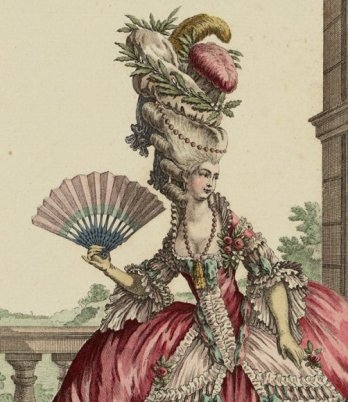
The royal coiffure was, indeed, unlike any coiffure her majesty had ever seen before. Instead of the customary white, it was a slightly pinkish color, like a cloud at sunset. The color was not the most salient feature, however; the one thing that made this coiffure so much different from others was its size. It was at least a foot high of gorgeousness—elaborate rolls and twists adorned with shimmering precious stones and ostrich feathers. On the sides and in the back, hanging about the royal neck and ears, was a profusion of sausage-like curls that seemed to have been spawned by the puff of pink rising above. It was truly a coiffure befitting the queen of the land.
However restrained her majesty might have been in showing approval, she was most pleased with the royal coiffure. She touched the court hairdresser lightly on the shoulder and passed from the room with a tiny smile on her lips. The court hairdresser collapsed into a chair and ordered a bottle of wine and a plate of sausages be brought to him.
That evening the queen wore a magenta gown and her ruby jewels to complement her pink hair. On the arm of the king, who always managed to look like an unhappy frog in a powdered wig, she entered the dining salon where her court was assembled. As she and the king passed in their stately procession from one side of the enormous room to the other to take their places at table, all eyes were upon her. She heard gasps, whispers, exclamations, but the looks of envy and jealousy were the most gratifying to her. All the other ladies present looked like laundresses and milk maids beside their queen.
They, the ladies of the court (and this included some of the men), were all delighted by the queen’s new coiffure. While they couldn’t run the risk of being seen as trying to better the queen, they were free to emulate her as much as was fitting. They could copy her coiffure if they so desired, but they had to be careful not to have hair higher than the queen; this could incur not only the disfavor of the queen but also of the king and the royal offspring. The queen was above all considerations of competitiveness. She was without peer. She was the queen.
So there followed a frenzy of high hair at the court. When all the ladies had hair as high as—but no higher—than the queen, the queen herself went a couple of inches higher each time they saw her. And if the queen appeared with blue hair, all the ladies the next day had hair the same shade of blue, but no bluer; the same for green, lilac, yellow, orange and every other color imaginable.
When the queen and all the ladies of the court had hair higher than about three feet, special accommodations had to be made. They had to sit on the floor in carriages because ceilings were just not high enough. A special section at the opera had to be designated for them because nobody ever wanted to sit behind them. Many of them had to sleep sitting up in a chair or flat on their backs on the floor, as they could no longer sleep in a bed with three-foot-high hair. These were all minor inconveniences, however, in light of what was to come.
The pomade the ladies used to keep their hair malleable was made of apples and other organic materials. At all times of the year, but especially in hot weather, the pomade was likely to turn sour and create a smell. This situation resulted in the ladies using overpowering scents to mask the smell of the pomade. Some of the gentlemen of the court, including the king, became sickened by the strong, unnatural smells. The king was forced to require the women to sit downwind from him and to have lackeys fan the air. The queen complained to the king that his behavior toward the ladies was insulting but he paid her no mind.
As if the smell wasn’t bad enough, some of the ladies began to be infected with all kinds of vermin. It seemed the very high, elaborate coiffures attracted unwelcome visitors. One lady died while eating a dinner of roasted squab. When her body was examined, it was discovered she had a family of poisonous spiders nesting in her hair that were feasting on her scalp as they saw fit. Another lady had a couple of enterprising bats take up residence in the upper reaches of her coiffure; the bats decided to vacate the premises at a very inopportune moment. Still another was infested with a rare kind of beetle that heretofore had been found only in the Orient. Other of the ladies complained of lice and fleas.
Outside the walls of the palace, more serious events were taking place, of which the king, the queen, and their court of aristocratic sycophants and hangers-on were largely unaware. The common people, many of whom were starving and dressed in tatters, were disenchanted with the king and queen and with royalty in general. There was a movement afoot to revolt, to bring down the government and put in place a fairer, more equitable system of running the country. Who needed a king and queen anyway? They were bleeding the country dry and enjoying themselves while they were doing it.
When the revolt finally came, the king and queen were preparing to decamp to their summer palace in the mountains with their enormous retinue of servants. The king immediately had the palace secured, but he knew that he and the queen and everybody else in the palace were not altogether safe from an angry mob.
Some members of the court assumed false identities and fled for their lives. The ladies with high hair dismantled their coiffures and washed out the dyes, as it happened that their coiffures had become hated symbols of excess and indifference to the plight of the common people. Some went so far as to shave their heads to disavow who they were. A few of the ladies were found to have been men all along.
The king and queen decided to stay in the palace, an act of defiance if there ever was one. When the mob came for them, they were standing at the top of the staircase of the grand salon as though posing for a picture. The king was dressed in his sumptuous robes of state, powdered wig and crown. The queen wore her loveliest gown and most elaborate jewels. Her coiffure was a grand, four-foot-high creation of defiant flaming orange, adorned with her many-jeweled crown proclaiming to the world that she was queen and none other.
The monarchy was abolished and a provisional government established in its place. The king and queen never saw each other again after the day they were taken and they never saw their children again. The king’s head was severed from his body and placed on a spike in front of the palace that had been his home.
When the queen a few weeks later met the same fate as the king, it was a grand event for the common people. Everybody crowded into the city to see the old girl get what she had coming. And when her head was finally severed from her body a great cheer went up, but there was something else, too: all the bugs, mice, vermin, spiders and small birds living in her hair scattered throughout the land to tell their tale of life and death at the court.
Copyright © 2017 by Allen Kopp





 Literary Fictions