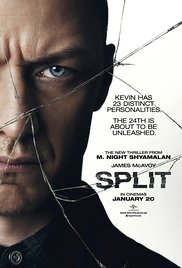
Split ~ A Capsule Movie Review

split

Split ~ A Capsule Movie Review by Allen Kopp

Split is an odd little horror film written and directed by M. Night Shyamalan. It’s about a seriously disturbed man (James McAvoy) with twenty-three personalities. He abducts three teenage girls (not for the usual reasons) by spraying them in the face with something that knocks them out and driving off with them. When they wake up, they find themselves locked in a place with no means of escape. They believe they will die, but that doesn’t keep them from hoping they will find a way out.

The odd thing about this man, the three girls soon discover, is that he is different people at different times. At one time, he’s Dennis, an authoritative man dressed in black; at other times, he’s Patricia, a lady who speaks in carefully modulated tones; and then he’s Hedwig, a boy of nine whom the girls try to finesse into letting them go before Dennis comes back. Hedwig talks like one of the Bowery Boys.

The disturbed man is being treated by a fashionable (and apparently very expensive, considering the surroundings) psychiatrist named Dr. Fletcher (Betty Buckley). He appears to Dr. Fletcher mostly as Barry, the fey fashion designer. When she tries to call forth any of the other personalities lurking behind Barry, he resists. When Dr. Fletcher is alone with him in her home/office, he seems menacing in an understated way. The music score adds to the feeling of menace we feel when Dr. Fletcher is alone with Barry. She, however, doesn’t seem to be the least bit afraid of him. She’s an expert on multiple-personality disorders, but even she seems to underestimate his capacity for evil. She doesn’t know, for example, that he has abducted those teenage girls and is holding them prisoner in his lair. (Just exactly what is his lair? We don’t know until the end of the movie.)

With all the man’s personalities, he talks about unleashing yet another one, the twenty-fourth, that will be worse than all the others. He calls this one the Beast. Dr. Fletcher takes a familial interest in her patients and truly wants to help. She goes to the man’s lair (she knows what and where it is before we do) and discovers the Beast in a most disadvantageous way (to her). She also discovers the abducted girls, or at least the one that remains. We are left wondering at this point what happened to the other two girls. One of them crawled through a hole in the ceiling, after which the man tells the other two girls they will never see their friend again. We assume, without knowing, that he caught her trying to get away and killed her.

Split is not overly violent or gory in the way that this kind of movie usually is. The bad man in this movie isn’t nearly as creepy or as twisted as, say, the killer in The Silence of the Lambs. He is more given to psychological terror than physical violence. The movie is engaging enough without being what we would call “entertaining” in the traditional sense. There’s a sense of suspense and unease, but it could have been a lot more effective if some of the missing gaps had been filled in. For example, how does the disturbed man come to be in the place where he hides the three teenage girls? Does he live there? How can he do what he does and not be seen or detected? Exactly what is his motivation for abducting the girls? We see right away that it’s not about sex, so what is it? He wants somebody to dance with him? That isn’t enough. The abduction of the girls just seems like a plot device that doesn’t play out.

Copyright © 2017 by Allen Kopp

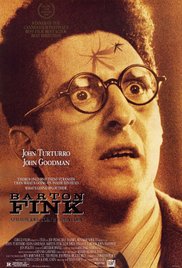
Barton Fink ~ A Capsule Movie Review

barton-fink-poster

Barton Fink ~ A Capsule Movie Review by Allen Kopp

Things are all balled up at the head office. Can it really be twenty-six years since the Coen brothers’ brilliant dark comedy Barton Fink first came out? I watched it again this week and liked it just as much as the first time I saw it on the movie screen.

Barton Fink (played by John Turturro) is a fuzzy-haired, bespectacled, New York, Jewish writer. He is a serious playwright who wants to create a “new, living theatre” extolling the common man. He has a hit play on Broadway. With his success comes new opportunities; his agent persuades him to go to Hollywood to write for the movies where he can make the big money he needs to continue writing his plays.

Hollywood for Barton is a vision of hell. He is installed in a seedy, seemingly empty hotel where everything is a little “off.” The fawning desk clerk named Chet appears to be the only employee at the hotel, except for the comatose elevator operator named Pete. “Have you read the Bible?” Barton asks Pete at one point in the story. “The Holy Bible?” Pete asks. “Yeah, I’ve read it. I’ve heard about it anyway.”

The wallpaper in Barton’s room on the sixth floor is peeling off from the Los Angeles heat. There’s a mosquito that buzzes around Barton’s head while he’s sleeping and it bites him on the face. (“We don’t have mosquitoes here,” someone tells him. “This is the desert. Mosquitoes live in swamps.”) The room is so quiet that he hears sounds coming from the room next door. It sounds like a man alternately laughing and crying in a distressed way. Barton calls down to Chet and politely complains. When the man next door finds out that Barton has complained about his noise, he confronts Barton. This is where Barton meets “Charlie Meadows” (John Goodman), the folksy and friendly insurance salesman (he says) who, we learn, is not really who or what he appears to be.

Barton’s problems with his hotel accommodations are nothing compared to the problems he has with the studio, Capitol Pictures, that employs him as a writer. His first assignment is to write a “wrestling picture for Wallace Beery.” He is completely out of his element here. He doesn’t go the movies, he says, and knows nothing about wrestling pictures. He doesn’t even know how to begin.

When Barton is visiting the studio one day, he runs into a writer named Bill Mayhew, vomiting his guts out in the men’s room. Barton discovers right away that this man is none other than the great writer W. P. Mayhew. “You are the greatest novelist of our time,” Barton gushes. “Why, thank you, son!” Mayhew drawls. He’s from Mississippi, don’t you know, and his character is obviously a take-off on the great American writer William Faulkner, who did, for a time, bastardize his great gift to write for the movies. Bill Mayhew is a terrible lush, but charming, and invites Barton to drop by his bungalow at the studio later in the day, where he will give Barton some pointers about writing a wrestling picture. When Barton arrives to meet with Mayhew, he (Mayhew) is in a drunken rage and can’t come to the door. Barton speaks instead to Audrey, Mayhew’s secretary. She is a Blanche Dubois-type character with a Southern accent. When Barton, who is lonely and knows nobody in Hollywood, asks Audrey to go out with him, she confides that she and W. P. Mayhew are “in love.”

Barton remains stymied with his script. He is “blocked,” he says. He must present an outline to the studio head. He doesn’t know what to do because he has written nothing. On the night before his meeting to present his outline, he is frantic and has no one to turn to, so he calls Bill Mayhew for some emergency advice. Mayhew is indisposed, Audrey says, and cannot come to the phone. When Barton tells her the predicament he is in, she agrees to come to his hotel room and try to help him with his script. “There’s nothing to writing a wrestling picture,” she says. Barton is appalled to learn that Audrey has done most of Mayhew’s writing in recent years, including his novels, because Mayhew has been too out of it with drink to do productive work. Audrey gives Barton a few suggestions for his script and then they kiss and end up together in bed. Fade out.

When Barton wakes up in the morning, Audrey is dead in the bed beside him, apparently stabbed many times in the chest. Barton is terrified. He knows he didn’t kill her, but he doesn’t know who did. Not knowing who else to turn to, he goes to the room next door and enlists the aid of Charlie Meadows. Charlie is sympathetic and, after helping to calm Barton down, disposes of Audrey’s body. All right, the body is gone, but the mattress is soaked with blood. What will Barton do about that?

Charlie has to leave town for a few days but will be back. He tells Barton to stay in his room and not talk to anybody. He asks Barton to take care of a box for him until he comes back. We don’t know what’s in the box—we never know—but Barton agrees to grant this little favor. The box is just about big enough to hold a human head.

When two police officers show up at Barton’s hotel, they are looking for Charlie Meadows. In a rapid-fire exchange of dialogue, they tell Barton that Charlie Meadows’ real name is Karl “Madman” Mundt. He’s a serial killer with a whole string of killings in his wake. Barton knows then who really killed Audrey.

In the last scene, Barton is seen sitting on a California beach, having escaped an inferno (part of the hell that he’s been in since he came to Hollywood?) at his hotel that Charlie Meadows/Karl Mundt set. He is carrying the box that Mundt asked him to safeguard. A girl comes along wearing a modest bathing suit. He tells her she is very beautiful and she blushes. He asks her if she is in pictures and she says, “Don’t be silly!” She sits down several feet away from Barton, facing the ocean, and raises her right hand to shade her eyes as she looks out to sea. The image that Barton sees of the girl is the picture he has been looking at the whole time on the wall above his writing desk in his hotel room. We know then how unhinged Barton has become. Does the girl really exist, except in his mind?

Few movies come along that are as memorable, inventive, and as much fun to watch as Barton Fink. The dialogue is a pleasure to hear (especially the exchange that Barton has in the lobby of his hotel with two hardboiled L.A. police officers), the photography and period sets are perfect, and the music score by Carter Burwell is beautiful and mysterious. One of my all-time favorite movies.

Everything is all balled up at the head office. By the end of the movie, we understand the significance of this statement.

Copyright © 2017 by Allen Kopp
Oscar is Hiding Behind the Couch

oscar

An industry congratulates itself by handing out trophies for the “best.”

The same annoying, unfunny host.

The same jiggly girls in their tired prom dresses.

The same faux-handsome men with their capped teeth and artful hairpieces.

The same whiny liberal elites spouting the same boring leftist propaganda.

How about if we just skip it this year?

Hidden Figures ~ A Capsule Movie Review

hidden-figures-poster

Hidden Figures ~ A Capsule Movie Review by Allen Kopp

Hidden Figures is a story about breaking barriers that is, at least in part, based on fact. It’s 1961 and the “space race” between the United States and Russia is underway. Russia has put a spy satellite into orbit around the earth, giving Americans a feeling of unease, and Russia is the first to put a man (Yuri Gagarin) into space. As Al Harrison (played by Kevin Costner), the big boss at NASA says, “we (meaning the United States) have come in second in a two-man race.” This state of affairs puts a lot of pressure on the American space program and forces NASA to work its employees mercilessly.

Three black woman named Katherine Goble, Mary Jackson and Dorothy Vaughan are new employees at NASA. Each of them is accomplished in her own way. Katherine Goble (played by Taraji P. Henson) has been a math prodigy since she was a small child. It takes a lot of calculating to launch a rocket into space and bring it safely down again. Katherine is more adept at the calculations than most of her male counterparts. She is, of course, underestimated because of her gender and her race. This is 1961, remember, so black people can’t use the same coffee pot as the white people, not to mention toilets and drinking fountains. Al Harrison seems a cold and forbidding boss, but as he sees how capable Katherine is, he develops a grudging admiration for her and becomes, in a way, her mentor. When Katherine wants to attend all-male briefings to better understand what is going on with swiftly implemented changes, she is told there is no protocol for a woman to attend briefings. “There is no protocol to put a man into orbit around the earth, either,” she says.

Dorothy Vaughan (played by Octavia Spencer, who won an Oscar playing a maid in The Help) is mechanically inclined. As a new employee at NASA, she heads up a group of black female employees, but she is stonewalled when she tries to get the pay and title of supervisor. (This slight is probably more about her race than her anything else.) When NASA installs a mainframe computer that takes up an entire room, Dorothy is the only person who seems to know how to get it going.

Mary Jackson (played by Janelle Monáe) is only an adjunct to her male counterparts, but she longs to be NASA’s first black female engineer. She lacks a few classes, though, to even qualify. She can pick up the classes she needs at a school near her home, but she’s not allowed to attend because it’s an all-white school and she’s black. Having no intention of being thwarted, she petitions the court to bend the rules a little bit to allow her to get the classes she needs. She finesses a white judge and he rules in her favor.

After being out-classed by the Russians at the beginning of the space race, the American space program finally finds its legs and does some amazing things, including putting a man, Alan Shepard, into space and putting another man, John Glenn, into orbit around the earth. At the end of Hidden Figures, when Katherine Goble is asked if the seemingly impossible goal of putting a man on the moon can be achieved by the end of the 1960s, she says with confidence, “We’re already there.” To her it’s the next barrier to be broken in a long line of them to come.

Copyright © 2017 by Allen Kopp
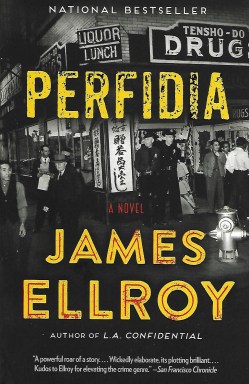
Perfidia ~ A Capsule Book Review

perfidia

Perfidia ~ A Capsule Book Review by Allen Kopp

Writer James Ellroy is unapologetically politically un-correct. If you are offended by racial slurs and blunt sex talk, he is not the writer you should be reading. He manages to insult almost every ethnic and niche group. He gets away with it, it is assumed, because all his novels are set in the not-too-distant American past, where racial prejudice and racial slurs were much more a part of everyday discourse than they are now. “If you’re looking for political correctness,” Mr. Ellroy says, “go someplace else.”

His big (almost 700 pages) novel Perfidia (a Spanish word meaning betrayal or treachery) is set in Los Angeles in the days following the Japanese attack on Pearl Harbor in December 1941. With all those Americans dead in Hawaii and with the country now at war, fear and unease—and in some cases, hysteria—are the order of the day. The west coast of California seems the logical place that the frighteningly aggressive “Japs” will attack next. And those mandatory blackouts don’t do anything to ease peoples’ fears, either. (Imagine moving through a big city at night with all the lights turned off.)

The Japanese people in the Los Angeles area are being rounded up, no matter how innocent or blameless they are. Their property is being confiscated and they are being housed in “internment” camps. Americans are so anti-Japanese because of Pearl Harbor that they want to kill or at least defile almost every Asian they see. (Most people can’t tell the Japanese from other Asians). It’s in this atmosphere of fear and distrust that Perfidia is set.

Dr. Hideo Ashida is an Americanized Japanese. He is a brilliant forensic chemist employed by the Los Angeles Police Department. When all the Japanese people on the city payroll are canned just because of their ethnic background, Dr. Ashida manages to hold onto his job because he is so good at solving crimes. (He is, of course, called Charlie Chan and Mr. Moto, but he seems impervious to insult.) When he is out in public in the days following the attack on Pearl Harbor, people call him names, spit on him and, in some cases, threaten him. The police department assigns bodyguards to keep him safe.

Dr. Ashida has what he believes is a “shameful” secret. In the world that he inhabits of hyper-masculine, crime-fighting alpha-males, he is secretly gay. The lone object of his desire is one Bucky Bleichert, a boxer with whom he has been friends since high school. He sets up a hidden movie camera in the shower room to capture footage of Bucky naked. The one femme fatale in Perfidia, one Katherine “Kay” Lake, offers Dr. Ashida a roll in the hay but he, of course, isn’t interested.

On the day before the Pearl Harbor attack, a Japanese family of four, the Watanabes, are brutally murdered in their home. It appears to be a sort of ritualized killing, maybe a suicide, but the police just can’t figure it out. There’s an apparent suicide note written in Japanese that speaks of the “coming apocalypse,” but it’s too ambiguous. On examining the background of the Watanabes, the police discover they are “Fifth Column,” meaning they are part of the non-fighting branch of the Japanese military whose job it is to create disorder on the civilian front. The Los Angeles police are hoping to find a Japanese suspect to pin the Watanabe murders on, to somehow mitigate the internment of the Japanese people. If it turns out that a white person committed the murders, it will be a public relations nightmare.

If you read Perfidia and some of the other novels of James Ellroy (L.A. Confidential, American Tabloid, among others) you know that the Los Angeles Police Department of the past was unspeakably corrupt, or at least it is that way in the Ellroy universe. Most of the upper tier of the police department are on the “make” in some way or other. They have no allegiance to anything other than themselves. They take drugs, cheat on their wives, kill without compunction whenever it suits them, cover up evidence, and involve themselves with gangsters and shady characters that will advance their own interests. They don’t account to anybody but themselves. These crime fighters are in some ways worse than the criminals they pursue.

Some real-life people (Bette Davis, Joan Crawford, J. Edgar Hoover) appear as minor characters in Perfidia, and James Ellroy paints a very unflattering portrait of them. It’s probably a good thing they’re all dead or they might be initiating some legal action. Bette Davis having a torrid affair with police sergeant Dudley Smith? It somehow doesn’t fit in with the idea we have of Bette Davis. (Bette’s husband, we are told, is a “chains-and-leather queen.”) Joan Crawford seducing a young police officer half her age? Maybe so, but it’s an odious thought. J. Edgar Hoover with pomaded hair and buffed fingernails developing “crushes” on handsome L.A. police officers? I somehow doubt it. It’s all part of the badly damaged world of James Ellroy.

However you look at it, Perfidia is fun to read for its portrayal of a time and place. Very few of us alive now were alive seventy-five years ago at the start of World War II; this is a vivid “re-imagining” of those days. As long as the novel is, the chapters are short, the paragraphs are short, the sentences are short and punchy, and we never get bored. Keep turning those pages and eventually you’ll come to the end and want more.

Copyright © 2017 by Allen Kopp

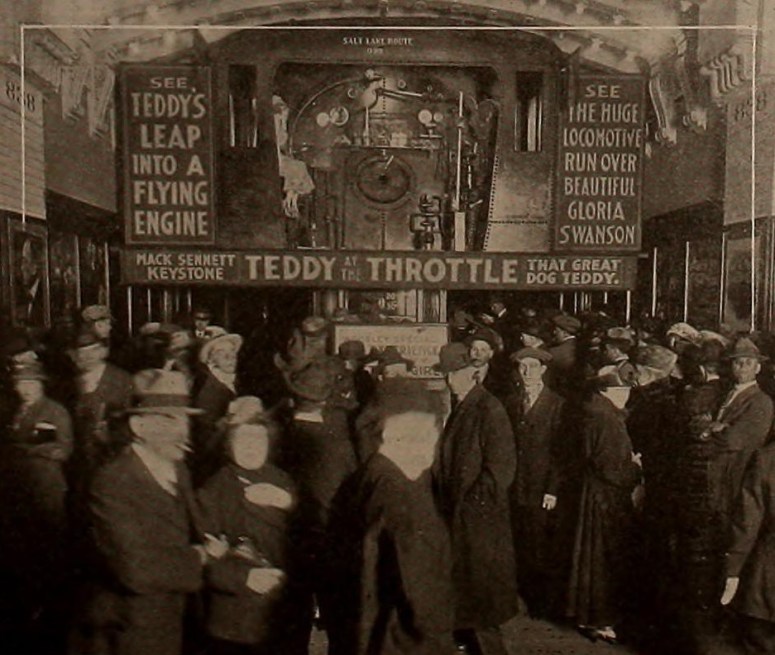
Teddy at the Throttle (1917)

Bobby Vernon, Teddy the dog, and Gloria Swanson in Teddy at the Throttle
Bobby Vernon, Teddy the dog, and Gloria Swanson in “Teddy at the Throttle”

This famous two-reel, 1917 slapstick comedy is notable for several reasons. It’s now one hundred years old. Think of that. A movie made a hundred years ago. I think it’s interesting to see the way people dressed, what they drove, and how they comported themselves a hundred years ago. Of course, it’s a silent film (sound movies were still about twelve years off). It stars eighteen-year-old Gloria Swanson and the first of her six husbands, Wallace Beery, who was fourteen years older she was. Her male love interest in the film is diminutive (5’ 2”) Bobby Vernon. Gloria is an heiress who stands to inherit a lot of money, but she doesn’t know it yet. She wants to marry little Bobby, but Wallace Beery wants to marry her so he can get the money. Wallace and his odd (and very statuesque) sister, played by May Emory, want Bobby to marry her (May), so he (Bobby) will no longer want to marry Gloria. Bobby and May are as mismatched as Gloria and Wallace are. Gloria ends up chained to the railroad tracks with a train coming along any minute but—never fear!—Gloria’s faithful dog Teddy is on the way to save her!   

teddy_at_the_throttle_-_motion_picture_news_may_19_1917

 View the 24-minute film here:

Gulliver’s Travels ~ A Capsule Book Review

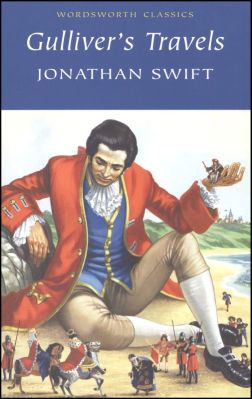
gullivers-travels-cover

Gulliver’s Travels ~ A Capsule Book Review by Allen Kopp

Irish writer and clergyman Jonathan Swift lived from 1667 to 1745. His most famous work, Gulliver’s Travels (complete title: Travels into Several Remote Nations of the World. In Four Parts. By Lemuel Gulliver, First a Surgeon, and then a Captain of Several Ships) was first published in 1726. It’s an account, in four sections, of the seafaring adventures of one Lemuel Gulliver, ship’s surgeon, and his sometimes-bizarre adventures among the strange inhabitants of strange lands that nobody in Europe ever heard of or knew about. It’s always through misfortune that Gulliver has his adventures. First he is shipwrecked and finds himself in the land of Lilliput, where the people are about six inches (according to Gulliver’s measurement) tall. The tiny people don’t trust him, of course, because he is so big and might take it into his head to smash them to pieces. It takes many hundreds of them to tie him down, including by the hair of his head. Eventually they come to trust him, though, and let him roam freely. He falls out of favor with the King and Queen, though, because he puts out a fire in the tiny Queen’s chambers in the castle by urinating on it.

He returns home to his wife and children in England after his adventures in Lilliput, but he is a seafaring man and just can’t stay away from the sea. He is only home for a few months before he sets out again. This time misfortune brings him to Brobdingnag, a land where all the inhabitants are giants compared to him. He is kept as a pet or a curiosity in a “traveling box” and eventually ends up in the royal court, where he spends many hours conversing with the king in the king’s native language, which Gulliver quickly learns.  On a trip to the seaside, the box in which he is traveling is snatched up by an eagle and dropped into the sea, where Gulliver is rescued by sailors and returned to his native England.

On his next seafaring adventure, Gulliver’s ship is attacked by pirates; he is marooned and soon picked up by the “flying island” of Laputa. The people of Laputa aren’t overly big or small, but they are strange. They blindly pursue science without any practical results. They use great resources and manpower to research preposterous schemes such as extracting sunbeams from cucumbers, softening marbles for pillows, mixing paint by smell, and uncovering political conspiracies by examining the excrement of suspicious persons. After his sojourn in (or on) Laputa, Gulliver is awaiting passage to Japan when he visits the island of Glubbdubdrib, where he visits a magician’s dwelling and discusses history with the ghosts of historical figures, including Julius Caesar, Brutus, Homer, and Aristotle, among others. On the island of Luggnagg, he discovers the immortal race of people known as the struldbrugs. They don’t have the gift of eternal youth, though; they get old and stay old forever.

On his fourth and final adventure, Gulliver returns to sea as captain of a merchantman. His crew mutinies and keep him tied up below deck for weeks, after which they leave him on the first piece of land they come to and then continue as pirates. He comes across a race of hideous humanoid creatures, which he finds out later, are known as Yahoos. The Yahoos are filthy and savage, human beings in their basest form. We learn that Yahoos are merely what pass for people back home. This is Swift’s statement about the human race and his not-very-high opinion of it.

Soon he meets the Houyhnhnms, a race of intelligent talking horses. He finds them to be everything humans are not: kind, caring, thoughtful, considerate, selfless, and completely alien to the idea of lying, war and warfare. In short, they lack all the qualities that make human beings so odious.

Gulliver is treated well by the Houyhnhnms and comes to admire them among all creatures he has ever encountered. He comes to want to be like them and live as they do. Much to his dismay, however, an Assembly of Houyhnhnms decides that Gulliver, as a Yahoo, has too much reasoning ability for his own good and poses a threat to the Houyhnhnms. They expel him, even though he would like to live among them forever, and he thereby returns to England. He is unable to reconcile himself to living again among the Yahoos, even though he is one of them, and remains a recluse in his own home in England, avoiding his family and all other people, and spends his time in the company of his horses in the stable.

Gulliver’s Travels exists on several levels. It is a satire, a science fiction story, a fantasy, an adventure story, and a forerunner to the modern novel; strangely accessible and readable, almost three hundred years after its first publication. Jonathan Swift stated that one of his purposes in writing the story was to write it for all, the high-born and the low, and to vex the world rather than divert it. It became an instant classic upon its publication and a huge literary success.

Copyright © 2017 by Allen Kopp