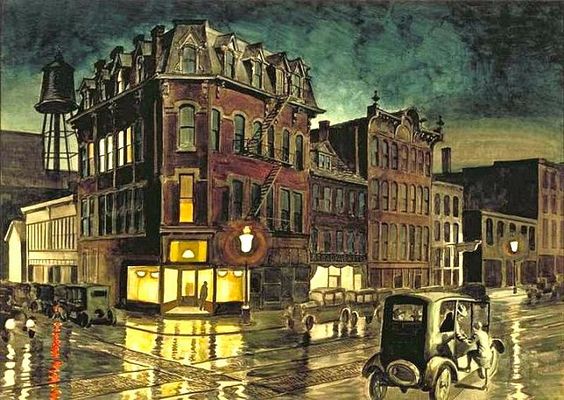
Rainy Night (1929) by Charles Burchfield
Charles Burchfield was an American painter and artist who lived from 1893 to 1967. He was known for his watercolors of nature scenes and townscapes. He painted Rainy Night in 1929.

Rainy Night (1929) by Charles Burchfield
Charles Burchfield was an American painter and artist who lived from 1893 to 1967. He was known for his watercolors of nature scenes and townscapes. He painted Rainy Night in 1929.

A Handful of Dust ~ A Capsule Book Review by Allen Kopp
English writer Evelyn Waugh lived from 1903 to 1966. His novel, A Handful of Dust, was published in 1934. The story is set in the late 1920s or early 1930s. Tony Last and his wife Brenda belong to the upper crust of English society. They have a country estate called Hetton, Tony’s ancestral home. Tony loves Hetton and is content to be there and no other place. Brenda isn’t happy with country life and loves to pop up to London on the train to shop and eat in smart restaurants and go around to the best nightclubs. In short, she is a social butterfly, while Tony is the more sedate, stay-at-home type. We see right away that they are mismatched. They have one child, an eight-year-old son named John Andrew.
Enter John Beaver. Tony and Brenda invite him down to their home for the weekend because that’s what these people do. He’s a rather dull, uninspiring young man, but Tony and Brenda treat him decently; the weekend ends and he goes home. We don’t know until later that he and Brenda have begun an unlikely love affair.
Brenda begins spending more and more time in London. She claims the need for a small “flat” so she can stay nights and not have to go back home to Hetton on the late-night train. She tells Tony she is studying economics but the truth is she’s carrying on with Beaver. Everybody knows it except Tony.
Finally things come to a head when a terrible riding accident claims the life of Tony and Brenda’s young son, John Andrew. Brenda is, of course, in London when it happens. After the dust settles, Brenda tells Tony that she is in love with Beaver, she’s through pretending, and she wants a divorce so she can marry Beaver.
Tony is perfectly willing to give up Brenda. He doesn’t have a lot of money, but he agrees to give her what he considers a fair amount in the divorce settlement. To Brenda, though—and especially to Beaver—it isn’t enough. Beaver will not marry Brenda, he says, until she is amply provided for. The amount Brenda and Beaver are asking for is ruinous to Tony. He refuses to grant them the amount they want and he tells Brenda he will not give her a divorce.
To try to escape his painful memories, Tony agrees to go on an ill-fated “expedition” to South America with a crackpot “explorer,” Dr. Messinger. The purpose of the expedition is not quite clear, except that Tony hopes to find a lost city. As might be expected, the expedition doesn’t go as planned and things turn very bad for Tony. Meanwhile, back in England, Beaver has abandoned Brenda and she is struggling to get by on the little bit of money she has. Tony is in South America, of course, and she can’t get in touch with him to ask for more.
A Handful of Dust is a satire on marriage and societal mores. We see how easily these people fall into infidelity and even encourage infidelity in one who isn’t predisposed to it. Brenda is a selfish bitch who cares more about her lover than she does about her son and husband. The ironic part is that her lover doesn’t care that much for her. She throws it all away for nothing and, through her selfishness and grasping for money, brings her world crashing down. If Tony had never married her, he could have had a happy life.
Copyright © 2017 by Allen Kopp

Tobacco Road ~ A Capsule Book Review by Allen Kopp
Erskine Caldwell’s venerable American classic, Tobacco Road, was first published in 1932. It’s the story of a few days in the life of Jeeter Lester, a lazy, ignorant, starving, dirt-poor Georgia farmer. It’s spring and Jeeter wants nothing more than to plant a crop of cotton, but he doesn’t have any seed-cotton or guano (fertilizer), no money to buy it with, and no mule for plowing.
Jeeter and his wife Ada had seventeen children, but only two still remain at home: Dude, a witless lout of sixteen, and Ellie May, a girl who doesn’t have a chance in life because she has a harelip and Jeeter doesn’t have enough money or enough initiative to take her to the doctor and get the lip “sewn up.” Jeeter’s wife, Ada, has pellagra, a vitamin deficiency disease; her fondest wish is to have a “stylish dress of the right length” to be buried in. Jeeter’s old mother lives with the family, but she never says anything; if she speaks or tries to steal food, Jeeter or Ada will clop her on the head.
Jeeter and Ada have married off their twelve-year-old daughter, Pearl, to Lov Bensey. Lov is upset because Pearl sleeps on a “pallet on the floor” and won’t let him touch her and won’t get into bed with him. When Lov comes by the Lester home with a bag full of turnips that he walked seven miles to get (which Jeeter is trying to steal), he is crying over Pearl but is drawn to Ellie May, even with her harelip. Ellie May is also drawn to Lov because she is lonely and her prospects of getting a man are slim. You can feel the sexual tension between them.
Sister Bessie Rice is a self-styled preacher. She doesn’t have a nose, but she has two nostrils flat on her face. “No nose would ever grow on me,” she says. When people are talking to her, they find themselves “looking down her nose holes.” Besides not having a nose, she’s about forty and a widow with eight hundred dollars in insurance money from her deceased husband. When she catches sight of sixteen-year-old Dude and has a petting (and rubbing) session with him, she decides she will marry him and make him a preacher. Dude isn’t much interested in marrying Sister Bessie until she tells him of her intention to go to town and buy a brand-new automobile with her insurance money. They get married (or at least get the license) and, after Sister Bessie buys the automobile, they ride all over the place, with Dude driving and blowing the horn like crazy. The same day they buy the automobile, Dude crashes into the back of a wagon, and from there, they set about tearing up the car as if that had been there intention all along. Every time they get a new dent, they say, “It don’t bother the drivin’ of it none.”
Being dirt poor and not having anything to eat is tragic, isn’t it? A girl having a harelip or a woman not having a nose is also tragic. What happens to Jeeter’s mother at the end of the book is tragic, but also funny. We don’t take the Lesters seriously enough to feel sorry for them because they are so hapless and ignorant. There’s humor in pathos, and no American novel does it better than Tobacco Road.
Copyright © 2016 by Allen Kopp

The Underground Railroad ~ A Capsule Book Review by Allen Kopp
The Underground Railroad by Colson Whitehead is this year’s winner of the Pulitzer Prize for fiction and, finally, the winner is once again about American life. It’s set in pre-Civil War America, when Southern plantation owners were allowed by law to own slaves as property, while sympathizers in the North and elsewhere viewed slavery as an abomination and were willing to do all they could to aid black slaves in their quest for freedom. In these dangerous times, the “underground railroad” sprang up, a series of rails, sometimes crude, constructed under the ground, to give slaves a means of escape from their sometimes-cruel owners. The people who built and maintained the underground railroad, the “station masters,” were often white men. They risked their lives every minute they aided slaves in escaping.
The main character of The Underground Railroad is a young slave girl named Cora. At the beginning of the book, she lives on the Randall plantation in Georgia, where vicious cruelty toward the slaves is the order of the day. Running away, is, of course, a terrible offense in the eyes of the plantation owners. Slaves who run away are caught and when they are brought back they are tortured and killed as an example to the other slaves.
A young man named Caesar gives Cora the idea of running away. At first she doesn’t want to risk it or even think about it, but when she gets a terrible beating for coming to the aid of a small boy, she decides she must run or die. Her mother before her, Mabel, ran away when Cora was only about ten and they never heard from her again. Everybody on the Randall plantation holds Mabel up as an example of what is possible. Cora has feelings of resentment toward her mother for abandoning her at such a young age. (We learn at the end of the book the ironic truth of what really happened to Mabel.)
After Cora’s harrowing escape from the Randall plantation, she is living in a black community in South Carolina under the name of Bessie Carpenter. She lives in a dormitory with lots of other runaway slaves, but there are no beatings and the living conditions are much better than on the plantation. A “slave catcher” by the name of Ridgeway is after her, though, especially determined to catch her and return her to the plantation because it is believed that her mother, Mabel, got away from him; he can’t let Cora humiliate him in the same way. In trying to escape from Ridgeway, Cora spends months in a stifling attic space in the home of a sympathizer.
After years of running and living in fear that she will finally be caught, Cora ends up on the Valentine farm in Indiana, home to a hundred or so runaways. She has books to read and sympathetic friends here, and life and is not so cruel and hard. Everybody who lives on the farm knows, though, that they live a fragile existence and that hostile forces are aligned against them. The slave catcher Ridgeway, though temporarily sidelined, is not about to give up the search for Cora as long as he is alive. The two of them will have a final fateful encounter before the story ends.
There have been lots of books and movies about slavery days and about how slaves were beaten and generally mistreated and sold at the whim of their owners. The Underground Railroad is a familiar story, but it’s a story that never ceases to be interesting in the same way that stories of World War II are interesting and compelling. No matter how terrible Cora’s life is as a slave and then as a runaway, she never loses hope that she can have a better life and live free. It’s a story, then, about hope and never giving up.
Copyright © 2017 by Allen Kopp

Selected Places: Anthology of Short Stories
From Simone Press
(My short story, “Find Out Where the Train is Going” is in this brand-new short story anthology.)
With short stories by Fariel Shafee, Gillian Rioja, John Mueter, Victoria Whittaker, Matthew McKiernan, Melodie Corrigall, William Doreski, Priscilla Cook, Rob Pope, Billie Louise Jones, Stephen McQuiggan, Katarina Boudreaux, Thomas Larsen, Michael Estabrook, Allen Kopp, Jim Meirose, Ken Leland, Gary Beck, Columbkill Noonan, Paul Lamble.
Available from Amazon for $12.99 at this link:
Napoleon ~ A Capsule Book Review by Allen Kopp
Napoleon Bonaparte was born on the tiny island of Corsica in 1769 to a minor aristocratic family. Corsica is closer to Italy but was a French possession, so Napoleon was born a French citizen and will forever be identified as French, although he didn’t have high regard for France. As he grew into adulthood (he was only five feet, five inches tall), he became interested in all things military. At a young age he became a military man and was found to have an uncanny instinct for military strategy. He rose through the ranks and soon was in command of a mighty military force.
Napoleon filled the leadership vacuum left by the French Revolution and can be said to have ended the Revolution. When France was struggling to find a foothold after years of turmoil, he stepped in and filled the void, declaring himself Emperor. His ego and ambition knew no bounds. His goal was to conquer all of Europe, from Spain in the west to Russia in the east. His military venturing even led him to Egypt and North Africa. He saw himself as a conqueror in the mold of Alexander the Great and Julius Caesar.
He engaged in almost constant war. Hundreds of thousands of people lost their lives in Napoleonic wars, not to mention the vast sums of money spent to finance the war machine. People began to consider him an opportunistic lunatic who would sacrifice anything or anybody on earth to satisfy his ambitious goals. He was a man without sentiment, loyalty or religion. He had nothing to hold him back.
Of course, he was not without his shortcomings. (Every tyrant, dictator or despot has his downfall built in.) He was impatient, impulsive, lacking in subtlety, refinement or social graces, incapable of deliberative thought or action. Though a master military strategist, he was not a politician and knew nothing of tact and diplomacy. He was all about force, taking the enemy by surprise and gaining the upper hand through superior strategy and cunning. When he sold what became known as the “Louisiana Purchase” to the United States (an enormous area that became thirteen states) for fifteen million dollars (about four cents an acre) to continue to finance his war machine, it was seen (in retrospect) as one of his biggest blunders. He might have extended his empire to the North American continent but wasn’t visionary enough to do so.
His disastrous military campaigns in Spain and Russia—with staggering loss of life and destruction of property—signaled his end. People were sick and tired of almost constant warfare and chaos. Even his most ardent admirers were beginning to turn against him. He was forced to abdicate his title of emperor—leading to a restoration of the monarchy—and was exiled to the tiny island of Elba, seven miles off the coast of Italy. He was not to be contained, however; he was still burning with desire and ambition. He was bored and wasn’t given as much money as he thought he needed. He returned to France, where he once again established himself as emperor and marshaled a huge army.
He met in battle the Duke of Wellington, an Anglo-Irish soldier and statesman, at a place called Waterloo in present-day Belgium. After a bloody and horrific battle, he was defeated. This was to be his final battle and his final defeat. The Napoleonic age was at an end.
Napoleon Bonaparte was this time exiled to the tiny island of Saint Helena, located in the South Atlantic. While not exactly a prisoner or under house arrest, he was closely guarded and would not again be allowed to return to France of his own volition. As long as he was alive, he was viewed as a threat, especially since he still had many admirers and adherents all over the world who would have gladly helped him to escape. He was kept on the island for about six years until he died at the age of fifty-one in 1821.
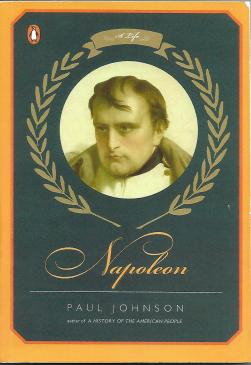
Napoleon by English historian Paul Johnson is a concise (187 pages) overview of Napoleon’s life and times. While it’s a historical biography, it’s also a fascinating story. A small, pale, young man from humble beginnings becomes the leader of the army of a great nation and, after declaring himself Emperor of that nation, sets out to conquer an entire continent. Truth is stranger than fiction.
Copyright © 2017 by Allen Kopp
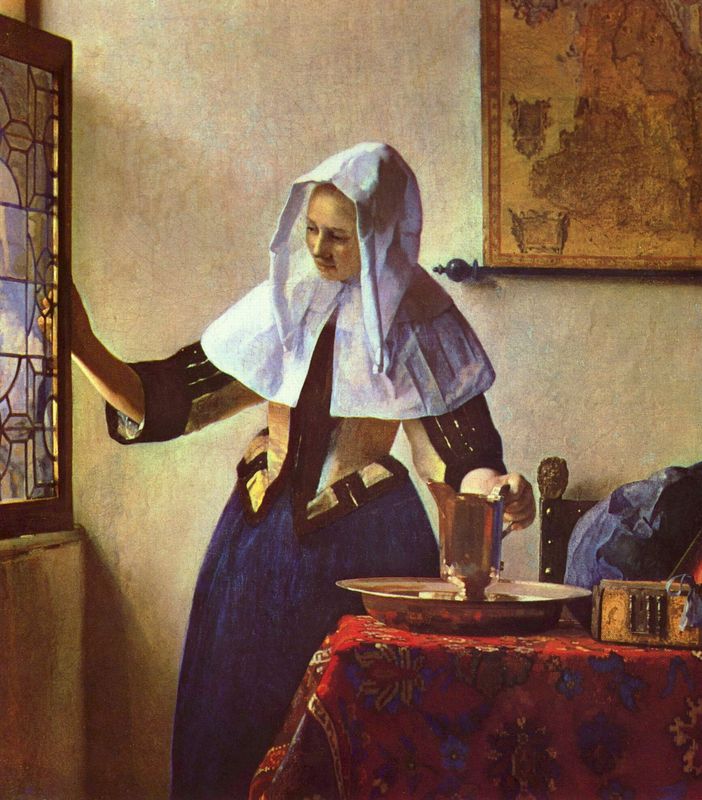
Young Woman with a Water Pitcher (1662) by Johannes Vermeer
Dutch painter Johannes Vermeer lived from 1632 to 1675 in the town of Delft. He painted modest domestic scenes in his own home, sometimes using the same people and objects. He enjoyed only limited success in his own life and was mostly forgotten after his death. His work was rediscovered in the 19th century, and his reputation has grown to the point where he is considered one of the greatest painters of his time and place. He finished Young Woman with a Water Pitcher around 1662.



 Literary Fictions