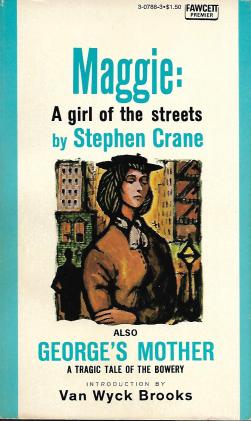
Maggie: A Girl of the Streets and George’s Mother ~ A Capsule Book Review by Allen Kopp
This slim volume contains two short novels by Stephen Crane: Maggie, A Girl of the Streets (1893) and George’s Mother (1896). Both explore the lives of lower working-class people in the section of New York known as the Bowery in the 1890s. These people speak fractured English, labor in factories and sweatshops, and most of them drink to excess to make their lives more endurable. They are contemptuous of people of wealth, refinement and education, and they have little or no hope of ever rising above their class.
The title character in Maggie: A Girl of the Streets lives with her family in a wretched tenement. Her mother is a drunken harridan and her brother a brutish lout almost devoid of human feeling. Despite her surroundings and her family, Maggie somehow manages to be attractive to men (the quality that will prove to be her downfall). Pete is a friend of Maggie’s brother who takes an interest in her. He is a bartender and Maggie believes he is sophisticated and worldly wise. She begins going around with him and they engage in sexual relations. After he gets tired of her, he discards her in favor of another girl. Maggie, at this point, is seen as “ruined” in the eyes of the world because she has given herself to a man who has rejected her. She has no chance for redemption.
The subtitle of George’s Mother is A Tragic Tale of the Bowery. George Kelcey is a laborer who lives with his mother in a Bowery tenement. Since all her other children have died, George’s mother is especially attentive to him. She harangues him to hang up his coat when he returns from work and to do all the things a mother thinks a son is supposed to do. She wants nothing more than for him to be the type of son she thinks he should be. He has an overwhelming fondness for alcohol, though, and he loves to spend evenings in the company of his male friends. After alcohol and merriment get the best of him, he loses his job and his irresponsible behavior begins to wear on his mother’s health.
Stephen Crane was one of the first, if not the first, American writers to write in a naturalistic or realistic style. His most famous work is his Civil War novel, The Red Badge of Courage, which he wrote without ever seeing combat. His life and writing career were cut short when he died of tuberculosis in 1900 at age 28.
Copyright © 2017 by Allen Kopp









 Literary Fictions