Dunkirk ~ A Capsule Movie Review

Dunkirk ~ A Capsule Movie Review by Allen Kopp

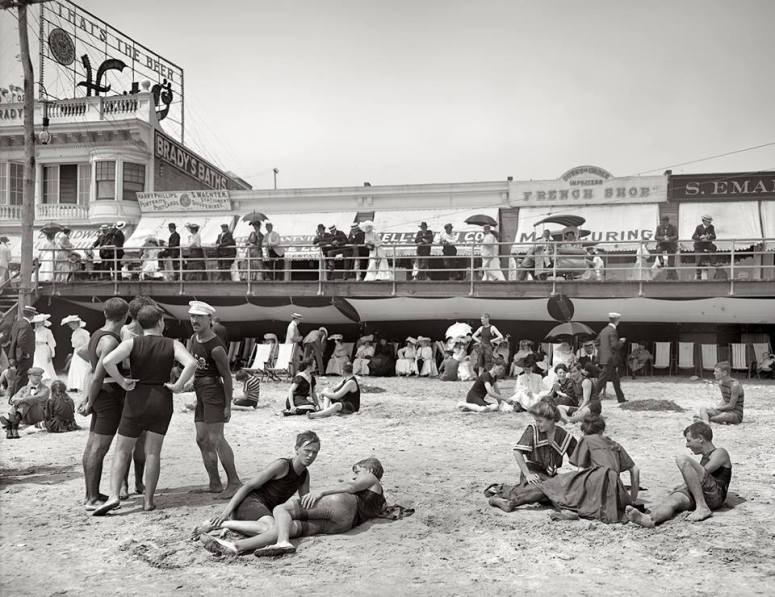
In 1940, in the early days of World War II (before America entered the war), German forces had Allied soldiers (British, French, Canadian, Belgium) pushed to the sea and surrounded in a place called Dunkirk in northern France. Some 338,000 Allied soldiers were expecting destroyers to come and pick them up, but no destroyers were available. In what is known as the “Dunkirk Evacuation,” hundreds of small civilian boats (yachts, fishing boats, pleasure craft, lifeboats) crossed the channel to France and carried as many soldiers to safety in England as they could. It was a turning point in the war that could very easily have spelled disaster for the British war effort.

The new movie Dunkirk is a stirring recreation of the evacuation at Dunkirk, told from three points of view: from the land (the “mole”), the sea, and the air. We shift back and forth from one to the other. We follow a young British soldier, a young French soldier, a combat pilot (Tom Hardy), the men on the beach waiting to be picked up, and a small yacht piloted by an older British man (Mark Rylance) with two teenage boys. There’s lots of intense action and many harrowing moments, as when the pilot runs out of gas (he glides gracefully to the ground in enemy territory); when a civilian teenage boy on the yacht is hit by a Nazi bullet; and when a young flyer crash lands in the sea and can’t get his hatch open to get out as his plane sinks. All of it has a kind of “you-are-there” feel to it, but the movie has an unconventional structure and there isn’t much in the way of exposition, especially at the beginning, so it’s going to be difficult for people to understand what is going on who don’t know the circumstances beforehand.

World War II provides a seemingly endless supply of material for filmmakers. Dunkirk is a rarity: a serious summer movie not aimed at the youth market that is entertaining and informative. If you’re looking for a summer movie that doesn’t have comic book heroes, intelligent talking apes, space adventure, or raunchy sexual situations, Dunkirk might be the movie for you.

Copyright © 2017 by Allen Kopp

Giallo, Rosso, Blu (Red, Yellow, Blue) ~ A Painting by Wassily Kandinsky

Giallo, Rosso, Blu by Wassily Kandinsky

Russian painter Wassily Kandinsky was born in 1866. He is credited with painting the first purely abstract works and was one of the most influential artists of the twentieth century. He started out as a lawyer and didn’t begin painting until the age of thirty. Having lived in Germany, he returned to Russia in 1914 after the start of World War I. He was unsympathetic to the official theories on art in Communist Moscow and returned to Germany in 1921. He taught at the Bauhaus school of art and architecture until the Nazis shut it down in 1933. He then moved to Paris, where he became a French citizen and lived until his death in 1944.

The Two Majesties ~ A Painting by Jean-Léon Gérôme

The Two Majesties (1883) by Jean-Léon Gérôme

Jean-Léon Gérôme (1824-1904) was a salon painter and professor at the École des Beaux-Arts in Paris. The Two Majesties shows a stately lion regarding the setting sun over a bleak ocean landscape. The lion is the single vertical element in the painting, against the horizontal planes of the landscape.

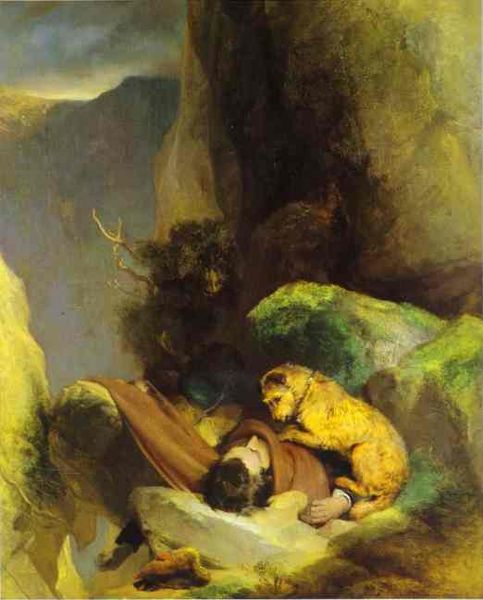
Attachment ~ A Painting by Edwin Henry Landseer

Attachment (1829) by Edwin Henry Landseer

This painting illustrates Sir Walter Scott’s poem “Helvellyn,” about a faithful dog that guarded his master’s body after he had fallen while mountain climbing. Though the body went undiscovered for three months, the dog stayed to keep away ravens and foxes that might have scavenged the remains. The painter dramatizes this scene through vivid contrasts of light and shadow and by placing the man’s body at the bottom of the composition, emphasizing the great height from which he fell.

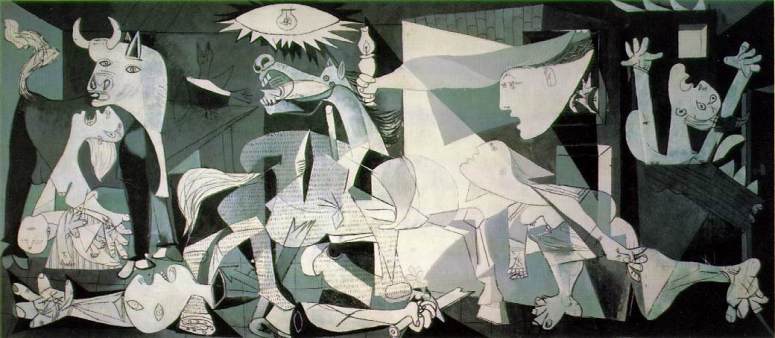
Guernica ~ A Painting by Pablo Picasso

Guernica (1937) by Pablo Picasso 

Pablo Picasso painted Guernica in response to the bombing, by German and Italian war planes, of the northern Spanish village of Guernica during the Spanish Civil War. The painting depicts the tragedy of war and the suffering it inflicts, especially on innocent civilians.

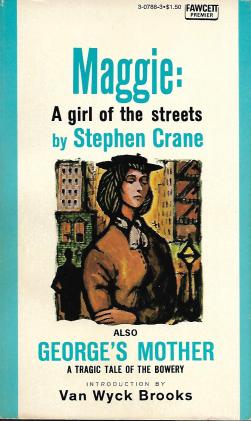
Maggie: A Girl of the Streets and George’s Mother ~ A Capsule Book Review

Maggie: A Girl of the Streets and George’s Mother ~ A Capsule Book Review by Allen Kopp

This slim volume contains two short novels by Stephen Crane: Maggie, A Girl of the Streets (1893) and George’s Mother (1896). Both explore the lives of lower working-class people in the section of New York known as the Bowery in the 1890s. These people speak fractured English, labor in factories and sweatshops, and most of them drink to excess to make their lives more endurable. They are contemptuous of people of wealth, refinement and education, and they have little or no hope of ever rising above their class.

The title character in Maggie: A Girl of the Streets lives with her family in a wretched tenement. Her mother is a drunken harridan and her brother a brutish lout almost devoid of human feeling. Despite her surroundings and her family, Maggie somehow manages to be attractive to men (the quality that will prove to be her downfall). Pete is a friend of Maggie’s brother who takes an interest in her. He is a bartender and Maggie believes he is sophisticated and worldly wise. She begins going around with him and they engage in sexual relations. After he gets tired of her, he discards her in favor of another girl. Maggie, at this point, is seen as “ruined” in the eyes of the world because she has given herself to a man who has rejected her. She has no chance for redemption.

The subtitle of George’s Mother is A Tragic Tale of the Bowery. George Kelcey is a laborer who lives with his mother in a Bowery tenement. Since all her other children have died, George’s mother is especially attentive to him. She harangues him to hang up his coat when he returns from work and to do all the things a mother thinks a son is supposed to do. She wants nothing more than for him to be the type of son she thinks he should be. He has an overwhelming fondness for alcohol, though, and he loves to spend evenings in the company of his male friends. After alcohol and merriment get the best of him, he loses his job and his irresponsible behavior begins to wear on his mother’s health.

Stephen Crane was one of the first, if not the first, American writers to write in a naturalistic or realistic style. His most famous work is his Civil War novel, The Red Badge of Courage, which he wrote without ever seeing combat. His life and writing career were cut short when he died of tuberculosis in 1900 at age 28.

Copyright © 2017 by Allen Kopp