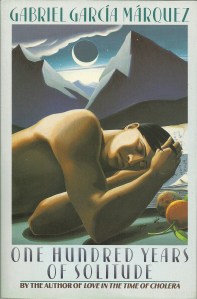
One Hundred Years of Solitude ~ A Capsule Book Review by Allen Kopp
The novel One Hundred Years of Solitude was written by Colombian author Gabriel García Márquez (1927-2014), first published in 1967, and translated to English in 1970. It tells the story of seven generations of the Buendía family, whose patriarch, José Arcadio Buendía, founds the town of Macondo (the city of mirrors that will reflect the world around it) in search of a better life. Ursula, José Arcadio Buendía’s wife (and first cousin), lives for 130 years and is a dominant character in the life of the family. (Incest is a recurring theme throughout the novel.)
One Hundred Years of Solitude can be read and enjoyed as merely a chronological sequence of events in the lives of the Buendia family, but it helps to know something of the underlying meaning. Gabriel García Márquez uses a fantastic fictional story as an expression of reality, with myth and history overlapping. Myth serves as a vehicle to transmit history to the reader. For example, the characters in the novel experience the Liberal political reformation of their colonial way of life, the arrival of the railway, the Thousand Days’ War (1899-1902), the corporate hegemony of the “banana company,” the cinema, the automobile, and the massacre of striking workers.
The inevitable and inescapable repetition of history is a dominant theme in One Hundred Years of Solitude. Márquez reiterates the metaphor of history as a circular phenomenon through the repetition of names and characteristics belonging to the Buendía family. The characters are controlled by their pasts and the complexity of time. Throughout the novel the characters are visited by ghosts that are symbols of the past and the haunting nature that the past has over their lives.
Another major theme is solitude. Macondo is in the remote jungles of the Colombian rain forest. The solitude of the town is representative of the colonial period in Latin American history, where outposts and colonies were, for the most part, not interconnected. The Buendías, isolated from the rest of the world, grow increasingly solitary and selfish. With every member of the family living only for himself or herself, they become representative of the aristocratic land-owning elite of that period in Latin American history.
Whether you’re interested in the political and historical implications or not, One Hundred Years of Solitude is still a multi-layered and entertaining story with many interesting characters. (Sometimes the names of the characters are difficult for the reader to keep straight because of the repetition of names.) José Arcadio Buendía and his wife Ursula are parents of José Arcadio, Colonel Aureliano Buendía, and Amaranta. Colonel Aureliano Buendía is a warrior and revolutionary leader. He starts thirty-two unsuccessful wars and fathers seventeen sons by seventeen different women. All of the sons have the name Aureliano with their mothers’ last names. He marries Remedios Moscote while she is still a child; she dies soon after the marriage during her first pregnancy.
Rebeca is the orphaned daughter of Ursula’s cousin who comes to live with the Buendías. She carries the bones of her parents in a bag and eats earth and whitewash off the walls. She eventually marries her adoptive brother José Arcadio and lives a life of seclusion after his death.
Arcadio is José Arcadio’s illegitimate son, a schoolteacher who assumes leadership of Macondo after Colonel Aureliano Buendía leaves. When Liberal forces in Macondo fall, he is shot by a Conservative firing squad.
Aureliano José is the illegitimate son of Colonel Aureliano Buendía. He joins his father in several wars but deserts to return home to Macondo because he believes he is in love with his aunt Amaranta. He is eventually shot to death by a Conservative captain midway through the wars.
Santa Sofía de la Piedad is a beautiful virgin girl who marries Arcadia Buendía. After her husband is executed, the Buendías take her in, along with her children.
Remedios the Beauty is Arcadio and Santa Sofía’s first child. She is so beautiful that several men die of love (or lust) for her. She is so naïve that she is perceived as being mentally retarded. Too beautiful and perhaps too wise for the world, she ascends into the sky one afternoon while folding a white sheet.
José Arcadio Segundo and Aureliano Segundo are twins born to Arcadio and Santa Sofía. José Arcadio Segundo plays a major role in the banana workers’ strike and is the only survivor when the striking workers are massacred. After the massacre, he spends the rest of his days studying the parchments of Melquiades (a history of the family written in Sanskrit, which is mentioned repeatedly throughout the novel) and tutoring the younger Aureliano. (The two twins die at the exact same time.) The twin brother, Aureliano Segundo, marries the beautiful and bitter Fernanda del Carpio and takes as his mistress Petra Cotes. After the long rains (four years, eleven months and two days), his fortune dies up. He begins searching for buried treasure, a pursuit that nearly drives him to insanity. He dies of throat cancer.
Renata Remedios, who is called Meme, is the second child and first daughter of Fernanda and Aureliano Segundo. To placate her mother, she learns to play the clavichord as well as a professional performer. When Meme falls in love with a mechanic named Mauricio Babilonia, her mother has him shot as a chicken thief and sends Meme off to a convent, where, a few months later, she gives birth to Mauricio Babilonia’s child. Her mother, Fernanda, takes the baby (Aureliano) and claims he was a foundling who came delivered in a basket to cover up her daughter’s promiscuity.
José Arcadio II (the only possibly gay character in the novel) is raised by Ursula, who wants him to enter the priesthood and become pope. He studies in Rome but doesn’t become pope. He eventually returns to Macondo and discovers buried treasure, which he wastes on lavish parties and escapades with adolescent boys. He plans to set up his nephew, Aureliano Babilonia, in business but is murdered in his bath by the adolescent boys, who ransack his house and steal his gold.
Amaranta Ursula is the third child of Fernanda and Aureliano. She never knows that the Aureliano Babilonia, the child sent to the Buendía home, is her nephew, the illegitimate child of Meme. Amaranta Ursula and Aureliano Babilonia become best friends in childhood and enter into a passionate affair when they are older, in spite of Amaranta Ursula having a husband, Gaston. Amaranta Ursula has a baby by Aureliano, which is born with a pig’s tail, as was prophesied. This baby, which is eaten by ants (also according to the prophesy), is the last of the Buendía line. As the line dies out, the town of Macondo is destroyed in a hurricane.
One Hundred Years of Solitude has become a classic of world literature and is the most famous work by Nobel Prize-winner Gabriel García Márquez, who died in April 2014 at the age of 87.
Copyright © 2014 by Allen Kopp




 Literary Fictions